
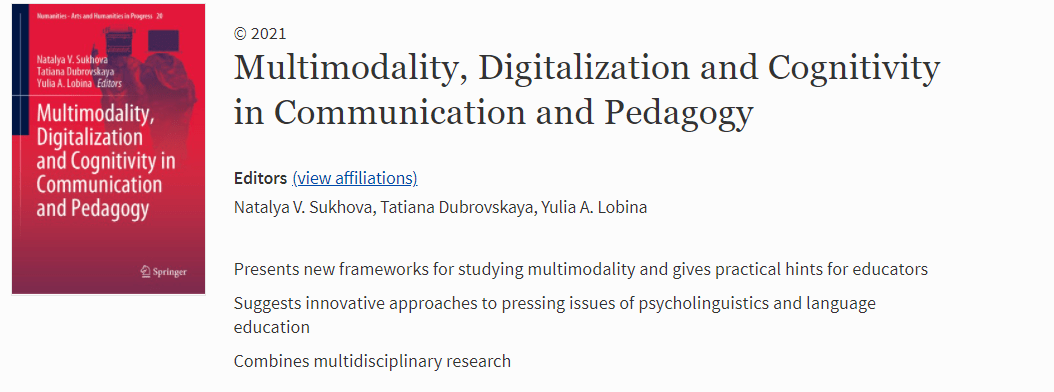
The book is out! And our chapter is published!
Multimodality, Digitalization and Cognitivity in Communication and Pedagogy
Editors:
Natalya V. Sukhova, Tatiana Dubrovskaya, Yulia A. Lobina
Presents new frameworks for studying multimodality and gives practical hints for educators
Suggests innovative approaches to pressing issues of psycholinguistics and language education
Combines multidisciplinary research
Part of the Numanities – Arts and Humanities in Progress book series (NAHP, volume 20)
Language Acquisition in Virtual Worlds Versus Traditional Classroom Environments: A Comparative Overview Between the United States and Russia by Jasmin B. Cowin and Dana S. Saulembekova
Abstract
The development of virtual worlds (VWs) in the field of language education evolved from purely text-based environments to two- and eventually three-dimensional spaces. VWs date back to the adventure games and simulations of the 1970s. Unlike traditional classroom settings, which are anchored in brick-and-mortar buildings, VWs give language learners the opportunity to practice languages in simulated, visually rich settings. Collaborative and communicative learning opportunities in VWs, together with the ubiquitous growth of online learning platforms and online degrees, raise questions on the long-term outlook for language teaching and learning in the Fourth Industrial Revolution. Although both the Russian Federation and the United States have a multitude of programmes, education degrees and certifications with specific competency requirements for future language teachers and higher education faculty, are there common long-term concerns about domains and respective definitions in technology, multicultural education and language acquisition? To shed light on these questions, the authors analysed US and Russian national missions and second language teaching standards for communication study teacher preparation programmes.
Keywords
Virtual worlds Digital environments Traditional classroom environments Second language acquisition Russia US
Cite this chapter as:
Cowin J.B., Saulembekova D.S. (2021) Language Acquisition in Virtual Worlds Versus Traditional Classroom Environments: A Comparative Overview Between the United States and Russia. In: Sukhova N.V., Dubrovskaya T., Lobina Y.A. (eds) Multimodality, Digitalization and Cognitivity in Communication and Pedagogy. Numanities – Arts and Humanities in Progress, vol 20. Springer, Cham. https://doi.org/10.1007/978-3-030-84071-6_6
https://link.springer.com/book/10.1007/978-3-030-84071-6#about
Introduction
This book positions itself at the intersection of the key areas of the modern humanities. Different authors from a variety of countries take innovative approaches to investigating multimodal communication, adapting pedagogical design to digital environments and enhancing cognitive skills through transformations in teaching and learning practices. The eclectic forms under study require eclectic approaches and methodologies, and the authors cross disciplinary boundaries drawing on philosophy, linguistics, semiotics, computational linguistics, mathematics, cognitive studies and neuroaesthetics.
Part I presents methods of analysing multimodal communication in its different displays, covering promotional video in crowdfunding project presentations, multimodal public signs of prohibition and visuals as arguments. Part II explores varied teaching methodologies that have emerged as a result of and in response to modern technological changes and contains some practical hints for educators. It demonstrates the pedagogical potential of video games, virtual worlds, linguistic corpora and online dictionaries. Part III focuses on psychological and cognitive factors influencing success in the classroom, primarily, ways of developing students’ and teachers’ personalities.
The volume sits at the intersection between Communication Studies, Digital Humanities, Discourse Analysis, Education Theory and Cognitive Studies and is useful to scholars and students of communication, languages, education and other areas of the humanities. This book should trigger scholarly discussions as well as stimulating practitioners’ interest in these fields.
Keywords
Methodology in Humanities Semiotic pragmatics Discourse Analysis Studies in Multimodality Cognitive Development Education in Digital Environments Pedagogical Design Foreign Language Teaching Online Lexicography Corpus Technologies

 Dr. J's Education Blog