Dacey, C. M., Cowin, J., & de los Reyes, J. (2026). Editorial: Artificial intelligence in educational and business ecosystems: Convergent perspectives on agency, ethics, and transformation. Frontiers in Education, 11, Article 1780854. https://doi.org/10.3389/feduc.2026.1780854
The contributions curated in this Research Topic resist the techno-solutionist narrative that frames AI as a neutral efficiency tool requiring only proper deployment. Instead, they capture tensions between automation and augmentation, between administrative rationalization and pedagogical transformation, and between predictive precision and educational equity. These tensions operate simultaneously across institutional, instructional, and individual levels, calling for analytical frameworks that draw on computer science, learning sciences, ethics, policy studies, and critical pedagogy. The authors invite readers to continue building collaborative and integrative approaches that match the scale and complexity of AI’s global impact. We can benefit from reconsidering our teaching methods and comparing the ethical challenges of AI in business education, as well as how AI can be effectively incorporated to help prepare workforce-ready graduates. The effects of using artificial intelligence in education are just beginning to be measured, and its use will likely have ripple effects for years to come (Dacey et al., 2023). As we look toward the horizon, we see the need for more flexible, decentralized, and inclusive governance and educational structures, much like a forest of diverse species adapting to changing conditions within a vibrant ecosystem (Dacey et al., 2025, p. 70). Throughout the production process of this Research Topic, we remained mindful that “companies like OpenAI stand at the forefront, pushing the boundaries of what generative pre-trained transformers or ‘GPTs’ can achieve. However, beneath this veneer of progress lies a complex web of epistemological and pedagogical quandaries that question the very foundation of AI’s trajectory in education” (Cowin, 2024). We invite continued dialogue on these fundamental questions as the field evolves. Author contributions CD: Conceptualization, Methodology, Project administration, Resources, Writing– original draft, Writing– review & editing. JC: Writing– original draft, Writing– review & editing. JdlR: Writing– review & editing. Conflict of interest The author(s) declared that this work was conducted in the absence of any commercial or financial relationships that could be construed as a potential conflict of interest.
Dacey, C. (2022). Examining ethical tensions and the pursuit of care through an invitational lens. J. Invit. Theory Pract. 28, 5–30. doi: 10.26522/jitp.v28i.4208
Why EDDN 637 Now Integrates the Science of Reading
Jasmin Cowin, Associate Professor, Touro University, GRE, TESOL/BLE Department | Path Forward Grant | PI: Dr. Seong Kim
New York is moving evidence-based literacy from professional judgment into regulatory expectation. Education Law §818 requires an annual review of district curriculum and instructional practices in reading for prekindergarten through grade three, with attestation to the Commissioner. In December 2024 the Board of Regents amended Section 100.3 of the Commissioner’s Regulations, and districts verified alignment by September 1, 2025. In July 2026 the Department introduced a proposed amendment of Sections 52.21 and 80-3.7 at the Board of Regents meeting. Teacher preparation programs in early childhood education, bilingual education, English language learners, literacy, and students with disabilities would be required to align their instruction with the State’s science of reading framework. Candidates would devote a portion of field experience and student teaching to evidence-based literacy instruction and to assessing students with reading challenges. A public comment period is underway and Board approval is anticipated in November.
Sources: NYSED, Elementary Requirements (Section 100.3): districts shall verify alignment of prekindergarten through grade three reading curriculum and instructional practices with the Commissioner’s instructional best practices on or before September 1, 2025, pursuant to Education Law §818 New York State Education Department NYSED, Prekindergarten-3rd Grade Literacy Instructional Best Practices Guide (§818 attestation) WXXI News, December 17, 2024: Board of Regents approval of the pre-K through grade three reading amendment Chalkbeat New York, July 20, 2026: proposed amendment of Sections 52.21 and 80-3.7 (https://lnkd.in/e3Pg9dQM)
EDDN 637 Second Language Learners and the Content Areas
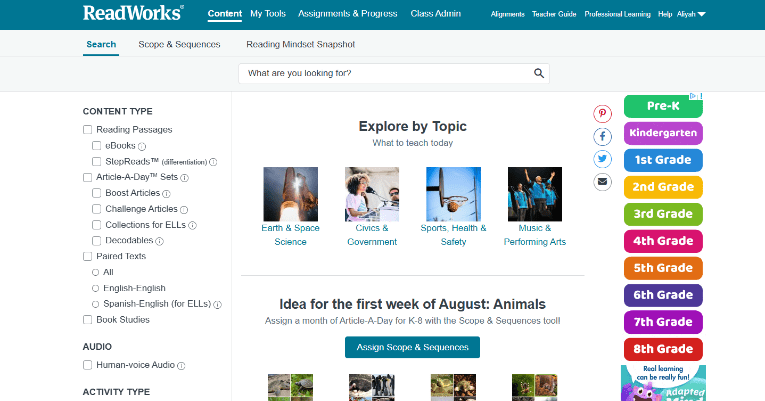
EDDN 637 – TESOL/BLE Department at Touro University responded through the Path Forward Grant with a module-by-module revision that preserves the SIOP architecture of the original Spring 2026 course while embedding reading research at each component. Module 1 opens with a mandatory Science of Reading survey establishing candidates’ baseline knowledge, which informs Lesson Preparation. Modules 2 and 4 add structured literacy to content and language objectives and to Comprehensible Input. Module 3 foregrounds oral language development and pathways to skilled reading under Building Background. Module 7 introduces phoneme segmentation, blending, and structured literacy assessment within Practice and Application. Module 9 adds Scarborough’s Reading Rope, ReadWorks resources, and a Diagnostic Decoding Survey so candidates can determine whether a reading difficulty originates in decoding, vocabulary, fluency, or language comprehension.
The alignment is deliberate since SIOP offers a framework for making content and academic language accessible, while the Science of Reading (SoR) explains the cognitive architecture that makes reading possible. Module 10 helps candidates distinguish second language acquisition needs from reading difficulties and disability-related needs, Module 11 introduces tiered instruction and infographic reflection, and Module 12 closes with a research reflection on skilled reading pathways. Candidates leave EDDN 637 prepared to plan, assess, and intervene using evidence, which is what New York now expects of them.
Conclusion via Candidate Evidence
Candidate work supplies the clearest measure of whether integration reached practice. In Discussion Board 5, Touro University TESOL Candidate Aliyah Giana Martinez in exemplary analysis of an informational text on trees built content and language objectives around the Big 6 components, vocabulary, and reading comprehension. She identified brick words carrying the domain-specific load of the text, including roots, trunk, branches, bark, crown, leaves, sap, stomata, flowers, and seeds, together with mortar words such as alive, grow, anchor, support, protect, and instead. The observation driving the plan was that brick words appear rarely outside scientific contexts, while mortar words surface across many contexts with shifting meaning, so both categories require explicit instruction before students encounter the text. Her differentiation plan drew on sentence frames, total physical response, shades of meaning, picture and audio support, and structured partner and whole-class discussion. Drawing on Herr’s The Sourcebook for Teaching Science, she designed labeled diagrams, comparison organizers connecting tree survival to human survival, a cumulative word wall, and a hands-on construction paper tree.
That construction paper tree is the realia outcome the course intends. Aliyah Giana Martinez moved from explicit vocabulary work toward comprehension of the text, then produced a tangible artifact that makes literacy learning visible and assessable. That construction paper tree is the realia outcome the course intends. Moving from explicit vocabulary work toward comprehension of the text, then producing a tangible artifact that makes literacy learning visible and assessable. The same theoretical learning carried into the fieldwork strands housed in Modules 10 and 11. Reporting from a placement classroom, a candidate documented lessons in which students reread familiar texts, read aloud individually, answered comprehension questions, discussed characters and events, and worked through new texts with teacher support. Her analysis was that word level skills and meaningful reading were being taught in connection with one another, so decoding work and comprehension work occupied the same instructional space. Ms. Martinez mapped these observations onto the SoR Pathways to Skilled Reading infographic introduced in Module 3, noting that skilled reading depends on word recognition together with language comprehension, and that students require explicit instruction in phonemic awareness, phonics, decoding, spelling, morphology, vocabulary, background knowledge, syntax, and comprehension. Locating each observed activity within that framework allowed her to read a single lesson as a set of identifiable components working together. Integration at the course level yielded observation, analysis, and application at the classroom level.
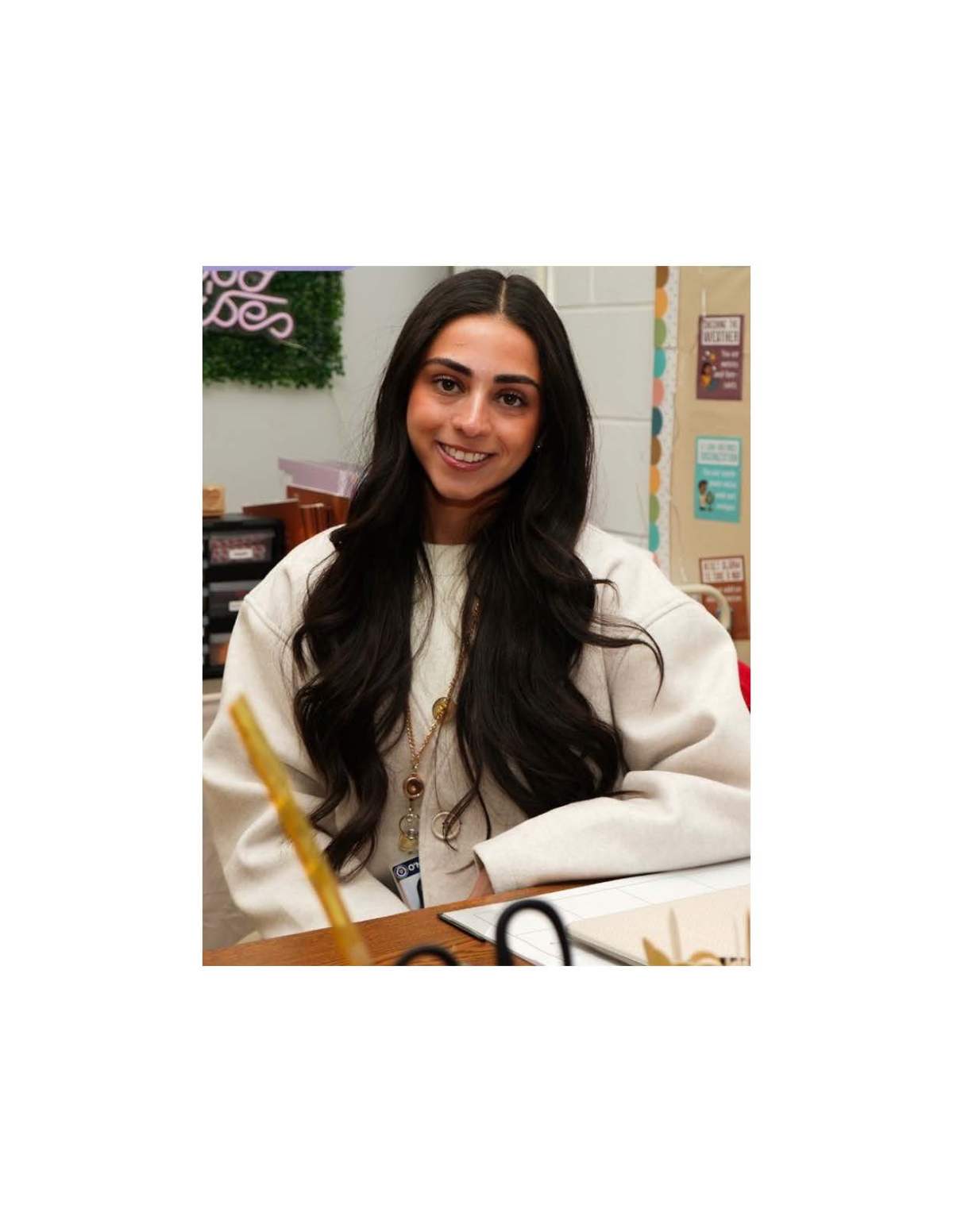
Aliyah Giana Martinez is of Chilean and Greek descent. She loves to travel, cook, and spend time outside going on adventures with her family and friends. She is a newly hired teacher who strives to support her students while learning from her colleagues in order to grow into the best educator she can be.
I am proud to feature her exemplary work in my blog!
Reading doesn’t just come to you, you have to be surrounded by people who believe in you and who will try a number of learning strategies with you to help you be the best reader you can be.
Aliyah Giana Martinez, Touro University TESOL Candidate
The Touro University TESOL EDDN 637 fieldwork experience is an essential component of TESOL preparation because it requires candidates to connect course theory with authentic instructional practice. Through focused observations, candidates examine how teachers support multilingual learners through comprehensible input, academic language development, differentiation, culturally responsive practices, technology, SIOP, and Science of Reading strategies. Rather than simply identifying instructional techniques, candidates must analyze how and why particular practices support, or fail to support, the linguistic, literacy, and academic development of multilingual learners.
This fieldwork also aligns with AAQEP expectations for high-quality educator preparation. AAQEP emphasizes candidate knowledge and skills, professional growth, responsiveness to diverse learners, evidence-based decision-making, and meaningful clinical experiences. The EDDN 637 fieldwork provides candidates with opportunities to demonstrate these expectations by observing instruction, documenting evidence, analyzing teacher and student interactions, and connecting observations to professional standards and course scholarship. The assignment therefore serves as more than a required number of field hours. It provides evidence that candidates can apply professional knowledge to the complex realities of TESOL practice.
Fieldwork as an AI-Resistant Assignment
This fieldwork is intentionally designed to require sustained, authentic engagement that cannot be replaced by AI. AI may assist with editing or organization, but it cannot complete the observation experience for the candidate. Candidates must closely examine actual teaching, maintain detailed field logs, document specific instructional events, include transcripts, and connect particular moments from lessons to SIOP, Science of Reading principles, course readings, and the needs of multilingual learners. Successful completion therefore depends on the candidate’s own observation, interpretation, and professional judgment.
The assignment also emphasizes the higher levels of Bloom’s Taxonomy. Candidates move beyond remembering and understanding course concepts to applying them to real instructional situations, analyzing relationships among teaching practices and student responses, and evaluating the effectiveness of instruction for multilingual learners. Candidates also engage in creating as they synthesize observations, transcripts, course scholarship, and professional reflection into a coherent analysis and propose ways instruction could be strengthened. In this way, the fieldwork assesses not only what our Touro University TESOL candidates know, but how effectively they can think, reason, and make evidence-based professional decisions.
Yeimy Alvarado is a graduate student at Touro University completing an Advanced Certificate in Teaching English to Speakers of Other Languages (TESOL). She is passionate about literacy and finding ways to support all students through effective and meaningful teaching practices. The summer 2026 semester at Touro has helped her to see the importance of the SIOP model and the Science of Reading and how she can use both to create a classroom where every student feels included, supported, and confident in their ability to learn and grow.
I have learned that teaching is not just about what we teach, but also about making sure students can understand and access the content. The Science of Reading has taught me the importance of explicit instruction, while SIOP has shown me how important it is to provide multilingual learners with the right language support, background knowledge, and opportunities to participate and learn. As an educator, these strategies have strengthened my understanding that making content comprehensible does not mean making the academic task easier, but rather providing students of all levels with the support they need to access challenging content and be successful.
Yeimy Alvarado, Touro University Advanced Certificate in Teaching English Candidate
Education for 2060: A New Chapter of Cooperation with Burundi
I am very pleased to share my appointment asVisiting Professor for AI and Pedagogy during August 2026, at Université Lumière de Bujumbura in Burundi.The appointment brings together several areas that have shaped my work for many years: education, artificial intelligence, international cooperation, institutional development, and the question of how we prepare learners for a future that is already beginning to take shape.
Université Lumière de Bujumbura is a recognized higher education institution accredited by Burundi’s Ministry of Higher Education and Scientific Research. With campuses in Mutanga Nord, Kinindo, Kajaga, and the Kubumenyi Compound in Bujumbura, the university offers a broad range of undergraduate and graduate programs, including communication sciences, law, management and administration, computer sciences, theology, clinical psychology, and political science and international relations. Its graduate offerings include areas such as business administration, corporate law, development management, organizational leadership, and IT management. The university also supports flexible access to higher education through traditional in-person teaching as well as online and distance-learning formats.
For me, this work is closely connected to the idea ofEducation for 2060. The year 2060 may seem far away, yet many of the students entering classrooms and universities today will still be active in their professions and communities at that time. Some will lead institutions, shape public policy, conduct research, establish businesses, educate future generations, and make decisions in environments that will look very different from those we know today. The educational choices being made now will influence how confidently and responsibly they can participate in that future.
Artificial intelligence is already changing the ways in which people search for information, communicate, conduct research, create knowledge, teach, and learn. Over the coming decades, these developments will become deeply embedded in educational and professional environments. This makes the role of education increasingly significant. Learners will require sound disciplinary knowledge alongside critical judgment, creativity, adaptability, ethical awareness, and the ability to evaluate information carefully. They will need the confidence to work with intelligent systems while understanding their limitations and recognizing the importance of human responsibility.
My cooperation with colleagues in Burundi provides an important setting in which to explore these questions. At Université Lumière de Bujumbura, I am interacting, discussing, exploring and collaborating with university leadership such as Dr. Bizimana Jean de Dieu, Deputy Vice- Chancellor – Global Partnerships, faculty, administrators, and educational partners through professional development and capacity-building activities focused on artificial intelligence, innovative pedagogy, educational transformation, and the responsible integration of AI into higher education. The university’s invitation places particular emphasis on the effective and ethical use of AI in teaching, learning, leadership, and institutional governance.
I am also particularly pleased that this work involves cooperation with Computers for Schools Burundi and the dynamic CEO and founder Emmanuel Ngendakuriyo. Educational transformation depends on strong relationships between institutions, educators, technology initiatives, and the communities they serve. Digital access, professional development, institutional capacity, and informed leadership all contribute to the conditions in which meaningful innovation can take place. Cooperation across these areas creates opportunities for knowledge to circulate and for ideas to develop within the realities of a particular educational environment. Discussions about the future of education and artificial intelligence gain strength through the participation of universities and educators from different regions of the world. Each educational context brings its own experience, knowledge, priorities, and questions. International cooperation creates a space in which these perspectives can meet, and this exchange can lead to research collaborations, new educational approaches, professional networks, and lasting institutional relationships.
Thinking about Education for 2060 also requires us to consider the future role of universities. Universities prepare people whose work will shape societies for decades. They are places of research, intellectual exchange, professional formation, and institutional leadership. As artificial intelligence becomes increasingly capable, universities will need to make thoughtful decisions about teaching, assessment, academic integrity, research, governance, and the preparation of graduates for changing professional environments. These decisions require informed leadership and sustained dialogue across the university community.
Teachers will remain central to this future. Artificial intelligence will provide increasingly sophisticated support for research, translation, content creation, feedback, and personalized learning. The educational relationship itself will continue to depend on human judgment, trust, encouragement, cultural understanding, and the ability to recognize the development of an individual learner. Preparing for 2060 therefore includes investing in educators and giving them meaningful opportunities to understand emerging technologies, experiment with new pedagogical approaches, and contribute to decisions about their use.
AI literacy will also become a fundamental part of education. Understanding artificial intelligence involves much more than knowing how to operate a particular tool. It requires an ability to assess the quality of AI-generated information, recognize uncertainty and bias, verify sources, understand questions of privacy and governance, and decide when human expertise must guide the process. These capabilities will become increasingly important for students, educators, researchers, and institutional leaders.
My appointment at Université Lumière de Bujumbura gives me the opportunity to connect these long-term questions with practical educational work. It creates a space for professional exchange, shared learning, and discussion about how institutions can develop their capacity for a future in which AI will be part of everyday academic life. I am especially interested in the knowledge that can emerge through dialogue with colleagues in Burundi and in the possibilities for future collaboration that may grow from this work.
Education for 2060 begins long before 2060 arrives. It is being shaped in today’s classrooms, universities, professional development programs, institutional strategies, and international partnerships. Looking several decades ahead encourages us to consider the kind of educational environments we want to create and the kind of human capacities we want to strengthen.
This comprehensive course builds upon the foundation of curriculum development and classroom management in the context of teaching English language learners. Expanding its horizons to embrace the digital age, the course adeptly weaves innovative technology integration into the domain of Teaching English to Speakers of Other Languages (TESOL). Crafted to empower prospective TESOL/BLE educators, the course hones in on fostering competence in designing, implementing, assessing, and reflecting within diverse language learning environments, all while capitalizing on the potentials of cutting-edge technology. With a strong focus on practical application and discerning appraisal of technological tools, this course primes upcoming educators to excel amidst the ever-evolving educational landscape. Includes 10 hours of field work.
Angelina Libardi is a special education teacher in the Central Islip School District and a graduate student in the M.S. in TESOL program at Touro University. She is passionate about creating inclusive, engaging learning environments that support multilingual learners and students with diverse learning needs. Through her graduate studies, she has strengthened her commitment to culturally responsive teaching and lifelong professional growth.
My journey at Touro has strengthened my confidence as an educator, challenged me to think more deeply about equitable instruction, and inspired me to become a stronger advocate for multilingual learners and all students.
Angelina Libardi, M.S. in TESOL Program Candidate at Touro University
This Curriculum Mapping for English Language Learners assignment is an important anchor for the Touro University TESOL Development and Classroom Management in the Technology Era – EDDN 635 curriculum course because it moves candidates beyond simply identifying standards toward critically examining how curriculum decisions affect multilingual learners’ access, participation, and academic achievement. By using and populating a curriculum map template, candidates learn to evaluate alignment among standards, learning objectives, instructional strategies, assessments, academic language demands, and appropriate scaffolds. The reflection process also requires candidates to justify what they retained, revised, or added after verifying AI-generated suggestions against NYSED standards, district documents, and established ESOL practices.
Working with the Touro University approved Microsoft Copilot AI provides an added professional benefit by helping candidates harness artificial intelligence for practical curriculum work. Candidates use carefully designed prompts to organize alignment checks, identify possible gaps, generate initial evidence statements, and consider accommodations for multilingual learners. However, they must also evaluate, verify, and revise Copilot’s output rather than accepting it uncritically. This process develops AI literacy alongside curriculum-design expertise and prepares candidates to use emerging technologies responsibly, efficiently, and thoughtfully in educational settings.
Jacqueline Shaffer is a 34‑year‑old educator with eleven years of teaching experience. She currently teaches middle school Spanish in Brooklyn. Jacqueline is dedicated to supporting diverse learners and creating an engaging, culturally responsive classroom environment.
Through this assignment, I learned how important it is to design a curriculum that includes clear supports for multilingual learners, so they can access grade‑level content, participate in discussions, and show their understanding through reading and writing. I realized that scaffolds like visuals, sentence frames, and bilingual resources aren’t optional, they’re essential for equity. This process helped me see how thoughtful planning can make learning more inclusive and meaningful for all students.
Jacqueline Shaffer, M.S. Candidate, TESOL, Touro University
New article published: The Compliance Clock Strikes: Brussels Begins Enforcing the AI Act, and Transatlantic University Partnerships Must Answer As of yesterday, August 2, 2026, the European Commission’s AI Office and national market surveillance authorities hold the power to investigate, sanction, and compel compliance under the EU Artificial Intelligence Act. The framework that took effect in August 2024 has moved from legislative architecture to active enforcement. ⏰ The timeline has been running for some time. Prohibited practices became enforceable in February 2025. Technical documentation for newly placed general-purpose models came due in August 2025. Conformity assessments for high-risk systems reached their deadline this summer. What changed on August 2 is that the oversight machinery moved from preparation to practice. 🗞️ For universities, the question is no longer whether the Act applies but in what capacity. My article works through four scenarios that determine whether an institution carries provider obligations, deployer obligations, or both. 📖 Read the full piece in The Government View https://lnkd.in/emyExZaW
Teaching the Teachers of 2060: The Embodied Method Simulation
Since the arrival of Large Language Models (LLMs) I experimented and worked on designing what I consider AI-proof assignments: tasks where candidates must demonstrate their understanding of theory through practical application, which no chatbot can do for them. The Embodied Method Simulation is a prime example. Each Touro University TESOL course participant selects a single language teaching method from our course readings, such as Total Physical Response, Suggestopedia, the Silent Way, or Communicative Language Teaching, and performs it in its pure, original form. In a 6 to 7-minute video, they teach an imaginary group of multilingual learners as if the class were real: on camera, in a physical space, surrounded by realia, using their voice, gestures, and movement to bring a method’s theory to life.
The assignment asks for an embodied demonstration of pedagogy. Candidates show how a method actually works when they stand in a room with (imaginary) learners, handling materials, and moving through space. Theory earns its value there, in the moment of embodied instruction.
Why Copilot?
Alongside the performance, candidates co-create their teaching scripts with the Touro-approved Microsoft Copilot. Beginning with a person-centered, spatially grounded prompt, they engage in an iterative dialogue with AI, refining teacher talk, rehearsing simulated learner responses, and interrogating how their bodies and materials express the method’s principles. They then write a reflection analyzing what they accepted, adapted, or rejected from the AI’s suggestions.
Why build AI into an AI-proof assignment? Because the educators we certify today will still be teaching in 2060. They will spend their entire careers alongside artificial intelligence, and the essential career skill is directing these tools with professional judgment. When a candidate pushes back on Copilot’s suggestion because it violates the logic of TPR, or expands an AI-generated dialogue to better serve a newcomer learner, they are practicing exactly that skill: keeping the human teacher at the center while using AI as a thinking partner.
Kalee Fan is an early childhood special education teacher in a NYCPS. She is currently pursuing a Bilingual Education Extension to better support multilingual learners and create more equitable learning opportunities for all students. She is passionate about fostering an inclusive classroom where every child feels valued, confident, and empowered to succeed.
Quote about the Science of Reading:
“One of my biggest takeaways from studying the Science of Reading is that strong literacy instruction is both evidence-based and responsive to students’ individual needs. It has reinforced the importance of intentionally developing oral language alongside foundational reading skills so that multilingual learners can thrive academically.” Kalee Fan, Touro University TESOL Candidate
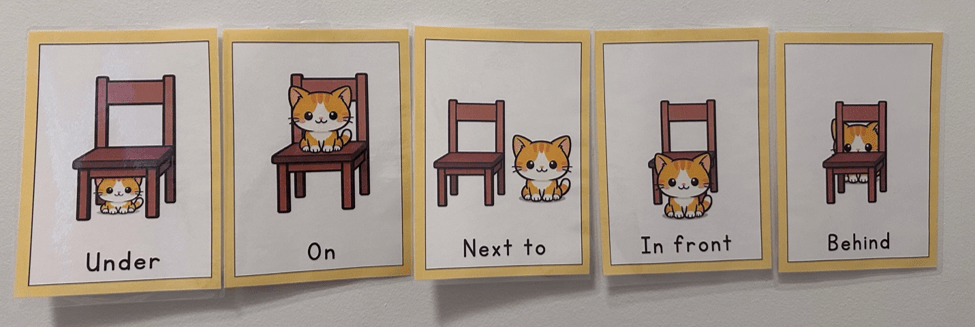
I used a few materials to support my mini-lesson recording
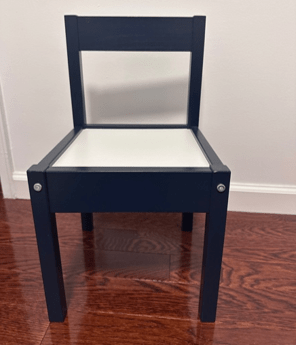
A Chair:
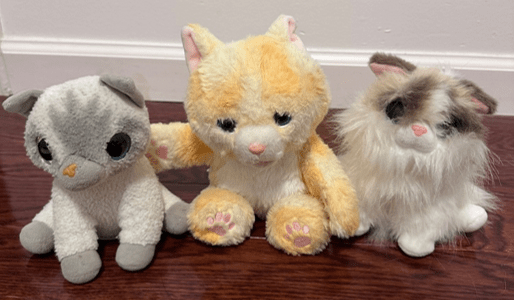
Cat Plushies:
Vocabulary Cards:
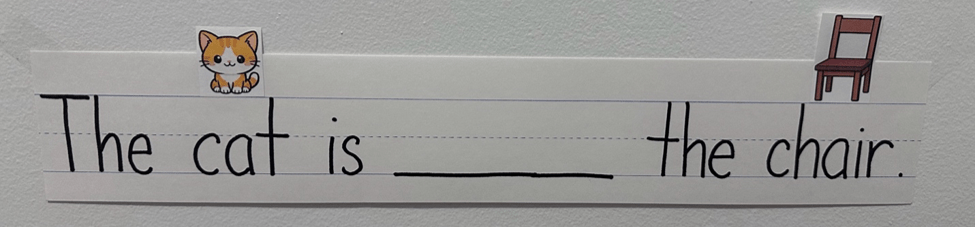
Sentence frame:
Part 3: Written Analysis and Copilot Co-Creation Reflection
Method Analysis
As an early childhood educator, I selected Total Physical Response (TPR) for my mini lesson because it aligns with the developmental needs of my kindergarten ENL students, who benefit from movement, hands-on experiences, and concrete language instruction. Developed by James Asher in the 1970s, TPR is based on the idea that language learning should resemble first language acquisition, in which children listen and respond physically long before they are expected to speak. The method creates a low-stress learning environment where learners develop comprehension through listening and movement. In a TPR classroom, the teacher gives commands and models actions while students demonstrate understanding through physical responses. The main principles of TPR include listening comprehension, physical movement, repetition, and delayed speech production. By connecting language to actions and engaging visual, auditory, and kinesthetic senses, learners gradually build understanding and confidence before producing language independently (Helbling English, n.d.).
TPR has several strengths. It lowers learners’ anxiety, increases engagement, and makes language comprehensible through concrete actions and real objects. These characteristics make it particularly effective for beginning English learners and young children (Cowin, n.d.). However, TPR also has limitations. As learners become more proficient, the method becomes less distinctive because advanced language functions and abstract concepts cannot always be represented through physical actions. In addition, reading and writing activities are often limited extensions of the oral activities in the classroom (Cowin, n.d.).
I selected TPR for my mini lesson on positional words as this topic is part of my school’s kindergarten math curriculum and provides a meaningful opportunity to connect language learning with content instruction. Positional words can be abstract for young English learners, but using TPR allows students to visualize and understand these concepts through physical movement and hands-on experiences. TPR emphasizes connecting language with actions and providing opportunities for learners to develop comprehension before producing language (Celce-Murcia et al., 2014). In my lesson, students first demonstrated their understanding by moving their bodies and a toy cat to different positions around a chair. After students had multiple opportunities to practice through physical responses, I incorporated a sentence frame, “The cat is _____ the chair,” to support oral language production. I selected a chair, cat plushies, vocabulary cards, and a sentence frame since these materials are concrete, visually accessible, and easy for young learners to manipulate. This lesson reflects the core principles of TPR by using repeated actions, multisensory experiences, and gradual language production to build students’ confidence and create an engaging, low-anxiety learning environment (Helbling English, n.d.).
Copilot Co-Creation Reflection
Before I began recording my videotaped mini lesson, I entered my initial prompt into Copilot to refine the structure and delivery of a six‑minute Total Physical Response lesson designed for Kindergarten ENL learners in a 12:1:1 bilingual special education setting. My prompt described the instructional context, the linguistic profiles of the students, and my goal of teaching spatial vocabulary using realia such as a chair and a cat plushie. Copilot generated a first draft that offered a clear introduction, a well‑sequenced modeling phase for positional vocabulary, and a strong closing routine. This initial script aligned closely with my own vision, and it helped me see how my ideas could be organized into a coherent, embodied lesson that foregrounded movement, gesture, and predictable routines. The process of reviewing this draft made me more aware of how intentional teacher talk and physical demonstration work together to support comprehension for Entering and Emerging learners.
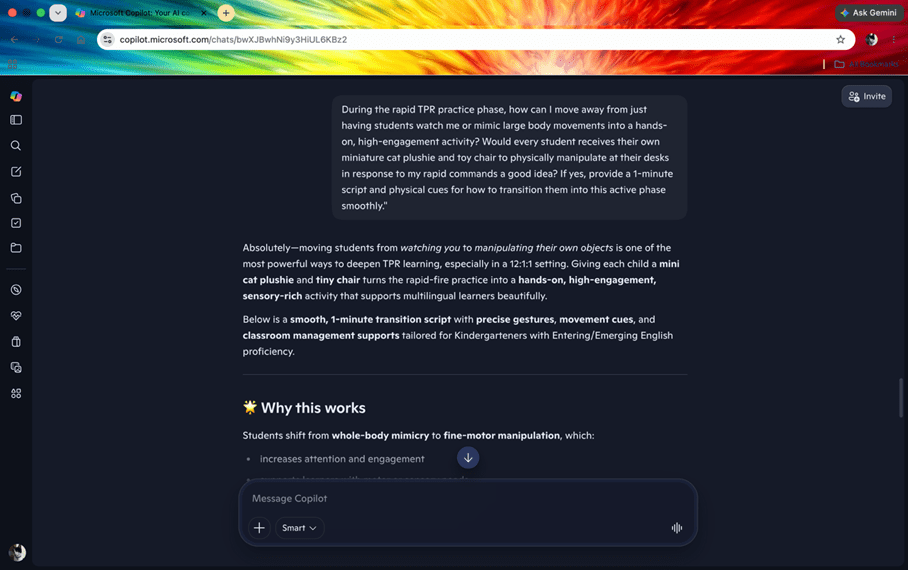
As I continued refining the lesson, I entered a second prompt asking how to shift the rapid TPR practice from simple mimicry to a more hands‑on, high‑engagement activity. I asked whether providing each student with a miniature cat plushie and toy chair would be appropriate and how to transition them smoothly into this active phase. Copilot responded with a detailed one‑minute transition script that emphasized slow pacing, clear gestures, and explicit modeling of how students should manipulate their objects. This suggestion helped me clarify my embodied role in the method. I realized that TPR is not only about demonstrating vocabulary with my own body but also about orchestrating students’ physical responses in ways that reduce cognitive load and increase autonomy. I adapted Copilot’s script by simplifying some of the language and adjusting the pacing to fit the realities of a rug‑seated Kindergarten group. I kept the core idea of using manipulatives because it aligned with my professional judgment about sensory engagement and accessibility for multilingual learners.
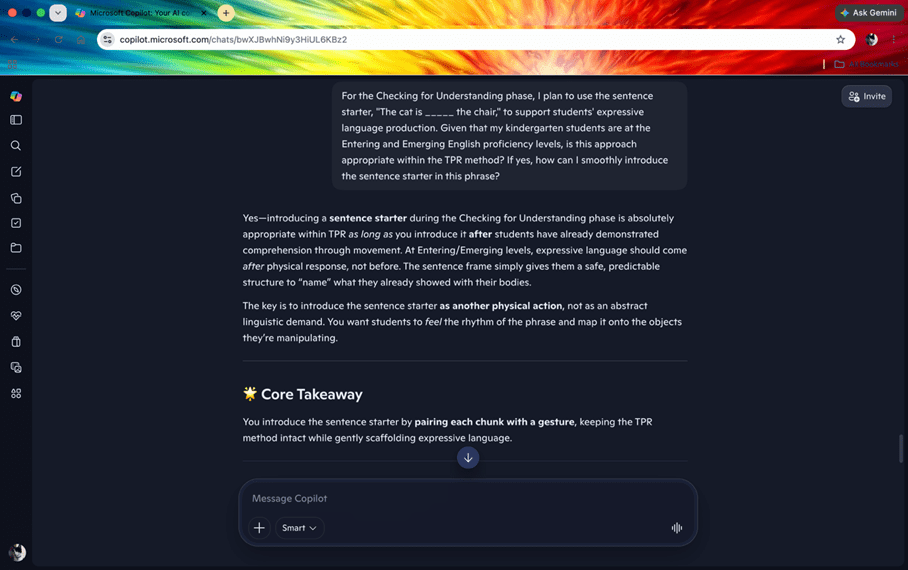
My next prompt focused on the Checking for Understanding phase, where I planned to introduce the sentence starter “The cat is ___ the chair” to support expressive language production. I asked Copilot whether this was appropriate for students at Entering and Emerging proficiency levels and how to introduce the sentence frame smoothly within the TPR method. Copilot affirmed the approach and provided a scaffolded routine that paired each chunk of the sentence with a gesture, ensuring that the language remained grounded in physical action. This helped me better understand how my embodied role could support early expressive language without overwhelming students. I adjusted the script by reducing the verbal load even further and by ensuring that students demonstrated comprehension physically before attempting any spoken output. This adaptation reflected my professional judgment about developmental readiness and the importance of maintaining TPR principles even when introducing language frames.
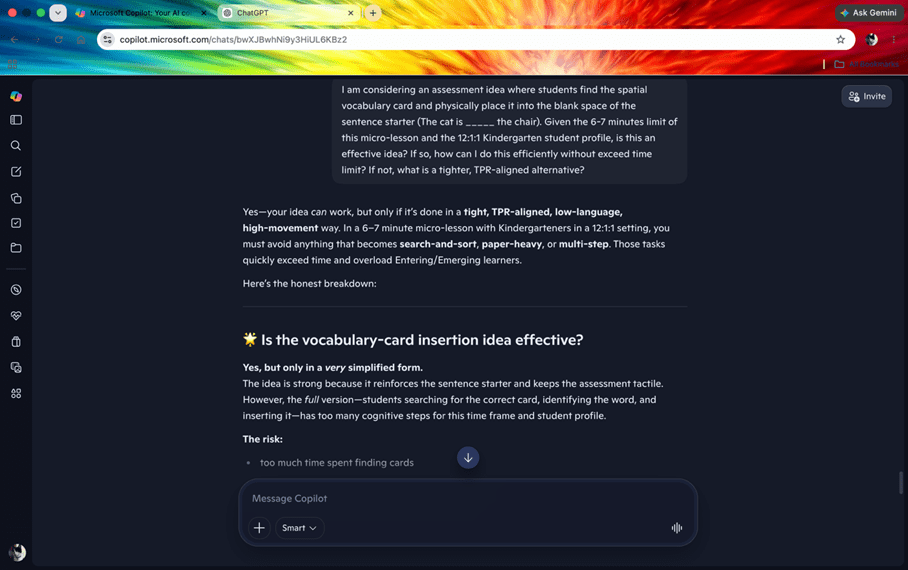
Finally, I asked Copilot about an assessment idea involving vocabulary cards that students would place into the blank space of the sentence starter. I wanted to know whether this was feasible within the six‑to‑seven‑minute time limit and appropriate for a 12:1:1 Kindergarten group. Copilot explained that the idea could work only in a highly simplified form and recommended a tighter, more TPR‑aligned alternative that removed unnecessary cognitive steps. This feedback prompted me to reconsider the assessment entirely. I rejected the original card‑search idea because it introduced too many demands for this age group and time frame. Instead, I adopted the “Touch and Tell” approach, where students physically position their mini cat and chair and then echo the sentence starter. This alternative preserved the embodied nature of TPR, respected the developmental needs of my learners, and fit smoothly within the lesson’s pacing.
Through this process, I learned how valuable it is to refine instructional decisions through cycles of questioning, reflection, and revision. Copilot helped me clarify the embodied dimensions of TPR, especially the ways teacher movement, gesture clarity, and pacing shape multilingual learners’ access to meaning. At the same time, I exercised professional judgment by adapting suggestions to fit the specific needs of my classroom, rejecting ideas that were too complex, and expanding others to strengthen linguistic accessibility. This experience reinforced the importance of designing lessons that are intentional, responsive, and grounded in both pedagogical theory and the lived realities of young ENL learners.
References:
Celce-Murcia, M., Brinton, D. M., & Snow, M. A. (Eds.). (2014). Teaching English as a second or foreign language (4th ed.). Heinle ELT.
Cowin, J. B. (n.d.). Methods and techniques in teaching ENL: Total Physical Response.
Helbling English. (n.d.). Total Physical Response [Video]. YouTube.
Microsoft Copilot. (2026). Responses generated for lesson‑planning refinement. Microsoft.https://copilot.microsoft.com
The Professional PPS Resource for Parents assignment is important because it requires candidates to translate their specialized knowledge into clear, practical, and culturally responsive guidance for bilingual families. Rather than demonstrating competence only through case reports, evaluations, or reflective essays, candidates must consider how parents understand school procedures, student needs, available services, and their own rights and responsibilities. Creating the brochure bilingually also reinforces that equitable family engagement depends on meaningful language access, not simply the translation of isolated information.
The assignment directly supports the goals of PSGN 698 Field Experiences in Bilingual Pupil Personnel Services by connecting professional experience with consultation, advocacy, and community communication. It demonstrates whether candidates can identify barriers faced by bilingual students and families, select relevant information, and present it in an accessible format that parents can use when making decisions or collaborating with school personnel. The brochure therefore becomes both evidence of professional growth and a usable resource that can strengthen trust, participation, and culturally responsive service delivery.
PSGN 698 Field Experiences in Bilingual Pupil Personnel Services
Course Description Since students in the program are certified professionals, their work experience (no less than one academic year) will be considered as fulfillment of the field experience requirement, along with attendance at three field experience seminars and submission of a portfolio which synthesizes their experience and understanding of effective services for bilingual population. The portfolio will include: samples of professional work with bilingual students, including case histories, evaluation reports, progress notes, and IEPs; a written essay presenting the student’s professional philosophy, a discussion of issues involved in providing bilingual services in the New York area, and a description of the student’s professional growth in the Bilingual Advanced Certificate Program.
Bilingual Education – Pupil Personnel (Certificate), Touro University Graduate School of Education – Online Length of Program 12 credits Student teaching is in New York State. You’ll need access to a school with a bilingual population and a mentor PPS who is certified in bilingual education in order to complete the field experience course
Dr. Raphael Reichel is a New York State Certified School Psychologist. His professional interests include psychoeducational assessment, PBIS, bilingual service delivery, and improving educational outcomes for students with extensive support needs. He enjoys translating research into practical strategies that educators, school psychologists, and families can apply in everyday practice.
One of the most valuable lessons I’ve learned in Touro University’s PPS program is that culturally responsive practice is about more than speaking a family’s language. It’s about helping families understand the process so they can confidently participate in their child’s education. Dr. Raphael Reichel
This assignment for Curriculum Development and Classroom Management in the Technology Era prepares TESOL candidates to become informed curriculum designers who can select and use technology purposefully rather than treating digital tools as instructional add-ons. By researching each tool, evaluating its functions, and connecting it to language objectives, standards, learner needs, and curriculum goals, candidates develop the professional judgment required to determine when technology strengthens curriculum design and when it does not. The assignment therefore emphasizes technological competence as the ability to make evidence-informed, context-sensitive decisions.
The digital portfolio also requires candidates to use technology to organize, synthesize, and present their research in a professional and shareable format. Candidates are not only studying technology but also using it to communicate their findings through embedded resources, visuals, links, and candidate-created artifacts. This prepares them to create curriculum resources that can be reviewed, adapted, and shared with colleagues, families, and professional communities.
Shobha Kunjbeharry: I am a graduate student in the TESOL program at Touro University, committed to creating equitable and engaging learning experiences for multilingual learners. I am passionate about integrating educational technology, culturally responsive teaching, and family partnerships to support students’ language development and academic success. My work focuses on designing inclusive learning environments where multilingual students can thrive through meaningful communication, collaboration, and authentic learning experiences.
“Creating this Padlet helped me realize that technology is most powerful when it is intentionally selected to remove language barriers, amplify student voice, and strengthen partnerships between schools and multilingual families. I learned that digital tools should enhance and not replace high-quality teaching while creating more equitable opportunities for every learner.” Shobha Kunjbeharry, Touro University TESOL Candidate