

May 5th, 2023

The topic of intercultural competence was the focus of my exploration with the Rotaract group. We discussed how to enhance communication and collaboration among people from diverse cultural backgrounds. This skill is essential in the contemporary globalized workforce, where cross-cultural teams are increasingly common and require effective coordination and mutual understanding. To illustrate the differences and similarities among various cultural styles, we used the Hofstede Insights tool (https://www.hofstede-insights.com/country-comparison-tool) to compare and contrast the dimensions of national culture for several countries. This exercise helped us to appreciate the complexity and richness of intercultural interactions.
Hofstede’s Cultural Dimensions Theory, developed by Geert Hofstede, is a framework used to understand the differences in culture across countries.
Hofstede’s initial six key dimensions include power distance, uncertainty avoidance, individualism-collectivism, masculinity-femininity, and short vs. long-term orientation. Later, researchers added restraint vs. indulgence to this list. The extent to which individual countries share key dimensions depends on a number of factors, such as shared language and geographical location.
Hofstede’s cultural dimensions are widely used to understand etiquette and facilitate communication across cultures in areas ranging from business to diplomacy.
We then took a look at the hurdles when encountering cultural differences:
| Stage | Name | Description |
| 1 | Denial of difference | Participants in communication fear that cultural differences threaten them or simply deny their existence. As a result, they ignore difficulties and misunderstandings in intercultural communication. Ethnocentrism is a common stance in this stage, meaning that one’s culture is considered better than others. |
| 2 | Defense | Participants in communication perceive cultural differences as a threat and react defensively. They see their own culture as superior to others and tend to criticize other cultures. They feel attacked by other cultures and therefore tend to avoid intercultural communication. |
| 3 | Minimization | Participants in communication acknowledge the existence of cultural differences but try to minimize their importance. They tend to ignore cultural differences, as they see them as insignificant, or even irrelevant. They may also try to universalize their own cultural norms and values. |
| 4 | Acceptance | Participants in communication recognize and respect cultural differences and acknowledge that other cultures have equally valid ways of seeing and doing things. They try to understand and appreciate different cultural perspectives. However, they may still struggle with misunderstandings and conflicts. |
| 5 | Adaptation | Participants in communication are willing to adapt their communication style and behavior to better fit the cultural norms and values of the other culture. They are open to learning from different cultural perspectives and willing to change their own perspectives and behaviors. |
| 6 | Integration | Participants in communication have reached the final stage where they are capable of reconciling cultural differences and forging a multicultural identity. They are skilled at intercultural communication and can effectively navigate different cultural perspectives. They are able to combine different cultural identities and develop a unique multicultural identity. |
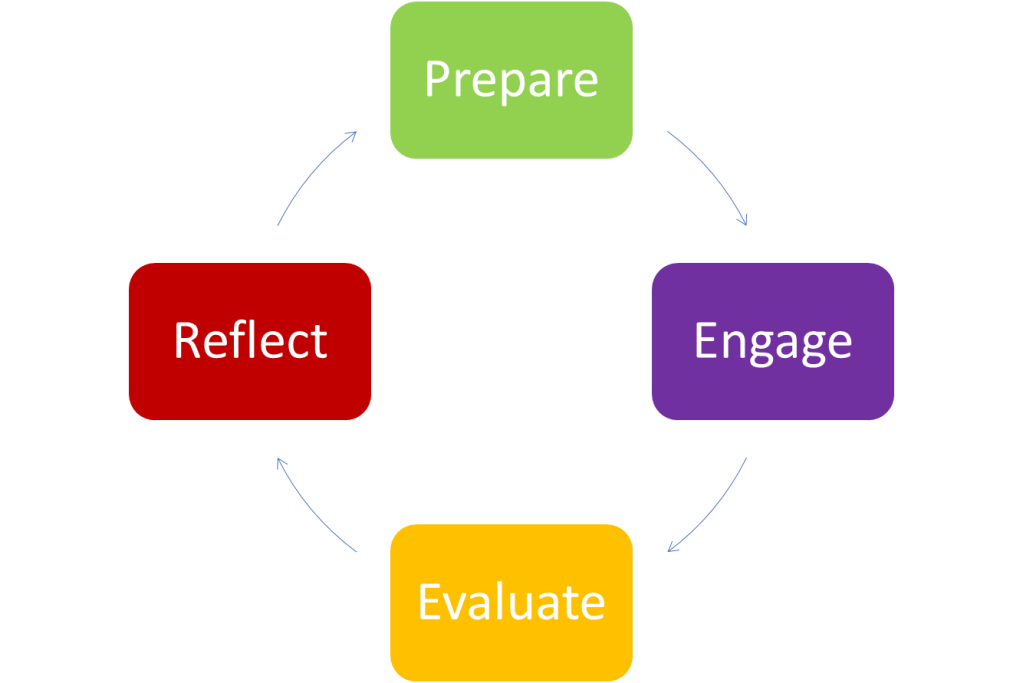
Intercultural Communication Cycle by Dr. Jasmin (Bey) Cowin:

 Dr. J's Education Blog