ESL Textbook evaluation for EDPN 673 by Touro TESOL teacher candidate Yevette Jensen

Touro TESOL teacher Candidate Yevette Jensen is 22 years old. She graduated from St. Joseph’s College with her Bachelor’s degree in elementary education. Ms. Jensen currently working towards her Master’s degree in TESOL and looks “forward to applying everything I will learn in my future classroom!”

The assignment in the course Methods and Materials for Teaching English calls for an evaluation of ESL Textbooks.

ESL Textbook evaluation assignment

Refer to Matching Books and Readers by Nancy Hathaway

With thousands of textbooks on the market, and dozens of publishers vying for your business, the selection of appropriate classroom materials is far from a simple process. To help you make well-informed decisions, here are some widely held myths about EFL/ESL textbooks and then three key steps to guide your evaluation of materials and selection of the most appropriate textbooks for your instructional needs.

Evaluation and Selection

Choose 3 chapters/sections OR 3 books (either from a textbook series, library, or a set of supplemental texts to review). Prepare a written description minimum of 2 pages per chapter/book/resource and critique of the material or resource, analyzing its effectiveness for ELL students. Your critique must address the following questions:

  • Know your students’ needs: four categories: (1) language background, (2) proficiency level, (3) goals, and (4) preferred approaches to learning.
  • What are your students’ native languages?
  • Can they read and write in their native language?
  • In what settings have they studied English (e.g., classroom, tutoring, self-study)
  • Proficiency level in English – Are they beginners, or do they already know some English? Are all students at the same level? Are they stronger in some skills (e.g., reading and writing) and weaker in others (e.g., listening and speaking)?

2. Know your instructional objectives
Taking the time to clearly define your objectives—or to understand the list of objectives provided by the institution in which you teach—will greatly limit the scope of your search for the right textbooks. To do this, you should ask questions such as this:

Given my students’ language background, proficiency level, learning goals, and preferred approaches to learning, what can I realistically expect them to be able to do as a result of my English instruction?

Then move from their needs to teaching objectives. With a list of objectives in hand, you can narrow your textbook selection considerably. You do this by matching your objectives with the proficiency level, content focus, and activity types of a number of potential choices.

3. Know your personal teaching preferences
The third step in the selection process is the assessment of your own teaching style and teaching preferences. To help you to think about the teaching-learning environment that is most ideal for you, as well as your expectations of a textbook, you can begin with questions such as these:

Classroom environment: roles of teacher and students

What teacher role(s) suit your personality and teaching style? Do you prefer the role of director (one who carefully guides students in their learning exercises and activities, usually having them interact more with you than with each other), the role of facilitator (one who organizes and monitors pair work and small group work), or some combination of these roles?

The “fit” between teaching style and textbook choice

How dependent are you on the textbook content for planning your lessons? For example, do you prefer to stick to the textbook, using it as your basic syllabus? Or, do you like to vary your approach based on the content of the lesson?
Are you good at adapting materials and/or creating supplemental activities?

Key Questions to be addressed in Materials Critique

  • What are the lesson objectives the material infers?
  • Can the identified methods and techniques be used appropriately to the teaching situation that you have in your classroom? (Describe your classroom situation in detail) Your students’ needs: four categories: (1) language background, (2) proficiency level, (3) goals, and (4) preferred approaches to learning.
  • Do the techniques used in the material advocate for achieving the stated/assumed objectives most effectively?
  • Do the techniques maintain the engagement of the learners and at what level of instruction (beginning, intermediate, advanced proficiency)?
  • How are the techniques appropriate for all types of students and can they be easily adapted in your classroom?
  • What are the identified methods and are they used appropriately to the teaching situation that you have in your classroom?
  • Do the techniques used in the material advocate for achieving the stated/assumed objectives most effectively?
  • Do the techniques maintain the engagement of the learners and at what level of instruction (beginning, intermediate, advanced proficiency)?
  • How are the techniques appropriate for all types of students including special needs students and can they be easily adapted in your classroom?
  • List which NYS TESOL standards this book addresses.
  • List key vocabulary.
  • Create a general Bloom’s Knowledge Matrix per selection – this means you will have 3 matrixes
  • Complete ESL TEXTBOOK EVALUATION CHECKLIST

Here the submission by Touro TESOL teacher Candidate Yevette Jensen: Materials Critique 673

Reflections on the article Sociocultural Perspectives on Foreign Language Learning by Samantha Solomita TESOL Course EDPN 673 Touro College

This week I am featuring TESOL candidate Samantha Solomita’s thoughtful Reflective Journal assignment. All teacher candidates are required to write reflective learning journals for every course as part of the TESOL Touro program, CR-ITI-BE in TESOL and CR-ITI-BE in Bilingual Education.  As teacher candidates prepare for a career in TESOL and Bilingual education becoming a reflective practitioner the hallmark for metacognitive learning and taking an active role in one’s own learning. Therefore, the TESOL Program at Touro College, CR-ITI-BE in TESOL, CR-ITI-BE in Bilingual Education requires Reflective Learning Journals for both professional growth and assessment.
Purpose: To provide teacher candidates with a framework making connections between prior knowledge and new information. The framework engages teacher candidates in a systematic process to guide their ongoing reflection, a process they can internalize and practice as constructive educators. Teacher candidates will be able to engage in this process to improve their teaching throughout their careers. Teacher candidates reflective journal entries will be included in the final portfolio.

Bio: Samantha Solomita, a TESOL candidate at Touro College, GSE currently teaches a 12:1+1 bridge self- contained class in  Sunnyside, Queens. Her class is composed of 3rd and 4th graders who have learning disabilities and are mostly English Language Learners. Ms. Solomita is certified in childhood studies and students with disabilities 1-6 and holds a Masters in Educational Psychology.

Description of Highlight(s) – chapter, article or event that pertains to EDPN 673 course. 

In the article Sociocultural Perspectives on Foreign Language Learning, the authors Mansoor Fahim and Mastaneh Haghani discuss how the sociocultural theory (SCT) relates to learning and teaching a second language. According to Fahim and Haghani (2012) “In sociocultural theory learning is thought of as a social event taking place as a result of interaction between the learner and the environment (p. 693) Therefore, language learning is optimal when the learner is actively involved in their learning and interacting with others. Language and learning are also strengthened as the individual participates in cultural, linguistic, and historical settings. For example, the learner is involved in interactions within peer groups, families, sports activities, etc. Sociocultural theory uses a holistic approach in which meaning is developed through complex forms rather than isolated concepts; therefore, learners have a role in their own learning process. They are problem solvers and meaning makers in their language acquisition process. In addition, this theory stresses an interconnectedness among teachers, learners, and tasks. Social interaction is believed to facilitate the learning process. Learners work together with their teacher to solve the problems. As they work together to solve a problem, individuals are internalizing how to solve the problem on their own. As the learner is developing the language, he/she is benefiting from others participation in the process. With the support of peers and teacher, students can develop language (Fahim & Haghani, 2012). Vygotsky introduced a concept called Zone of Proximal Development (ZPD). With this concept, Vygotsky argues that “psychology should be more concerned with the potential abilities of a child, i.e. what a child will be to accomplish in the future but he/she has not achieved yet” (p. 694). Therefore, scaffolding must take place so that the child can grow and develop. Scaffolding can be referred to as social assistance. Scaffolding can also be anything a learner benefits from. Therefore, scaffolds may be textbooks, dictionaries, and diagrams; however, scaffolds can also be peer feedback and teacher support. Scaffolds may be direct or explicit instruction. The key is that the learning takes place within the learner’s zone of proximal development. Therefore, no learning is “out of reach.” Another concept of SCT is internalization. There needs to be an enhancement of interactions among the learners. The expert role can be applied to the teacher but also to learners as well. Reciprocal teaching may be adopted to have expert learners teach students who are still developing the language. Teachers could adopt a learner-centered approach to instruction to help students with internalization (Fahim & Haghani, 2012). Another essential component of SCT is the activity theory. Activity theory focused on task-based performances which provide learners with an active role. The learner becomes socially and academically motivated which leads to success in the language learning process. Engaging the students in interviews, role-plays, and other real-world tasks increase the value of learning for students. The learners’ motives, goals and values contribute to their success in language acquisition. Overall, the SCT argues that learning is optimal when it is within the learner’s zone of proximal development, scaffolds are provided, and there are interactions within social contexts (Fahim & Haghani, 2012).

2. Initial Emotional Response (surprised, embarrassed, sad, inspired, excited, puzzled, etc.)

Initially, I was surprised when I read this article because I did not think that the sociocultural theory applied to language learning. I have researched and read a lot about Lev Vygotsky’s theory in my undergraduate and graduate courses; however, I do not remember any research focusing on language learning. I was surprised and excited to learn that there are connections between what I have learned in psychology courses and TESOL courses. I was surprised that the sociocultural theory connects to language learning; therefore, I was eager to reflect on this article.

Learning Process

3. Prior Assumptions or Opinions about the described highlight

Prior to reading this article, I thought that second language learning should be mostly teacher-directed. I assumed that for students to learn the language they needed to be passive learners. I thought ENL teaching was very teacher-directed with limited interaction and discussions between peers and teacher. I thought that students simply listened to the teacher and repeated what the teacher stated. I perceived ENL teaching as teaching the basics of English such as grammar, spelling, and verb agreement. I also thought ENL teaching incorporated mostly drill practices and repetition. In addition, I believed ENL was a pull-out service which was separate from content. I thought students were pulled out to practice basic English skills which were not aligned to the curriculum taught in the classroom. Therefore, as a student, I thought that ENL teachers were separate from classroom teachers. I did not realize that an ENL teacher could be a classroom teacher as well. Lastly, I also thought that ENL teaching incorporated specific teacher feedback as opposed to self- and peer- feedback.

4. Source of Assumption or Opinion What made you have such an assumption? (

I had this assumption because most of the videos that I have watched for this course have been very teacher-directed. Also, the readings from earlier on in the course were also more teacher-directed methods. For example, the Audiolingual Method, the Grammar-Translation method, and the Direct Method and very teacher-centered. The teacher is the expert and the students practice language without really understanding the content. The student’s role is mostly to listen to language and then repeat words and phrases. However, when I read the title of the article, I knew that the sociocultural theory focused on interactions; therefore, I was eager to read the article and make connections to language learning. Another reason is, before I became a teacher, I always thought that ENL was teaching simply English. I did not realize that it was integrated. I envisioned the ENL teachers doing basic grammar and sentence structure. From elementary school, I remember the ENL teachers having their own rooms and the students only going to their rooms. I do not remember ENL teachers ever coming into my classroom or teaching general content.

5. Assumption/Opinion Check – Validation/Invalidation 

My assumptions about the instruction of a foreign language were invalidated due to research on sociocultural theory and other methods of teaching. For example, Vygotsky’s sociocultural theory proposes for students to be active in their learning in order to create meaning. According to Fahim and Haghani (2012), “the theory also lays great stress on the dynamic nature of interconnections among teachers, learners and tasks and advocates the concept of learning which stems from interactions among individuals” (p.694). Therefore, according to SCT, learners should be engaged in tasks that are meaningful and challenging. Students show optimal growth when learning is within their zone of proximal development and they are supported by peers and teachers. According to SCT, language learning is best when there are meaningful interactions between students and teachers. Similarly, further research has supported and validated the points made by Vygotsky regarding language learning. For example, in the article On Teaching Strategies in Second Language Acquisition Yang Hong argues for creating a learner-centered classroom. According to Hong (2008), “In the learning process, the teacher can guide, facilitate, present materials clearly and answer questions, but the teacher cannot learn the language for students or even make students learn the language” (p. 64). The teacher’s role is the role of the facilitator. It is up to the student to take initiative for their learning. Teachers should facilitate the learners through meaningful tasks. For example, “second language learners are more motivated on tasks that they value (Hong, 2008, p. 66). Students may value a task more if it is applicable to their daily life or if it incorporates their interests. Teachers can try to increase value by incorporating authentic literature, using culturally relevant topics, or providing student choice. Also, Hong argues that teachers should provide opportunities for success. Therefore, teachers should choose tasks that are authentic and appropriately challenging. Appropriately challenging tasks are supported by the Vygotsky’s zone of proximal development. In addition, the Silent Way method also uses some strategies which are reflective of the sociocultural theory. Using the Silent Way Method, the teacher does not have to explicitly model for students. The teacher provides students with learning tasks and activities that encourage student responses. According to Richards and Rogers (2016), “the materials are designed for manipulation by the students as well as by the teacher, independently and cooperatively, in promoting language learning by direct association” (p. 108). Therefore, the students work together to make sense of the content and develop the language. The students rely on each other to strengthen their language; therefore, the students work collaboratively and provide specific, constructive feedback. Also, the silent way uses materials that are meaningful to the students. For example, According to Richards and Rogers (2016). “the materials are designed for manipulation by the students as well as by the teacher, independently and cooperatively, in promoting language learning by direct association” (p.108). Like the sociocultural theory, the Silent Way integrates tasks that are meaningful and authentic in order to promote language learning.

6. Realization/Aha Moment or Epiphany 

I had an “aha!” moment when I realized how the recent articles I read and the videos I watched related. The articles I mentioned all stress the importance of students collaborating to develop language. In addition, students provide each other with feedback during this process. The teacher works as the facilitator who guides the students through meaningful, authentic tasks. The teacher provides scaffolds such as various materials, teacher support, and peer support to assist the students throughout their language learning process. I believe that this type of second language teaching and learning is the best for my students. For the first few weeks of this course, I was having a difficult time applying the information from the readings and my observations from the videos to my teaching. A lot of the new content I learned about second language teaching was teacher-centered. Methods such as the Audiolingual Method and Communicative Language Method seemed very time consuming and hard to fit in with teaching the general curriculum. Similarly, methods such as Grammar Translation Method and the Direct Method seemed to be very specific and difficult to integrate into content. However, after recent readings and videos, I am envisioning how I can implement strategies into my classroom to teach and support second language learners. After learning more about the Sociocultural theory, I realize that students need to work together more to develop language. Instead of modeling as a teacher, I can have my students act as models for each other. The learning is more valuable when the students are presented with engaging tasks. Therefore, I would like to incorporate more tasks such as the one in the Silent Way video (English, 2013). In the video, the teacher provided the students with a hands-on experience of a floor plan. Students were able to manipulate the pieces and make sense of language as a group. This was a great example for me, students developing language through participating in a meaningful task. Through this task, students learned vocabulary terms, spatial relationships, and prepositions. This was a great “aha!” moment for me because I was able to actually see the concepts that I was reading about portrayed in a lesson. This video helped me put the readings into perspective. Moving forward, I trust that I have research-based practices that I can apply to my classroom to best support my English Language Learners. My thoughts have been changed about second language teaching. I no longer believe that second language teaching should be teacher-centered and teacher dominated. I believe to teach a second language I should use tasks that are meaningful and authentic. In addition, I should provide opportunities for the students to collaborate and provide feedback to one another. I believe that if the students value the learning, they will truly internalize it and strengthen their language.

7. Implications for future teaching practice

As I reflect on what I have learned so far in this course, I plan on making many changes to my teaching and classroom environment. I will incorporate many aspects of the sociocultural theory into my classroom. I would like to incorporate the Zone of Proximal Development as I plan for lessons. As I plan for tasks, I want to ensure that I am selecting materials that are within the ZPD for my learners. I want to make sure that it is appropriately challenging, yet not out of reach; therefore, students can experience success as they work with scaffolds. I plan on scaffolding for my students. Scaffolds will vary depending on the lesson. Scaffolds I would like to include for my students are words walls, reference books, familiar charts, and sentence stems. In addition, I will provide support as a teacher such as prompting questions and guiding the students to refer to resources. In addition, students will scaffold for one another by providing peer feedback. In addition, I would like to implement the Activity Theory in my classroom. For example, I will provide my students with meaningful learning opportunities for them to practice language and learn content simultaneously. For example, I will infuse more group work and partner work into my lessons so that students have an opportunity to share and learn from one another. I will have students participate in authentic, meaningful tasks that target language needs. For instance, my students struggle with prepositions. I would love to incorporate an activity like the one in the video. I would try to connect it to content that is in our curriculum. When my students create dioramas of the rain forest, I can have them practice and use prepositions in their speech and writing. Students task can be to describe the plants and animals in their rainforest using spatial relationships and prepositions. As a group, students can work together to decide where the plants and animals go in the diorama and how to describe them. Similarly, I would like to incorporate real-world mathematics problems in which the students can practice their mathematics vocabulary because that is also something my English Language Learners struggle with. I do anticipate some challenges with incorporating the sociocultural theory into my classroom. I think it will be difficult to incorporate meaningful, authentic tasks into the classroom daily; however, I do believe that it is very beneficial for my learners. Therefore, I will try to start building tasks by evaluating each unit and developing a task per unit. As I continue to develop tasks, I hope to build a repertoire of meaningful tasks that can be implemented into many lessons in all content areas. Overall, there are many strategies that I have learned through coursework that I am eager to implement into my classroom. I trust that implementing concepts from the sociocultural theory will have positive impacts on my English Language Learners.

References

English, A. (2013, January 25). Language Teaching Methods: Silent Way. Retrieved from https://www.youtube.com/watch?time_continue=2&v=xqLzbLCpack

Fahim, M., & Haghani, M. (2012). Sociocultural Perspectives on Foreign Language Learning. Journal of Language Teaching and Research, 3(4). doi:10.4304/jltr.3.4.693-699

Hong, Y. (2008). On Teaching Strategies in Second Language Acquisition. US- China Education Review, 5(1), 61-67.

Richards, J. C., & Rodgers, T. S. (2016). Approaches and methods in language teaching. Cambridge: Cambridge University Press.

The Silent Way – a discussion contribution for EDDN 673, Methods and Materials for Teaching English as a Second Language at Touro College, GSE by TESOL candidate Rose Linehan

This discussion board focus for EDDN 673 was on The Silent Way, an unconventional Language Teaching Method in today’s teaching landscape. It was based upon ideas outlined in Caleb Cattegno’s book “Teaching Foreign Languages in Schools the Silent Way,” published in 1963. Like most cultural events of the 60s and 70s, it was a reaction to previous approaches and methods that were considered excessively rigid and constricting. The basic method that underlies this approach is simple but potentially quite powerful: The teacher is silent, only speaking if the students are struggling.  While Silent Method is currently not used in schools I believe understanding the different methods and their applications gives teacher candidates for TESOL and Bilingual  Education powerful ideas to incorporate into their clinical teaching approaches. (Adapted from https://www.fluentu.com/blog/educator/silent-way-teaching-method/)

Rose Linehan holds her Bachelor’s Degree in History with a concentration in General Education and Students with Disabilities 1-6, with a minor in Psychology. She is a New York State certified teacher currently working in the East Meadow School District as an Intervention Teacher while obtaining her Master’s Degree in TESOL at Touro College.

TEACHER TRAINING DISCUSSION QUESTIONS BASED ON THE VIDEO/Silent Way

The Silent Way Video

1. What did the students learn in this lesson?

Throughout this lesson, the students learned a few different topics with the Silent Way Method. Students learned vocabulary and prepositions with a location as they both related to a house.

• What was introduced?

Fidel chartThe first thing that was introduced was the different pronunciation of ‘the’ with the help of a color-coded word chart, a Fidel. Next, the teacher introduced a floor plan to the students using different colored rods. The teacher created the floor plan of a house so that students could practice words such as other, another, front wall, back wall, etc. With the floor plan, students also learned other vocabulary words such as living room, kitchen, bed and dining room. Furthermore, the teacher introduced students to the appropriate word structure in sentences.

• What points were practiced?

The first point that was practiced was the pronunciation of ‘the’, which was practiced with the Fidel chart. Students reviewed many words always coming back to ‘the’ and making sure the pronunciation was correct. The next point that was practiced was with the floor plan. By creating the floor plan the teacher was able to have students come up with their own answers using the language while only guiding them. In the Silent Way, it is important that the students are responsible for their own production of the language. Therefore, the teacher uses a variety of strategies to guide the students and allow them to come up with the language on their own. The next point that was practiced was labeling the different rooms and their locations. This point was practiced by having the students sit together in a circle and ask them questions about where certain furniture should go. The students answer with the help of the teacher’s cues. Students need to be watching the teacher closely.

• What was mastered?

Students were able to master the location of certain areas within the house and the floor plan. Students were able to determine what location the teacher was pointing to, such as the living room, dining room, etc. Students were also able to master using prepositions as they related to the house and floor plan. In addition to mastering the location, students were able to decide where certain pieces of furniture went where in the house. They were able to decide what furniture would go in what room. Lastly, students continued to perfect their sentence structure when speaking with the tools used by the teacher to guide them.

2. How were the four basic language skills (listening, speaking, reading, writing) used in the lesson?

The four basic language skills were used throughout this lesson. The students had to listen closely to the teacher from the very beginning. As soon as the lesson started students had to be listening to the correct pronunciation of different words in order to learn. Students had to make sure to be listening to each other as well because it is important that students learn from each other as well as the teacher. Speaking was used throughout the lesson when students were constantly working with the language. Students were continuously speaking and practicing the language. It is important that the students speak up and practice the language so the teacher can take note and see what they are learning. It is important that students are speaking because mistakes are important and once they are addressed the content can be retained more easily. Reading was used at the very beginning of the lesson with the Fidel Chart that the teacher used. The teacher pointed to different words on the colored chart and students read them out loud. The teacher was listening for the correct pronunciation. If there were a mistake the teacher would have the students keep trying until they got it right. At the end of the lesson, students also read out loud sentences that they had written. Writing was used at the end of the lesson when the teacher had the students write about what they learned about the house today. The teacher gave the students some time to complete the writing and then asked for volunteers to share their sentences. The teacher was looking for correct pronunciation and sentence structure within their sentences.

3. Describe any assessment or corrective feedback the teacher incorporated during the lesson.

The teacher was informally assessing the students throughout the lesson. The teacher was observing students during the lesson and listening to how they were interacting with the language. When it came to errors made by students the teacher worked hard to help the student’s self-correct. While providing corrective feedback to the students the teacher used different techniques to guide the students, such as gestures. The teacher makes sure to guide the students to realize their own errors and correct it themselves. This makes sure that the teacher is as silent as possible when it comes to the language. This is beneficial because students are responsible for their own production of the language.

4. Have you ever seen the Silent Way Method before this course incorporated in a classroom for ENL’s?

I have not seen the Silent Way Method incorporated into the classroom for ENL’s before this course. I can see how this method would be very beneficial for the students. I like that students are guided to self correct their own language. I think it is very important for the students to be able to produce as much language as possible on their own. I would be very excited to see the Silent Way Method incorporated into more lessons for ENL students!

Bibliography

English, A. (2013, January 25). Language Teaching Methods: Silent Way. Retrieved from https://www.youtube.com/watch?time_continue=2&v=x qLzbLCpack

Larsen-Freeman, D. (2000). Techniques and Principles in Language Teaching. Oxford: Oxford University Press.

Richards, J.C., & Rodgers, T.S. (2009). Approaches and Methods in Language Teaching. Cambridge: Cambridge University Press.

TEACHER-TRAINING DISCUSSION by Touro GSE TESOL teacher candidate Crystal Demma for EDPN 673 – Methods and Materials for Teaching English as a Second Language

Crystal Picture

Touro GSE TESOL teacher candidate Crystal Demma holds a Bachelor Degree in Early Childhood and Childhood Education. She is a NY certified teacher working on her Master’s Degree for TESOL and works in the Brentwood Union Free School District where there is a high population of ELL students. Here her personal quote, ” I have worked closely with these students, and truly enjoyed the relationship we built.”

Every week in our Touro online course EDPN 673 – Methods and Materials for Teaching English as a Second Language, teacher candidates analyze and reflect on videos and readings with direct applications to their teaching practice.  This discussion board contribution by Crystal Demma shows the dedication and thoroughness of Touro’s candidates.

TEACHER-TRAINING DISCUSSION QUESTIONS BASED ON THE VIDEO

English, A. (Ed.). (2013, January 25). Language Teaching Methods: Suggestopedia.
1. What did the students learn in this lesson?
• What was introduced?
• What points were practiced?
• What was mastered?
2. How were the four basic language skills (listening, speaking, reading, writing) used in the lesson?
3. What were the contents of the different posters? What functions did they fulfill?
4. Examine the contents of the passage itself. In the contents, what is suggested?
5. What direct suggestions does the teacher make to the students?
6. Examine the teacher’s manner: What variations do you see from activity to activity, from beginning to
end? What might explain these variations?
7. What forms of indirect suggestion, beyond the teacher’s manner, were used?
8. In the initial concert, the teacher asked the students to both watch the actions and listen to the words being read. This is an example of an activity with a dual focus. Which other activities divided the students’ attention? Specify the focus for each activity.

1. Lesson-
• The students learned about verbs, the pronunciation of past-tense verbs (t or d sound), vocabulary, and intonation of phrases.
• She introduced acting out verbs as you are speaking them and verbs in the passage.
• The class practiced pronunciation of past-tense verbs, listening/speaking to a partner, acting out verbs, reading from a paper, repeating dictation, past to present tense of same words, and writing down dictation
• I believe repeating dictation and acting out the passage was mastered. They did this multiple times in differing variations. They did this with the class, with partners, and with a student demonstrator.

2. The four basic language skills were used throughout the lesson in multiple activities. The teacher had the students use more than one language skill at a time to create dual focus. The students were expected to listen to a passage, verbs, and sentences while also doing another action. Sometimes this action included orally repeating, reading, and writing. One example of the students using two language skills is the activity at the end of the lesson. The teacher dictated a sentence to the students (listening), and the students wrote down what they heard (writing). Another activity that required students to practice language skills was when the class chorally read the passage and acted it out together. There were many more activities that helped refine the language skills of the students.

3. The posters hanging in the classroom had a purpose. One poster she specifically drew the class’ attention to had past-tense verbs. This could be to help the students visualize the written word and focus on listening to the sounds of the word. The other posters were there to create a comfortable and non-threatening environment. The students learn best when they are in a positive learning environment.

4. As I listened to the passage a few times I realized that it had some implicit suggestion within. I believe that it was implying that although Sarah had a lot to do she was still calm, relaxed, and assured she would complete her task. The video states, “She stretched lazily and placed her feet one by one on the floor… She tiptoed through the boxes, which lay everywhere, and put a kettle of water on to boil.” This shows me that the character is not overwhelmed and implies that it is best to remain calm and at peace.

5. The teacher makes direct suggestions in the lesson. In the beginning of the lesson, she asks the students to sit back and relax. She adds that the students should take a deep breath and think about something pleasant like the beautiful weather they were having. Another direct suggestion she makes is at the end of the lesson during the closing. She advises the students to read the piece of paper with sentences on it and think about the pronunciation and intonation of the words.

6. The teacher uses different variations of activities. The first activity, the teacher spoke very slowly while acting out the passage. The second activity she started off the same by giving a direct suggestion to calm the students and then began. She read at a faster pace without using body movement. Next, she asks the students to act it out together instead of her doing it alone. She emphasizes the intonation more than the beginning. She speaks slower as the students try to keep up. I think her mannerisms change because she is trying to help guide the students when they are working together with her. She continues to give positive feedback and suggestions. Once she starts playing the game with the verbs with t or d she jokes around with the students. She laughs with them and makes it feel like they are playing a game. This could be because she wants the students to associate learning with fun. This is another technique to help imply relaxation and create a positive learning environment.

7. There was a lot of indirect suggestion in this lesson. The teacher decreased the fear of the students by creating a positive and pleasant learning environment. She played music, put out flowers, and displayed posters. Another example of indirect suggestion is the ball activity. The teacher used a game involving a ball with the class. This suggests to the students that learning can be fun and non-threatening. According to the video, learning should be facilitated in a comfortable environment because it increases the students’ confidence; therefore, the students will perform better and ultimately learn more in a non-threatening positive classroom.

8. The video displayed many activities that used dual focus:
• Activity 1- Listen to teachers sentence, repeat sentence, act out the story with body movement
• Activity 2- Listen to partner, act out dictation/Read aloud the passage, watch your partner’s actions
• Activity 3- Listen to past-tense verb, hold up sound card
• Activity 4- Listen to present-tense verb, catch a ball, dictate past-tense version of the verb
• Activity 5- Chorally read aloud passage, watch one student act out the dictation
• Activity 6- Listen to sentence, write down dictation

Reading Response:

1. As I was reading this chapter I noticed that there were not a lot of reading activities. There were many methods, but many of them had a focus off of reading. It was believed by some theorists that language is primarily what is spoken so that is how they would try to acquire the L2 instead of writing or reading (p. 49, 1986, Richards & Rodgers).
• Direct Method- Teachers taught from books containing short reading passages in the foreign language. After the class read they would study lists of vocabulary that was in the reading.
• Reading Based- Read passages in the foreign language, then discuss the passage in English to deepen comprehension
• Structured Linguistics- Studying characteristics of the language like morphemes, phonemes, words, structures, sentence types, etc.

I think the most effective reading activity would be the Reading Based Approach. It is important to expose students to text in the target language; however, it is even more valuable to discuss the text in their L1. This gives them the opportunity to digest and make sense of the text. Some students may not have understood the entire reading, and discussing it as a whole class can fix any misunderstandings they had. I believe discussing ideas deepens comprehension and increases speaking skills. This would also allow me the opportunity to evaluate if they understood the text or not. Students who do not participate and are unable to answer my questions probably struggled with the reading. I should make note who struggled and use this data to target my instruction. I could give them an easier text, or read the passage with them after they read independently.

English, A. (Ed.). (2013, January 25). Language Teaching Methods: Suggestopedia. Retrieved July 2, 2019, from https://www.youtube.com/watch?time_continue=139&v=3rkrvRlty5M

Richards, J. C., & Rodgers, T. S. (2009). Approaches and methods in language teaching. Cambridge: Cambridge University Press.

Thoughts and Musings: Project Libra – Facebook’s GlobalCoin White Paper is Public

by Jasmin Bey Cowin, Ed.D.

Facebooks Project Libra, the long anticipated, secretive GlobalCoin White Paper finally went public https://libra.org/en-US/white-paper/. It creates more questions about the implications of decentralized blockchains,  low-volatility cryptocurrency, and smart contract platforms. According to the White Paper the decentralized currency will be Byzantine Fault Tolerant (BFT). Byzantine Fault Tolerance (BFT) is the ability of a decentralized system to provide safety guarantees in the presence of faulty, or “Byzantine” members. (BFT consensus protocols are designed to function correctly even if some validator nodes — up to one-third of the network — are compromised or fail.)

The Switzerland-based Libra Association, a group composed of Facebook and its global corporate partners with an entry fee of $10 million, will be making all the governance decisions surrounding this new global currency. Chris Hughes, who left Facebook in 2007, tweeted on Friday that Libra is both “brilliant and frightening” because it shifts crucial power into the hands of private companies. In the Financial Times op-ed, he wrote:

Let us imagine that Libra works as planned. Hundreds of millions of people around the world will be able to send money across borders as easily as they send a text message. The Libra Association’s goals specifically say that ability will encourage “decentralised forms of governance”. In other words, Libra will disrupt and weaken nation states by enabling people to move out of unstable local currencies and into a currency denominated in dollars and euros and managed by corporations. quoted from https://gizmodo.com/facebook-co-founder-says-libra-will-empower-corporation-1835735044

Bitcoin oracle Andreas Antonopolous’ (https://aantonop.com/) initial review and reaction to the Facebook GlobalCoin Initiative: “While Facebook’s Libra doesn’t compete against any open, public, permissionless, borderless, neutral, censorship-resistant blockchains, it *will* compete against both retail banks and central banks. This is going to be fun to watch.”

Larry Cermak, Director of Research at The Block @TheBlock__ , was more specific in his observations: “Just so we are clear, Libra is: not decentralized not censorship resistant not guaranteed to work technologically not guaranteed to be cleared by regulators not clear in regards to tax implications” from https://lnkd.in/eiBXe6d

Here my concern: Will Facebook through GlobalCoin pose a threat to the US Dollar? GlobalCoin will be a stablecoin. Stablecoins are cryptocurrencies designed to minimize the volatility of the price by being pegged to currency, or to exchange-traded commodities such as precious metals or industrial metals. GlobalCoin will be pegged to a “basket of fiat currencies”. The Wall Street Journal reported that the social media giant has signed on more than a dozen backers for its GlobalCoin cryptocurrency. “Each of the new backers will invest roughly $10 million in the project as part of a governing consortium for the cryptocurrency. The crypto will operate within the company’s messaging infrastructure – WhatsApp, Instagram, and Facebook Messenger.” quoted from Nikhilesh De.

Featured Image: Facebook Stablecoin Initiative is Internally Called “Project Libra”
Glen Bates May 6, 2019 https://news.ibinex.com/2019/05/06/facebook-stablecoin-initiative-is-internally-called-project-libra/


FaceBook, GlobalCoin and the US Dollar

Facebook-Global-Coin-2020 (1)Jasmin Cowin, Ed.D.

A few days ago, Laura Mccracken, Facebook’s head of financial services in Northern Europe, announced that Facebook will release the White Paper for their cryptocurrency GlobalCoin (nicknamed Project Libra) on June 18th, 2019. (https://lnkd.in/d5rk7FC). Here my concern: Will Facebook through GlobalCoin pose a threat to the US Dollar? GlobalCoin will be a stablecoin. Stablecoins are cryptocurrencies designed to minimize the volatility of the price by being pegged to a currency, or to exchange-traded commodities such as precious metals or industrial metals. GlobalCoin will be pegged to a “basket of fiat currencies”. The Wall Street Journal reported that the social media giant has signed on more than a dozen backers for its GlobalCoin cryptocurrency. “Each of the new backers will invest roughly $10 million in the project as part of a governing consortium for the cryptocurrency. The crypto will operate within the company’s messaging infrastructure – WhatsApp, Instagram, and Facebook Messenger.” quoted from Nikhilesh De, https://lnkd.in/dNtzMcC hashtag#GlobalCoin hashtag#ProjectLibra hashtag#stablecoin hashtag#Facebook

Touro College Graduate School of Education Information Session

Join me at this informative event on how to become a public school teacher. It is not too late to register for the Touro GSE information session tomorrow! The goal is to provide content of value by having our DOE rep talk about the process on becoming a public NYC teacher. After the event, we will have a table for those interested in learning more about our programs. The goal is to provide a space where prospective students can organically interact with our students, staff, faculty, and alumni.

Touro GSE How to Become NYC Public School Teacher event on 5.23.19

Bridging the Divide Project a Case Study on Multicultural Education by Touro Certificate Candidate Luz Alina Muñoz Rivas

An exemplary submission of a case study was submitted by Luz Alina Muñoz Rivas, who holds a bachelors in music, minor in dance and a masters in Education. She is working to obtain a Bilingual Education Advanced Certificate at Touro College, Graduate School of Education, Tesol, and Bilingual Department, to append to her NYS Ed. Professional teacher certificate in music.

For the Touro TESOL EDPN 671 Theory and Practice of Bilingual and Multicultural Education, the course reviewed the impact of historical, legal, sociological, and political issues in relationship to the education of culturally and linguistically diverse students. Students explore the evolution of attitudes regarding bilingualism and multiculturalism in the United States. Emphasis will be placed on developing multicultural competence as educators, with areas of focus including cross-cultural communication in the classroom and with parents; how the language and culture of the home and the community impact student learning; cultural factors in the relationships between the school and the community. Models of multicultural and bilingual education were presented and analyzed. A final project was a case study with interviews which Ms. Rivas conducted.

Luz Alina Muñoz Rivas:

Bridging the Divide Project is an arduously focused attempt to place myself in a family’s shoes in order to understand how they have constructed meaning from their experiences. As I endeavor to do this, I explore their views about immigrating or their role in the host country, educating their children, and engaging with the educational system, and other relevant findings. In my findings, I will include: Part I – setting, family background, an explanation why this family was chosen for this study, social, economic, educational, and personal backgrounds, if applicable: Immigration (first, second generation) experience. Relatives in the area, Funds of knowledge, cultural competencies, and difficulties encountered (e.g., prejudice, discrimination). Part II – Analysis: How language and culture interact in the formation of a student’s identity, Identifying any cross-cultural conflicts apparent in the interview process and distinguishing between cultural boundary and a cultural border, selecting appropriate teaching techniques based on knowledge of students’ cultural backgrounds, how the importance of the home culture and the effect on student learning and Part III – Conclusions and Recommendations.

Part I – A. Setting

  1. Describe the setting in which the dialogue took place.
  • Huntington New York at their home on 3/28/19 at 8:30 a.m. until almost 10 a.m.
  • Dialogue with youngest child (Little Miss X) in music classroom 4/5/19 at 9:20 a.m. and observed her in DL classroom setting on 4/10/19 at 11 a.m. ‘til 11:40 a.m.
  • A small and very clean house on the top of a hill by a narrow two way street.
  • Small Clean Living room with sofa, love seat and wall TV with family pictures
  • Chihuahua dog greeter
  1. Describe the neighborhood and reflections about your walk-through.
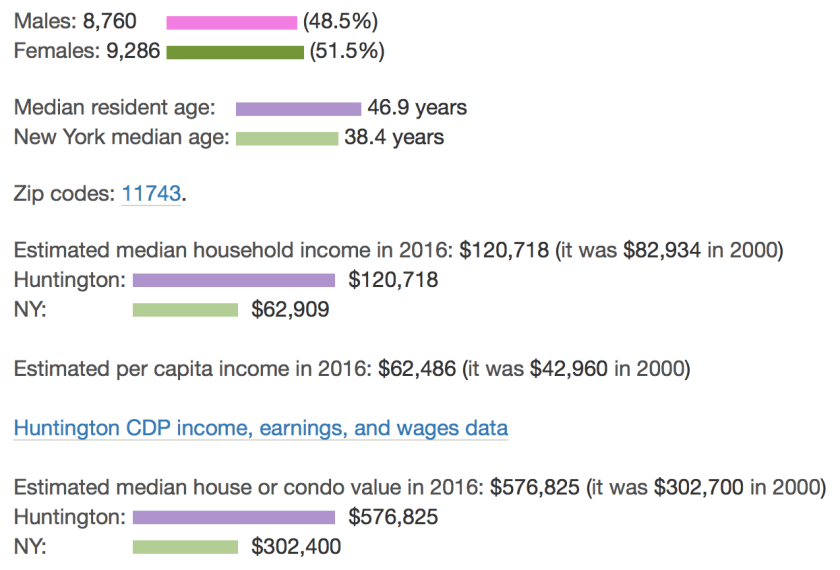
  • Living in Huntington. Huntington is a medium-sized coastal town (i.e. on the ocean, a bay, or inlet) located in the state of New York. With a population of 18,176 people and nine constituent neighborhoods, Huntington is the 104th largest community in New York.
  • Narrow streets are lined with multiple storefronts and busy traffic with cars and trucks traveling to and from.
  • Major street divides 400K homes from 1.5 million dollar homes
  • Private pools all around the neighborhood

Walk through was safe and relatively comfortable.

  1. Family Background
  • Parents are Latin American and Bilingual (Spanish & English)
  • Family is Christian
  • Young Mr. B participates in a young Single Adults program at the local church
  • Miss Y is an 8th grade student in high honors. She has won their annual art contest 8 years consecutively. Wants to grow up to be a lawyer.
  • Little Miss X and Little Mr. W go to church with their family every Sunday and participate in a primary organization for children 18 months to 11 years of age. She does sports on Fridays at their elementary school and is a member of the church’s primary organization.
  1. Explain why this family was chosen for this study.
  • Recommended by my supervisor
  • Children are DL learners that were born in the U.S.A. and have or are being taught by Mr. EZ
  • Bilingual family
  • Latino culture- 1st generation
  • Strong family support for better education
  • “Sojourners” with the intent to be permanent
  • Sturdy signs of good assimilation of both Eastern American and Latin American cultures evident
  • Judeo/Christian culture

A brief history of the AB family:

Mama A, a sojourner, arrived as a single mother to the U.S. from Honduras with her 3-year-old son nineteen years ago with the intent to become permanent. She quickly acquired L2 skills in order to find work and make a permanent home of New York, U.S.A. Mama A works part-time as a waitress and Papa W works as a foreman for a luxury ship on Long Island. They are all permanent residents except for U.S. born children that are U.S. citizens. Their oldest son (now age 21) has been diagnosed ADD and has been educated in the U.S. his entire life. He can speak English well and can understand conversational Spanish. Mama A married fifteen years ago and since then gave birth to three children while living in New York: Miss Y; age 14, Little Mr. W; age 10 and Little Miss X; age 8.  Their two daughters qualified to take part of the school’s  DL program. The following diagram shows each member of the AB Family, age, place of birth, countries and cities where they have lived as well as ages when children immigrated:

Luz Family

  1. Social, economic, educational, and personal backgrounds.

Social: Papa W currently works at the bay and Mama A works as a waitress and live in an affluent neighborhood. They have strong Christian values, strong family values and strong extended family connections despite the distance.

Economic: Both are working and live in a 400K house and own a car.

Personal Backgrounds:  She arrived to NY a single mom and with a strong desire for education and L2 acquisition in order to support her family.

  1. If applicable: Immigration (first, second generation) experience. Relatives in the area?
  • Mama A and Papa W are first generation with permanent residency status
  • No relatives in the area but they maintain strong connections with them
  1. Funds of knowledge, cultural competencies, difficulties encountered (e.g., prejudice, discrimination).
  • Very happy home, church and school environment
  • After 15 years and only under the Trump administration did their family experience scrutiny for their nationality and culture in the school setting where her son was asked by another student if he was undocumented.
  1. The educational experience from the family’s perspectives

This family has had no issues with enrollment and supporting their children in their school. Interactions with teachers and administrators have been and continue to be proactive. They are very satisfied with the schools in their area. Despite one of their sons delay in classifying him with dyslexia, there has been nothing but support and good experiences. Both their sons have IEPs and have been given the services they need to do comfortably well in their school district. Both daughters (ENL students) are soaring in their dual language cultural identities both academically and socially in their school environments as their family actively takes part in their DL program. This is working well for them. If it were not for this, they would not have had the same positive impact on their progress since Honduras’ bilingual schools would not have been feasible because they are very expensive.  Also, Honduras does not have a system for support of children with special needs. This explains the educational experience from the family’s perspectives.

Part II: Analysis

In an effort to develop an understanding of how language and culture interact in the formation of the student’s identity, I found that “little miss X” and her sister, “Miss Y” and their brothers have assimilated with both mainstream American and Latin American culture via a strong family support system and an active church community. Even more so, by little Miss X and Miss Y, whose participation in a DL program at their public school have amalgamated their student identity. Since kindergarten, they have had both their L1 and L2 embedded in academic content. A third-grade teacher I observed teaching “little miss X” (Mr. EZ) said they’ve utilized educational resources in two languages: Journeys (English) and counterpart, Senderos (Spanish) reading programs among other dual language materials. We discussed the limits of translation in a bilingual classroom setting, the use of code-switching and translanguaging, using the arts for bilingualism and biliteracy; and reading aloud in bilingual settings. “Little Miss X” has grasped onto components of culture in a modernized society as mentioned by Haiyan Gu in “Developing Related Cultural Awareness in TEFL”, where Gu (Gu, 2017, p.472) clearly states that language learning cannot be separated from culture. He says the most important components of culture in a modernized society must be included because it is the language that is already embedded in the culture. These components are the system of belief, customs, morals and emotion of the target culture and language teaching should occur in conjunction with the related culture. It is a symbolic communication. Gu clarifies for us that culture has been defined by different perspectives (Gu, 2017). From my own performance artist standpoint, I’d say culture is defined as the arts and other manifestations of human intellectual achievement regarded collectively.  However, in terms of society, culture is often defined as the customs, arts, social institutions, and achievements of a particular nation, people, or other social groups. He finally concludes that a commonly accepted view is that culture is the common knowledge and values that people of a particular group share.5

As far as identifying any cross-cultural conflicts apparent in the interview process, I identified none. Understanding that cross-cultural misunderstandings or conflict may arise whenever there are cultural differences, I was mindful but had none nor did I see any potential of them in foresight. In fact, some potential causes or situations in which conflicts or misunderstandings can happen such as misunderstandings or conflict between different nationalities, religious or ethnic groups, did not occur because both the family and myself are of the same religion and the same ethnic group. I was aware of invisible culture knowing when teachers focus on visible culture at the expense of invisible culture, students of all ages may do poorly and in worse cases become radicalized. One case study notes, Iraqi (Kurdish and Irabic) students were doing poorly in achieving academically in the classroom. According to Reyes, it was very likely they were not adapting well to western thought based curriculum that was culturally alien to them.  The western thought paradigm which merges Judeo/Christian values with evidence-based approach to scientific knowledge is difficult for non-westerners to access. For example, although Tamerlan Tsnarnaev, a college student and permanent resident (now known as the Boston bomber) enrolled in college as an english as a second language learner, he never quite assimilated. He eventually upset services at a local mosque with a denunciation of Martin Luther King Jr. and Thanksgiving. He could not understand when teachers focussed on explicit culture nor could he tolerate it. This problem affected his younger brother who was also a college student that became radicalized. Without the knowledge of the intangible aspects of culture the teacher risks overvaluing or undervaluing said culture’s differences unintentionally. It may also cause confusion. Unlike this starkly different occurrence, this family has nothing close to signs of radicalization or difficulty in the formation of a productive student identity. Cultural boundaries and cultural borders were simple and mutually understood throughout the interview process as well.

In order to distinguish between cultural boundary and a cultural border, the Dual Language/DL teacher and I briefly discussed what it means in a DL classroom verses a TEFL classroom. Similar to what the author uses in chapter 2 of Multicultural Education: Issues and Perspectives, we agreed upon these distinctions by utilizing this example where they argue that what happened in a sequence on page 33 was ‘‘cultural.’’ The teacher had chosen to make a moment in the reading lesson a practice session in cultural ways of speaking rather than using that moment as an opportunity for teaching children the sense of the words they were reading aloud. According to Banks, this put the spotlight of public attention on a subtle cultural difference, but it did so in an indirect way that was confusing for the students. The appearance of a small feature in pronunciation style (deletion of final t) became the occasion for the teacher’s making a big thing of a small cultural difference. But the teacher did not explain that, so it was not clear to the children that what was being asked of them was to participate in a practice session in cultural style in talking. (Banks & McGee Banks, 34) Aligning the objectives from the start would have been more effective (SIOP model). Completing the lesson by restating the objectives met or unmet would clarify what was being asked of students. However, in a DL classroom, mistakes are often made and are never critiqued because they are viewed as part of the intricate process of oral language development. What makes this distinction important is the influence on student’s understanding. Chapter 2 considers that the choice of focus by the teacher as an example of treating a feature of cultural difference as a cultural border matter rather than as a cultural boundary matter. As DL Teachers, we have a great deal of discretion in how we frame and deal with cultural difference in the classroom—as border or as boundary. Specifically, it is “The way we choose to frame cultural difference that has a profound influence on students’ understanding of what is being asked of them instructionally and on their motivation to learn” (Banks, 34).

As far as selecting appropriate teaching techniques based on knowledge of students’ cultural backgrounds, Mr. EZ, their DL teacher, uses what comes closest to the  Communication Language Teaching Method and most of his instruction is born from academic texts so reading, writing, listening and speaking are all incorporated in this family’s native language. For example, in an effort to name, list by standard, and explore three important Common Core Standards as they relate to DL’s and Multicultural Sensitivity, I listed the following with relevant details as to how he explored them:

STANDARDS: RI.3.4, L3.4a, L3.6, RI.3.7

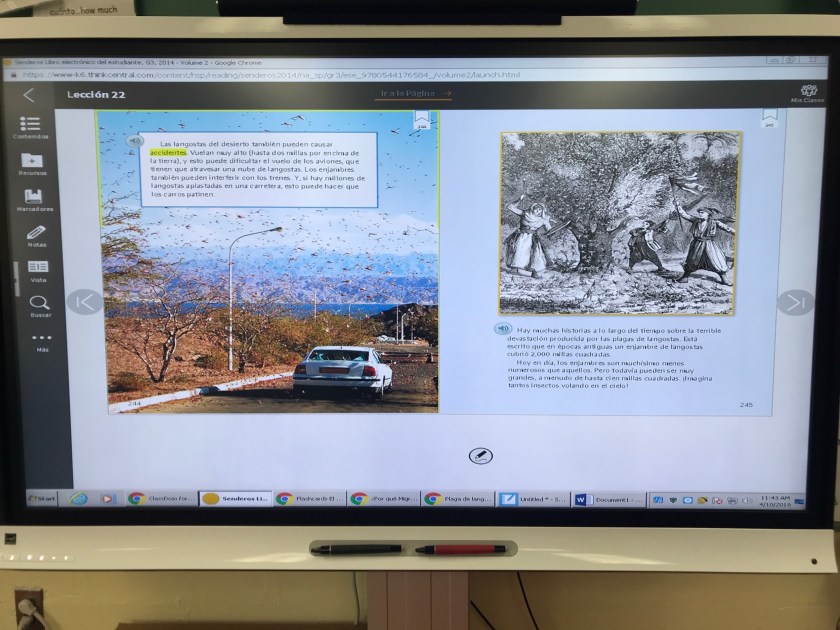
RI.3.4 – Vocabulary Activity includes use of technology & visuals in Spanish.

Mr. EZ’s room and monitor/screen
Luz classroom

L3.4a – To determine or clarify the meaning of  “Langostas” he compared a lobster and a locust which can both be defined as “langosta” in Spanish. An African locust was also compared to a Long Island grasshopper (one has longer antennae).

L3.6 – To acquire and use accurately grade-appropriate conversational general academic and domain-specific words and phrases, including those that signal spatial and temporal relationships he discussed on how African locusts are located on a different continent as compared to locust found in the U.S.A. He encouraged them to take note of the reasons why they migrate, where they are from, how far they travel as well as what harm they can cause.

R.I.3.7 – He explains how specific aspects of a text’s illustrations contribute to what is conveyed by the words in a story (e.g., create mood, emphasize aspects of a character or setting)

Mr. EZ taught an ELA lesson from Senderos; a comprehensive Spanish reading and language arts program that has been specifically designed for use in dual language program and bilingual instruction program. The topic was on animals that migrate.

Luz classroom 2

In addition to Communication Language Learning Method, Mr. EZ utilizes what we would refer to as (Gary R. Howard’s) Culturally Responsive Teaching in a very receptive school environment. This includes the seven principles found in the model:

  1. “Teaching across differences” where Mr. EZ’s students are affirmed in their cultural connections by being seated in mixed performance levels of ENL. These groups of students can work cooperatively in both there L1 and L2.
  2. “Teachers are personally inviting”; so that Mr. EZ encourages with a gentle yet assertive tone consistently to speak in Spanish/English using academic language. He also utilized routine classroom management cues (ie: he says: sh-sh and they respond: sshhhh). His classroom has a rug for closer group instruction as well as 4 chairs joined to form a smaller group/section-about 5 sections total.
  3. Classroom is physically and culturally inviting: uses Smartboard, uses Journeys and Senderos; their dual language literacy program and all the student textbooks for the class are situated neatly in a designated location. Numerous visuals are provided.
  4. Students are reinforced for academic development when he reviews vocabulary before and ELA lesson to prompt foreknowledge of material about to be presented. Vocabulary activities are created with the use of technology (picture below)
  5. Instructional changes are made to accommodate differences when lesson will be conducted in Spanish but a student will insist on speaking English in response to questions regarding designated topic. He will not discourage them but will acknowledge their responses and then continue to engage them persuasively as to focussing on L2 acquisition by simply resuming in this language without switching all together.
  6. Classroom is managed with a firm, consistent loving control understanding the limits of code-switching and translanguaging for native Speakers. He also addresses their immediate and most basic needs quickly and judiciously. Fortunately, this child, Little Miss X, is at a school that is culturally responsive where the system understands the home language and the culture as assets and teachers know how to use it.
  7. Interactions stress collectively as well as individually are done with some TPR methodology.

I agree that “Singing harmony to our kids’ song rather than forcing them to always sing our song.” I agree that with all the many differences in our classroom, we need to always strive to keep improving our instruction and connect with our individual students.

  1. In order to understand the importance of the home culture and the effect on student learning, I worked with Luis Moll’s concept of Funds of Knowledge which is the knowledge base generated by families on the basis of their experiences (at work), social practices and their social history. I applied the strategies and visited their household and documented these experiences and became a learner instead of the teacher. My reality is altered by adapting this concept as I observed and asked about family routine and traditions. Mama A says they value family education and time at home and dedicate one night a week to family where they share their school experiences with one another. They also read spiritually focussed reading materials together: The Bible, etc., spend quality time, pray together and plan their weekly/Sunday church attendance as a family. This experience is instructional and is advised by their Bishop and church educational system. She constantly reinforces her children’s thinking skills and knowledge and works only part-time. They also participate in various activities outside of the home environment including soccer (the main sport in Honduras) and sports at school. Mama A always reviews homework assignments with them in English. She says they voice their basic needs in Spanish but will voice their academic concerns in English. She notices their strengths and weaknesses academically and will voice her opinion sufficiently so that it is addressed in school. She says she has not felt a victim to racism or gender bias but her middle school age daughter feels that it is more evident in her friends’ lives; especially friends of color and Latin American in Middle School. If these make a mistake, they will be reprimanded more severely than white Middle School aged students. She wants to grow up to become an immigration lawyer.
  2. In an attempt to finally seek to involve ESOL families in student learning, I discovered that Mamá A and Papa W were already aware of its importance and are consistently involved in student learning by reading as a family 2-3 times a week in the L2. Mama A speaks to them in their L1 as well. Consistent and even laborious communication between teachers and administrators is considered important to Family AB. Mama A says its a must since she believes their children’s achievement is dependent upon the interdependent nature of their involvement with the school, teachers, staff and administration.


FAMILY CONTEXT:

  1. Physical characteristics of the home (if interviews are conducted in the home);

Luz family 2

The home[1] is a 400K house on a hill of a narrow two-way street. Interview took place in a small and very clean house on the top of a hill by a narrow two-way street. They have a small clean living room with sofa, love seat and wall TV with family pictures. Family AB has a Chihuahua dog greeter that sits on a lounge chair after he greets.

  1. Community characteristics;

An affluent area.
Luz family 2

Luz Race


Demographic/background information;

  1. Educational background of parents; ages and grades of the children;

Mama A was not educated in the US. Neither was Dad. Young Mr. B age: 22 – HS Grad., Miss Y age: 14 – 8th grade, Little Mr. W – 10 – 5th grade, 8 – 3rd grade

  1. If applicable: Immigration experience (How/why they decide to come to the U.S. or the third country? What was it like?); Seeking a better life for herself and her three-year-old son.
  2. Child-rearing practices and philosophy; Teach a child words of wisdom and to “Choose the Right”. “Choose the right” is a saying or motto among members of The Church of Jesus Christ of Latter-day Saints that is taught to children and used by members of the church as a reminder to make choices that will help an individual to live righteously. The phrase is taken from an LDS hymn Choose the Right.
  3. Economic/work issues; None
  4. Funds of Knowledge (Luis Moll); At home interview, teach at Little Miss X’s elementary school music class and observe DL teacher teach inside the classroom and participate and observe in 1st grade DL teaching
  5. Perspectives about education. What is a well-educated child? During the interview, Mama A says “The future depends on a well-educated child.”

What are the roles of families and schools in children’s education?  Mama A says “Both are very important because we can motivate them at home but if they don’t have the correct support; such as well trained teachers who understand the student’s culture and their academic needs then they will not progress.”

  1. Experiences with children’s school(s). “We’ve had a lot of good experiences at the Elementary School. Teachers, nurses and aids are very kind. They know all the students by name. It’s important to know that they all know your kids and they know the parents. I’m not in the PTA but they know me.”

Types of support they have received;

2 have IEPs and 2 have/are participating in a dual language program at their school.

  1. Misunderstandings, difficulties and challenges and how they have handled them;

There have been no misunderstanding or difficulties worth mentioning.

  1. What do these families want their children’s teachers and administrators to know about them and their children?

This family wants their children’s teachers and administrators to know that they are hard-working and responsible children that hope and aspire to be educated and become professionals.

Part III: Conclusions and Recommendations

The meaning of this study is derived in the prospects that I, a student, am to better understand the role of culture in student learning and engagement. Prior to conducting this study, I did not expect to find so much information about family and CLD families interconnection with teachers and administrators at the site. It was a culturally responsive school at the end of the day. My assumptions and beliefs change as a result of this experience because my views are multi-dimensional versus two-dimensional. The knowledge I acquired that I wish to share with other PK-12 teachers is that having a perspective that leads to compassion and understanding for CLD families is a must. In order to improve programs for culturally and linguistically diverse families, one should improve the understanding of faculty and staff about CLD families.

In order to provide specific, concrete examples of things teachers and schools can do to:

  1. Improve the understanding of faculty and staff about CLD families

I recommend more dual language programs embedded in the conviction to promote students achievement with a multicultural perspective. Reinforce the five conditions to promote students achievement with a multicultural perspective which are namely:

  1. School reform would be anti-racist and anti-biased.
  2. School reform should reflect an understanding and acceptance of all students as having talents and strengths that can enhance their education.
  3. School reform should be considered within the parameters of critical pedagogy.
  4. The people most intimately connected with teaching and learning (teachers, parents, and students themselves) need to be meaningfully involved in school reform.
  5. School reform needs to be based on high expectations and rigorous standards for all learners.
  6. Proactively develop stronger school-family partnerships through ongoing communication between teachers, parents and students.
  7. Adorn and make their schools and classrooms more welcoming places for CLD & non-native English speaking families and connect students’ funds of knowledge to instruction. Teachers should endeavor to make the classroom welcoming to the student through pictures, and colorful visuals as well as variety of books about different cultures including their own (samples shown below).

Part IV: Personal Reflections

Through this project I have learned to better understand the role of culture in student learning and engagement and I reflect on my preconceptions on language learning and multicultural books and stories that were utilized in the dual language curriculum that this family takes part in. I now understood, most importantly, what Luis Moll says about Funds of Knowledge and “how teachers experiences (live) interact with the academic and pedagogical knowledge their supposed to master as professional educators. He says “There is always a filter in acquiring these more academic concepts: social and emotional experiences of our lives so in a sense the teachers’ funds of knowledge become part and parcel of that element needed to assimilate that pedagogical knowledge and become an outstanding teacher.”[2]

My preconception about language learning is based on the notion that English from Great Britain and Castilian Spanish were considered pure, perfect and the true standard; borrowing, compounding, and cropping was a sign of a debased idiom. In fact, the notion that American English was eventually considered better than British English is new to me. I’d considered Castilian Spanish and British English of equal standard. I seemed to have believed that it was the standard that I never thought could be toppled over as pretentious as that sounds. And yet, I’m sure that it is what people thought when Latin was toppled over by a mere Germanic dialect! Yet, I welcome this new perspective whole-heartedly as an American. I’ve heard L2 learners speak and change the language before and sympathized. Now I consider it ingenious! As a music educator, I am adopting ELL methods like Suggestopedia and Jazz chants as I grapple with students’ oral language development. My preconceptions about language learning and, by extension, what is involved in oral language development? Input, Output, and interaction were interpreted by a musical standpoint which hones in on the National Standards for Music Education 2014; Connect #11: Relate musical ideas and works with varied context to deepen understanding. At first, I thought it was easy because for me since it is intuitive to chant or sing having been a singer for decades. The term “Jazz Chants” was unfamiliar to me but the approach looked so familiar that I decided to adopt it. But in my opinion, if I really want to adapt it to my teaching method, I needed to have something useful and simple.

I am happy that through this DL fieldwork experience I was given the facility to engage in teaching related fieldwork and make observations of culturally appropriate/responsive teaching practices in classrooms serving culturally, linguistically, and socio-economically diverse student populations and, by extension, reflect on those experiences in relation to theory, course objectives, and course content. Interestingly, I’ve also utilized a multicultural children’s book and created a checkers game for grade 1-3 based on the DL vocabulary found in it and created a general music lesson focused on their music genre (checkers game picture below). While doing field work at the home and school of Family AB, I have spotlighted high-quality multicultural literature in the textbook Houghton Mifflin Harcourt Journeys Anthologies and a dual language multicultural book assessed by five major characteristics: accuracy, expertise, respect, purpose, and quality. I also found one of the best selection of multicultural and social justice books for children, YA, and educators. It is a dual language book added to these for a 3rd Grade reading curriculum titled Biblioburro; A True Story from Colombia by Jeanette Winter. I also created a checkerboard game based on words found in Biblioburro; a true story from Colombia by Jeanette Winter that is a dual language book for children, YA and adults on social justice. I intend to share the game and music with Family AB.

Yet, I am somewhat limited as a permanent substitute teacher. If I found a place in a music department similar to the school site, I would work in a culturally responsive school where there is a dual language program where I could become a dual language music teacher. I would then continue my work and continually adapt my curriculum and teaching to ensure that it is culturally responsive.

FIELDWORK PICTURES OF DL CLASSROOMS Grades 1 & 3 and General Music.

Luz classroom 3

Luz classroom 5.png

SOURCES:

  1. Banks, J. A., & McGee Banks, C. A. (2010). Multicultural Education: Issues and Perspectives (7th ed.). Hoboken, NJ: John Wiley & Sons.
  2. “Teaching in 2 Languages: A Guide for K-12 Bilingual Educators” by Sharon Adelman Reyes

& Tatyana Kleyn Thousand Oaks, CA: Corwin/Sage, 2010. ISBN: 978-1-4129-7802-6.

  1. Common core state standards initiative found in url: ​http://www.corestandards.org/read-the-standards/ (Links to an external site.) Links to an external site.
  2. Huntington, New York (NY 11743) profile: population, maps, real estate, averages, homes, statistics, relocation, travel, jobs, hospitals, etc. http://www.city-data.com/city/Huntington-New-York.html
  3. Gu, H. (2018). “Developing Related Cultural Awareness in TEFL”, Advances in Social Sciences, Education and Humanities Research, volume 185 6th International Conferences in Social Sciences, Education and Humanities Research (SSEHR 2017), p. 472.

[1] From the url: http://www.city-data.com/city/Huntington-New-York.html

[2] Funds of Knowledge for Teaching: Using a Qualitative Approach to Connect Homes and Classrooms Author(s): Luis C. Moll, Cathy Amanti, Deborah Neff, Norma Gonzalez

Source: Theory into Practice, Vol. 31, No. 2, Qualitative Issues in Educational Research (Spring, 1992), pp. 132-141 Published by: Taylor & Francis, Ltd.

Stable URL: http://www.jstor.org/stable/1476399Accessed: 17/02/2010 17:44

From the Url: https://rylak.files.wordpress.com/2012/08/moll-et-al-1992.pdf


Reflections on Educational Equality for Students with Disabilities by Touro TESOL teacher candidate Kevin Mongan

As a Professor for TESOL and Bilingual Education, I focus on different domains during our semester-long journey.  This blog features Touro TESOL teacher candidate Kevin Mongan, a Social Studies Teacher from Sachem Central School District. He is seeking his TESOL Certificate to better assist his English Language Learner population and better himself as an educator. He appreciates the hard work and dedication of the Touro College Faculty and Staff.

This weeks focus are on:

Domain 2 – Culture (TESOL Domains )
Standard: Nature and Role of Culture

Candidates know, understand, and use the major concepts, principles, theories, and
research related to the nature and role of culture in language development and
academic achievement that support individual students’ learning.

Domain 3: Planning, Implementing, and Managing Instruction
Standard: Planning for Standards-Based ESL and Content Instruction
Candidates know, understand, and apply concepts, research, and best practices to
plan classroom instruction in a supportive learning environment for ESOL students.
Candidates serve as effective English-language models, as they plan for multilevel
classrooms with learners from diverse backgrounds using standards-based ESL and
content curriculum.

Reflective Journal:

In “Chapter 13: Educational Equality for Students with Disabilities,” written by Sara C. Bicard and William L. Heward, Multicultural Education: Issues and Perspectives by James A. Banks and Cherry A. McGee Banks, the reader is posed with a question that reaches into the core of every teacher: Am I providing ALL of my students with the best education I can provide for them? The authors present a statement very early in their piece:

The skill differences among most children are relatively small, allowing these children to benefit from the general education program offered by their schools. When the physical, social, and academic skills of children differ to such an extent that typical school curricula or teaching methods are neither appropriate nor effective, however, equitable access to and benefits from educational programs are at stake. (Bicard, p. 315)

Every teacher has had at least one moment where they asked themselves, am I doing enough? When students with disabilities, whether physical, social, or academic, are not being given the proper tools to succeed in their learning environment, they will not succeed. It is up to the classroom teacher, administration, family at home, and the students to make sure that their needs for success are constantly being maintained inside and outside of the classroom.

color coded 3
The authors explain how students with disabilities are identified and classified, how students with disabilities do not benefit from a single change to the classroom environment, and also, how not all students with disabilities will benefit from the same accommodations. The classification system for students with disabilities is often targeted as a problem than as a system that can lead to solutions. “Some educators believe the classification and labeling of exceptional students serve only to stigmatize and exclude them from the mainstream of educational opportunities” (p. 319). “Others argue that a workable system of classification is necessary to obtain the special education services and programs that are prerequisite to educational equality for exceptional students” (p. 319.) If labels and classifications are not present, how can general education teachers, special education teachers, parents, various professionals whose sole duty is to help the child, communicate common goals for the student? Real issues need real solutions and without having a real comprehension of the task at hand for all parties involved, the student can never benefit from any services provided because there would be no goal to reach or endgame in sight.

The authors then embark on a legislative study on how students with disabilities have been treated in the public education system of the United States. When students with disabilities were brought into public schools they were immediately judged and labeled, often cast aside and not granted access to the public school system. Students were labeled by their teachers as “slow learners” and “disciplinary problems” when they would act out in class, from the frustration of not understanding the material (p.320-321). In Brown v. Board of Education of Topeka (1954), “the U.S. Supreme Court ruled that education must be available to all children on equal terms and that is unconstitutional to operate segregated schools under the premise that they are separate but equal” (p. 321). For most students and teachers, this case falls under the constructs of African-Americans and the Civil Rights Movement, however, to parents of children with disabilities, this ruling pushed the door wide open for students with disabilities to have the right for the best education they can receive in their local public school district. Laws would be created to further protect the right and liberties of those with disabilities, but under the amendments of the Education for All Handicapped Children Act, which renamed it the Individuals with Disabilities Education Act (IDEA), it “ensure[s] the rights of students with disabilities to a free appropriate public education, including early intervention services, and to provide the necessary supports for oversight for states, districts, schools, and educators to improve the educational results for students with disabilities” (p.322).

The final area of concern for the authors is the inequality and discrimination that students from “culturally and linguistically diverse backgrounds” often face in special education. They are often overrepresented or underrepresented. The authors ask educators to focus on three specifics when it comes to students of culturally and linguistically diverse students: the assessment and placement procedures are sensitive to the student’s culture and language, appropriate services are provided to that students with their linguistic and cultural needs in mind, and lastly, that teachers and other professionals who work with the student understand the student’s culture and home values. “The instructional materials that educators use and the methods that they employ while teaching must be responsive to the differing cultural backgrounds of their students” (p. 334). Every professional that interacts with students with disabilities must contribute to the betterment of the students’ lives. It requires work on the professional’s part: not just teaching the curriculum as is, but adapting the curriculum every day to fit the needs of their student’s body. Respectful and sensitive teachers will make the special education setting a more trustworthy and worthwhile environment for students with disabilities.

2) Initial Emotional Response:
I have always found that pieces about students with disabilities always bring out a passion within me as an educator. I believe the root of passion is frustration. I try to provide my students with the best education possible and I know there is nothing I can control about what has happened before they walk through my classroom door, but I always encourage them to be the best students they can be, to always ask for help if they need it, and to truly give it their all. In turn, I will provide them with the best education I can. I know that not all teachers extend so much of themselves into the classroom and into the lives of their students but at least I know I am doing my part. We, as educators, always need to be advocates for our students. If they are struggling, our job is to get down to the root of the problem. Why are they struggling, what can I help them with, where can I access resources to provide them with the help that they need? All of these questions should flow through the mind of a passionate educator when their students struggle. To quote Bicard, “Good teachers must…be responsive to changes (or lack of changes) in individual students’ performance” (p. 334). We always need to be invested in the betterment of the lives of our students. If we are not, why do we do it?

3) Prior Assumption/Opinion
As an educator, I had always assumed that students with disabilities have been slowly but surely been granted the rights to an equal and equitable public education over time. Just African-Americans, women, and Native Americans had to wait for the right to vote, as African-Americans had to wait for equal access to public education, and as Civil Liberties were protected under the law for all Americans, students with disabilities received equal protection under the law as people fought for the rights of their children and their students. In a country where “all men are created equal,” it is often forgotten that most Americans had to wait, fight, and wait a little longer to be fully protected by the legislative body of the U.S. government.

4) Source of Assumption
As a social studies teacher, I discuss the protection of freedoms regularly. But rarely do we discuss the freedoms of the student or the freedoms of the education that we are entitled to as Americans. We have to consistently wait for, fight for, and plead for equality across all facets of American life, but at least we know, that all have access to a free, public education. It is what we do with that access that defines our futures.
5) Assumption Check
According to Bicard and Williams, “Teachers must have the knowledge and skills to recognize and to be instructionally responsive to the diversity their students represent…[the chapter] lays the foundations for teachers to examine educational equity for learners with diverse skills” (p. 316). Most teachers assume they can spot a student’s issues or disabilities from a specific assessment or from simple encounters with the student. Educators understand that students with disabilities have rights, but teachers have the responsibility to make sure that those rights are not only be protected, but they are being fulfilled through every single school day for the betterment of the lives of their students. Educators must continue to challenge the educational hierarchy so that they can provide their students with most fair educational system that can be created. Bicard and Williams said, “All students are alike in that they can benefit from an appropriate education that enables them to do things they were previously unable to do and to do things with greater independence and enjoyment” (p. 317). If educators can provide their students with the skills and necessaries to become as independent of the teacher as possible, lifelong learners can be created and nurtured.

6) Realization (Epiphany):
Educators need to always fight for the rights of their students. If teachers can unite under a common banner of student equity and teacher responsibility for their students, then teachers will work harder for their students. Teachers should not be judged for how their students perform on tests, teachers should be observed and guided toward creating a more positive, nurturing, and safe learning environment for their students. Encourage teachers to get to know their kids, to invite students up to their classrooms to eat lunch, to actively seek out parental involvement rather than avoiding them like the plague. Teachers should not be in the profession for the paycheck. They should be in the profession to foster passion in their subject area, to provoke thought, to provoke future citizenry and change, and to create future leaders of the world. The first thing that teachers need to do, as a whole, is a smile. Too many educators walk through the halls with a look of gloom and dissatisfaction on their faces. Say hello to a student, a colleague, a custodian, a secretary, and if you can’t take the moment to get a word out of your mouth, at least smile.
7) Implication of Future Teaching Practice:
Making sure every single one of our students has access to every resource we can guarantee them. Making sure our culturally and linguistically diverse student populations have the resources they need to succeed, not only within the four walls of the classroom, but in every hallway, every room, and in every step, they take inside and outside of school. Students from diverse backgrounds need to know where to access resources that can assist them and their families whenever they want them. A true teacher makes time for all of their students and makes time to make sure that all of their students are being taken care of. We may not have control over what happens in our students’ lives when they walk out of our classrooms, but we can encourage them to seek assistance, show them where resources are, and be a resource for them whenever they need it. I know that I can become better by making sure all of my students’ needs are being met. I do not keep a good record of the resources my students utilize and the accommodations that my students utilize as well. We often find ourselves separated from the other departments, but just as Bicard said, “our kids,” is becoming and needs to continue becoming the terminology used when describing our student body, if we truly want to watch a positive learning environment take hold.

References
Banks, J. A., & Banks, C. A. M. G. (2004). Multicultural education: Issues and perspectives. Hoboken, N.J: Wiley.

Gender Bias- From Colonial America to Today’s Classrooms by Touro GSE TESOL Candidate Amanda Giarrizzo

In order to detect gender biases in curriculum materials, there are seven components to analyze: invisibility, stereotyping, imbalance and selectivity, unreality, fragmentation, linguistic bias, and cosmetic bias.
“Occasionally, teachers divide their classrooms along gender-segregated lines in groups, work and play areas, and seating; more frequently, students gender-segregate themselves (Banks & McGee Banks, pg. 147).”

For EDPN 671 Theory and Practice of Bilingual and Multicultural Education, I focus on Domain 2. Culture: Candidates know, understand, and use major concepts, principles, theories, and research related to the nature and role of culture and cultural groups to construct supportive learning environments for ELLs.

Standard 2. Culture as It Affects Student Learning – Candidates know, understand, and use major theories and research related to the nature and role of culture in their instruction. They demonstrate understanding of how cultural groups and individual cultural identities affect language learning and school achievement.

Supporting Explanation.

Candidates recognize that language and culture interact in the formation of students’ cultural identities. They further recognize that students’ identities are tied closely to their sense of self‐worth, which is correlated to their academic achievement. Candidates know that all students can learn more readily when cultural factors are recognized, respected, and accommodated, and they demonstrate that knowledge in their practice. They further understand that students’ academic achievement can suffer if classroom instruction does not respect students’ cultural identities.

Here a reflection by Amanda Giarrizzo who is currently in her 5th year of teaching and 3rd year as a Special Education Teacher. She currently teaches 3rd grade ICT at the Jamaica Children’s School in Queens. This is Amanda’s last semester as a graduate student in the Touro TESOL Masters program.

Multicultural Education: Issues and Perspectives, Chapter 6: Gender Bias- From Colonial America to Today’s Classrooms

(Banks, J. A., & McGee Banks, C. A. (2010)

by Amanda Giarrizzo

When comparing Colonial America classrooms to today’s there are many differences. In Colonial America, few girls were able to attend school. When the girls did attend school, they were not receiving the same formalized instruction as boys. The boys would learn writing and concepts necessary in order for them to further their education; on the other hand, girls would learn how to become housewives. The girls would be taught how to be in the kitchen and caretaking skills. During this time, gender biases originated. Over time, slowly but surely, women were extending their educations. However, they were still not equal to males. Title IX was a big stepping stone for females, not only in education but in the world. Title IX of 1972 states, “No person in the United States shall, on the basis of sex, be excluded from participation in, be denied benefits of, or be subjected to discrimination under any education program or activity receiving federal financial assistance (Banks & McGee Banks, pg. 140).” Title IX support women in sports, education, employment, and health.”

Unfortunately, despite the advancement of women gender bias still exists in classrooms today. The main two places where gender biases exist in schools today are with the curriculum and interactions. Curriculum content is an extremely influential part of student’s lives because this is what helps them understand concepts. However, if the curriculum contains gender biases, then students will think that biases and stereotypes are typical and accepted. This is why educators must assess curriculum materials and determine if they are gender fair. Many books in curriculums nowadays present gender biases, by including male dominance, women and men in “traditional” careers, male aggressiveness, boys causing trouble, male-centered stories, brave boys, and helpless girls.  In order to detect gender biases in curriculum materials, there are seven components to analyze: invisibility, stereotyping, imbalance and selectivity, unreality, fragmentation, linguistic bias, and cosmetic bias. Invisibility refers to the fact that within the materials there is not teaching about certain groups or events. Stereotyping refers to pointing out certain roles or having “stereotypical” traits portrayed by certain groups of people. Linguistic bias refers to using language/words to create a bias between groups of people. Imbalance refers to holding a single interpretation of any issue. Unreality refers to ignoring the full reality of nations. Fragmentation refers to separating discussions into different viewpoints. Lastly, cosmetic bias refers to creating a false picture of the material presented inside of a text. For example, the pictures on the outside of the materials may pretend to be diversified, but the actual content does not connect (Banks & McGee Banks, pg. 143-144). The other place that gender biases exist in classrooms is social interactions. Teachers may not even realize they are being gender biased during classroom routines and activities, but it is likely. Instances, where teachers do not redirect certain students for talking out of turn, can turn into a gender bias. For example, the author discusses an instance wherein a classroom boys are calling out and responding to each other’s answers, without raising their hand and being called on. It is not until a girl calls out that the teacher redirects the students to raise their hand (Banks & McGee Banks, pg. 145-146). This is considered bias because the boys did not get redirected, but the girl did. “Occasionally, teachers divide their classrooms along gender-segregated lines in groups, work and play areas, and seating; more frequently, students gender-segregate themselves (Banks & McGee Banks, pg. 147).” This is another example of how gender biases exist in classrooms. It is essential we limit these instances, in order to promote gender fairness.

In the end, there are a few steps that can be taken in order to create a gender-fair classroom. Steps that are important to take include analyzing materials and textbooks that you are teaching from. In order to stop biases, we need to show them to students and confront them. It is encouraged to do so when engaging in everyday content lessons.  Another suggestion is for your students to create a list of famous men and women. As a class, you should analyze the data gained and identify patterns. If you notice that you are not equal with learning about both genders, then make a change. Third, it is important to analyze your own classroom groupings and seatings. It is important to diversify these groups by all different factors, in order to ensure equality. Fourth, it is important to enforce a no tolerance rule with negative language use. It is imperative to create an environment where everyone is accepted; promoting acceptance can guide the way for students to be respectful to all. Lastly, extend your own knowledge and professional learning on gender equity. It is imperative to understand gender fairness, in order to reinforce it (Banks & McGee Banks, pgs. 151-152). To conclude, it is essential we analyze our curriculum and interactions with our students in order to promote gender fairness. Once these are monitored and actions are taken, gender equity in classrooms will be more noticeable.

  1. Initial Emotional Response (surprised, embarrassed, sad, inspired, excited, puzzled, etc.)

I was surprised to find out about the different ways gender bias is identified in school. I was excited and inspired to read about the history of women overcoming and lessening biases in different environments. I was inspired to hear about ways to create a gender-fair classroom.

Learning Process

  1.  Prior Assumptions or Opinions about the described highlight

I assumed that gender bias in education, meant to only have one gender of students participate in activities. I also assumed that it meant that one gender was becoming overrepresented during classroom discussions. I figured that gender bias could be considered when there are boys teams vs. girl teams, or solely boys tables and solely girls tables within the room. I essentially assumed that the gender bias had to specifically segregate the two genders.

I believed that gender bias also included when someone makes comments about gender and stereotypes, such as women belong in the kitchen, men are the alphas, men need to work, women can’t do that. All of these are showing a bias against the other sex because they are saying one sex is more prevalent in instances than the other.

  1.  Source of Assumption or Opinion

I assumed that gender bias meant to only have one gender of students participate in activities because of the definition of the words gender and bias. The word gender refers to someone’s sex: female or male. The word bias refers to being in favor of or against one specific group. In this case, I assumed that gender bias in education meant that the teacher would be in favor (bias) of one gender of students having them be the ones to participate in activities, participate in classroom discussions, sit at tables together, complete tasks in groups together, or have teams together. Another reason why I believed that this was gender bias, was because in high school my 7th grade Social Studies teacher was sexist (or showed gender biases). In his class, the girls would try to participate and raise their hands to volunteer many times; however, the teacher chose a boy majority of the time. The teacher was a football coach and knew many of the boys from there, he would choose his players more often than anyone else. In addition, there were many instances throughout the year, where the teacher would not allow females to use the bathroom during his class. However, the teacher would allow the boys to use the bathroom and get water. This experience made me aware of some forms of gender biases that are present in classrooms.

My assumption of gender biases having to do with the language people use against someone’s sex came from personal experiences and previous education. When I was in highschool I learned about different biases and stereotypes that exist within the world. Within my history classes, I learned what a bias was and how people use language in order to show they are biased. I was able to apply that knowledge to understand that using derogatory language towards a gender, would be considered having a bias.

5. Assumption/Opinion Check – Validation/Invalidation

My assumption what gender bias in education meant, only having one gender participate in classroom activities was validated in a few different ways when reading the Bank’s. The text states:

“Occasionally, teachers divide their classrooms along gender-segregated lines in groups, work and play areas, and seating; more frequently, students gender-segregate themselves (Banks & McGee Banks, pg. 147).”

This shows that gender segregation is a form of gender bias. In the chapter, the author discusses an instance wherein a classroom boys are calling out and responding to each other’s answers without raising their hand and being called on. It is not until a girl calls out that the teacher redirects the students to raise their hand (Banks & McGee Banks, pg. 145-146). This form of bias shows a male-dominated conversation and different expectations for students of different genders. This example supports gender bias being only one gender participating in classroom activities specifically, discussions.

My assumption of gender bias having to do with the language that people use against someone’s gender was validated many times throughout the chapter. The text states,

“Linguistic Bias: Words Count- Language can be a powerful conveyor of bias in both blatant and subtle forms. The exclusive use of masculine terms and pronouns, ranging from our forefathers, mankind, and businessman to the generic he, denies the full participation and recognition of women. More subtle examples include word orders and choices that place males in a primary role, such as “men and their wives.” (Banks & McGee, pg. 145)”

This paragraph describes how word choice, which is language, can be used to show a bias against someone’s gender. In addition, the textbook gives suggestions on how to create a gender-fair classroom. Within the suggestions, there is one that refers to the language used within your classroom. “Do no say “boys will be boys” to excuse sexist comments or behaviors… As a teacher, you are the model and the norm setter: “If you do not tolerate hurtful prejudice, your students will learn to honor and respect each other.” (Banks & McGee, pg. 152)” This shows how language can represent gender biases.

6. Realization/Aha Moment or Epiphany

Now I realize that there are many different ways that you can be gender-biased in a classroom. I realize that not being consistent with enforcing expectations for all students, can be considered a gender bias. I now know that I have to be more consistent with instructing ALL students to follow the same set of rules, at all times. I know that I cannot have some students speak out (and not redirect them to follow the expectation) but then redirect another student for doing the same thing. This instance is considered biased and now I know that no matter what the situation I need to reinforce the expectations.

I also realized that some of the texts and materials that are used to instruct the students are gender biased. The chapter book Peter Pan is one that I used to teach my students about character traits, motivation, and actions. Throughout this book, there are many examples of gender bias. Within Peter Pan, Wendy is portrayed as the mother of the boys. Peter asks her to stay in Neverland in order to take care of the Lost Boys. This supports the stereotype that all women should become mothers and stay home taking care of the men/boys. Due to this stereotype, the book is gender biased.  Furthermore, the Lost Boys, Wendy’s brothers, and Peter Pan are always the ones to fight off the bad guys and protect Wendy. This could be viewed as a gender bias as well, signifying Wendy can’t defend herself or that the men always have to be the protectors.

I am also thinking back to when I was in high school. We read books such as to Kill a Mockingbird. Within To Kill a Mockingbird, Scout was considered a tomboy because of the way that she dressed, she wore overalls all the time. In addition, she was considered a tomboy because of the way she played, she enjoyed being outdoors and participating in activities that took place outdoors. This is gender bias because it is portraying girls as not being allowed to enjoy the outdoors and dress in a certain way.

Another realization is that most content I teach provides an imbalance of genders. If I asked the students (like the text suggested) to create a list of famous men and women, they would probably write down more men. This shows me that our curriculum is gender bias toward women. Moreover, during the winter break, my students were tasked with researching a famous African American for Black History Month. 11/12 of the boys in my class researched and completed their project on a male and 8/9 girls researched/completed their project on a famous woman. This could be because the girls wanted to learn about more women since they don’t. It could also be that the boys are more comfortable learning about men.

7. Implications for future teaching practice

In the future, I will alter a few approaches to my teaching in order to foster a gender-fair classroom. First, I will definitely be sure to reinforce following the expectations for all students. I will try to not let any friends speak out of turn, without being redirected to follow the expectation. This may sound something like, “Please make sure you follow the expectation of raising a quiet hand to speak. When you do so, you may share your answer.” In order to ensure and monitor that I am following through with this expectation, I will use a talking piece for classroom discussions or questioning. During this time, only the person who is holding the talking piece (because they have met the expectation on how to raise a silent hand) will be able to share their response/thoughts. Having this talking piece will hopefully help me redirect other students to follow the expectations, and minimize the number of times I show bias with redirecting some students, but not all.

Another way I can foster a gender-fair classroom is by infusing more women profiles in our social studies curriculum. I only spent one day talking about women in history, for the month of March. The students were able to choose an influential woman from a list, research her, and provide some facts about her on a worksheet. The students were then tasked with creating a postage stamp to represent that woman and why she is important. I feel as though, one day was not enough to suffice for the amount of learning about men we do. I believe that during March, Women’s history month, the students should be learning about influential women that helped shape today’s world. In order to not stray completely from the Social Studies curriculum, I figured we could research important women in the different cultures we are learning about. For example, we are learning about China right now. We can research influential women that contributed to China’s success or influential Chinese women in our country, who are successful and important. If this is not an option, we should at least be spending two weeks researching women influencers. This will create a gender-fair classroom because most of the people we seem to focus on in history are men.

Reference:

Banks, J. A., & McGee Banks, C. A. (2010). Multicultural Education: Issues and Perspectives (7th ed.). Hoboken, NJ: John Wiley & Sons.