

EDDN 637 Second Language Learners and the Content Areas
Students will become acquainted with and practice effective approaches, methods, and strategies for teaching and evaluating English language learners in the content areas (ELA, social studies, math and science). Throughout the course, students will explore the impact of culture and language on classroom learning. Special challenges in teaching and assessment in each content area will also be discussed. Includes 15 hours of fieldwork.
Mindmapping is a strategy that helps students study and professors teach course material. A mindmap is a diagram that is used to visually outline information. One of the most common types of mindmaps is a large brainstorming web where a central word or idea branches out into related subjects. As ideas are fleshed out and connect to one another, one can see how concepts tie together to get a better understanding of what you are trying to study. By using words, pictures, and diagrams, you are able to organize your thoughts in a way that helps you follow your train of thought when you come back to study further. Using a combination of words and pictures while studying is six times more advantageous for remembering information than words alone. Mindmaps differ from other forms of outlines by removing their linear nature and instead positioning information in a way that is more natural for the brain to process and retain. Mindmapping takes a conceptual approach to teaching and learning, and helps students visualize a subject and understand how various ideas are interconnected in both the theoretical and practical senses. In addition to seeing information in a way that helps students remember more of what they are being taught, they are also able to increase their critical thinking and/or memory skills (and thus correct the deficit in critical thinking). Long after their days of cramming for finals are over, the skills they sharpen by using mindmaps will translate to their professional lives. For students that rely on visual learning methods in order to complete projects and study for exams, mindmaps make it easier to communicate thought processes so their teachers and classmates can better understand their ideas.
Mindmaps also allow teachers to gain insight into their students’ thought processes and see the development of their work. This allows them to assess strengths and weaknesses, while also monitoring growth.
The Benefits Of Mindmapping For Learning:
Drawing Ideas
by Andrew Sperl
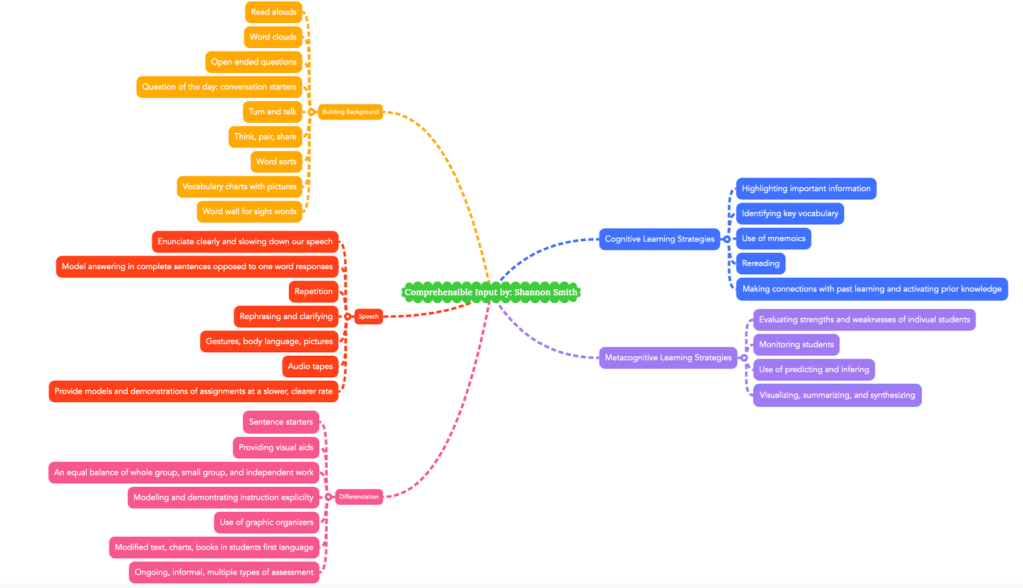
Week 4’s Discussion Board is constructing a mindmap of comprehensible input strategies AND connecting those to teaching strategies.
- Share the mindmap in your DB as a screenshot.
- Below a sample Mind Map from Mind Meister, a free mind mapping tool https://www.mindmeister.com/
- You need to include your name in the mindmap, title it, and show the connections of comprehensible input strategies to YOUR teaching IN your CLASSROOM.
- Make sure you include all sources in your mind map
- Give feedback on 2 of your peers’ mind maps.

Touro University TESOL Candidate Rachel Brielmeier is a certified teacher from B-6th grade general education and special education. She teaches in an 8:1:1 special education classroom and is completing her master’s degree in the TESOL program at TOURO College.

Touro University TESOL Candidate Shannon Smith pursues a master’s degree in TESOL at Touro University, Graduate School of Education. She is currently filling in as a leave replacement Kindergarten and First grade ENL teacher at Greenport Elementary School. Shannon Smith, “This mind map is a digital representation of all the different techniques and strategies I utilize in my own teaching to help support my ENL students.”

 Dr. J's Education Blog