

The opportunity to do this assignment and try out the Canva program was truly invaluable. I will be making many more and also introducing the app to my students as a possible research end product.
Adah Hirschfeld, Touro University TESOL Candidate
For EDPN 673 Methods and Materials for Teaching English as a Second Language TESOL candidates create an infographic.
Assignment Description: For this assignment, you will create an infographic for a specific group of learners (your audience). It is highly recommended that you create your infographic for the learners that you are currently teaching, or typically teach. You will know more about this group than other groups of learners, and are likely to have an easier time designing instruction for them. Integrating the infographic into one of the SIOP lessons is recommended.
Your project will be assessed on the following: Content: content is specifically tailored to ENL/ESL students for a specific grade level.
Focus: All content (visual and textual) concisely complements the purpose of the infographic.
Visual Appeal: Fonts, colors, layouts, & visual elements meaningfully contribute to the infographic’s ability to convey the overall message.
Argument: The infographic effectively informs and convinces the reader of its intended purpose.
Organization: Information is systematically organized and supports readers’ comprehension of the main message.
Citation: Full bibliographic citations are included for all sources referenced
Mechanics: The infographic is free of spelling or grammatical errors.
Adah Hirschfeld is a New York City Public School librarian who currently works at IS 240 in Midwood, Brooklyn. She holds a Master of Library and Information Science degree from Pratt Institute and a Master’s degree in School Administration from Touro College. She is pursuing certification in TESOL to better meet the language and literacy needs of her students.
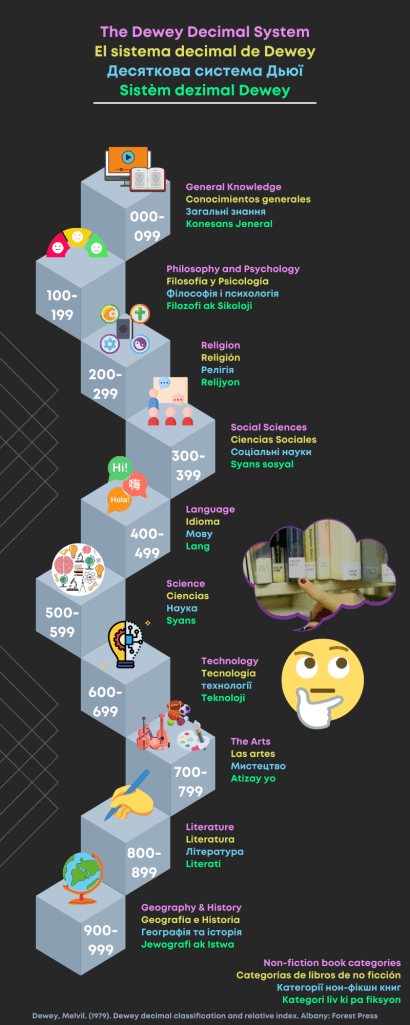
The Dewey Decimal System in English, Spanish, Ukrainian and Haitian Creole.
- WHY are you designing this infographic?
I wanted to make this to post in the library so students will be able to find the categories of non-fiction books easily. I give an orientation to all the new 6th grade classes in the fall and try to encourage and foster skill and provide materials that will make my students independent library users.
- HOW will this infographic serve MLs?
English, Spanish and Haitian Creole are the dominant languages in my middle school in Flatbush / Midwood, Brooklyn. I added Ukrainian because we had an influx of students when the conflict started and will have more Ukrainian speaking students in September.
- WHAT are you trying to point out, teach, focus on, or reinforce?
Non-fiction books in the library are organized and shelved according to categories or subjects. Students need to know where to find books to help them with their research or reading interests. The dewey decimal system also reinforces math skills and helps students become aware that many academic terms such as decimal can be used across subjects.
- WHICH language production is this infographic focusing on?
This infographic is focused on reading, but may lead to speaking discussion when explaining the system or sending students to find specific dewey numbers on the shelves.
- WHERE in your lesson plan will YOU be able to use this infographic?
This infographic can be used in the mini lesson. It can also be used for independent practice with a worksheet matching Dewey call numbers to subject headings / categories.

 Dr. J's Education Blog