
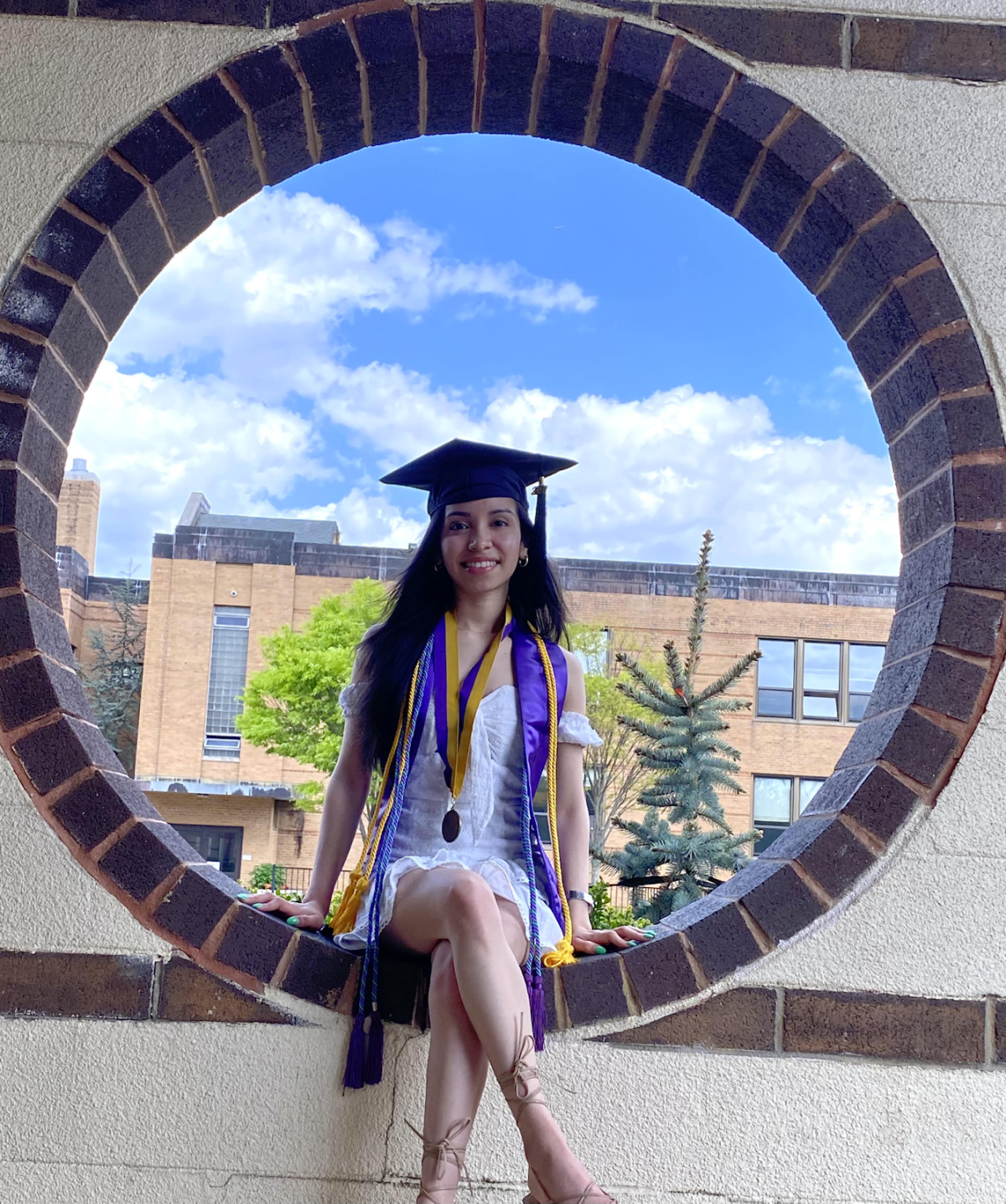
As a Professor for TESOL, I am immensely proud to feature outstanding student work from our MS in Teaching English to Speakers of Other Languages (TESOL) Program. New York’s linguistic diversity demands teachers who can find common ground and effectively communicate with students from different language backgrounds. Academically rigorous and practice-intensive, the 33-credit program includes 50 hours of fieldwork and supervised student teaching experiences. Candidates that complete all coursework, fieldwork, and student teaching requirements are eligible for recommendation for ESL certification.
Bio
Kenia Torres graduated summa cum laude from St. Joseph’s University in May 2022 with a Child Studies degree and a concentration in Speech Communication. She is currently pursuing her Bilingual Extension from Touro University. Kenia is a bilingual kindergarten teacher in the Brentwood Union Free School District in Brentwood, NY. She is certified in Birth-6th grade in general and special education. Kenia aspires to be a school leader in the future. She believes: “Our fingerprints don’t fade from the lives we touch.“-Judy Blume
My journey in Touro University has evolved my professional development and understanding of English language learners in the learning environment, to be an effective bilingual educator.
Kenia Torres, Touro University Bilingual Extension Candidate
- Discussion Board Question: How could the WIDA Can Do descriptors help you in choosing reading materials for teaching your ELL’s/MLs? https://wida.wisc.edu/teach/can-do/descriptors
Links to an external site.
The WIDA Can Do descriptors are an extremely useful tool to evaluate what language learners can do at various stages of language development. As a bilingual kindergarten tool, I can use the WIDA Can Do tool to supplement content instruction with activities that develop my students’ language learning at the same time. For instance, as depicted in the WIDA Can Do key, kindergarteners at the ELP Level 1, Entering, students should point to pictures described orally in context. Therefore, I can develop activities for my literacy centers that ask students to identify pictures from a story read aloud. This would be an appropriate activity for students at the Entering level according to WIDA Can Do.
- Discussion Board Question: How could the WIDA Can Do descriptors help you create differentiation for the reading assessment of your ELL’s//MLs?
The WIDA Can Do Descriptors can assist me in differentiating for the reading assessment of my ELLs/MLs as it gives me an accurate description of what language learners can do at their specific language level. For instance, a kindergarten student at the Entering level can point to pictures described orally in context. A kindergarten student at the Developing level can act out songs, chants, stories, and poems, with gestures as a whole group. Meanwhile as described in the WIDA Can Do key, a student at the Reaching level will be able to identify drawings or other visual displays from elaborate descriptions with details. Therefore, I can use this key to identify specific strategies and skills to assess my English language learners, dependent on their language level. - Discussion Board Question: Chapter 12: Use and upload (you can also take a photo) a graphic organizer of your choice to showcase five areas you would like to improve in your teaching of L2 reading that you have learned about in this chapter. Choose one thing at a time, and focus on improving that aspect of your teaching. Share with others what you are doing to become a better teacher of reading. Remember that it will take time to fully develop the ability to integrate improvements into your teaching. Celce-Murcia, Marianne; Brinton, Donna M.; Snow, Marguerite Ann. Teaching English as a Second or Foreign Language (p. 186). Heinle ELT. Kindle Edition


 Dr. J's Education Blog