Teaching Philosophy

20160831_134638Jasmin B. Cowin, Ed.D.

As a teacher and facilitator, I establish learning communities where we come to learn with each other and from each other in a collaborative process. Collaborative processes give rise to vibrant cultures of growth and development with the result of a harvest of student achievement filled with a growth mindset, mental flexibility, curiosity, risk taking and intrinsic motivation. My approach to teaching is student-centered with the aim to open the doors of knowledge not only empirically but emotionally as well. As a facilitator and ESL learner, I sat where my students sit today. Genuine sympathy and sincere empathy for their struggles, aspirations, successes and failures guide my teaching philosophy. My former ESL professor at Rice University (a life-time ago) gifted me her guiding quote on teaching ESL writing: Caelum video lussit, et erectos ad sidera tollere vultu (He bid them look at the sky and lift their faces to the stars.) Ovid.
Technology is changing the context of education. Cultivating digital literacy is an essential part of a writing course. In today’s workplace, digital literacy is essential. But teaching and learning should go beyond access to basic technology based tools. Students must learn to apply digital resources to creatively solve problems, produce innovative projects, and enhance communications to prepare for a career in any field. My writing courses encourage a dialogue between technological tools and students to achieve polished, in-depth pieces highlighting a mastery of analysis and form.
I reflected deeply on Driscoll’s (2000) definition of learning as “a persisting change in human performance or performance potential…[which] must come about as a result of the learner’s experience and interaction with the world” and rely on Siemens’s reflection (2005) on that definition; “[Driscoll’s] definition encompasses many of the attributes commonly associated with behaviorism, cognitivism, and constructivism – namely, learning as a lasting changed state (emotional, mental, physiological (i.e. skills)) brought about as a result of experiences and interactions with content or other people,” in the context of technology a modern, yet common sense approach in higher education classrooms. “Connectivism presents a model of learning that acknowledges the tectonic shifts in society where learning is no longer an internal, individualistic activity. How people work and function is altered when new tools are utilized,” and going on to say that, “the field of education has been slow to recognize both the impact of new learning tools and the environmental changes in what it means to learn. Connectivism provides insight into learning skills and tasks needed for learners to flourish in a digital era.”
Academic ability is not necessarily an indication of intelligence as talent is diverse. Often instructional methods are preoccupied with academic ability. I prefer a common-sense approach where the writer’s mind focuses on both the practical and analytical. Interactive, collaborative, and personalized instruction address the hopes and aspirations of nascent writers. I encourage diversity in writing with a broad curriculum to feed the spirit; writing about issues which resonate; fostering creativity in the writing process while embracing and consistently applying essential cornerstones of the writing process.
Beyond grammatical skills, writing a college-level essay requires the following: a thesis; factual support; and clear lines of logic to link the factual support into arguments either supporting or refuting the thesis. Regardless of the topic; from art to business, from journalism to international relations; any compelling essay will require these elements. Therefore, in our essays classes use Google based fact sheets to scaffold their arguments and delineate thinking in a clear, organized method. These personally developed Google instruments provide writing exercises through which students can concentrate on the logical components of the writing process by choosing relevant facts, analyzing them, and developing clear arguments based on such facts. This fosters a writing approach which lends itself to writing across disciplines. Our elevator pitches focus on the topic and infuse the course with real-life presentation experience using various technology suites while simultaneously fostering fluency, strong delivery and a sense of real-life application for ESL students.
The Experiential Learning Philosophy and authentic learning in a student-centered classroom are the cornerstones of my educational approach. My primary goals in teaching writing are: First, increasing students’ metacognitive awareness so that they better understand themselves as learners and enable students to take responsibility for their learning. Second, providing a clear lesson structure with objectives and aims for students. Third, improving students’ understanding of, and ability to accurately use English in speaking, writing and reading. My overarching goal is to develop communicative competence.

Connectivism, Siemens, and teaching in 3D Enviroments

This week I was struck by the Siemens’ article Connectivism: Connectivism: A Learning Theory for the Digital Age. Siemens states, ‘Informal learning is a significant aspect of our learning. Learning is a continual process, lasting for a lifetime. Technology is altering our brains => the tools we use define and shape our thinking.” I believe Siemens (p.8) makes an excellent point in relating learning theories and the impact of technology and new sciences => chaos and networks.

Again, I am looking at what this means in relation to teaching ESL and ELA in Virtual 3 D environments. My predisposition is the belief that learning is about to enter the “chaos and network” realm. Furthermore, the concept of “unbundling” colleges and universities might put much of learning online or into 3D environments, which is more aligned to hybrid constructivist – chaos approach where “learners create knowledge as they attempt to understand their experiences.”

VW’s strengths as learning platforms for English language teaching and training lie in their multinational, multiethnic, and multilingual set-up. “The organization and the individual are both learning organisms.” VW’s essentially are sandboxes for highly immersive experiential learning where almost any conceivable educational scenario can be simulated and carried out. In-World students often identify strongly with their alter-ego avatar. Avatars can manipulate and use objects while socially networking in a 3D environment. With an alter ego buffering the self-conscious hurdle of fluency practice participants are more likely to speak to peers and mentors, join or form groups to meet like-minded persons, seek out casual conversations and enjoy educative congregating such as coffee house socializing, fire-pit talks or rezzing in to meet new group members for hang-outs.

Hodges notes:

Conversations depend on action-perception systems operating in dialogical arrays to orient us to the ecosystem and to identify its goods, and the directions in which we might go to realize them. Language, thus rendered, is a values-realizing activity, one that allows us to engage in the moral tasks of caring for others, ourselves, and the ecosystem within which we all live. (Hodges 2007b, p. 602)

Again this points to  networks, an interconnected world and “decision-making itself [as] a learning process” (Siemens p.5)

Once participants become comfortable in their virtual learning environment, they experience VWs as places that enable both native and non-native interaction with a potential for community building and Virtual World –> Real World (RW) carryover. Particularly favored features are instantaneous virtual traveling (teleporting) to a variety of locations on SL, the existence of support groups and forums for formal and informal learning, all of which enable L2 language acquisition through innovative experiences.

L2 is furthered not only through voice communication and interacting with a broad range of accents, pronunciation, and language usage but also through lectures, presentations, RL-like lessons, team teaching, collaborative projects, quests, storytelling, games, and roleplaying. Other favorite activities include holodecks with instant simulations focusing on situation-based learning, which potentially leads to higher retention due to word, image, action and experience association. Speed writing is inadvertently practiced through in-world blogging, twittering such as BlogHUD and SLTweets with choices of private versus public text. VW’s encourage volunteerism with eagerness to participate and connect to RW supplemental experiences such as web 2.0, are opportunities for introspection, self-examination, observation of others, and the ability to log out at any time => self-organized, controlled experience.
In VW’s there is a new orientation and (de)evolution of the teacher status as hierarchy has no place in VW, all are learners. The teacher’s role becomes that of a “facilitator” of both content and process. In the content area tasks, subjects, problems are being addressed while in the process area it is the how which is being addressed. Procedures, format, tools, style of interaction and group climate play a significant role in enabling students to interact and reach their fullest potential. So facilitator-teachers essentially become guides or discussion leaders. The process of facilitation is a way of providing leadership without taking the reins. A facilitator’s job is to get others to assume responsibility and take the lead. I believe this reaffirms “Chaos,” as the “cryptic form of order” – the connection of everything to everything section in Siemens Alternative Theory part (p. 4)

Skepticism for professional ESL teachers centers around possible gung-ho adoptions of lessons, an undefined SL learning curve due to a lack of clear objectives since most of the learning arises from self-determined experiences.Other issues center around confidentiality (recording chat), certified vs. non-certified teachers who have various linguistic backgrounds, reliability, and other collaboration difficulties, plus no apparent dominant standard such as American, British or ‘Globlish.’ In his article “Rethinking Language Learning: Virtual Worlds as a Catalyst for Change,” Dongping Zheng of University of Hawaii cautions “that many educators simply apply their classroom approaches in the virtual space, treating the environment merely as input.”

In my interpretation of this quote, this means that ESL teachers try to transfer their Behaviorist or Cognitive teaching approaches into the Chaos and Networking Reality – an unsuccessful approach which does not work in a 3D environment.

I believe that Virtual World – 3 D learning will one day become a standard tool in the 21st Century classroom, especially with the rise of 3D technology. However, there is a tendency in educators, particularly administrators, to look for a panacea. As virtual world technology strengthens, some will look to these virtual worlds with just such an eye. Sydney Papert and the predictions he made in Mindstorms asserts that we are “…indeed in the world of the future, a world where connectivity spawns creativity, where the ability to transcend barriers to communication and to spread seeds of growth and knowledge has been enhanced to a point almost beyond comprehension just thirty years ago.”

Virtlantis self portrait.PNG

Issues and Concerns in VW Learning

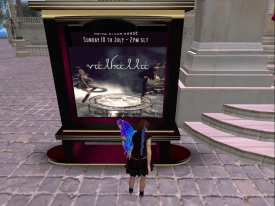
royal-opera-house-sl_001Several issues regarding VW participation and learning are concerning. The first set can be called technical concerns for both facilitators and users. A standard issue is platform difficulty and a steep learning curve if this is a new teaching environment. In addition, there are platform performance and technical disrupters such lag. Other issues center around digital native vs. digital immigrant, non-commercial vs. commercial areas. Skepticism for professional ESL teachers center around possible gung-ho adoptions of lessons, an undefined SL learning curve due to a lack of clear objectives since most of the learning arises from self-determined experiences. Other issues center around confidentiality (recording chat), certified vs. non-certified teachers who have various linguistic backgrounds, reliability, and other collaboration difficulties, plus no apparent dominant standard such as American, British or ‘Globlish.’

Error corrections in VW’s are another minefield. Esl facilitators must think about active vs. passive correction, dealing with typos and missing punctuation, text manipulation, the absence of dynamic text, net and SL lingo which features abbreviated vs. non-abbreviated language.VW students favor pro-text, be anti-voice vs. pro-voice, anti-text, or adopters of both. Also, multiple language levels, needs, learning styles must be factored into the VW activities against the background of sometimes problematic concurrent communication with natives and non-natives. Determining teaching format and ideal group size (1-to-1, small, 5-10, large, 10 +) and set-up of groupings can be a challenge as the VW landscape is a fluid one. Also, when designing VW activities in-world content such as grammar exercises copyright vs. creative commons need to be vetted.

Turtle Academy Discovered

Click me for a video on: The Crazy Octagon Project

What I learned this week in Turtle Academy was a better understanding of angles and being able to change established codes to create something a bit different regarding color, size, and speed.  Really, the most important thing was the understanding about angles.   Seeing the angles drawn out after giving a command created a connection between formal knowledge and a personal activity.

However, at this point, I have Scratch, beginnings of HTML, some commands in Java for my Creating in Code for the Lily pad and Turtle Academy.   It’s too much at the same time. Every one of these tutorials uses a different format and doing three to four of these programming languages simultaneously creates terrible confusion.  While the concepts are the same, the commands seem very different.

So far, Turtle was the best fit for me so far and the most fun.  I can see what I am doing and love the Turtle.  Papert in his book Mindstorms (p.57)  speaks about identification with the Turtle.  I even made the same mistakes as the child (on p. 61) with drawing a house and the triangle was inside.  This syntonic learning resonates very powerfully because I can see what it is that I am doing.  For me, the most difficult part has always been a lack of spacial perception.  Once I grasped the principle of how to do a triangle creating the square became easier.  I then started looking in Turtle Academy for similar scripts to see if I could spot them. I could.  Then I moved on to look Octagon scripts again, it all started to make sense.  Manipulating the code showed me instantly what would happen.

The biggest Aha moment came when I read in Papert (p.67)  that Euclid defined the characteristic of a circle the constant distance between the point on the circle and a point, the center, that is not itself a part of the circle.  I got that immediately!

Implicit Assumptions, Constructivist Approaches, and Folk Pedagogy


 by Jasmin Cowin, Ed.D.

After reading Bruner and his Folk Pedagogy paper, I thought about what the essence of teaching is. I came to the conclusion that teaching is, fundamentally, a noble endeavor. Teaching has far reaching consequences for those whom we code-week-2teach. As teachers, we make decisions and take actions on behalf of others. We shape how our students develop a particular view of the world because we are entrusted to promote a worldview that is consistent with social tenets of rightness and wrongness, goodness and badness. However, as Bruner analyzes in depth the meaning of “folk pedagogy,” he speaks about instructors and their “implicit assumptions.” Those assumptions influence and shape the teaching of children (students). In Bruner’s opinion, much of formalized und informal teaching is determined to a great extent by those “implicit assumptions” which can hinder the “meaning-making” by students. I believe Bruner favors a constructivist approach where learners grasp at understanding, and some ideas appear. He details this natural learning process and knowledge acquisition in “The Gears of my Childhood.”

Virtual Worlds as Learning Platforms

VW’s strengths as learning platforms for English language teaching and training lie in their multinational, multiethnic, and multilingual set-up.  They essentially are a sandbox for highly immersive experiential learning where almost any conceivable educational scenario can be simulated and carried out. In-World students often identify strongly with their alter-ego avatar.  Avatars can manipulate and use objects while socially networking in a 3D environment. With an alter ego buffering the self-conscious hurdle of fluency practice participants are more likely to speak to peers and mentors, join and/or form groups to meet like-minded persons, seek out casual conversations and enjoy educative congregating such as coffee house socializing, fire-pit talks or rezzing in to meet new group members for hang-outs.

Generally, participants experience VW’s as less intimidating places which enable both native and non-native interaction with a potential for community building and Virtual World –> Real World (RW) carryover. Particularly favored features are instantaneous virtual traveling (teleporting) to RW locations in SL, the existence of support groups and forums for formal and informal learning, all of which enable L2 language acquisition through experimental experiences.