by Jasmin B. Cowin, Ed.D.

Full Moon Germany by Jasmin B. Cowin

Johannisfeuer midsummer festival Bretten Germany by Jasmin B. Cowin
You had a great relationship with your man. You knew his faults, joys, and foibles but despite your great love for him he moved on. A bit of time passed and you are starting a new relationship, but your apartment is still stuffed full of mementos: his shaving kit, the shopping lists, holiday mementos and clothes. It’s time to do a full clean-up. Packing the stuff up and moving it into the basement is no help as you are still holding onto bits of his physical being. As long as that box is in the basement you are holding on to parts of him. Best to pack it up and send the items on their way. The same holds true for uninstalled programs which leave a residue and may interfere and glitch new or updated programs or releases.
Think about your first serious update. For me, it was Windows 10. After hesitating for months, I finally took the plunge and updated. Windows 10 requires new and different interactions. Items are located in different places and might have a different name. A lot of personal time was spent in this new environment exploring, reacquainting myself with features that had moved, plus there were new features too. Oh, how I longed for the look and feel of my old Windows, my former friend.
Then came the notice that Firestorm had updated to a new version that I needed to install to be inworld. Having dealt with Windows 10 and the personal hunt for files that had “disappeared,” I went on the net and did some research before hitting the Firestorm install button. The advice was: Do the uninstall first, clearing your computer of the former version, just like cleaning out your apartment before your new love comes over. Essentially, one creates a clean slate.
On the Phoenix clean Phoenix clean reinstall I was directed to:
Uninstall All Viewers
The steps given below refer to Phoenix specifically, but please do the same for all viewers you currently have installed, to ensure that you have no corrupted data that a new install of Phoenix might pick up.
Windows
You may use the Add/Remove Programs panel to remove Phoenix, or simply delete the entire installation folder. This is typically located C:\Program Files\Phoenix Viewer. You will be left with the folder in the Start menu, however. Which is why it is preferable to uninstall as previously described. This is the way all other Second Life viewers should be uninstalled.
I watched the youtube clips and went ahead. Indeed, I uninstalled and reinstalled but not with the desired results. I could not find Jokaydia Grid any longer. Multiple attempts to regain access were unsuccessful. The underlying assumption is that people in the general population understand tech jargon and have deeper skills sets than reality bears out. According to Sally Bisaccio, my tech guru and independent study advisor at Marlboro College for Graduate and Professional Studies, “there isn’t the support for glitches and malfunctions at a level that people may need. This sometimes leads to frustration, particularly when you unwittingly pursue avenues leading to dead ends – kind of like a rabbit hole.” Sally was right. By midnight, unable to gain access, I had disintegrated into a frustrated, quivering, angry zombie, experiencing a personal Mindstorm leading me into the vortex of Dantes Circles of Hell, Level 6, the City of Dis, Satan’s wretched city where one beholds a wide plain surrounded by iron walls and fields full of distress and terrible torment.
I survived the night and woke up the next morning thinking about technology and ESL teachers. ESL teachers preparing to enter the OpenSym Grids for teaching and content delivery enter a fluid and constantly changing landscape of technical requirements and system updates. The worlds and content within are well worth the time spent on mastering inworld adventures but I really recommend having either a natural aptitude for computers, solid knowledge of operating systems or a special computer buddy to whom to turn to. Your best buddy could be your teenager loafing around on the couch watching reruns of Gravity Falls.




 Center for Learning and Living
 his multi-media lecture examines Carmen, a major opera character, dismissed by contemporary critics as a “prostitute of the gutter,” “wild animal” and “cynical harlot.” Featuring excerpts of performances, we explore several questions: can Carmen be diagnosed as a Malignant Narcissist or is she the early embodiment of the modern, sexually emancipated woman? Is her lover Don José what psychologists call “narcissistic food”? Is she an appealing predator or a victim? Does the audience experience what Aristotle described as “a purging of the spirit of morbid and base ideas or emotions by witnessing the playing out of such emotions or ideas on stage”?
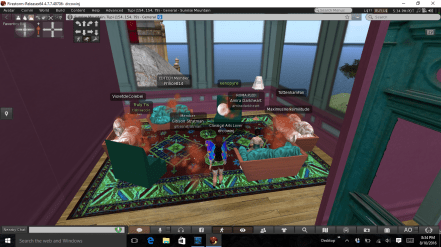
 The last few weeks I spend taking care of my mother, traveling on occasion and exploring virtual worlds and their possibilities in the teaching profession. The goal of the course was to expose us, a group of students at Marlboro College for Graduate and Professional Studies to the relevance of virtual worlds for real-world learning environments.


 Dr. J's Education Blog