
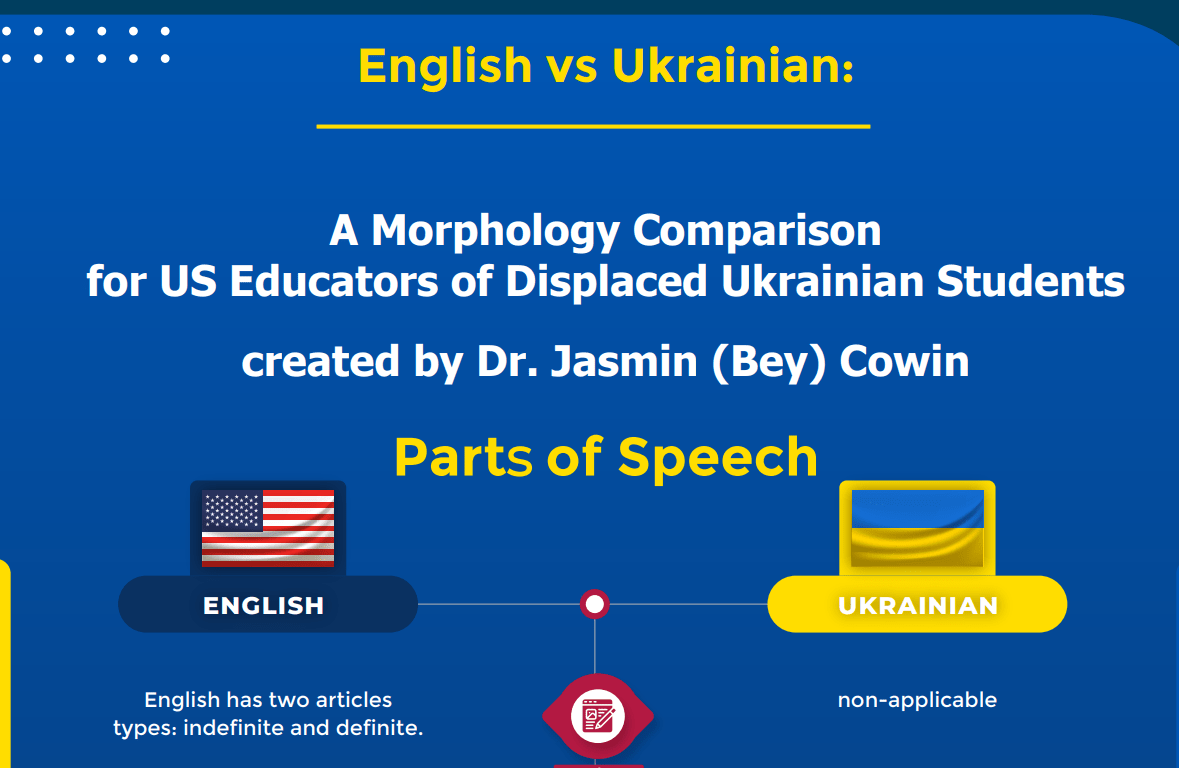
by Dr. Jasmin (Bey) Cowin
To support teachers working with Ukrainian students, I prepared this grammar resource for teachers and students alike to showcase a morphology comparison between Ukrainian and English parts of speech. Morphological awareness has been related to literacy development including vocabulary development and reading comprehension (Ke & Xiao, 2015).
I believe that developing morphological awareness across both languages, enables both teachers and Ukrainian students to use their linguistic repertoire across languages and benefit from their multilingual resources.
Dr. Jasmin (Bey) Cowin
In addition, Translate Google is a useful tool for basic translations. Feel free to share my resource!
As displaced Ukrainian families are dispersing out across the country they are finding refuge with family, friends, and volunteers and enroll their children in school. In New York, the Mayor’s Office of Immigrant Affairs (MOIA) Commissioner Manuel Castro launched New York City’s Ukrainian Response Initiative in June 2022, to help currently residing and newly arrived Ukrainian New Yorkers access immigration legal assistance, translation services, social services, and other resources. Information on how to access services provided through this initiative can be found on nyc.gov/ukraineresources or by calling NYC’s immigration hotline at 800-354-0365.
New York State officials estimate New York will need more than 180,000 new teachers in the next decade, however, the teacher shortage is already hitting selected subject specialties and geographic areas. According to NYSUT, New York reports persistent shortages in teachers for special education, bilingual education, English as a Second Language, science, mathematics, English Language Arts, social studies, world languages, career and technical education, health education, literacy and library science.
Touro University’s TESOL and bilingual certificate programs prepare NYS-certified teachers to provide responsive, comprehensive education to students of every background.
What You’ll Learn
The 15-credit program includes five courses—each with carefully designed fieldwork experiences—that emphasize both academic content learning and English fluency for English Language Learners.
We explore contemporary theory and research-based instructional strategies for multicultural education, methods and materials for second language acquisition, and best practices for teaching ELLs in specific subjects. We give you the tools to ensure that your students meet the latest performance standards of PreK-12 curricula in both private and public schools.
Courses are offered evenings and Sundays, and online to accommodate our students’ diverse scheduling needs, and you’ll receive personalized guidance based on your current work and career goals from highly qualified and experience professors.
Upon completion of the program, you’ll be eligible for the New York State Advanced Certificate in ESOL. All courses are transferable to the master’s degree program in TESOL at Touro College.
Admissions Requirements
In addition to general requirements, applicants must provide proof of initial or professional teaching certificate, as well as 12 credits of foreign language study or a passing score on a CLEP examination. Students who have not satisfied the foreign language studies requirement may be admitted to the program, but with the understanding that they must satisfy this requirement as soon as possible and prior to graduation.
Contact us to learn more about our advanced certificate and master’s programs.
References:
Ke, S., & Xiao, F. (2015). Cross-linguistic transfer of morphological awareness between Chinese and English. Language Awareness, 24(4), 355–380. doi:10.1080/09658416.2015.1114624 [Taylor & Francis Online], [Web of Science ®], [Google Scholar]

 Dr. J's Education Blog