

EDDN 635 Curriculum Development and Classroom Management in the Technology Era
This comprehensive course builds upon the foundation of curriculum development and classroom management in the context of teaching English language learners. Expanding its horizons to embrace the digital age, the course adeptly weaves innovative technology integration into the domain of Teaching English to Speakers of Other Languages (TESOL). Crafted to empower prospective TESOL/BLE educators, the course hones in on fostering competence in designing, implementing, assessing, and reflecting within diverse language learning environments, all while capitalizing on the potentials of cutting-edge technology. With a strong focus on practical application and discerning appraisal of technological tools, this course primes upcoming educators to excel amidst the ever-evolving educational landscape. Includes 10 hours of field work.
Personal Opinion: Pedagogical Value of Discussion Boards in Online Courses
I utilize discussion boards as essential scaffolding tools in my online courses at Touro University, providing multilayered support for my master’s degree candidates’ academic development. These course discussion boards function as preparatory spaces where my teacher candidates can practice academic writing conventions, develop critical thinking skills, and experiment with disciplinary discourse before tackling more substantial assignments such as research papers or presentations. Through regular posting requirements, my candidates create meaningful artifacts that demonstrate their evolving command of academic English and pedagogical understanding, including proper APA citation practices which prepare them for graduate-level academic work. The iterative nature of discussion board participation allows me to track my candidates’ linguistic and academic progress throughout the semester, giving me valuable opportunities to observe candidate growth over time and identify when coaching sessions are needed if I notice disconnects between course materials and student responses. Additionally, peer response activities foster collaborative learning and provide authentic audiences for feedback exchange on their larger assignments. Using discussion boards to introduce emerging technologies such as mind mapping tools, multimedia integration, and collaborative platforms helps prepare my teacher candidates for 21st-century classroom instruction and professional communication demands. I believe, that this scaffolded approach ultimately bridges theory and practice while allowing me to provide targeted, individualized support based on ongoing assessment of candidate performance. Madison Derwin submitted an exemplary Discussion board in EDDN 635 Curriculum Development and Classroom Management in the Technology Era and permitted me to share it.
Madison Derwin, holds a Bachelor’s Degree in Inclusive Childhood Education from SUNY Cortland. She currently pursuing a Master’s Degree in TESOL at Touro University while working as a 4th-grade Teacher’s Assistant at an elementary school on Long Island. Her goal as an educator is to create an inclusive, supportive learning environment that empowers every student to reach their full potential and thrive both academically and socially. Her motto is “I’m not telling you it’s going to be easy- I’m telling you it’s going to be worth it.” – Art Williams
Module 3 Discussion Board 3 by Madison Derwin
- Try out Wakelet https://wakelet.com/explore
As a teacher’s assistant in a 4th grade classroom, planning and collaborating with my teacher ensures consistent support for our students’ learning needs. Together, we align lesson goals, share resources, and coordinate instructional strategies to create a fun and engaging environment. Because of this, I chose to focus my Wakelet on the math unit that we just recently finished. The collection includes the four lessons that were learned throughout the chapter. Within each one is a YouTube mini lesson video, a reteach worksheet, and an enrichment worksheet. This is going to best support our students by providing them with additional resources to help them to study for the upcoming exam.
https://wakelet.com/wake/jsZ2OlinRlfYujy77p_EN
- Outline the process of aligning a TESOL curriculum with state and national standards as demonstrated in the Newburgh, NYS Curriculum Map using a mindmap tool such as FIGMALinks to an external site. or LucidChart.Links to an external site.
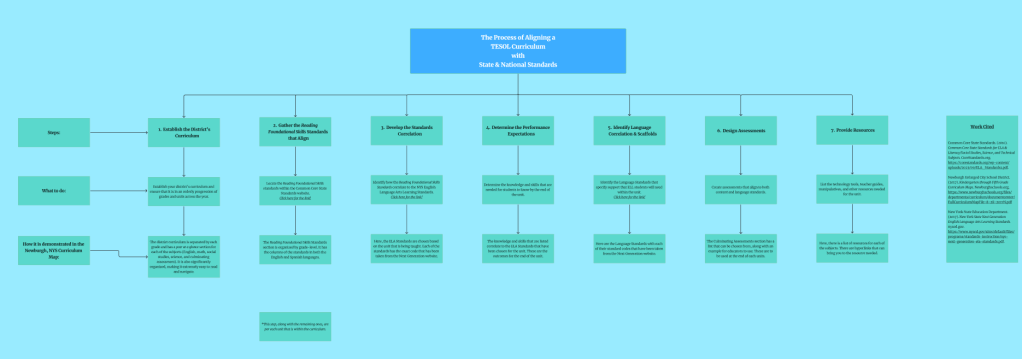
Discuss the English Learner Education Collaboration Tool (PDF is provided in the course). How might this tool help you with your Curriculum map? Be specific!
The English Learner Education Collaboration Tool is a guide that is designed to help educators work together to support English learners in both language and content learning. I believe that its main goal is to offer a framework that integrates the WIDA English Language Development Standards into daily lesson planning. The WIDA Standards “can help you [educators] integrate language development and content learning that is suitable to the grade level and the various English language proficiencies of your students” (WIDA, 2025). The Collaboration Tool addresses three essential questions, such as how to teach language and content at the same time, which language skills to prioritize with limited time, and how language and content teachers can collaborate using shared language and processes (DESE, 2025). There are thinking spaces that are divided into two categories: Language for Learning, Thinking, and Being; and Developing Unit-Level Focus Language Goals. The first Thinking Space is about guiding educators to set learning goals, gather evidence, plan for teaching, and plan for student activities. The other Thinking Space connects language goals with content standards.
I believe the English Learner Education Collaboration Tool might help me with my Curriculum Map by providing me with a practical framework to integrate meaningful language supports as well as academic content. The tool focuses on combining language development and content learning together, not separately. I am looking forward to seeing how I can use this knowledge while working on my curriculum map while addressing both areas. I can also align my curriculum map with the WIDA standards and proficiency levels, as they will assist me in checking in to ensure that my curriculum map matches the language skills my students are learning.
- Discuss the following curriculum analysis and think about how you might do your curriculum analysis. Think about which curriculum you might use for YOUR analysis. (Curriculum analysis example provided in the course)
Personally, I believe that the following curriculum map analysis has many strengths and areas for improvement. For example, the curriculum analysis provided correlates to the Next Generation ELA Standards while integrating the topic of science to reinforce literacy skills. Although the standards are connected to assessment tasks, they are not WIDA or proficiency level aligned. I feel like if the standards were WIDA aligned, then the student who analyzed this curriculum would have had an easier time combining language development and content learning together and not separately. Second, this curriculum analysis does use phenomena-based learning and incorporates multiple learning methods to enhance understanding. This provides support for Multilingual Learners. One thing that I would change within this analysis is the use of technology. There are some digital tools that were mentioned, however expanding the integration of technology could boost learning beyond the classroom. When it comes time for me to start on my curriculum analysis, I am going to align my standards to WIDA as well as include multiple and different uses of technology for my students to use. For my analysis, I am thinking of using the Personal Identity unit that is part of my 4th grade curriculum.
References:
Common Core State Standards. (2010). Common Core State Standards for ELA & Literacy/Social Studies, Science, and Technical Subjects. CoreStandards.org.
https://corestandards.org/wp-content/uploads/2023/09/ELA_Standards1.pdf.
Department of Elementary and Secondary Education (DESE). (2025). English Learner Education Collaboration Tool. Doe.mass.edu. https://www.doe.mass.edu/ele/instruction/.
Newburgh Enlarged City School District. (2017). Kindergarten through Fifth Grade Curriculum Maps. Newburghschools.org. https://www.newburghschools.org/files/departments/curriculum/documentcenter/FullCurriculumMapFile-8-28-2017N.pdf
New York State Education Department. (2017). New York State Next Generation English Language Arts Learning Standards. nysed.gov.
https://www.nysed.gov/sites/default/files/programs/standards-instruction/nys-next-generation-ela-standards.pdf.
WIDA, University of Wisconsin-Madison. (2025). Teaching with Standards. WIDA. https://wida.wisc.edu/teach/standards.

 Dr. J's Education Blog