
By Dr. Jasmin (Bey) Cowin
The five-stage Affix Word Tree Action Guide is not a standalone vocabulary exercise. It is, in fact, deeply grounded in the evidentiary base that constitutes the Science of Reading (SoR), a body of converging research drawn from cognitive science, linguistics, and educational psychology that identifies the foundational competencies required for skilled reading. Situating this instructional framework within SoR principles strengthens its theoretical legitimacy for ESOL, ENL, EFL and TESOL teacher candidates working across multilingual, K-12, and adult literacy contexts.
Morphological Awareness Within the Science of Reading
The Science of Reading is frequently organized around two overarching constructs: word recognition and language comprehension (Scarborough, 2001). Scarborough’s (2001) multistrand model of reading development identifies morphological knowledge as a contributing thread within the language comprehension strand, alongside background knowledge, vocabulary, and syntactic awareness. The Affix Word Tree Action Guide directly addresses this strand by systematically building learners’ capacity to recognize how morphological structure signals both meaning and grammatical function.
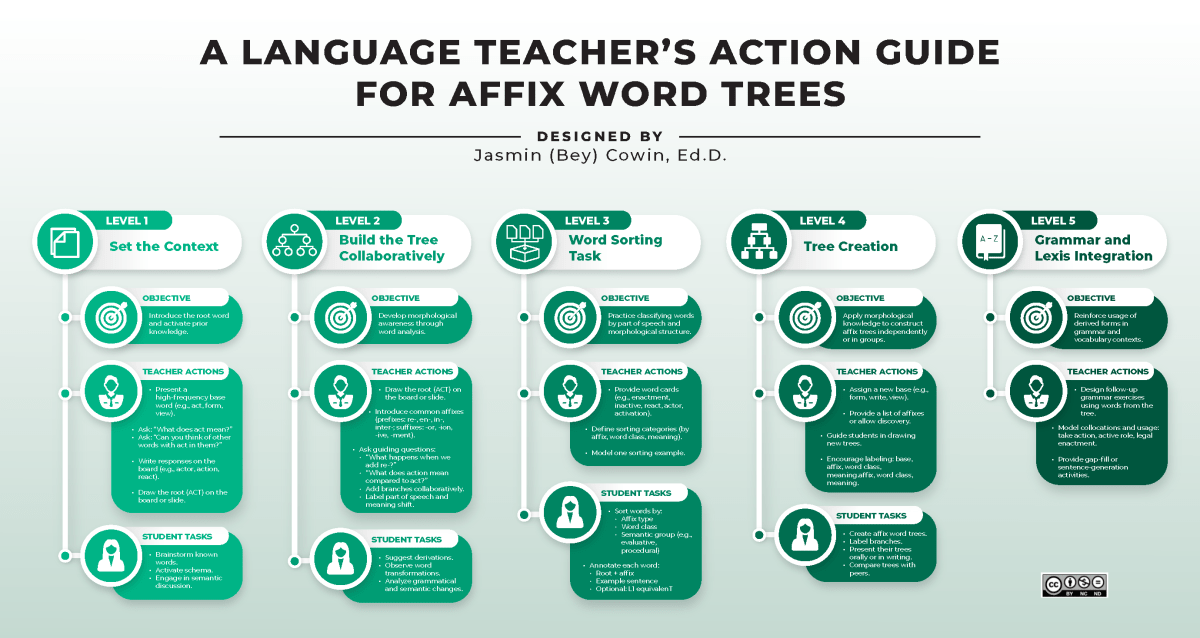
The infographic presented constitutes a structured pedagogical framework designed to scaffold morphological awareness instruction within second language acquisition (SLA) contexts. Drawing on foundational research in vocabulary development, particularly Nation’s (2001) lexical approach and Bauer and Nation’s (1993) taxonomy of English word families, this five-stage action guide operationalizes affix word tree methodology as a systematic instructional sequence rather than an incidental classroom activity.
Morphological awareness, defined as the explicit knowledge of how meaningful units (morphemes) combine to form words, has been consistently identified in the literature as a robust predictor of reading comprehension and productive vocabulary growth among English language learners (Kieffer & Lesaux, 2008; Tyler & Nagy, 1989). Yet despite this evidence base, morphology instruction remains underrepresented in many TESOL classrooms, often displaced by communicative fluency activities or decontextualized vocabulary lists. This action guide directly addresses that pedagogical gap.
Each stage in the framework reflects a deliberate progression from receptive recognition to productive application, mirroring the input-to-output continuum foundational to Swain’s (1985) Output Hypothesis. Stage 1 activates prior lexical schemata; Stages 2 and 3 engage learners in collaborative analysis and categorization; Stages 4 and 5 shift agency to the learner, requiring both generative tree construction and grammatical integration of derived forms.
As ESOL/ENL/EFL educators, you might engage with this infographic in two ways. First, analyze each stage as a principled instructional decision, noting how teacher actions and student tasks are deliberately aligned. Second, you are invited to consider how this framework might be adapted across proficiency levels, L1 backgrounds, and disciplinary content areas, recognizing that morphologically rich instruction is not a one-size-fits-all intervention but a flexible, evidence-informed repertoire. The integration of part-of-speech labeling, semantic analysis, and L1 equivalence in Stage 3 reflects an additive, translanguaging-informed stance toward linguistic diversity in the multilingual classroom.
This framework is offered not as a rigid script but as a visualization or thinking tool, one that makes the invisible architecture of English word formation visible, learnable, and teachable.
References
Bauer, L., & Nation, I. S. P. (1993). Word families. International Journal of Lexicography, 6(4), 253–279. https://doi.org/10.1093/ijl/6.4.253
Kieffer, M. J., & Lesaux, N. K. (2008). The role of derivational morphology in the reading comprehension of Spanish-speaking English language learners. Reading and Writing, 21(8), 783–804. https://doi.org/10.1007/s11145-007-9092-8
Nation, I. S. P. (2001). Learning vocabulary in another language. Cambridge University Press.
Scarborough, H. S. (2001). Connecting early language and literacy to later reading (dis)abilities: Evidence, theory, and practice. In S. B. Neuman & D. K. Dickinson (Eds.), Handbook of early literacy research (pp. 97–110). Guilford Press.
Swain, M. (1985). Communicative competence: Some roles of comprehensible input and comprehensible output in its development. In S. M. Gass & C. G. Madden (Eds.), Input in second language acquisition (pp. 235–253). Newbury House. https://www.scirp.org/reference/referencespapers?referenceid=1501919
Tyler, A., & Nagy, W. (1989). The acquisition of English derivational morphology. Journal of Memory and Language, 28(6), 649–667. https://doi.org/10.1016/0749-596X(89)90002-8

 Dr. J's Education Blog