Why EDDN 637 Now Integrates the Science of Reading
Jasmin Cowin, Associate Professor, Touro University, GRE, TESOL/BLE Department | Path Forward Grant | PI: Dr. Seong Kim
New York is moving evidence-based literacy from professional judgment into regulatory expectation. Education Law §818 requires an annual review of district curriculum and instructional practices in reading for prekindergarten through grade three, with attestation to the Commissioner. In December 2024 the Board of Regents amended Section 100.3 of the Commissioner’s Regulations, and districts verified alignment by September 1, 2025. In July 2026 the Department introduced a proposed amendment of Sections 52.21 and 80-3.7 at the Board of Regents meeting. Teacher preparation programs in early childhood education, bilingual education, English language learners, literacy, and students with disabilities would be required to align their instruction with the State’s science of reading framework. Candidates would devote a portion of field experience and student teaching to evidence-based literacy instruction and to assessing students with reading challenges. A public comment period is underway and Board approval is anticipated in November.
Sources: NYSED, Elementary Requirements (Section 100.3): districts shall verify alignment of prekindergarten through grade three reading curriculum and instructional practices with the Commissioner’s instructional best practices on or before September 1, 2025, pursuant to Education Law §818 New York State Education Department NYSED, Prekindergarten-3rd Grade Literacy Instructional Best Practices Guide (§818 attestation) WXXI News, December 17, 2024: Board of Regents approval of the pre-K through grade three reading amendment Chalkbeat New York, July 20, 2026: proposed amendment of Sections 52.21 and 80-3.7 (https://lnkd.in/e3Pg9dQM)
EDDN 637 Second Language Learners and the Content Areas
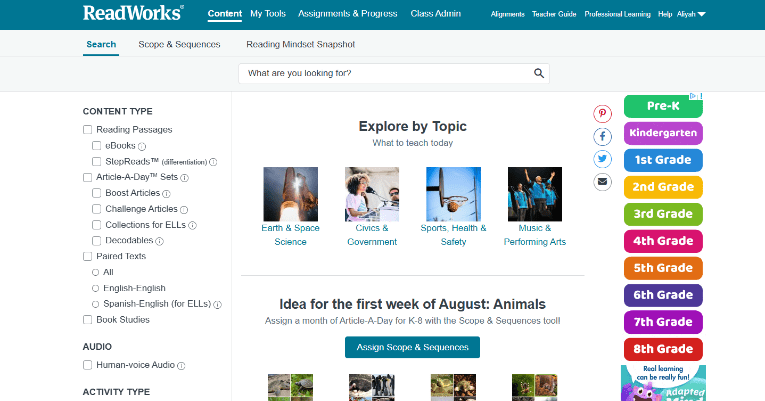
EDDN 637 – TESOL/BLE Department at Touro University responded through the Path Forward Grant with a module-by-module revision that preserves the SIOP architecture of the original Spring 2026 course while embedding reading research at each component. Module 1 opens with a mandatory Science of Reading survey establishing candidates’ baseline knowledge, which informs Lesson Preparation. Modules 2 and 4 add structured literacy to content and language objectives and to Comprehensible Input. Module 3 foregrounds oral language development and pathways to skilled reading under Building Background. Module 7 introduces phoneme segmentation, blending, and structured literacy assessment within Practice and Application. Module 9 adds Scarborough’s Reading Rope, ReadWorks resources, and a Diagnostic Decoding Survey so candidates can determine whether a reading difficulty originates in decoding, vocabulary, fluency, or language comprehension.
The alignment is deliberate since SIOP offers a framework for making content and academic language accessible, while the Science of Reading (SoR) explains the cognitive architecture that makes reading possible. Module 10 helps candidates distinguish second language acquisition needs from reading difficulties and disability-related needs, Module 11 introduces tiered instruction and infographic reflection, and Module 12 closes with a research reflection on skilled reading pathways. Candidates leave EDDN 637 prepared to plan, assess, and intervene using evidence, which is what New York now expects of them.
Conclusion via Candidate Evidence
Candidate work supplies the clearest measure of whether integration reached practice. In Discussion Board 5, Touro University TESOL Candidate Aliyah Giana Martinez in exemplary analysis of an informational text on trees built content and language objectives around the Big 6 components, vocabulary, and reading comprehension. She identified brick words carrying the domain-specific load of the text, including roots, trunk, branches, bark, crown, leaves, sap, stomata, flowers, and seeds, together with mortar words such as alive, grow, anchor, support, protect, and instead. The observation driving the plan was that brick words appear rarely outside scientific contexts, while mortar words surface across many contexts with shifting meaning, so both categories require explicit instruction before students encounter the text. Her differentiation plan drew on sentence frames, total physical response, shades of meaning, picture and audio support, and structured partner and whole-class discussion. Drawing on Herr’s The Sourcebook for Teaching Science, she designed labeled diagrams, comparison organizers connecting tree survival to human survival, a cumulative word wall, and a hands-on construction paper tree.
That construction paper tree is the realia outcome the course intends. Aliyah Giana Martinez moved from explicit vocabulary work toward comprehension of the text, then produced a tangible artifact that makes literacy learning visible and assessable. That construction paper tree is the realia outcome the course intends. Moving from explicit vocabulary work toward comprehension of the text, then producing a tangible artifact that makes literacy learning visible and assessable. The same theoretical learning carried into the fieldwork strands housed in Modules 10 and 11. Reporting from a placement classroom, a candidate documented lessons in which students reread familiar texts, read aloud individually, answered comprehension questions, discussed characters and events, and worked through new texts with teacher support. Her analysis was that word level skills and meaningful reading were being taught in connection with one another, so decoding work and comprehension work occupied the same instructional space. Ms. Martinez mapped these observations onto the SoR Pathways to Skilled Reading infographic introduced in Module 3, noting that skilled reading depends on word recognition together with language comprehension, and that students require explicit instruction in phonemic awareness, phonics, decoding, spelling, morphology, vocabulary, background knowledge, syntax, and comprehension. Locating each observed activity within that framework allowed her to read a single lesson as a set of identifiable components working together. Integration at the course level yielded observation, analysis, and application at the classroom level.
Aliyah Giana Martinez is of Chilean and Greek descent. She loves to travel, cook, and spend time outside going on adventures with her family and friends. She is a newly hired teacher who strives to support her students while learning from her colleagues in order to grow into the best educator she can be.
I am proud to feature her exemplary work in my blog!
Reading doesn’t just come to you, you have to be surrounded by people who believe in you and who will try a number of learning strategies with you to help you be the best reader you can be.
Aliyah Giana Martinez, Touro University TESOL Candidate
By Dr. Jasmin Cowin: Discussion boards are an effective starting point for a sequential introduction to the Science of Reading because they give candidates a low-stakes, asynchronous space to work through foundational constructs, such as vocabulary’s role within the Big 6, while grounding their analysis in authentic texts. As Ishrat Jahan’s Science of Reading Insights on Esperanza Rising demonstrates, candidates can practice applying frameworks like brick-and-mortar words, cite course readings, and articulate instructional moves in writing, which makes their conceptual understanding visible to the instructor while giving candidates choices in choosing their own texts.
In addition, the required peer responses build a professional learning community as candidates refine or even revise their thinking (e.g., reconsidering whether brick-or-mortar words pose greater challenges for multilingual learners) through dialogue with colleagues. This written, iterative format is ideal early in the semester because it requires careful reading, evidence-based reasoning, and academic language development before candidates are asked to perform pedagogically. Later in the semester, short video demonstrations are folded in because they require candidates to transfer theoretical knowledge into observable practice, such as explicitly teaching Tier 2 vocabulary in context, modeling phoneme-grapheme mapping, or demonstrating a decoding routine as they would with real learners.. This sequence from written analysis to recorded enactment ensures that candidates’ SoR knowledge is not merely theoretical but demonstrably applicable, mirroring the transfer from declarative to procedural knowledge that we expect them to foster in their own students.
Ishrat Jahan’s Bio: I earned my Bachelor of Science in Childhood Education with a bilingual extension in Bangla. Currently, I work in an elementary school dual-language classroom, supporting students from diverse cultural backgrounds and varying levels of English proficiency. To strengthen my ability to support multilingual learners and expand my professional knowledge, I am pursuing a master’s degree in TESOL at Touro University, where the flexible schedule and practical coursework have helped prepare me to better meet students’ academic and language needs.
“The Science of Reading has taught me that every child deserves instruction built on evidence, not assumptions. It also taught me that successful reading is not left to chance-it is built through explicit, systematic, and evidence-based instruction.”
Ishrat Jahan, Touro University TESOL Candidate
The DB question:
Vocabulary — The Fourth Pillar of the Big 6 Vocabulary is one of the Big 6 components of the Science of Reading and a critical lever for multilingual learner achievement. One practical entry point into vocabulary instruction is the Brick and Mortar framework, which helps teachers assess a text’s full vocabulary demand before teaching it. Select a short text from your text anlaysis. Analyze its vocabulary complexity by identifying the following: Brick words are specialized, content-specific terms essential for understanding the topic of the text (e.g., ecosystem, photosynthesis, denominator). These correspond to Tier 3 vocabulary in Beck, McKeown, and Kucan’s framework. Mortar words are the general academic and functional language that holds ideas together and supports comprehension across content areas (e.g., however, as a result, evaluate, in contrast). These correspond largely to Tier 2 vocabulary. Your post should include:
Your text excerpt, cited with author, title, and page number – you must use text you will be using for your text analysis assignment next week. A list of the brick words you identified and a brief explanation of why each is essential for comprehension of this text. A list of the mortar words you identified and the comprehension or reasoning function each one serves. A reflection on which word type poses the greater challenge for your multilingual learners and what one instructional move you would make before reading to reduce that barrier.
Connect your analysis explicitly to the Science of Reading component of vocabulary instruction and cite at least one course reading in your response.
Ishrat Jahan’s Science of Reading Insights in EDDN 637
Text excerpt: For my text analysis, I selected an excerpt from Esperanza Rising by Pam Muñoz Ryan. I focused on the “Los Melones” section. In this scene, Esperanza, Miguel, Isabel, and Marta discuss the separate labor camps and the unfair conditions faced by farmworkers. Marta explains, “We all live separate and work separate. They don’t mix us” (Ryan, 2000, p. 62). She later explains that workers may need to strike to have better conditions. She said, “They don’t want us banding together for higher wages or better housing” (Ryan, 2000, p. 62). In this part of the story, Esperanza is learning about the living and working conditions of migrant workers in California.
Brick words identified:
Wages: This word is important because it explains the money workers earn for their labor. Students need to understand wages to understand why the workers want better treatment.
Conditions: This word refers to the workers’ living and working situation. It helps students understand what Marta means when she says workers want “better conditions.”
Owners: This word refers to the people who control the farms and make decisions about workers’ pay, housing, and treatment. In this excerpt, the word “they” refers to owners. This word is important to know because it does not directly state that the word “they” refers to owners, and it is a pronoun that many students might not know about.
Housing: In this excerpt, housing refers to the cabins and living conditions provided to farmworker families. It helps students understand why the workers are unhappy and why they want change.
Strike: This word is especially important because it explains the action workers may take by refusing to work together to demand fair treatment.
These words are important because they are connected to the main social and historical issues of the story, including migrant farm work, poverty, and unfair living conditions. Without understanding these words, students may understand that the characters are upset, but they may not fully understand why the workers are separated or why they are considering a strike.
Mortar words identified:
Banding together: This word helps students understand the idea of workers joining as one group.
Separate: This word shows how the farm owners keep different groups of workers apart.
Higher: This comparison word shows that the workers want more pay than they currently receive.
Or: This word connects two possible needs: better wages or better housing.
Don’t want: This phrase helps students understand the motivation of the owners. The owners do not want workers to unite because they may ask for fairer treatment.
Better: This is a comparison word that helps students understand that the workers want improved wages, housing, and treatment.
Reflection:
I think mortar words may be more challenging for multilingual learners than brick words because they represent abstract, functional language rather than concrete objects. Brick words usually have a clear visual representation, while mortar words require students to understand logical relationships and cognitive processes that can not be easily pictured. Mortar words can also change meaning depending on the context. For example, students may learn words like wages, housing, and strike with pictures, examples, and student-friendly definitions. However, words and phrases such as or, higher, and banding together may be harder to teach because their meanings depend on the context. These words are less concrete, and students may not understand their deeper meaning without support. They show relationships, comparison, action, and motivation in the sentence. If students do not understand these words, they may not fully understand the context of the passage.
One instructional move I would make before reading is to use a simple cause-and-effect chart with visuals. I would write “Workers are separated” on one side and “They can not share information or organize for better wages and housing” on the other side. Then, I would introduce the sentence starter, “If workers join together, they might________.” Students would use the sentence starter to discuss their ideas. This would help students practice the mortar language while also preparing them to understand the problem of the text.
Connect your analysis explicitly to the Science of Reading component of vocabulary instruction and cite at least one course reading in your response.
Connection to the Science of Reading: This Brick and Mortar analysis connects to the Science of Reading because vocabulary is an important part of language comprehension. Both types of words are important for students to understand the context of the text. For example, students need to understand brick words such as strike, wages, and housing, but they also need mortar words such as or, higher, don’t want, and better to understand the relationships and conflicts of the text. Multilingual learners may find Mortar words challenging because they are less concrete and show cause, effect, comparison, and motivation. Before reading, I would use visuals and sentence starters, such as “The owners keep workers separate because________,” to help students practice these words in context. This supports vocabulary instruction because students learn both the meaning of the words and how the words work together in a sentence. This connects to Lesaux and Galloway’s (2017) point that “word knowledge develops for students as they connect what they know about a word, in any language, with new information being taught” (p.4). Before reading, I would encourage students to connect these words or ideas to what they already know in their home language.
Links to an external site.to discuss how explicitly teaching vocabulary can enhance multilingual learners’ comprehension and engagement with complex texts.
Teaching vocabulary explicitly can enhance multilingual learners’ comprehension and engagement with complex texts because it gives them access to important words before those words become barriers to comprehension. Sandora (2023) explains that traditional activities, such as looking up definitions, may only create a “superficial understanding” of words instead of the deeper knowledge students need to understand a text. To help students understand complex texts, teachers should explicitly teach important Tier 2 and Tier 3 words, especially for multilingual learners. Teachers should use simple and clear language, student-friendly definitions, visuals, examples, cognates when appropriate, and repeated opportunities to use the words in speaking and writing. For example, before reading a complex text, I would introduce a few important words in context and ask students to discuss examples and non-examples with a partner. This would help students move beyond memorizing a definition and use the words to explain ideas from the text. As Sandora (2023) explains, students should interact with words in meaningful ways that “depend their understanding,” which can make them more confident and engaged when reading challenging text.
References
Echevarría, J., Vogt, M. E., & Short, D. J. (2017). Making content comprehensible for English learners: The SIOP model (5th ed.). Pearson.
Peer Response 1: I found your post interesting because you explained that brick words can also be challenging for multilingual learners. At first, I thought mortar words were more difficult for them because their meanings can change depending on the context and students need to understand grammar and sentence structure to use them correctly. However, your post helped me realize that brick words can be just as challenging, especially when students do not have background knowledge about the topic. Although teachers can use visuals to explain brick words, students still need multiple opportunities to hear, discuss, read, and use those words in context. I also liked your idea of using visuals and a bilingual glossary before reading. This is a meaningful way to activate prior knowledge and reduce vocabulary barriers before students begin the text. Chapter 4 explains that teachers should use “a variety of techniques … to make content concepts clear” (Echevarría et al., 2017, p. 110). Your use of visuals and bilingual support connects well to this feature because students can better understand important vocabulary before reading. One suggestion I would add is having students use both brick and mortar words in sentence starters after the pre-reading activity. This would help students not only recognize the words, but also use them to explain their thinking and better understand the text.
References
Echevarría, J., Vogt, M. E., & Short, D. J. (2017). Making content comprehensible for English learners: The SIOP model (5th ed.). Pearson.
Peer Response 2: I agree with you that mortar words can be more difficult for multilingual learners because their meanings may change depending on the context. I also liked how you gave an example of the word “difference,” which can have different meanings depending on how it is used. This example clearly shows why multilingual learners may need extra support to understand these words. I also think giving oral examples in a sentence can help reduce confusion and support students’ understanding. In addition to oral examples, visuals would be helpful, as students can see and hear the word at the same time. I support your ideas because Mr. Lew also used visuals, hands-on experiments, and clear explanations of terminology, which made the lesson easier for students to understand. His lesson was among the strongest because he provided students with multiple ways to access the content.
Peer Response 3: I also chose Esperanza Rising for my vocabulary excerpt. Vocabulary in this book may be difficult for non-Spanish speakers and multilingual learners from other language backgrounds, so they may need a lot of support. However, with the right support, the vocabulary will not feel as challenging. I also agree that brick words are easier to teach than mortar words because teachers can teach brick words with visual examples, while mortar words require a deeper understanding of the context. I think using visuals and Frayer Models would be a good way to explore mortar words because students can learn the definition, see examples and non-examples, and discuss how the word is used in different sentences. This can help students understand that the meaning of a mortar word may change depending on the context.
Your reflection also stood out to me when you explained that students at Levels 2 and 3 may struggle more with mortar words than brick words. I agree because concrete words such as campesinos or quinceañeras can be supported with pictures, while abstract words such as premonition and uneasiness require students to understand emotions and context. I liked your plan to use Frayer Models, pictures, examples, and connections to students’ own experiences before reading. This connects to your point because students need support with both brick and mortar words to understand the story. As Sandora (2023) explains, “Knowing the right vocabulary is essential for reading comprehension; students need to understand words to grasp the text’s meaning”. One additional strategy could be having students use sentence frames to practice the mortar words in discussion before reading, so they can understand both the meaning of the words and how they work in the story.
“Creating this Padlet taught me that technology is most meaningful when it helps multilingual learners and their families feel included, supported, and connected to learning both inside and outside the classroom.”
I believe that highlighting an exemplary discussion board post does more than celebrate one candidate’s success; it sets a visible, attainable standard that shows the whole course cohort what thoughtful, well-developed thinking looks like in practice. When I feature one of my candidates’ work on my blog, I want them to feel that the often invisible labor of reflection, synthesis, and pedagogical reasoning behind a strong post has truly been seen. I also believe that celebrating progress, not just polished perfection, builds a culture where candidates learn from and encourage one another rather than viewing the discussion board as a box to check. Ultimately, I share this work because I want my future educators to know their voices matter, modeling the same encouraging, growth-oriented feedback I hope they will one day offer their own students.Beyond the present cohort, my blog also serves as a living repository, offering future students clear and exemplary models to draw inspiration from as they develop their own voices.
Ishrat Jahan: I earned my Bachelor of Science in Childhood Education with a bilingual extension in Bangla. I currently work in an elementary school dual-language classroom, supporting students from diverse cultural backgrounds and varying levels of English proficiency. To strengthen my ability to support multilingual learners and expand my professional knowledge, I am pursuing a master’s degree in TESOL at Touro University, where the flexible schedule and practical coursework have helped prepare me to better meet students’ academic and language needs.
“My journey at Touro has helped me better understand the importance of supporting multilingual learners through meaningful, equitable, and culturally responsive instruction.”
Ishrat Jahan, Touro University TESOL Candidate
EDDN 637 Module 1
Discussion Board Post
1. What are some characteristics of ELL’s to consider to implement effective teaching?
There are many characteristics of ELLs to consider when implementing effective teaching. First, teachers need to understand that all ELLs are not the same, so they should not be taught in the exact same way because ELLs come to the classroom with different English proficiency levels, first languages, family situations, schooling experiences, interrupted schooling, cultural backgrounds, literacy skills in their home language, and academic strengths. The SIOP chapter clearly states that “all English learners in schools are not alike” (Echevarria et al., 2017). This means that students should receive support based on their individual needs. For example, if a student attended school in a different country and is literate in their first language, they may not need the same support as a student who has had no previous schooling, interrupted schooling, or limited literacy experiences.
In my view, effective teaching starts with knowing the whole student, not just their English level, because every student comes to the classroom with some knowledge. If the teacher already knows the student’s background, they can build from there. For example, if a student already understands a concept in their home language, the teacher can use that existing knowledge to build further understanding instead of reteaching everything from the beginning. This connects to the idea that “when teachers know students’ backgrounds and native-language abilities, they can choose better materials and instructional strategies” (Echevarria et al., 2017). This means that teachers need to understand students as a whole, including their language, culture, and learning history, to make content accessible and effective.
2. On Teaching Fairness: Considering the concept of fairness in education, how can TESOL educators ensure equitable classroom practices for multilingual learners? Provide specific examples from the P–3 Multilingual Learning Toolkit to support your response.
Fairness in education does not mean giving every student the exact same thing. To me, fairness means giving students the specific supports they need to succeed by providing opportunities to access learning and show what they know. This is very important for multilingual learners because it values their home language, culture, and prior knowledge instead of viewing them as barriers. The P-3 Multilingual Learning Toolkit explains that learning and using key words in a child’s home language “shows respect and interest” and helps children feel valued (New Venture Fund, n.d.). A practical example would be labeling classroom objects in English and students’ home languages, inviting students to teach the class or their partner a word from their home language, or previewing important vocabulary in both languages when possible. In addition, teachers can create equitable classroom practices by using different approaches to support and assess students fairly. The Toolkit explains that multilingual learners’ language and content skills may be “distributed across English and the home language” (New Venture Fund, n.d.). This means that a student may understand a concept, but they may not yet be able to fully explain their thinking in English. If they are unable to explain their ideas in English, that does not mean they are not strong students. It means they need different support. Teachers can use different approaches to help students demonstrate their understanding through oral responses, pointing, drawings, partner discussions, group discussions, sentence starters, and home-language support when needed. The Toolkit also states that assessment should be “linguistically, culturally, and developmentally appropriate” (New Venture Fund, n.d.) because fairness should measure what students already know, not only how much English they can produce at that moment.
3. SIOP and Structured Literacy Introduction and Practical Application: Reflect on your initial understanding of the SIOP model. How does the approach outlined in the SIOP at a Glance Practical Guide enhance both content and language instruction? Identify one SIOP component and one structured literacy approach from the structured literacy map you believe is particularly impactful for multilingual learners and justify your choice with a practical example.
My initial understanding of the SIOP model is that it helps teachers plan lessons so multilingual learners can understand both the content and the language needed to succeed. After reviewing the SIOP at a Glance Practical Guide, I realized that creating a SIOP lesson is not just about simplifying a lesson. Instead, it is about making instruction explicit, intentional, clear, and accessible for everyone. The guide shows that an effective lesson should include clear content and language objectives, vocabulary support, comprehensible input, background knowledge, interaction, practice, and assessment. This approach supports content instruction because students are not just being given information; they are being supported step by step through hands-on activities, visuals, modeling, and connections to their experiences. It also supports language learning by giving students opportunities to speak, listen, read, and write with clear vocabulary and sentence practice in meaningful ways.
One SIOP component I find important is building background because it connects students’ culture, first language, and existing knowledge to new learning. For example, before teaching a lesson about culture, I could ask students to talk about their culture, teach key vocabulary, show pictures, bring in items, and connect the English words to words they may know in their first language. This helps students feel confident and comfortable before learning new content. One structured literacy approach I think is important is explicit and systematic vocabulary instruction because when teachers preteach and directly teach important words, it benefits multilingual learners instead of assuming they will understand the words from the context. For example, if students are learning about culture, I would introduce key words like food, belief, and tradition using vocabulary cards, anchor charts, student-friendly definitions, pictures, examples, sentence starters, and gestures before asking students to read and write. Before asking them to complete the work, I would explicitly model using sentence starters such as “In my culture, I celebrate_____ becaue_____,” and “A special food from my culture is______”. After that, students could share more about their culture by creating their own sentence with the whole class or with a partner. This makes the lesson clear, meaningful, and supportive for multilingual learners because students are learning grammar, vocabulary, speaking, and writing in an organized way.
4. Supports for Multilingual Learners: Based on your review of the SUPPORTS FOR MULTILINGUAL LEARNERS document and the structured literacy map, discuss two specific strategies or resources you could incorporate into a SIOP lesson plan to strengthen language acquisition for multilingual learners. How would these strategies directly support student literacy, engagement, and academic success?
Based on my review of the Supports for Multilingual Learners document and the structured literacy map, two specific strategies or resources I could incorporate into a SIOP lesson plan to strengthen language acquisition for multilingual learners are differentiated language supports and intentional vocabulary resources that connect language with grade-level content. The Supports for Multilingual Learners document explains that multilingual learners and English learners have different proficiency levels and educational backgrounds, so teachers should avoid a “one-size-fits-all approach” (Mavrogordato et al., 2024). In a SIOP lesson, this could mean using visuals, partner discussions, sentence starters, and small-group instruction based on students’ needs. Another strategy is using instructional resources that build English while still giving students access to grade-level content. The Supports for Multilingual Learners document states that “translations, eBooks, intentional vocabulary development, and the use of definitions and cognates” can support language development and help multilingual learners and English learners access lessons (Mavrogordato et al., 2024). This means that using instructional resources, teachers can still teach the same content while using different supports. For example, in an ELA lesson on tradition, I could pre-teach key vocabulary with interactive cards, pictures, and gestures, include cognates when possible, and let students practice the words through speaking, reading, and writing.
These strategies directly support student literacy, engagement, and academic success because students are learning in meaningful ways that include comprehension, vocabulary, and academic language in context. They also increase engagement and provide opportunities for students to engage in learning without feeling lost or shy. Most importantly, they support academic success by helping multilingual learners access the same meaningful content as their classmates while still developing English.
References
Echevarría, J., Vogt, M. E., & Short, D. J. (2017). Making content comprehensible for English learners: The SIOP model (5th ed.). Pearson.
Kim, S. (n.d.). SIOP at a glance: A practical guide for beginners. Touro University Graduate School of Education.
Mavrogordato, M., Bartlett, C., Callahan, R., DeMatthews, D., & Izquierdo, E. (2024). Supports for multilingual students who are classified as English learners. EdResearch for Action. https://files.eric.ed.gov/fulltext/ED656680.pdf
In Teaching Scenarios, Chapter 2 p. 43 on, pay attention to the lessons of Mr. Cullen, Mr. Ryan, and Ms. Sauerbraun on each of the Lesson Preparation features. What did you learn? How did reading the lesson scenarios give you insight into the SIOP model? Did you notice any Science of Reading (SoR) or structured literacy approaches? You must quote directly from the textbook to support your statements.
After reading Chapter 2 teaching scenarios, I learned that lesson preparation is very important in the SIOP model because it supports students’ success. Another way to say this is that lesson preparation affects how clearly students understand both the content and the language of the lesson. If lesson preparation is strong, it increases the chances of student success. Echevarria et al. (2017) state that “lesson planning is critical to both a student’s and a teacher’s success” (p.28). This means that lesson planning affects not only students but also teachers because it serves as a roadmap for effective teaching. It helps make learning meaningful and organized, and it shows that SIOP is not just a checklist. I understand that lesson preparation helps ensure English learners can access grade-level content through necessary components such as clear objectives, vocabulary support, scaffolds, and meaningful activities. Another important thing I learned is that teachers should have high expectations for English learners because students come to the classroom with background knowledge. Teachers should provide the right tools and support so students can still work with grade-level content regardless of their English proficiency. Echevarria et al. (2017) state that teachers should not use “watered-down curricula” because this can create a learning gap between English learners and native English speakers (p. 29). This means teachers should not lower their expectations or remove the main content for English learners. Instead, they should provide the right support and adapt the lesson based on students’ needs. For example, teachers can give students visuals, vocabulary support, and scaffolded outlines, just like Ms. Chen did in her lesson for her English learners. Instead of changing or removing the main content, she adapted the lesson based on students’ needs, and English learners were still learning about the same content as the rest of the class.
The lesson scenarios from all three teachers gave me a clearer picture of what strong SIOP instruction looks like in practice. The lessons showed how clear, explicit, and meaningful activities can make instruction more effective. For example, when I looked at Ms. Chen’s lesson, I found it to be a strong SIOP lesson because her lesson was explicit, clearly displayed both content and language objectives, used picture books, outlines, maps, and a jump-start mini lesson to support her English learners. Her lesson preparation was careful and purposeful, which helped her instruction and helped her students understand what they were learning. This showed me that effective preparation helps students know what they are learning and how they will use language to show understanding. Echevarria et al. (2017) explain that “content objectives need to be written in terms of what students will learn or do; they should be stated simply, orally and in writing” (p. 31). This stood out to me because lessons should be student-centered. Students, especially multilingual learners, need to understand the purpose of the lesson and what they will do or learn before they can fully participate.
Besides that, I also noticed several Science of Reading and structured literacy connections in Chapter 2. I noticed the use of outlines, graphic organizers, sentence starters, adapted texts, and audio-supported text. In structured literacy, there are many important areas to consider, such as explicit vocabulary instruction, morphemes, semantics, and clarifying context. One example I noticed was explicit vocabulary instruction, which connects to structured literacy because students need direct and systematic instruction in vocabulary and language structures. Echevarria et al. (2017) explain that language objectives may focus on “students’ vocabulary, new words and concepts, or teaching word structure” (p. 36). This connects to structured literacy because it helps students organize information, understand vocabulary, and build reading comprehension.
Overall, the lesson scenarios helped me see that the SIOP model becomes effective when teachers plan intentionally, consider students’ needs, and support them with the right tools so English learners can meet the lesson goal, and help them learn the same content as their native English- language peers without removing the main content. After reading Chapter 2, I learned that a strong lesson includes clear content and language objectives, differentiated support, meaningful activities, and opportunities for students to listen, speak, read, and write. As the chapter summary states, SIOP teachers should “teach the academic language of their subject explicitly and use different techniques to make new information accessible to English learners” (Echevarria et al., 2017, p. 68). This gave me a better understanding that the SIOP model works best when teachers support both content learning and language development at the same time with correct support.
a. After looking at this infographic, connect the infographic with your reading in this module – how would you connect Lesson preparation with the Science of Reading and structured literacy?
After looking at the Science of Reading infographic, I noticed a strong connection between SIOP lesson preparation, the Big 6, and structured literacy. When I looked at the infographic, I noticed several important areas of literacy development, including phonics, vocabulary, phonological awareness, oral language, fluency, and comprehension. The infographic states that oral language is the foundation because “speaking and listening “ are the bases of literacy (Cowin, n.d.). This connects to lesson preparation because it allows teachers to create opportunities for all students, including multilingual learners, to listen, speak, read, and write while also learning grade-level content. It also allows teachers to intentionally connect literacy, language objectives, and content before instruction begins because strong lesson preparation requires teachers to plan ahead of time. Echevarria et al. (2017) explain that “lesson planning is critical to both a student’s and a teacher’s success” (p. 28). This means lesson preparation is important for both students’ and teachers’ success because it supports clear instruction. This connects to structured literacy because, according to the structured literacy infographic, instruction should be explicit, systematic, and scaffolded (International Dyslexia Association, 2025). I also noticed that SIOP lesson preparation supports the Science of Reading because it includes background knowledge, comprehension, vocabulary development, and oral language. From the readings, I understand that multilingual learners need rich, grade-level content paired with clear communication, not watered-down lessons. Teachers must provide clear and accessible explanations while keeping academic materials challenging for language learners without lowering academic standards. This connects to Chapter 2’s idea that teachers should not use “watered-down curricula,” but should instead provide scaffolds so English learners can still access grade-level content (Echevarria et al., 2017, p. 29). This idea also reflects on the lesson plan because, in a lesson plan, it might mean using visuals, modeling sentence starters, pre-teaching vocabulary, adapting text, and providing opportunities for students to listen, speak, read, and write.
The structured literacy infographic also connects strongly to lesson preparation because it describes effective instruction as explicit, sequential, multimodal, systematic, and scaffolded (International Dyslexia Association, 2025). This idea connects with the SIOP lesson preparation model because teachers must plan language and content objectives, vocabulary, assessments, meaningful activities, scaffolds, and adapted instruction for different proficiency levels. For example, if I am teaching a lesson about feelings, I would plan a content objective such as, “Students will identify a character’s feeling,” and a language objective such as, “Students will describe a character’s feeling using sentence starters, such as, ‘The character is feeling _________.’” This supports multilingual learners because they are learning both ELA content and the academic language and vocabulary needed to explain their thinking. From the infographic and SIOP lesson model, I learned that teachers should not assume students already know academic language or literacy skills on their own. Instead, teachers need to directly teach and model these skills for students. Symons (2016) explains that multilingual learners bring important strengths to the classroom and that “linguistic diversity is an asset” (p. 14 ). She also explains that teachers should “create opportunities for students to use oral language, to hear language, to read language, and to write for authentic, academic purposes” (Symons, 2016, p.15). This connects to lesson preparation and the Science of Reading because teachers need to plan lessons while keeping students’ cultures, home languages, and background knowledge in mind, while oral language, vocabulary, and comprehension are all important parts of literacy development. Kramer et al. (2010) also explain the importance of clear language objectives. Their reading helped me understand that SIOP lessons should include academic language functions, not just vocabulary, because language objectives help teachers focus on what students need to do with language. In a SIOP lesson plan, teachers should not only write content objectives, but also language objectives to help students practice vocabulary, sentence structure, oral language, and comprehension in an explicit and organized way.
Overall, I would connect lesson preparation with the Science of Reading and structured literacy by saying that strong lesson planning makes literacy instruction meaningful and purposeful for students. Each of these plays an important role in effective instruction because SIOP lesson preparation helps teachers plan how multilingual learners can access both content and language. Structured literacy explains how instruction should be delivered, and the Science of Reading informs teachers about what students need for literacy development.
b. Find one article/website on SoR and share it in your DSB with a link, and in 3 sentences, share what you learned or questions you have.
One helpful website I found is Reading Rockets: Science of Reading: https://www.readingrockets.org/classroom/evidence-based-instruction/science-reading.Reading Rockets explains that the Science of Readingis grounded in research and evidence from multiple fields, including quantitative and qualitative studies, education, linguistics, and psychology. It gives important insight into effective classroom practices. One important thing I learned is that the Science of Reading is not based on only one study, but on multiple research studies about how students learn to read, write, and spell (Reading Rockets, n.d.). Although children learn to talk naturally, reading needs to be taught. I also learned that SoR does not only focus on phonics; it also includes fluency, comprehension, vocabulary, and oral language, which strongly connect to multilingual learners. In addition to explicit literacy instruction, multilingual learners also need to build academic language and background knowledge. However, one question I still have is: in a busy classroom, what is the best way for teachers to incorporate fluency, vocabulary, oral language, comprehension, and meaningful content-based discussions in a single lesson every day? How can teachers balance phonics and decoding instruction with enough time for all these areas to work together in the classroom?
References
Cowin, J. (n.d). Science of reading: Big 6 + instructional framework: Foundations, instruction, and equity in literacy development [Infographic].
Echevarría, J., Vogt, M. E., & Short, D. J. (2017). Making content comprehensible for English learners: The SIOP model (5th ed.). Pearson.
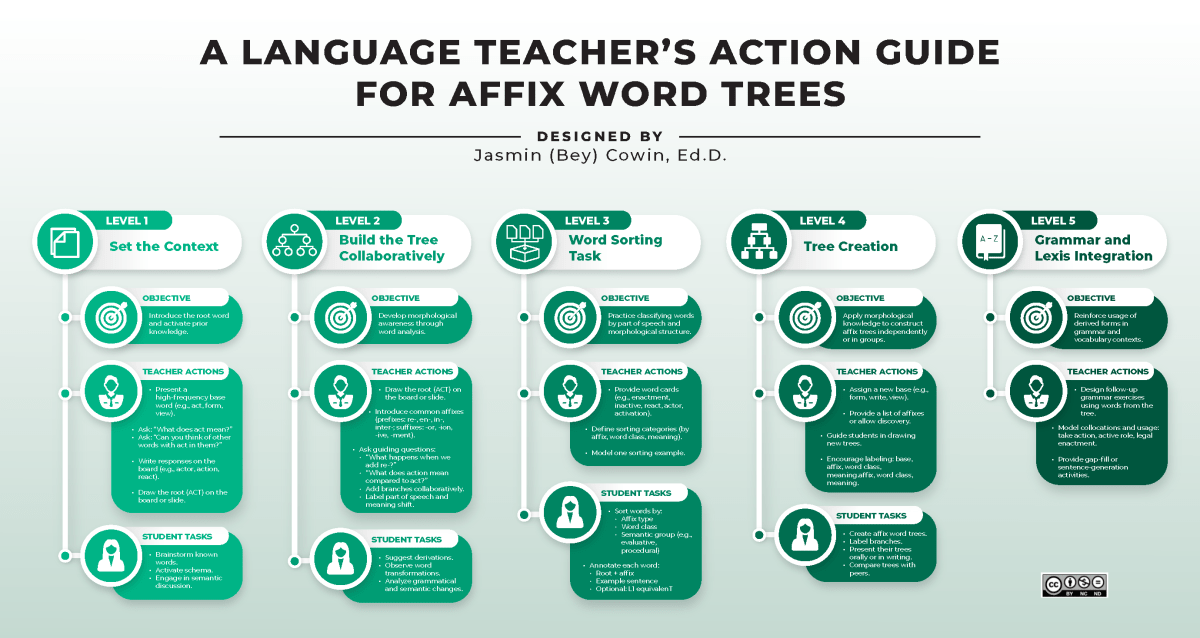
The five-stage Affix Word Tree Action Guide is not a standalone vocabulary exercise. It is, in fact, deeply grounded in the evidentiary base that constitutes the Science of Reading (SoR), a body of converging research drawn from cognitive science, linguistics, and educational psychology that identifies the foundational competencies required for skilled reading. Situating this instructional framework within SoR principles strengthens its theoretical legitimacy for ESOL, ENL, EFL and TESOL teacher candidates working across multilingual, K-12, and adult literacy contexts.
Morphological Awareness Within the Science of Reading
The Science of Reading is frequently organized around two overarching constructs: word recognition and language comprehension (Scarborough, 2001). Scarborough’s (2001) multistrand model of reading development identifies morphological knowledge as a contributing thread within the language comprehension strand, alongside background knowledge, vocabulary, and syntactic awareness. The Affix Word Tree Action Guide directly addresses this strand by systematically building learners’ capacity to recognize how morphological structure signals both meaning and grammatical function.
The infographic presented constitutes a structured pedagogical framework designed to scaffold morphological awareness instruction within second language acquisition (SLA) contexts. Drawing on foundational research in vocabulary development, particularly Nation’s (2001) lexical approach and Bauer and Nation’s (1993) taxonomy of English word families, this five-stage action guide operationalizes affix word tree methodology as a systematic instructional sequence rather than an incidental classroom activity.
Morphological awareness, defined as the explicit knowledge of how meaningful units (morphemes) combine to form words, has been consistently identified in the literature as a robust predictor of reading comprehension and productive vocabulary growth among English language learners (Kieffer & Lesaux, 2008; Tyler & Nagy, 1989). Yet despite this evidence base, morphology instruction remains underrepresented in many TESOL classrooms, often displaced by communicative fluency activities or decontextualized vocabulary lists. This action guide directly addresses that pedagogical gap.
Each stage in the framework reflects a deliberate progression from receptive recognition to productive application, mirroring the input-to-output continuum foundational to Swain’s (1985) Output Hypothesis. Stage 1 activates prior lexical schemata; Stages 2 and 3 engage learners in collaborative analysis and categorization; Stages 4 and 5 shift agency to the learner, requiring both generative tree construction and grammatical integration of derived forms.
As ESOL/ENL/EFL educators, you might engage with this infographic in two ways. First, analyze each stage as a principled instructional decision, noting how teacher actions and student tasks are deliberately aligned. Second, you are invited to consider how this framework might be adapted across proficiency levels, L1 backgrounds, and disciplinary content areas, recognizing that morphologically rich instruction is not a one-size-fits-all intervention but a flexible, evidence-informed repertoire. The integration of part-of-speech labeling, semantic analysis, and L1 equivalence in Stage 3 reflects an additive, translanguaging-informed stance toward linguistic diversity in the multilingual classroom.
This framework is offered not as a rigid script but as a visualization or thinking tool, one that makes the invisible architecture of English word formation visible, learnable, and teachable.
References
Bauer, L., & Nation, I. S. P. (1993). Word families. International Journal of Lexicography, 6(4), 253–279.https://doi.org/10.1093/ijl/6.4.253
Kieffer, M. J., & Lesaux, N. K. (2008). The role of derivational morphology in the reading comprehension of Spanish-speaking English language learners. Reading and Writing, 21(8), 783–804.https://doi.org/10.1007/s11145-007-9092-8
Nation, I. S. P. (2001). Learning vocabulary in another language. Cambridge University Press.
Scarborough, H. S. (2001). Connecting early language and literacy to later reading (dis)abilities: Evidence, theory, and practice. In S. B. Neuman & D. K. Dickinson (Eds.), Handbook of early literacy research (pp. 97–110). Guilford Press.
Swain, M. (1985). Communicative competence: Some roles of comprehensible input and comprehensible output in its development. In S. M. Gass & C. G. Madden (Eds.), Input in second language acquisition (pp. 235–253). Newbury House. https://www.scirp.org/reference/referencespapers?referenceid=1501919
Supporting Instructional Alignment in Science of Reading Implementation
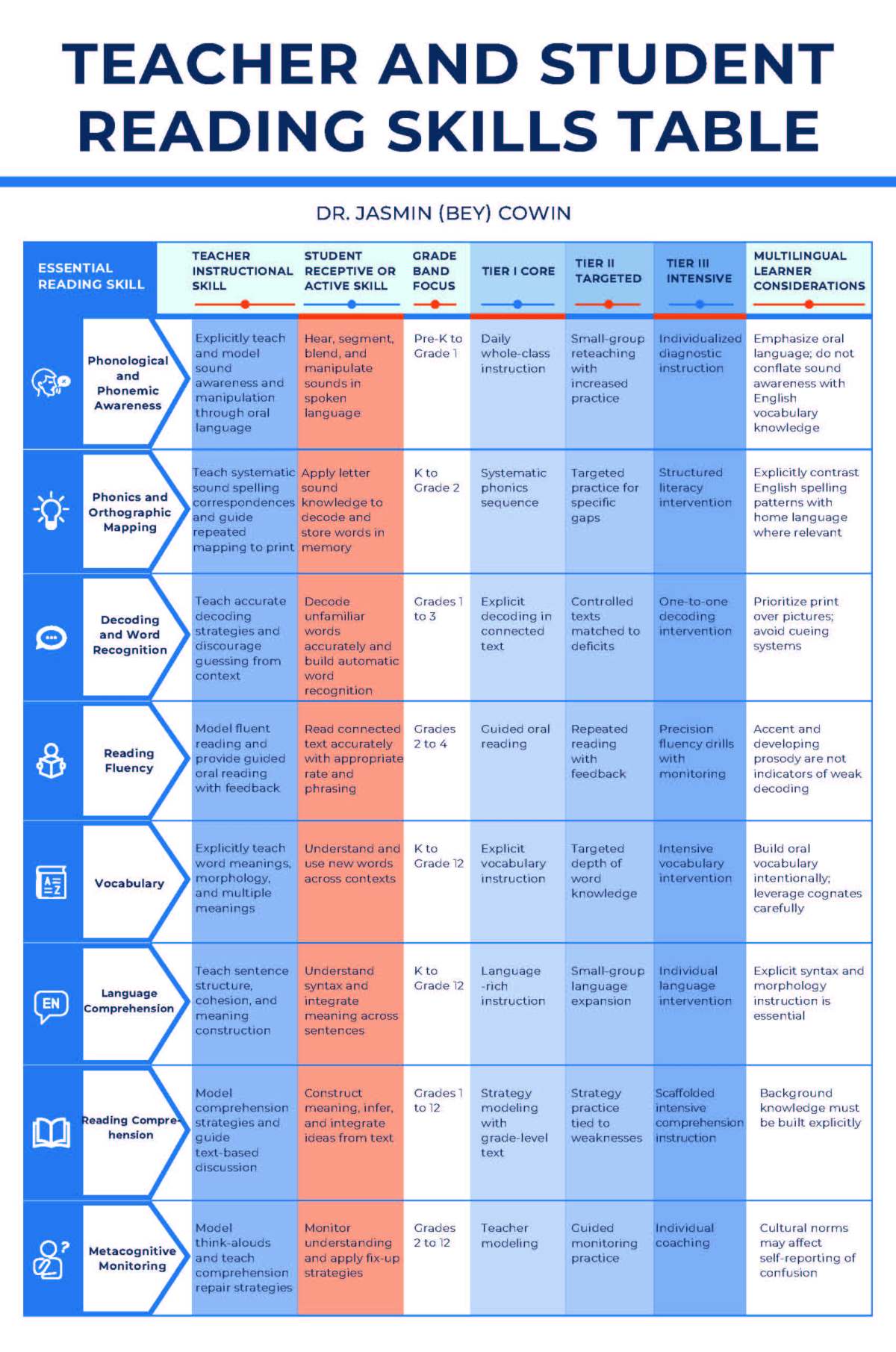
The Teacher and Student Reading Skills Table is intended to support educators in aligning instructional practices with evidence-based literacy research. Rather than operating as a scope-and-sequence, the table aims to clarify instructional roles, student skill development, grade band emphasis, tiered supports, and multilingual learner considerations. When used deliberately, it may help reduce ambiguity in Science of Reading implementation.
Foundational Skills: Phonological and Phonemic Awareness
The chart places phonological and phonemic awareness within oral language instruction, with emphasis in Pre-K through Grade 1. Teachers are expected to model and teach sound awareness and manipulation, while students work to hear, segment, blend, and manipulate sounds in spoken language.
An important implication of this framing is that phonemic awareness instruction does not rely on English vocabulary knowledge. For multilingual learners, sound awareness and lexical knowledge represent related but distinct competencies. Instruction that separates these skills may support more accurate interpretation of student performance and instructional need.
Across tiers, the chart suggests that increased intensity should involve additional practice and diagnostic attention rather than a shift to alternative activities.
Phonics and Orthographic Mapping
The chart situates phonics and orthographic mapping primarily in Kindergarten through Grade 2. Teachers provide systematic instruction in sound–spelling correspondences and guide repeated connections between print, pronunciation, and meaning. Students apply letter–sound knowledge to decode and gradually store words in memory.
This progression reflects the view that orthographic mapping develops through repeated, accurate decoding rather than exposure alone. The tiered structure emphasizes that students who experience difficulty may benefit from greater explicitness and structured practice rather than compensatory strategies.
For multilingual learners, contrastive analysis of English spelling patterns and home language orthographies is presented as an important instructional support when integrated within explicit phonics instruction.
Decoding and Word Recognition
In Grades 1 through 3, the table highlights instruction focused on accurate decoding strategies. Teachers guide students to attend to print, while students practice decoding unfamiliar words and building automatic word recognition.
The multilingual learner guidance encourages prioritizing print-based information and limiting reliance on pictures or context cues. This emphasis aims to support efficient word recognition development and to reduce instructional practices that may interfere with decoding growth.
Tiered supports in this domain are intended to reflect differences in intensity and instructional focus, informed by observed error patterns and student response to instruction.
Reading Fluency
Fluency instruction is emphasized in Grades 2 through 4 and is described as involving teacher modeling and guided oral reading with feedback. Students work toward reading connected text with increasing accuracy, rate, and phrasing.
The table notes that accent and developing prosody are not necessarily indicators of decoding difficulty. This consideration may help educators interpret fluency data more carefully for multilingual learners and distinguish between linguistic variation and skill-based needs.
Across tiers, fluency instruction becomes more targeted and closely monitored, with attention to maintaining a connection to underlying decoding accuracy.
Vocabulary and Language Comprehension
Vocabulary and language comprehension are presented as ongoing instructional priorities from Kindergarten through Grade 12. Teachers explicitly address word meanings, morphology, syntax, and sentence-level cohesion, while students work to understand and use language across contexts.
The chart’s separation of vocabulary, language comprehension, and reading comprehension reflects the view that these domains develop through related but distinct instructional pathways. For multilingual learners, intentional oral vocabulary development, explicit syntax instruction, and careful use of cognates may support language comprehension growth.
Tiered instruction in these areas often emphasizes depth of understanding and structured language practice rather than reduced linguistic demand.
Reading Comprehension and Metacognitive Monitoring
Reading comprehension instruction begins in early elementary grades and extends through secondary levels. Teachers model comprehension strategies and guide discussion grounded in text, while students practice constructing meaning, making inferences, and integrating ideas.
Metacognitive monitoring, introduced in Grade 2 and beyond, involves teacher modeling of think-alouds and instruction in comprehension repair strategies. Students develop the ability to notice breakdowns in understanding and apply appropriate fix-up strategies.
The table acknowledges that cultural norms may influence how students express confusion, suggesting that educators consider multiple indicators of comprehension.
Multi-Tiered Systems of Support and Instructional Coherence
The tiered structure outlined in the chart is intended to support instructional coherence across Tier I, Tier II, and Tier III. Core instruction provides the foundation, while targeted and intensive supports increase explicitness, practice, and responsiveness.
This framing positions MTSS as a system for adjusting instruction based on student need rather than as a static placement model.
Conclusion
I believe the value of the Teacher and Student Reading Skills Reference Table lies in its attempt to make instructional expectations more explicit across reading domains, grade bands, and tiers of support. When used reflectively, it may support instructional planning, collaborative decision-making, and more consistent implementation of Science of Reading principles across diverse classroom contexts.
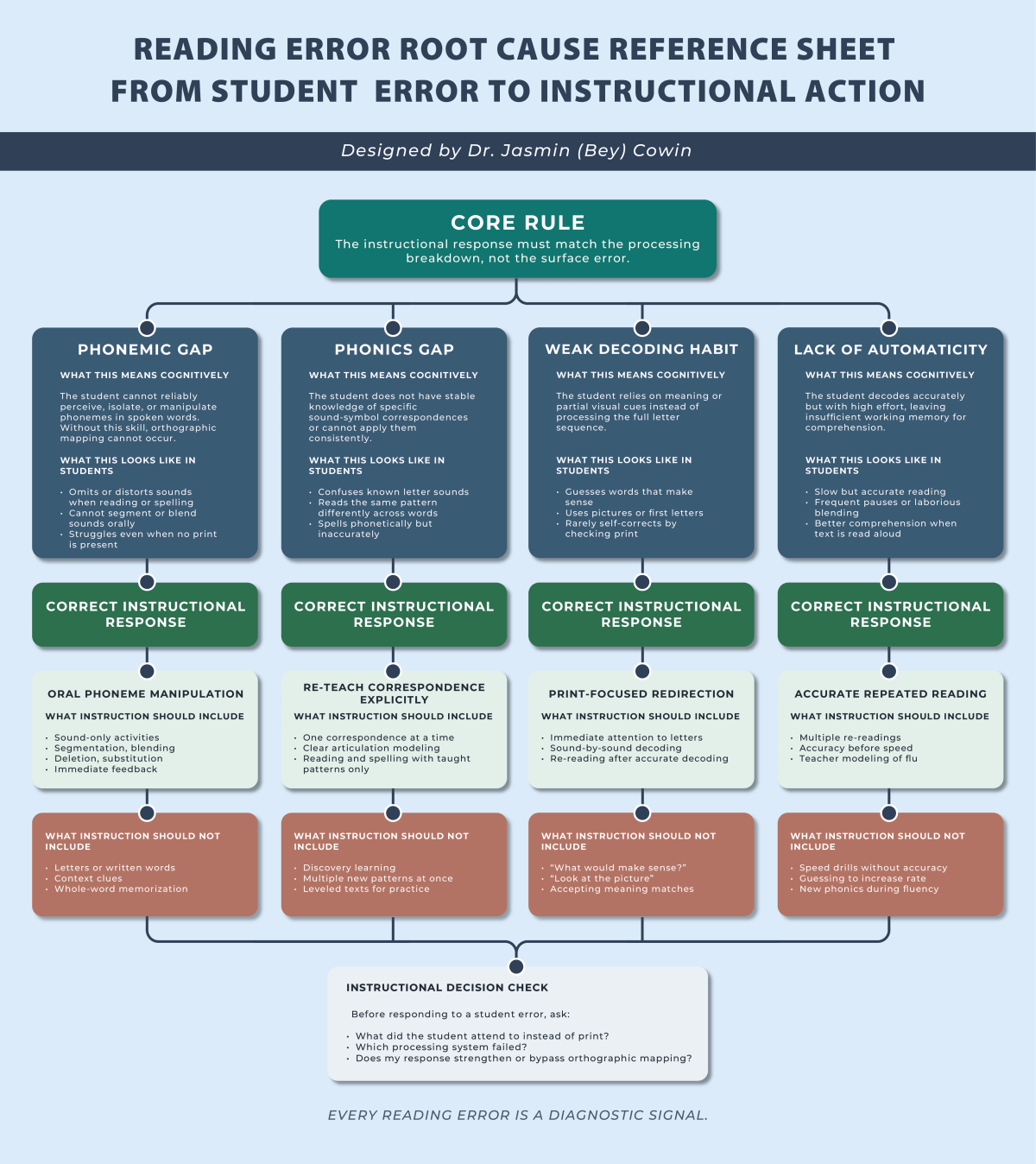
This infographic is designed for educators working with Emergent Writers and Newcomers to Literacy (EWNL), English as a Foreign Language (EFL), and TESOL learners across elementary, secondary, and adult contexts who are acquiring literacy in alphabetic writing systems. Its purpose is to support instructional decision-making grounded in the Science of Reading by linking observable reading errors to the specific cognitive and linguistic processes that underlie word recognition.
The organizing principle of the infographic, the instructional response must match the processing breakdown, not the surface error, reflects a central finding of reading science: word reading difficulties arise from identifiable breakdowns in component processes rather than from general language proficiency, motivation, or exposure to text. Decades of research demonstrate that effective reading instruction requires diagnosing which processing system has failed and responding at that level with targeted instruction (Gough & Tunmer, 1986; Moats, 2020).
The framework is structured around four empirically supported domains of word recognition: phonemic awareness, phonics knowledge, decoding behavior, and automaticity. These domains align with models of skilled reading that distinguish between language comprehension and word recognition, most notably the Simple View of Reading (Gough & Tunmer, 1986), and with research on orthographic mapping as the mechanism that enables accurate and fluent word reading (Ehri, 2014; Share, 1995).
Each panel in the infographic identifies a specific processing breakdown and pairs it with an instructional response that directly supports orthographic mapping. For example, phonemic gaps require oral phoneme manipulation without print, while phonics gaps require explicit instruction in sound–symbol correspondences. Weak decoding habits reflect reliance on context or partial visual cues, which research has shown does not support long-term word learning (Share, 1995). Lack of automaticity reflects constrained working memory during reading and calls for accurate repeated practice rather than new phonics instruction (LaBerge & Samuels, 1974).
Working Memory Capacity: Readers have limited working memory. Non-automatic word recognition quickly exhausts this capacity, hindering comprehension.
Role of Practice: The goal of practice is to make decoding and word recognition so fast and accurate that it becomes automatic.
Focus on Fluency: Instead of introducing new rules, practice should focus on increasing the speed and ease with which known skills are applied.
For multilingual learners, including EFL and TESOL students of all ages, this distinction is essential. Research indicates that decoding difficulties in second-language readers often mirror those of monolingual learners and should be addressed through the same evidence-based instructional approaches, while keeping language comprehension supports separate (August & Shanahan, 2006; Lesaux et al., 2007).
The instructional decision check reinforces a diagnostic stance toward reading errors, treating them as data that inform instruction. This approach aligns with Science of Reading principles that emphasize precision, systematic instruction, and alignment between assessment and response.
Ehri, L. C. (2014). Orthographic mapping in the acquisition of sight word reading, spelling memory, and vocabulary learning. Scientific Studies of Reading, 18(1), 5–21. https://doi.org/10.1080/10888438.2013.819356
August, D., & Shanahan, T. (Eds.). (2007). Developing Reading and Writing in Second-Language Learners: Lessons from the Report of the National Literacy Panel on Language-Minority Children and Youth. Published by Routledge for the American Association of Colleges for Teacher Education (1st ed.). Routledge. https://doi.org/10.4324/9780203937600
Course Description Students will become acquainted with and practice effective approaches, methods, and strategies for teaching and evaluating English language learners in the content areas (ELA, Social Studies, Math and Science). Throughout the course, students will explore the impact of culture and language upon classroom learning. Special challenges in teaching and assessment in each content area will be discussed. Examination and analysis of curriculum materials and instructional strategies for creative teaching and learning in grades Pe-K-12. Includes content-specific lesson planning that addresses the New York State Student Content Learning Standards with emphasis on English Language Arts, English as a Second Language, and content area instruction. Course content includes demonstrations, simulated activities, and field observations in Pre-K-12 classrooms. The course also examines how the teaching of English to non- native speakers can be integrated with the teaching of cognitive skills in all content areas. Students will be offered a variety of methods and materials to integrate ESL standards throughout all content areas for classroom use. Includes 15 hours of fieldwork. Includes 15 hours of fieldwork. 3 credits
Jennifer Taranto: I’m graduating with my TESOL certification this June, and I can’t wait to bring everything I’ve learned into the classroom. After 17 years as a paraprofessional and now three years as a special education teacher, I’ve learned that every student shines when given the right scaffolds and support. Teaching in a 12:1 classroom keeps me on my toes, challenges me to be creative, and reminds me why I love this work every single day.
“During my 15 hours of ENL field observations, I learned that effective teaching goes beyond delivering content; it’s about creating a learning environment where all students can participate and feel confident. Seeing how intentional scaffolding, clear instruction, and ongoing support help English learners access content showed me the real impact thoughtful teaching can have on student engagement and success.” Jennifer Taranto, Touro University TESOL Candidate
Ms. Taranto wrote in her fieldwork paper:
“Throughout these lessons, teachers consistently integrated explicit language objectives, modeled think-alouds, provided sentence frames and word banks, and designed opportunities for oral rehearsal prior to writing, moves that reflect core sheltered instruction practices for making content comprehensible while advancing language development (Echevarria, Vogt, & Short, 2017; Kareva & Echevarria, 2013). The instructional materials throughout the lesson followed a purposeful multimodal approach. The segregation lesson utilized historical photographs, while picture cards and sentence strips helped students learn sentence structure and the past tense, and emojis aided them in understanding the meanings of adjectives and their effects.”Jennifer Taranto, Touro University TESOL Candidate
In my opinion, this passage clearly crystallizes her fieldwork insights for several reasons.
First, it demonstrates analytic synthesis rather than description. Jennifer moves beyond listing observed practices and explicitly names how those practices function within a sheltered instruction framework. The linkage between observed classroom moves and theoretical constructs such as comprehensible input, multimodality, and oral rehearsal signals disciplinary competence and analytic maturity.
Second, this section demonstrates a tight alignment between the data and the framework. She does not merely cite the SIOP Model, but illustrates its components through concrete instructional examples, such as think-alouds and sentence frames. This alignment indicates that she synthesized SIOP as an enacted pedagogy rather than an abstract checklist.
Third, the passage captures fieldwork-specific insight that could only emerge from sustained observation. The reference to emojis, historical photographs, and sentence strips reflects attention to how teachers translate abstract language demands into tangible semiotic supports. This is a hallmark of strong qualitative fieldwork analysis, as it foregrounds instructional decision-making in context.
Students will become acquainted with and practice effective approaches, methods, and strategies for teaching and evaluating English language learners in the content areas (ELA, social studies, math and science). Throughout the course, students will explore the impact of culture and language on classroom learning. Special challenges in teaching and assessment in each content area will also be discussed. Includes 15 hours of field work.
Anastasios Panagiotidis is a dedicated high school Earth Science teacher serving the South Huntington Union Free School District. As he approaches his tenure year at the age of 25, he recognizes that his career is still in its early stages. However, his passion for education and commitment to fostering a supportive and inclusive learning environment drive his work every day. Inspired by the culturally and academically diverse student population he teaches, he strives to design engaging, student-centered lessons that not only address individual needs but also connect learning to real-world contexts. His ultimate goal is to ensure that every student, regardless of their language proficiency or academic abilities, has the opportunity to reach their fullest potential under his instruction.
Touro University contributes to the tools, knowledge, and wisdom I strive to acquire as I continue to develop and mature as an educator, while allowing me the opportunity to broaden my horizons in a wide variety of areas relative to the rapidly evolving field of education.
Anastasios Panagiotidis, Touro University TESOL candidate
The SIOP Model: An Essential Framework for ESL Instruction by Prof. Dr. Jasmin Cowin
The Sheltered Instruction Observation Protocol (SIOP) is a research-based instructional model designed to support English Learners (ELs) in developing both content knowledge and English language proficiency simultaneously. Developed by Echevarria, Vogt, and Short, the SIOP model provides a structured approach to lesson planning and delivery, ensuring that ELs receive comprehensible input and meaningful language support across content areas.
As a TESOL educator, understanding and implementing the SIOP model is essential for effective ESL instruction. The model provides a structured yet flexible framework that ensures ELs have equitable access to academic content while simultaneously developing their language proficiency. By integrating language and content instruction, teachers can create an inclusive classroom environment that promotes both linguistic and cognitive development for English Learners.
The SIOP Model: Components and Structure
The SIOP framework consists of eight interrelated components that guide teachers in designing effective lessons for ELs:
Lesson Preparation
Clearly defined content and language objectives
Use of supplementary materials to support comprehension
Meaningful activities that integrate both content and language practice
Building Background
Explicitly linking students’ background knowledge to new content
Connecting past learning experiences to new concepts
Introducing and reinforcing key vocabulary
Comprehensible Input
Adjusting speech for EL proficiency levels
Using clear explanations of academic tasks
Incorporating visuals, gestures, and realia to support understanding
Strategies
Teaching students learning strategies to support comprehension
Encouraging metacognitive awareness and self-monitoring of learning
Scaffolding tasks through teacher modeling, guided practice, and peer collaboration
Interaction
Promoting student-to-student discourse using structured peer interactions
Designing opportunities for extended academic conversations
Encouraging collaborative learning experiences
Practice & Application
Providing hands-on learning experiences
Integrating reading, writing, speaking, and listening activities
Allowing ELs to apply language skills in meaningful contexts
Lesson Delivery
Ensuring objectives are clearly communicated and met
Keeping students engaged and maintaining an appropriate pace
Aligning instruction with student needs
Review & Assessment
Regularly reviewing key concepts and vocabulary
Conducting formative assessments to monitor comprehension
Providing feedback to guide language and content development
Anastasios Panagiotidis’ Discussion Board provides excellent insight into Building Background.
Literacy [MS] The Master of Literacy program prepares teachers to become Literacy Specialists who work with students with reading and writing difficulties. The program includes ample field experience and leads to certification in both Birth – Grade 6 and Grades 5 – 12. Classes are offered online, as well as on site in Bay Shore in the evenings.
Alissa Fernstrom is currently a Teaching Assistant for a Special Education classroom in the Herricks School District. She completed her undergraduate dual degree in Early Childhood and Childhood Education at Molloy College, graduating in 2018. Afterward, she took graduate courses through Queens College to obtain her Special Education certification before selecting Touro University to obtain her Masters in Literacy. In addition to teaching in the classroom, she teaches dance, which allows her to share one of her life-long passions with others.
My time here at Touro has not been traditional, but the flexibility of the online program coupled with the supportive professors and staff, have made my journey to obtain my Masters in Literacy one I will forever be grateful for.
Alissa Fernstrom, Masters in Literacy, Touro University
Part I
a. Identify techniques for connecting students’ personal experiences and past learning to lesson concepts.
“It is a widely accepted notion among experts that a learner’s “schemata”—knowledge of the world—provides a basis for understanding, learning, and remembering facts and ideas found in texts” (Vogt, M., Echevarria, J.J., & Short, D. J., 2016, p.72). This fact is important to consider as a teacher, specifically of ENL students, because every learner comes into the classroom with their own set of knowledge that can be tapped into and utilized to help them better understand the new content being taught. One technique to connect students’ past experience with new lesson concepts is the use of anticipation guides. These guides consist of a number of statements that students can agree or disagree with based on their background knowledge of the topic being taught. This serves not only to activate their prior knowledge, but also to set a purpose for what they are to learn during the lesson. These questions should also be revisited at the end of a lesson in order to address any misconceptions and help students make new connections. Another technique that should be used when activating prior knowledge is culturally responsive teaching. Since students from different cultures will have vastly different experiences from their peers, it is important to consider that the way in which they will react to new information may not align with the way their peers do. It has been “questioned whether we can assume that students from every subculture will have the same experience with, or emotional reaction to a story or article, or whether we should expect the same outcomes from them” (Vogt, M., Echevarria, J.J., & Short, D. J., 2016, p.73). Teachers must consider that a student’s reading comprehension may be affected by their prior experiences or background knowledge and may not interpret a situation in the expected way. This is why culturally responsive teaching is a very important technique to utilize with ENL students.
b. List 2 elements of academic language and describe their importance for English learners.
”Academic language involves the use of more sophisticated sentence structures and forms of expression than are found in everyday conversation” (Vogt, M., Echevarria, J.J., & Short, D. J., 2016, p.76). This language is commonly seen in the content subject areas and leads to academic success. This type of language can be broken down into two specific groups, content vocabulary and general academic vocabulary. Content vocabulary “are the key words and terms associated with a particular topic being taught” (Vogt, M., Echevarria, J.J., & Short, D. J., 2016, p.76). These words are normally found in bold in the informational texts students read about a topic. They also include the words students need to know in order to share their thinking about a topic, such as character and setting. General academic vocabulary “are academic words and phrases students must learn because they are used in all academic disciplines” (Vogt, M., Echevarria, J.J., & Short, D. J., 2016, p.77). These types of words are not normally explicitly taught, but should be since they are words commonly seen in every academic setting. These words may have multiple meanings depending on the content being explored and can cause issues for ENL students. These words also help students to understand how information may be provided to them and how they are expected to interact with it. Both types of academic language are important and should be taught when working with ENL students.
Part II
a. Describe 1 activity YOU used during this week to introduce key academic subject-specific vocabulary for your ENL students. (p 76/77) divide your academic vocabulary using words from these three groups: content vocabulary, general academic vocabulary, word parts: roots and affixes?
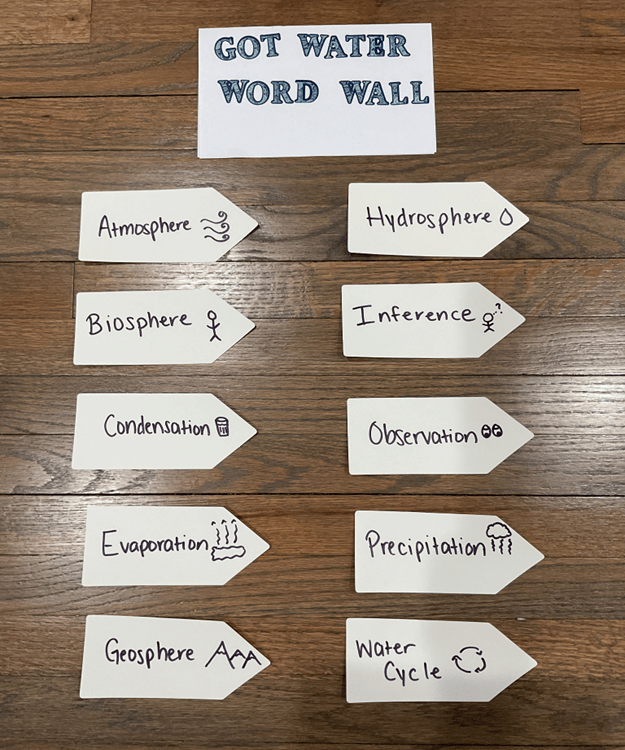
This week, I introduced academic subject-specific vocabulary to my 5th grade class, of which one student is an ENL student. We started a new science topic entitled “Got Water?” which focuses on the different spheres of the earth, specifically water. The way in which I introduced these words was by providing students with a list of the words and a picture to accompany each that they glued into their science notebooks. The pictures served as a great way for not only my ENL student, but for all students in my special education room, to create a concrete picture in their mind of what each word meant. Once students had their list, we went through each word one by one, giving students a chance to share their own background knowledge and build upon the definition I had given by using the word in a sentence. This allowed all students to participate and utilize the new vocabulary in a way that was familiar to them. We also talked about the prefixes on some of the words and had students share other words they knew of that started in a similar way. This further helped students to solidify the meaning of these new words.
general academic vocabulary: observation, inference, cycle
roots and affixes: hydro-, bio-
b. Describe 1 activity YOU used during this week to introduce general academic or language function vocabulary for your ENL students (p 76/77).
In our reading unit, students are working on a culminating project with their fantasy novels. The general academic words that were introduced and utilized this week to start this project were compare, contrast, and support your answer. The overall task is for students to pick two elements of a fantasy book and compare and contrast how these elements are seen in the class read aloud and their independent book. In order for students to effectively complete the assignment, they first had to understand what these general academic words mean. I started by simply writing both words on the board and having students use any prior knowledge they had about each word to create their own definition. Since these students are in 5th grade, they had all, including my ENL student, been exposed to these words and were quickly able to come up with definitions as a class. They also identified that we could use a venn diagram to help us compare and contrast the two books. Utilizing charts is a great way to help all students organize their thinking. Finally, we discussed what it means to support your answer. We first compared it to our math lessons when we are always asked to show our work. Students were able to make the connection that the work supports our answer and that in the case of reading, the words in the book are our support. This helped them to realize that supporting their answers in reading meant going back into the text.
c. Use one of the methods described (p 82 – 88) in YOUR classroom and describe what happened – please include a photo of any of YOUR realia/anchor chart/game cards.
The method I chose to utilize with my class is a word wall. A word wall is a place for relevant content words to be displayed in alphabetical order. “These words are revisited frequently throughout the lesson or unit, and students are encouraged to use them in their writing and discussions” (Vogt, M., Echevarria, J.J., & Short, D. J., 2016, p.85-86). I decided that a word wall could be a great way to display our new science words for students. I noticed that once the words were visible to students at all times, they were more likely to use the words when answering questions, not only during our science lessons, but making connections back to them throughout the entire day. For example, students spoke about how our predictions at the end of our chapter in reading were really inferences because we were using what we saw in the book to make a guess as to what would happen. This was so amazing to see as a teacher and hearing students that are both in special education and ENL utilize such sophisticated language in an appropriate way showed me how impactful such a simple vocabulary method could be.
C Vogt, M., Echevarria, J. J., & Short, D. J. (2016). Making content comprehensible for English Learners. (5th ed.). Pearson: New York.
Students will become acquainted with and practice effective approaches, methods, and strategies for teaching and evaluating English language learners in the content areas (ELA, social studies, math and science). Throughout the course, students will explore the impact of culture and language on classroom learning. Special challenges in teaching and assessment in each content area will also be discussed. Includes 15 hours of field work.
“As I begin my journey at Touro, I aspire to grow as an educator, enhancing my effectiveness and inspiration for my students along the way.”
Alexandra Olivo, Touro University, TESOL Candidate
Alexandra Olivo is a second-year teacher and graduate student from Long Island, New York. Through her advanced studies, she aims to bring creative approaches to the classroom and create an engaging and supportive learning environment where students can succeed. Alexandra said, “I am committed to student growth and empowering students to reach their full potential.”
Ms. Olivo submitted an exemplary Discussion Board:
Identify techniques for connecting students’ personal experiences and past learning to lesson concepts.
After reading, I better understand how students can benefit from connecting personal experiences and past learning to continue learning new concepts and hit target objectives. I found that on page 74 of Making Content Comprehensible for English Learners, KWL charts can help classes brainstorm about a topic, which can be helpful when grasping what students know and what they will learn. There is one disadvantage of this technique because, as mentioned on page 74, “some English learners have little or no prior knowledge about a content topic,” so teachers should be aware that choosing the right topic for their KWL can have a difference in how much information they receive from students. For example, if you are teaching a writing lesson about favorite holidays, choose a widely celebrated holiday rather than “Fourth of July,” which is only celebrated in The United States of America. Another technique discussed in this chapter is implementing information students have learned in new lessons. Integrating knowledge helps students to see the connections and think back to resources such as anchor charts and vocabulary. Just this past week, I was teaching an ELA lesson. Although the objective differed from the prior day, I connected the lessons because the language used was in the readings and the strategy we were implementing. (Echevarría et al., 2017)
List 2 elements of academic language and describe their importance for English learners.
One element of academic language I will describe is using and implementing “Content Vocabulary.” Content vocabulary is described in Chapter 3 as “…keywords and terms associated with a particular topic being taught” (Echevarría et al., 2017). This is important for English learners because they may not know these terms in their first language, which means they may be unable to use that knowledge to help them understand the meaning of English. In general, I find that in my second-grade classroom, content and vocabulary are difficult for most students but harder for ELLs because they struggle to comprehend the meaning of words. A great way to implement content vocabulary for my ELL students is to have my general education students help describe what the word means by shouting out words based on a student-friendly definition I provide. I also show visuals to help students understand what these words represent. They can connect with their peers, explaining and using visuals to grasp content vocabulary. The second element of academic language described is “General academic Vocabulary.” This is where students have to understand words used across multiple content areas. Although content vocabulary is essential for students to know what we are learning about, I find that general academic vocabulary works hand in hand and sometimes may be more critical. This is because students used general vocabulary to conversate with me, other teachers, and their peers. Without this, they cannot understand lesson objectives, assignment directions, social cues, and other essential aspects of daily language. ELLs may not have words equivalent to English terms. Therefore, it is vital to make sure we are scaffolding ways for these students to learn this discourse, such as visuals in the classroom, describing and explaining the meaning, and using context clues.
Jana, Echevarria; Vogt MaryEllen; Short Deborah J.. Making Content Comprehensible for English Learners (SIOP Series) (p. 100). Pearson Education. Kindle Edition.
Describe 1 activity YOU used during this week to introduce key academic subject-specific vocabulary for your ENL students. (p 76/77) divide your academic vocabulary using words from these three groups: content vocabulary, general academic vocabulary, word parts: roots and affixes?
This week, my students were introduced to key academic vocabulary in math. The unit we are currently working on is adding and subtracting within 20. We used the activity of a word wall displayed in the front of the classroom. This was the first time I was showing students this resource, and I built the word wall with them rather than displaying it for them to view independently. I decided to pull all students to the carpet to go through each word and have students try to remember what the terms meant if they had heard them in first grade. This sparked some curiosity in my ELLs. As we put up each word, I describe it and then discuss it together, especially when we see it in either addition or subtraction problems.
Content Vocabulary: sum, equation, difference,
General academic vocabulary: describe, write, draw, word parts: none used for this lesson.
Jana, Echevarria; Vogt MaryEllen; Short Deborah J.. Making Content Comprehensible for English Learners: The SIOP Model (SIOP Series) (p. 100). Pearson Education. Kindle Edition.
Describe 1 activity YOU used during this week to introduce general academic or language function vocabulary for your ENL students (p 76/77)
One activity I used this week to introduce general academic language was a vocabulary word wall, but I changed this activity by adding an act-it-out activity. As a class, during ELA, we discussed five new words: describe, “presenter, explain, observe, and listen. We began by saying each word aloud and predicting what these words mean in our classroom. Then, I provided them with a definition, and we read it together, repeating it after me. Following this, we acted out each one to provide a visual, and I chose a few students who accurately portrayed it to show the class. This helped my ENL students because they repeated the word multiple times and then connected it to whatever the acting-out move was. A few students had a live “aha” moment during the word presenter. The ELA reading for that day was science-based, and these words helped guide students through the vocabulary content.
Use one of the methods described (p 82 – 88) in YOUR classroom and describe what happened. Please include a photo of any of YOUR realia/anchor chart/game cards.
This week, I used the “four corners vocabulary charts” as an activity to learn about nouns. I gave my students directions for choosing a corner and then discussed the card in that corner with one partner. I showed them how to complete the activity by using the first image below of the vocabulary word “noun,” then we continued this activity but with five different nouns, such as the image of the word beach below. This helped all students, specifically ELLs, because I noticed they were listening to their peers, and some students were working hard to help their friends learn about nouns. I enjoyed using this activity because students loved walking around the room, allowing them to look at vocabulary differently. The multiple ways of representing nouns helped them clarify the differences between the types of nouns.
Review the Teaching Scenario Ms. Saunders (p. 90) and give one feedback point.
One feedback point is that Ms. Saunders could have spent more time reviewing the word sequence for English Learners (ENLs). The word sequence is a general academic vocabulary that not all students may know just by a quick reminder. Along with the SIOP Model’s emphasis on vocabulary development, I think incorporating one or two examples of sequencing before asking students to create a storyboard would have been beneficial. This approach would use a modeling strategy, which helps students visualize the concept. I also think that having students sequence seven parts of the story, it would have been more effective to start with just four parts. This adjustment would accommodate those who seemed unsure if they understood the assignment. As highlighted in the SIOP framework, breaking down tasks into manageable chunks is helpful by supporting comprehension. Seven parts may have overwhelmed students who are still developing their language skills and lowered their ability to engage with the task. By providing clearer instructions and examples, Ms. Saunders could have created a more supportive learning environment, which could have allowed more students to participate confidently.
Reference:
Echevarría, J., Vogt, M., & Short, D. (2017). Making Content Comprehensible for English Learners: The SIOP Model.
Peer Responses
Hi Q., I enjoyed your post. Specifically, your activity is introducing multiplication vocabulary. I used a similar activity but needed to include the drawing aspect. This would benefit ELLs because they can view other students’ work and connect the pictures to newly learned content vocabulary. I will be including this in my future lessons. I also agree that in your review of Ms. Saunders’s teaching scenario, she could have added a check for understanding and review at the end of the lesson. This could have provided students with a wrap-up to clarify misconceptions within student responses. I always try to do this in my classroom, and I am sometimes surprised at the confusion, but ultimately, it helps me grow as an educator.
Hi S., I enjoyed your post because I found connections to what I use in my classroom. I see that you use HMH for your English language arts program. I also conduct my lessons with vocabulary in the same way. My students struggle to read independently, so when I introduce the words, we say them together orally, discuss the meaning, and then use examples. I am unsure if you have tried this, but my students benefit from acting out the words when possible, depending on the context. I also like how you explained that your kindergarteners are now aware of a lot of general academic vocabulary, and I commend your patience as you teach it to them. As a second-grade teacher, I can say that if they begin in Kinder, then it becomes natural for them to hear and use these terms as they get older.
Hi C.! I loved your response to using an activity/method in your classroom. I loved how you did a read-aloud book to teach an important skill: washing hands. I also thought that after you discussed the story, you would provide a video. Not only did this provide visuals, but you also had another source of representation of the same skill. ELLs learn better with visuals and learning something in multiple ways. Then, providing students with a live experience of walking to the bathroom is exceptional. I will carry this lesson format into my classroom but with different content. Thank you for sharing.