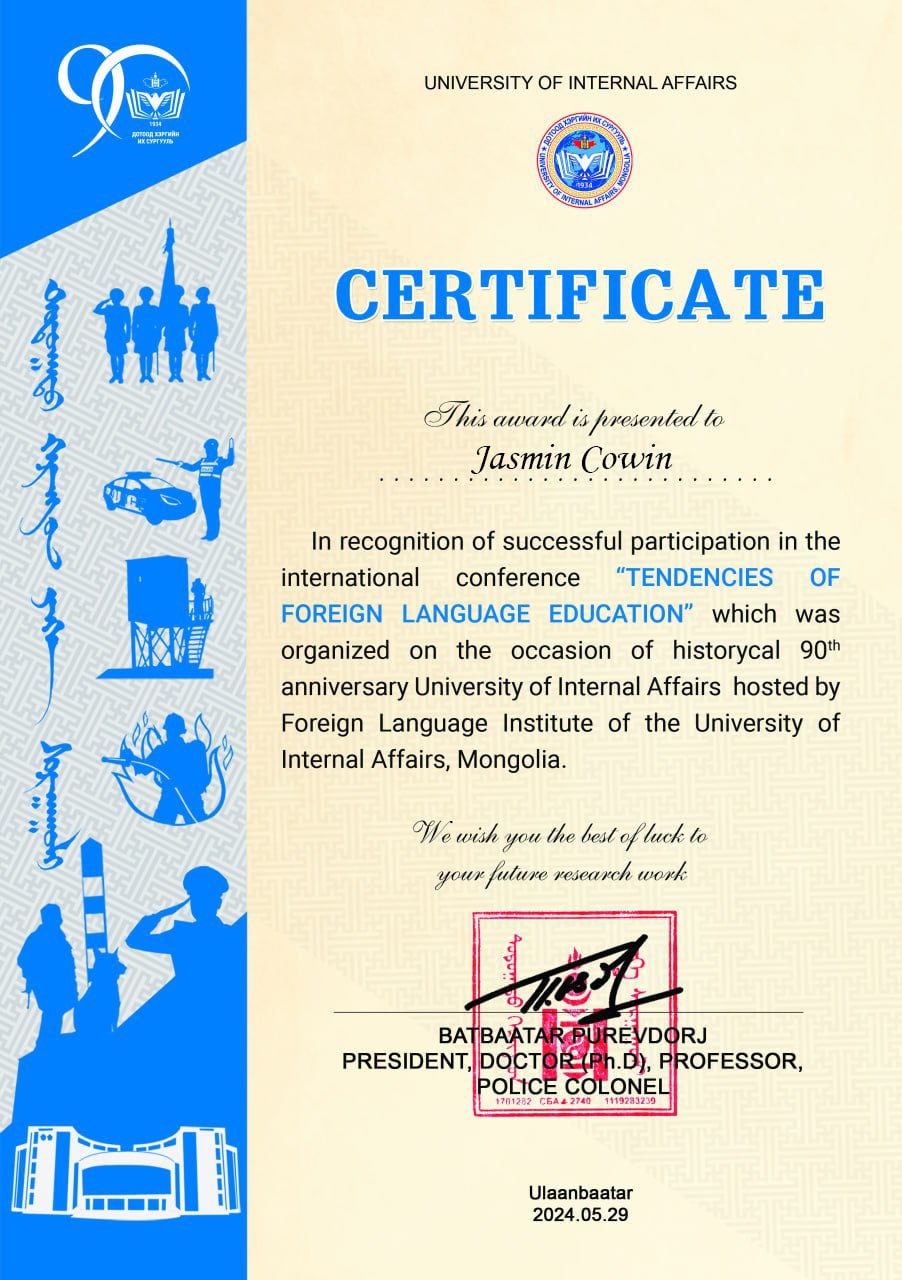
Dr. Jasmin (Bey) Cowin, an Associate Professor at Touro University, received the 2024 Touro University CETL Faculty Fellowship for Excellence in Teaching and the Rockefeller Institute of Government awarded her the prestigious Richard P. Nathan Public Policy Fellowship (2024-2025). As a Fulbright Scholar and SIT Graduate, she was selected to be a U.S. Department of State English Language Specialist. Her expertise in AI in education is underscored by her role as an AI trainer and former Education Policy Fellow (EPFP™) at Columbia University's Teachers College. As a columnist for Stankevicius, she explores Nicomachean Ethics at the intersection of AI and education. She has contributed to initiatives like Computers for Schools Burundi, served as a resource specialist for Amity University in Uttar Pradesh, India, and participated in TESOL "Train the Trainer" programs in Yemen and Morocco. Her research interests include simulations and metaverse for educators-in-training, AI applications in education and language acquisition and teaching, and distributed ledger technologies, with a focus on her 'Education for 2060' theme.
In conclusion, my commitment extends beyond transactional interactions, focusing instead on utilizing my skills and privileges to make a positive, enduring impact on the world.
As an Associate Professor for the Touro University TESOL/BLE Department, I am immensely proud to feature outstanding student work from our MS in Teaching English to Speakers of Other Languages (TESOL) Program. New York’s linguistic diversity demands teachers who can find common ground and effectively communicate with students from different language backgrounds. Academically rigorous and practice-intensive, the 33-credit program leads candidates who complete all coursework, and fieldwork to recommendation for ESL certification.
BIO: Emily Georgoulakos is enrolled in the TESOL master’s program at Touro University. She is certified in General and Special Education from Birth to 6th grade. Emily teaches in a 1st-grade self-contained (15:1) classroom in a district with a diverse and inclusive population.
My journey at Touro University in the TESOL program has been a valuable and positive experience as I have been able to develop professionally and personally. I have been able to grow as an educator to support students of all cultural backgrounds and individual needs. I have significantly developed an understanding of the importance of culturally relevant education and environmental inclusivity. I can implement this into my future practices by creating a positive and welcoming environment and integrating students’ culture.
My infographic, “At the Crossroads of Languages: Morocco Sings Its Diversity,” portrays Morocco’s linguistic diversity, celebrating the rich tapestry of languages spoken nationwide. It explores the prevalence and cultural significance of Arabic, Berber, French, Darija, and Tamazight, illustrating how each contributes to Morocco’s unique societal and cultural identity.
As an Associate Professor for the Touro University TESOL/BLE Department, I am immensely proud to feature outstanding student work from our MS in Teaching English to Speakers of Other Languages (TESOL) Program. New York’s linguistic diversity demands teachers who can find common ground and effectively communicate with students from different language backgrounds. Academically rigorous and practice-intensive, the 33-credit program leads candidates who complete all coursework, and fieldwork to recommendation for ESL certification.
Touro University has made it possible for me to be a full-time educator while also pursuing my master’s degree. The professors in the Touro GSE have been accommodating, knowledgeable, and incredibly helpful in my teaching journey, and I look forward to continuing my master’s degree.
Understand the significance of content, process, and product differentiation. Modify an existing content lesson plan YOU delivered to ELL/ML students: Integrate proactive adjustments based on student readiness, interest, and learning profiles.
Discuss anonymized student products as tangible evidence of differentiation in assessment. These products should align with differentiation principles, taking into account students’ readiness, interests, and learning profiles.
Align the assignment with the provided assessment criteria and integrate concepts and practices from “Classroom Practices for Multilingual Learners and English Language Learners” and “The Next Generation English Language Arts Learning Standards”
I was struck with the authentic reflection of Baily Konen:
“After teaching this lesson and differentiating it for my ELL/ML students, I’ve realized that some of my practices that I have used in the past may not have been appropriate for my English Language learners. It is important for educators to understand that their ELL/ML students can all learn in different ways, and that often it’s not that the student does not understand, but rather that they were never put in a position to succeed from the beginning of the lesson. It is not fair to expect a student that is a fluent English speaker and a student that is an emergent English Language learner to be able to complete the same academic tasks during a lesson.”
Bio: Bailey Konen is a graduate student at Touro University and a teacher in a Long Island school district. He completed his undergraduate degree at the State University of New York at Geneseo with a Bachelor of Science in Childhood/Early Childhood Education. B has always had a passion for working with children and is constantly trying to learn more about how he can help all of his students succeed.
As an Associate Professor for the Touro University TESOL/BLE Department, I am immensely proud to feature outstanding student work from our MS in Teaching English to Speakers of Other Languages (TESOL) Program. New York’s linguistic diversity demands teachers who can find common ground and effectively communicate with students from different language backgrounds. Academically rigorous and practice-intensive, the 33-credit program leads candidates who complete all coursework, and fieldwork to recommendation for ESL certification.
Rebecca Jarvis is a Preschool Special Education Teacher on Long Island. She holds a Bachelor’s Degree in Early Childhood Education and Speech Communication from St. Joseph’s College on Long Island. She is enrolled to receive a Master’s Degree in TESOL at Touro University.
Throughout my entire career and studies, I have had a passion for working with all students and making a truly positive impact on their education with the help of my professors at Touro University. They have helped guide me and teach me how to create lessons to ensure all my students’ needs are being met academically.
As an Associate Professor for the Touro University TESOL/BLE Department, I am immensely proud to feature outstanding student work from our MS in Teaching English to Speakers of Other Languages (TESOL) Program. New York’s linguistic diversity demands teachers who can find common ground and effectively communicate with students from different language backgrounds. Academically rigorous and practice-intensive, the 33-credit program leads candidates who complete all coursework, and fieldwork to recommendation for ESL certification.
Amanda Foti: She is in her third year as a fourth-grade teacher at P.S.131 in the vibrant Brooklyn, New York community. Alongside her teaching adventures, she is also deep into the TESOL graduate degree program at Touro University, adding more tools to her teaching toolbox. What really lights her up is the opportunity to step into the role of an ESL teacher for her incredible group of students, creating a classroom where everyone feels seen and supported. She believes that “In learning you will teach, and in teaching you will learn.” – Phil Collins
At Touro University, I found that learning and teaching go hand in hand. As I learned, I also got to teach others, creating a circle of knowledge. Touro is not just a school; it’s a place where everyone learns from each other, making education a shared adventure.
Amanda Foti, TESOL Candidate, Touro University, Graduate School of Education
Assignment description:
Instructional Material Critique & Redesign with Infographic
Setting the stage:
Imagine you are the TESOL expert and the librarian come to you to select books for your multilingual learners – how will you sdecide? This project will help you focus on choosing inclusive books AND academically rigorous for multilingual learners.
Look at the books and texts YOU are using RIGHT now in your classroom – what is in your reading corner, what do you use with your students for history, math, music etc? Look at those books or chapters with a fresh focus! How can YOU support English language acquisition for your ELL’s?
You will engage in a comprehensive evaluation and redesign project focused on creating culturally and linguistically responsive classrooms and instructional practices for English Language Learners (ELLs) and MLs. The assignment consists of five steps.
You will choose 3 books to analyze or 3 book chapters. Two of the books/chapters are in their grade level, and one book/chapter must be a different level; So if the first set is elementary level, the third book/chapter must be either middle or high school, and vice versa. Going to your library is an excellent resource, please use it. You must provide an appropriate APA style citation for EACH book. I welcome photos of your books that demonstrate what you are discussing.
As an Associate Professor for the Touro University TESOL/BLE Department, I am immensely proud to feature outstanding student work from our MS in Teaching English to Speakers of Other Languages (TESOL) Program. New York’s linguistic diversity demands teachers who can find common ground and effectively communicate with students from different language backgrounds. Academically rigorous and practice-intensive, the 33-credit program leads candidates who complete all coursework, and fieldwork to recommendation for ESL certification.
Anastasios Panagiotidis works as a secondary education Earth Science teacher, proudly serving the South Huntington Union Free School District. As he prepares for his fourth year in a probationary track position, he is simultaneously enrolled in courses through Touro University to acquire his Master’s degree in TESOL. As an educator, his utmost priority is ensuring he has the “tools” necessary to meet the individual needs of his diverse student population.
“The reason I feel so strongly about this statement is that I once had an 8th grade Science teacher myself, who not only met my individual needs, but made me believe that I could prevail beyond my learning disability to accomplish anything I put my heart, mind, and soul into. She is who has propelled me to the point I am at today.”
My goal in life since then, was to be that person for my students someday. This all begins by allowing equal opportunities for success regardless of the struggles our students face and using every resource we have access to to aid our student population. Touro University has paved the way for my continued growth and maturity as a young educator and has ultimately gotten me closer to achieving those goals I have set for myself way back in High school.
Anastasios Panagiotidis, Touro University TESOL Master’s Degree Candidate
Keep tuned for more in my upcoming column for Stankevicius.
Last week, I embarked on a transformative five-day journey in Mountainview, Silicon Valley with the Singularity Executive program that reshaped my perspective on leadership in the age of exponential technology. Through an intensive and comprehensive curriculum led by expert faculty, I learned about, engaged with, and tried out exponential technologies and envisioned their profound implications for our collective future(s).
I am still working through my reservations on the quest for an artificial intelligence that one day will surpass the human mind which I will discuss in my upcoming column for Stankevicius.
Perhaps Frank Herbert’s words (Dune 1) frame my thoughts best: “Thou shalt not make a machine in the likeness of a human mind.” My cautionary stance is rooted in the fear of losing control over such technologies and the unpredictable consequences such technologies will have on humanity. I believe that aspects of our human experience should remain unique and sacred.
Dr. Jasmin (Bey) Cowin
Engaging in hands-on workshops, thought-provoking presentations, and lively debates with my incredible cohort, we explored ethical considerations arising from technology’s exponential advancement. Together with our Singularity experts we discussed and debated what it means to be human, the value of human judgment, and the risks associated with blurring the line between human consciousness and artificial constructs.
Keep tuned for more in my upcoming column for Stankevicius.
As an Associate Professor for the Touro University TESOL/BLE Department, I am immensely proud to feature outstanding student work from our MS in Teaching English to Speakers of Other Languages (TESOL) Program. New York’s linguistic diversity demands teachers who can find common ground and effectively communicate with students from different language backgrounds. Academically rigorous and practice-intensive, the 33-credit program leads candidates who complete all coursework, and fieldwork to recommendation for ESL certification.
Carly Croteau: She graduated from SUNY New Paltz in 2021, earning a Bachelor of Science Degree in Early Childhood and Childhood Education, with a concentration in Spanish and a minor in Deaf Studies. Throughout her tenure at SUNY New Paltz, she was a four-year varsity student-athlete, playing for the field hockey team and serving as a three-year captain for the program. She began teaching fourth grade in September of 2022 and started pursuing her Master of Science Degree in Teaching English to Speakers of Other Languages (TESOL). Her Touro University journey quote is “I’ve learned that people will forget what you said, people will forget what you did, but people will never forget how you made them feel.”— Maya Angelou
Ms. Carly Croteau submitted an outstanding text analysis which I am proud to share.
As an Associate Professor for the Touro University TESOL/BLE Department, I am immensely proud to feature outstanding student work from our MS in Teaching English to Speakers of Other Languages (TESOL) Program. New York’s linguistic diversity demands teachers who can find common ground and effectively communicate with students from different language backgrounds. Academically rigorous and practice-intensive, the 33-credit program leads candidates who complete all coursework, and fieldwork to recommendation for ESL certification.
Soha Girguis: She serves as a special education teacher at P4K School in Brooklyn, New York. Having graduated from Touro College in 2023 with a Master’s degree in General Education and Special Education, she is enthusiastic about her ongoing educational journey. Currently, she is enrolled in a TESOL Master’s program at Touro College, aiming to expand her expertise and impact in the field of education.
Ms. Girguis submitted an outstanding text analysis.
Assignment description: Text Analysis & Critique
Analyzing Complex Texts and Addressing Challenges for ELLs/MLs in the Content Areas
Objective:
The objective of this assignment is to deepen your understanding of the cognitive and linguistic demands of complex texts in the content areas and to analyze a specific chapter or aspect of a content-area text currently used or recommended by the New York State/BOE. By closely examining the underlying concepts, you will develop a thesis and purpose for your analysis. You will critically evaluate the challenges that make the selected concept or section difficult for ELLs and provide substantial, logical, and concrete development of ideas in your critique.
Analyzing text complexity for English Language Learners (ELL) and Multilingual Learners (ML) requires a comprehensive approach that takes into account various factors. You can begin by examining the linguistic demands of the text, including vocabulary, sentence structure, and discourse patterns, ensuring they align with the proficiency levels of the students. Additionally, you, the teacher should consider the cultural and background knowledge necessary to comprehend the text, as well as the cognitive processes required, such as inference or critical thinking. Furthermore, evaluating the organization and coherence of the text, along with its purpose and intended audience, allows you, the teacher to gauge its appropriateness and relevance for ELL/ML learners. By conducting a thorough analysis of text complexity, you can make informed decisions about instructional strategies, adaptations, and scaffolding techniques to support their students’ language development and comprehension skills.
Deliverables:
Analysis of a Chapter or Aspect: Select a chapter or aspect of a content-area text and thoroughly analyze its complex nature. Identify and explain the quantitative elements, qualitative factors, and reader and task considerations that contribute to its complexity.
Development of Thesis and Purpose: Based on your analysis, develop a clear and concise thesis statement that reflects the main idea or argument of your analysis. State the purpose of your analysis, outlining the specific goals and objectives you aim to achieve.
Linguistic analysis which involves examining the linguistic features and demands of a text in order to determine its suitability for language learners. It focuses on various aspects of the text, including vocabulary, sentence structure, and discourse patterns, with the aim of aligning them with the proficiency levels of the students. Here’s a breakdown of these elements:
Vocabulary: The analysis considers the range and complexity of words used in the text. It examines whether the vocabulary is appropriate for the students’ language proficiency level, taking into account factors such as word frequency, difficulty, and relevance to the topic. It also considers the presence of idiomatic expressions, figurative language, and specialized terminology that might pose challenges for learners.
Sentence structure: The analysis looks at the complexity and variety of sentence structures employed in the text. It considers factors such as sentence length, grammatical structures (e.g., verb tenses, conditionals, relative clauses), and syntactic complexity. The aim is to ensure that the sentence structures are within the grasp of the students’ language proficiency level, allowing for gradual progression and challenges appropriate to their abilities.
Discourse patterns: This aspect of linguistic analysis examines how ideas and information are organized and presented in the text. It includes analyzing discourse markers (e.g., conjunctions, transitional phrases) that indicate relationships between ideas, as well as cohesive devices (e.g., pronouns, repetition, referencing) that connect sentences and paragraphs. The analysis ensures that the text’s discourse patterns are comprehensible and aligned with the students’ proficiency levels, promoting their understanding of the text’s overall structure and coherence.
Sequencing Ideas with Textual Evidence: Organize your ideas in a coherent and logical manner, using evidence from the selected text to support your important points. Explain how the evidence reinforces your analysis and contributes to the understanding of the challenges faced by ELLs.
Critique of Challenging Concepts for ELLs: Engage in substantial and concrete development of ideas to describe the specific challenges ELLs encounter when accessing the chosen concept or section of the text. Discuss the linguistic, cultural, and cognitive barriers that hinder their comprehension and propose strategies to overcome these challenges.
Attention to De-Mystifying Complex Texts: Reflect on the concept of “complex” texts and explore strategies to ensure that ELLs/MLLs can access them effectively. Consider the quantitative, qualitative, and reader/task elements involved in text complexity and how they relate to supporting ELLs’/MLs comprehension.
Format and Length: The assignment should be a typed, double-spaced paper with a 12-point font. The length of the paper should be 5-6 pages, excluding references. Follow the provided grading rubric for formatting guidelines and requirements.
The science fiction community mourns Vernor Vinge, who passed away on March 20th, 2024. His writings will continue to inspire reflection on technology and the potential of artificial intelligence. His space opera “A Fire Upon the Deep,” serves as a pivotal exploration of the complexities surrounding the advancement of intelligence and technology.
The late science fiction author Vernor Vinge left behind a legacy of thought-provoking and imaginative works that continue to inspire readers worldwide. As a pioneering voice in the genre, Vinge’s writings offer a wealth of opportunities for Teachers of English to Speakers of Other Languages (TESOL) to engage their students in meaningful language learning experiences.
One of the most compelling aspects of incorporating Vinge’s work into TESOL classrooms might be the potential for cultural enrichment. By introducing students to influential American science fiction, teachers could provide a gateway to understanding and appreciating the cultural significance of the science fiction genre. Vinge’s narratives often explore universal themes that transcend cultural boundaries, allowing students to potentially draw connections between their own experiences and those depicted in his stories while projecting future scenarios of their own lives.
Moreover, Vinge’s science fiction could serve as a catalyst for critical thinking and dynamic classroom discussions. Vinge’s works explore complex topics such as the advancement of artificial intelligence and the implications of technological progress. The interdisciplinary nature of his writings might further enhance their value in ENL/EFL classrooms. His stories often interweave scientific concepts, technological advancements, and philosophical inquiries, creating a rich tapestry of ideas that span multiple knowledge domains. By integrating these themes into language lessons, teachers could make English language more engaging and relevant to students’ diverse interests. For example, a lesson on Vinge’s “A Fire Upon the Deep” might incorporate discussions on computer science, ethics, and the societal impact of technology, all while strengthening students’ English language proficiency.