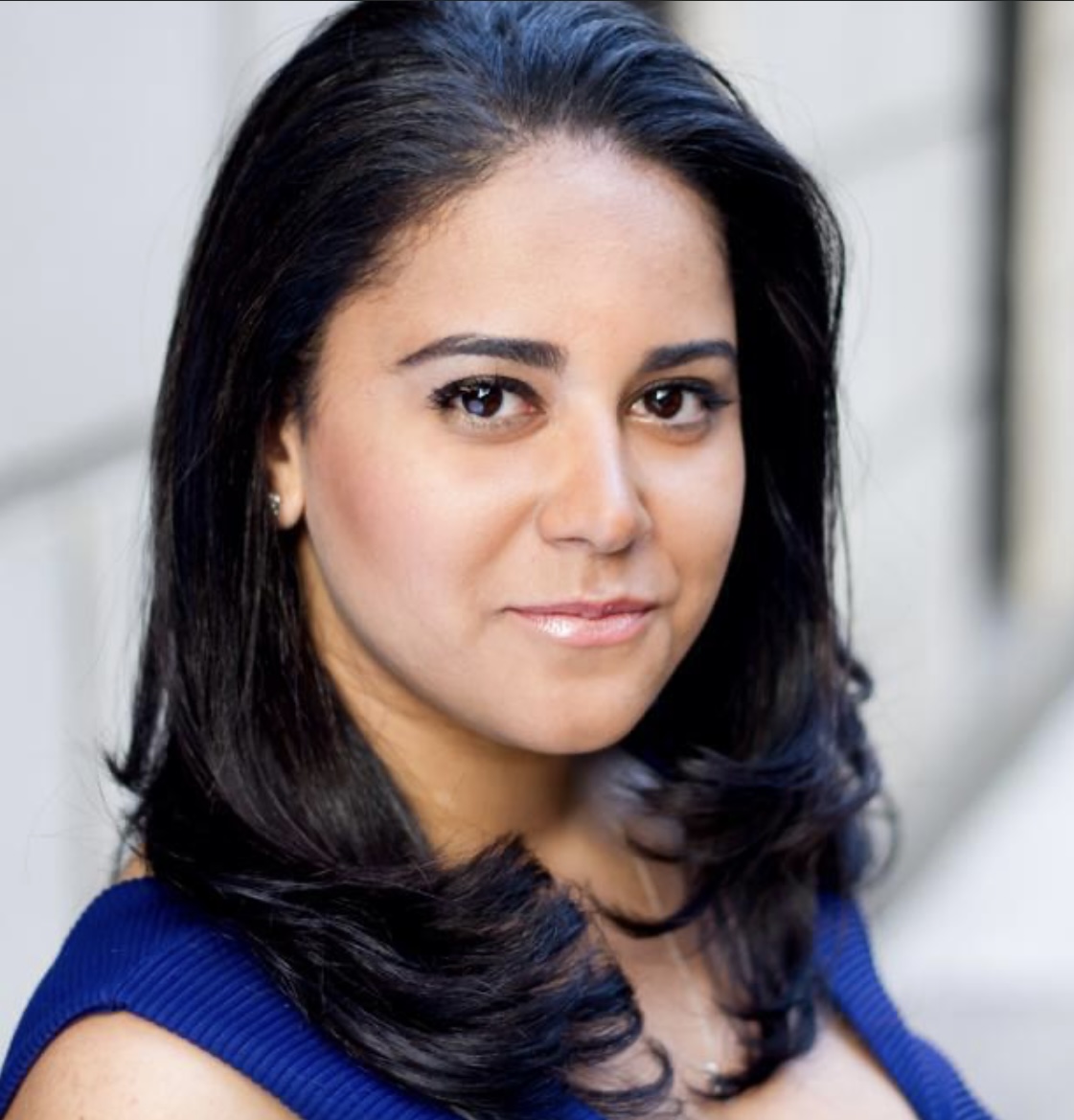
Dr. Jasmin (Bey) Cowin, an Associate Professor at Touro University, received the 2024 Touro University CETL Faculty Fellowship for Excellence in Teaching and the Rockefeller Institute of Government awarded her the prestigious Richard P. Nathan Public Policy Fellowship (2024-2025). As a Fulbright Scholar and SIT Graduate, she was selected to be a U.S. Department of State English Language Specialist. Her expertise in AI in education is underscored by her role as an AI trainer and former Education Policy Fellow (EPFP™) at Columbia University's Teachers College. As a columnist for Stankevicius, she explores Nicomachean Ethics at the intersection of AI and education. She has contributed to initiatives like Computers for Schools Burundi, served as a resource specialist for Amity University in Uttar Pradesh, India, and participated in TESOL "Train the Trainer" programs in Yemen and Morocco. Her research interests include simulations and metaverse for educators-in-training, AI applications in education and language acquisition and teaching, and distributed ledger technologies, with a focus on her 'Education for 2060' theme.
In conclusion, my commitment extends beyond transactional interactions, focusing instead on utilizing my skills and privileges to make a positive, enduring impact on the world.
I am pleased that my thoughts on “The Mitzvah of Mezzuzah and Metaverses” were featured in the Israel Herald. I believe it is time to engage in transdisciplinary discussions and explore the potential implications of dynamic simulation environments for Jewish educators, instructional designers, metaverse curators, and users to ensure Jewish principles are honored.
As a conference co-chair for the Third VirtuaTELL Conference, I am pleased to announce:
Conference Theme: Technology Enhanced Language Learning: Investigate, Identify, and Innovate
There will also be an Innovative Technology Use Teacher Competition
The Third VirtuaTELL Conference will be on May 6th, 2023.
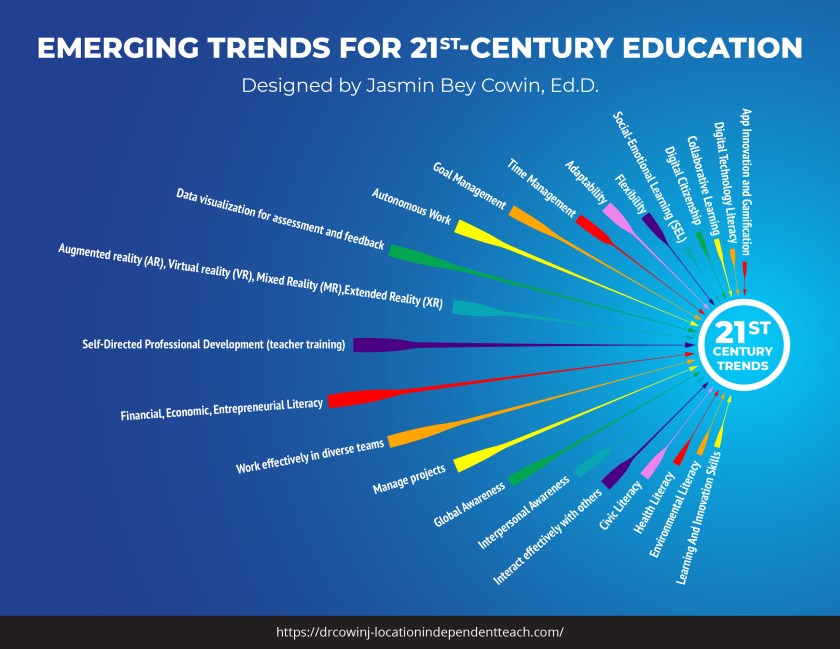
This year’s conference theme reflects on current trends and approaches in technology-enhanced language learning and teaching to investigate, identify and innovate within a broad consideration of related issues, including (but not limited to) the following: millennials and language acquisition; 21st Century pedagogies embedded in and using technology for language teaching and acquisition; assistive technologies, technology in special education; culturally relevant and asset-based pedagogy, gamification, e-assessment; and immersive realities for diverse linguistic learners.
This podcast is a go-to resource to stay updated with the latest and greatest Ed Tech tools that are disturbing (in a good way) education. EdUp EdTech is hosted by Holly Owens, whose ability to break down the complex components of edtech makes us believe we can do anything when it comes to education! Join Holly each week as she hosts insightful guests from the world of educational technology.
Holly Owens, “In this episode, I got to chat with my friend, Dr. Jasmin Cowin from Touro University! Jasmin is an Assistant Professor of TESOL, Ed Tech guru, and lover of all things education. In this episode, you get to hear about Jasmine’s journey into education, her thoughts on jobs of the future, and what we should be doing to prepare our educators for 21st-century classrooms.”
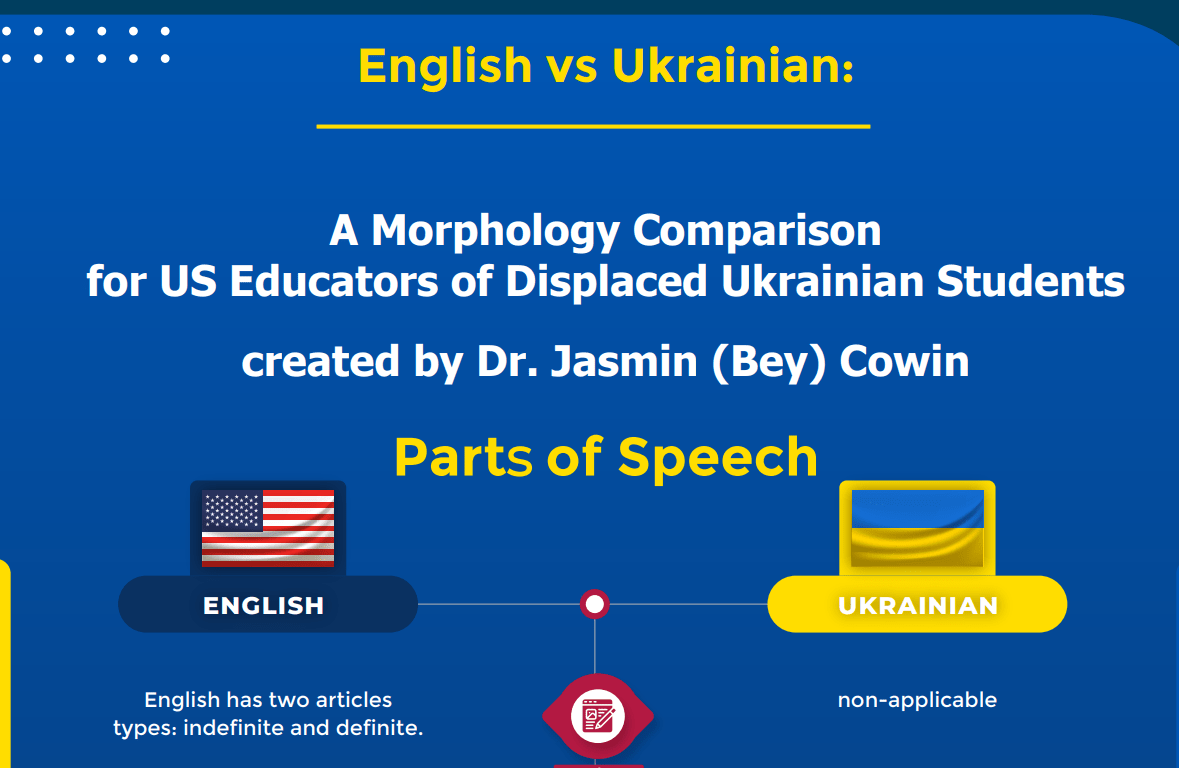
To support teachers working with Ukrainian students, I prepared this grammar resource for teachers and students alike to showcase a morphology comparison between Ukrainian and English parts of speech. Morphological awareness has been related to literacy development including vocabulary development and reading comprehension (Ke & Xiao, 2015).
I believe that developing morphological awareness across both languages, enables both teachers and Ukrainian students to use their linguistic repertoire across languages and benefit from their multilingual resources.
Dr. Jasmin (Bey) Cowin
In addition, Translate Google is a useful tool for basic translations. Feel free to share my resource!
As displaced Ukrainian families are dispersing out across the country they are finding refuge with family, friends, and volunteers and enroll their children in school. In New York, the Mayor’s Office of Immigrant Affairs (MOIA) Commissioner Manuel Castro launched New York City’s Ukrainian Response Initiative in June 2022, to help currently residing and newly arrived Ukrainian New Yorkers access immigration legal assistance, translation services, social services, and other resources. Information on how to access services provided through this initiative can be found on nyc.gov/ukraineresources or by calling NYC’s immigration hotline at 800-354-0365.
New York State officials estimate New York will need more than 180,000 new teachers in the next decade, however, the teacher shortage is already hitting selected subject specialties and geographic areas. According to NYSUT, New York reports persistent shortages in teachers for special education, bilingual education, English as a Second Language, science, mathematics, English Language Arts, social studies, world languages, career and technical education, health education, literacy and library science.
Touro University’s TESOL and bilingual certificate programs prepare NYS-certified teachers to provide responsive, comprehensive education to students of every background.
What You’ll Learn
The 15-credit program includes five courses—each with carefully designed fieldwork experiences—that emphasize both academic content learning and English fluency for English Language Learners.
We explore contemporary theory and research-based instructional strategies for multicultural education, methods and materials for second language acquisition, and best practices for teaching ELLs in specific subjects. We give you the tools to ensure that your students meet the latest performance standards of PreK-12 curricula in both private and public schools.
Courses are offered evenings and Sundays, and online to accommodate our students’ diverse scheduling needs, and you’ll receive personalized guidance based on your current work and career goals from highly qualified and experience professors.
Upon completion of the program, you’ll be eligible for the New York State Advanced Certificate in ESOL. All courses are transferable to the master’s degree program in TESOL at Touro College.
Admissions Requirements
In addition to general requirements, applicants must provide proof of initial or professional teaching certificate, as well as 12 credits of foreign language study or a passing score on a CLEP examination. Students who have not satisfied the foreign language studies requirement may be admitted to the program, but with the understanding that they must satisfy this requirement as soon as possible and prior to graduation.
Contact us to learn more about our advanced certificate and master’s programs.
References:
Ke, S., & Xiao, F. (2015). Cross-linguistic transfer of morphological awareness between Chinese and English. Language Awareness, 24(4), 355–380. doi:10.1080/09658416.2015.1114624 [Taylor & Francis Online], [Web of Science ®], [Google Scholar]
As the end of 2022 is approaching, I decided to design a “poster” and create a bilingual English-Spanish glossary as a resource for administrators and teachers working with Spanish-speaking families. The inspiration came from a text-heavy document by THE STATE EDUCATION DEPARTMENT / THE UNIVERSITY OF THE STATE OF NEW YORK, Office of P-12 Key Terms Used to Describe Practices Related to the Education of ELLs in New York State, March 2016. As I read through the document, I thought about visually creating a simpler structure to unbundle the information in a visual way.
Feel free to share!
“Learning another language is not only learning different words for the same things, but learning another way to think about things.”
The New York State Education Department is intending to make new grant awards for the operation of Clinically Rich Intensive Teacher Institute programs (CR-ITI). These Institutes are targeted at NYC teachers who want to obtain a TESOL or Bilingual General Education teaching certificate.
Touro College’s Graduate School of Education is successfully operating a 5-year CR-ITI Program under NYSED. Under the Touro program, an annual cohort of 20 teachers will take 5 courses and upon completion of the program, will be recommended to NYSED for either an ESOL (PreK-12) or Bilingual Extension. Under the grant, participants will receive tuition support of $900 per course, as well as a 15% Touro College discount for the remainder of tuition expenses. To complete the entire one-year certificate program,
Eligibility Requirements for Participating Teachers:
Participants must be NYC DOE teachers (with an initial or professional classroom teaching certificate) and must be recommended by their principals.
Teachers must be highly motivated and dedicated to better serving ELLs in their schools or districts.
TESOL candidates will need to provide proof of experience with learning a foreign language (equivalent to 12 college credits). Candidates may complete the necessary credits while in the program.
Bilingual Extension candidates will need to provide verification of target language proficiency.
For more details about this great opportunity program please see the attachment. For other information including deadlines for application please contact
Dr. Olga De Jesus-Diaz
To apply send required information to : Dr. Olga De Jesus-Diaz
Thousands of new students have arrived in city schools over the past few months, largely children of asylum seekers from South and Central America. Some have landed at schools with robust bilingual programs, where they can learn academic content while gaining English skills. Others find themselves lost in classes where the only language spoken is English.
Touro University’s TESOL/BLE Education Program offers an advanced certificate to address the shortage of bilingual teachers and administrators.
Bilingual Education and Services There is a need for high-quality educators trained to offer bilingual education and services. For certified teachers and professionals, a bilingual certificate can extend your certification and opportunities. All our courses stress the importance of considering cultural factors alongside individual abilities in teaching bilingual students. We offer three advanced certificates in bilingual education and services:
Bilingual General Education, PreK-12, for mainstream teachers looking to work with bilingual students, teaching their content area in two languages.
BILINGUAL SPECIAL EDUCATION AND SPEECH & LANGUAGE DISABILITIES is for special education teachers who want to work with bilingual students with cognitive impediments, and help assess whether it’s a hearing or speech impediment that makes it hard for the student to replicate the English language and with them on speech patterns.
Bilingual Pupil Personnel Services is for school counselors, social workers and psychologists, who want to work with bilingual students.
This course provides a historical overview of second language acquisition theories and teaching methods. Students learn how to apply current approaches, methods and techniques, with attention to the effective use of materials, in teaching English as a second language. Students will engage in the planning and implementation of standards-based ESL instruction which includes differentiated learning experiences geared to students’ needs. Emphasis is placed on creating culturally responsive learning environments. Includes 15 hours of fieldwork.
Fieldwork: Exploration and analysis of relevant K-12 pedagogical approaches, methods, and strategies needed to convey to a diverse population state and professional standards-based curricula. Development, adaptation and evaluation of materials for implementation in lesson planning and assessment for teaching English to speakers of other languages to particular groups of different ages, ability levels and cultural backgrounds.
Using centers will allow my students to work on activities that are differentiated according to their academic levels. In these centers, my paraprofessionals and I can give to one-on-one support to my students and collect data on the acquisition of IEP goals. Moving forward as a bilingual education teacher, I will provide a multicultural learning environment in which students’ native language is seen as an asset rather than a barrier.
Paola Gomez, Touro University Bilingual Advanced Certificate Candidate
“As a professor, I created this blog as a mechanism to support, appreciate and showcase the exemplary work of my graduate and professional Touro University TESOL/BLE teacher candidates. By emphasizing candidates’ best work, and their innovative, thoughtful, reflective contributions I provide a path to shift the focus to their professional values while recognizing and celebrating their significant milestones in the Touro University TESOL/BLE program.” by Dr. Jasmin (Bey) Cowin, Assistant Professor, TESOL/BLE Department, Touro University
Admissions Requirements
We welcome applications from NYS-certified teachers who would like to pursue TESOL certification. This program is designed to strengthen teachers’ capacities to effectively serve children for whom English is a second language.
Ready to Apply?
Visit admissions to find out how to apply and start your application.
EDDN 637 Second Language Learners and the Content Areas
Students will become acquainted with and practice effective approaches, methods, and strategies for teaching and evaluating English language learners in the content areas (ELA, social studies, math and science). Throughout the course, students will explore the impact of culture and language on classroom learning. Special challenges in teaching and assessment in each content area will also be discussed. Includes 15 hours of field work.
Touro University TESOL Candidate Nicole Andrade is 25 years old. Her family is from Bolivia. She has worked as a Lead Preschool teacher and as a substitute teacher for the DOE for two years, giving her experience in different classroom settings from grades K-5.
It is important to develop the proper instruction, intervention, and goals for students when designing a curriculum. Code-based skills and meaning based skills are what educators must work on with students in order to gain advancements in reading comprehension from students. Code-based skills rely on students’ abilities to sound words out and alphabet knowledge, whereas meaning-based skills refer to vocabulary. Vocabulary is essential in literacy development. English Language Arts Standards categorize three areas, reading literature, reading information text, and language. In these areas, educators must choose the correct interventions to best support students, for instance understanding the difference between a student who needs assistance in code-based skills such as reading words slowly, or meaning-based skills where a student may have difficulty with comprehension of an unfamiliar vocabulary word in a passage(NYSED, 2022).
It is my great pleasure to play with organist Charles Thatcher for the Deutsche Martin-Luther-Gemeinde, 1600 S Orlando Ave, Winter Park, FL 32789 (St. John Lutheran Church) Pastor Wilfried Wassermann Christvesper am 4. Advent, 18. Dezember 2022 Martin-Luther-Gemeinde, Orlando, Email: dtgemeindeorl@aol.com Internet: www.deutschekircheflorida.com/de/orlando-de.html
When: Dec 14, 2022, from 01:00 PM to 02:00 PM (ET)
DESCRIPTION: In this sharing session, we will look at a number of public domain websites that are used for sourcing materials for language teaching. Specifically, we will review pedagogical tools, actual lessons, language aids in terms of videos, readings, practice exercises, and some teacher training materials and resources.
PRESENTER
Lubie Alatriste holds a doctorate from Columbia University and is a professor of English/Applied Linguistics at the City University of New York (CUNY). Her research interests include genre analysis, institutional discourse, reflexivity and praxis in education, second language writing, curriculum, and materials development. Her most recent book-length publication is Language Research in Multilingual Settings (2020, Palgrave MacMillan), and Second Language Writing in Transitional Spaces (2020, University of Michigan Press). She is the author of numerous articles and has served on editorial boards of international journals. Lubie is a founding co-editor/Editor-in-Chief of TESOL Affiliate NYS TESOL Journal. The webinar will be moderated by Dr. Jasmin (Bey) Cowin, Touro University.







 Dr. J's Education Blog
