As a Professor for TESOL, I am immensely proud to feature outstanding student work from our MS in Teaching English to Speakers of Other Languages (TESOL) Program. New York’s linguistic diversity demands teachers who can find common ground and effectively communicate with students from different language backgrounds. Academically rigorous and practice-intensive, the 33-credit program includes 50 hours of fieldwork andsupervised student teaching experiences. Candidates who complete all coursework, fieldwork, and student teaching requirements are eligible for recommendation for ESL certification.
Emily Georgoulakos is a second-year master’s student in the TESOL program at Touro University. With certifications in General and Special Education for Birth through 6th Grade, Ms. Georgoulakos brings a wealth of knowledge and practical expertise to their current role. She teaches in a first-grade self-contained classroom, following a 15:1 student-to-teacher ratio, in a district that serves a substantial ENL (English as a New Language) population.
My journey at Touro University has been a valuable and positive experience as am able to continue to develop and grow as a teacher to support students of all cultural backgrounds and individual needs.
Emily Georgoulakos, TESOL/BLE candidate at Touro University
As a Professor for TESOL, I am immensely proud to feature outstanding student work from our MS in Teaching English to Speakers of Other Languages (TESOL) Program. New York’s linguistic diversity demands teachers who can find common ground and effectively communicate with students from different language backgrounds. Academically rigorous and practice-intensive, the 33-credit program includes 50 hours of fieldwork andsupervised student teaching experiences. Candidates who complete all coursework, fieldwork, and student teaching requirements are eligible for recommendation for ESL certification.
EDDN 637: Students will become acquainted with and practice effective approaches, methods, and strategies for teaching and evaluating English language learners in the content areas (ELA, Social Studies, Math and Science). Throughout the course, students will explore the impact of culture and language upon classroom learning. Special challenges in teaching and assessment in each content area will be discussed. Examination and analysis of curriculum materials and instructional strategies for creative teaching and learning in grades Pe-K-12. Includes content-specific lesson planning that addresses the New York State Student Content Learning Standards with emphasis on English Language Arts, English as a Second Language, and content area instruction. Course content includes demonstrations, simulated activities, and field observations in Pre-K-12 classrooms. The course also examines how the teaching of English to non-native speakers can be integrated with the teaching of cognitive skills in all content areas. Students will be offered a variety of methods and materials to integrate ESL standards throughout all content areas for classroom use. Includes 15 hours of fieldwork.
Kayla Challenor currently works as a Reading Teacher at Island Trees Memorial Middle School in Levittown, NY. She holds a master’s degree in Reading and Literacy (K-12). Passionate about furthering her education, she is currently in the process of earning her TESOL certification at Touro University. Her dedication is evident in her ongoing efforts to ensure the success of all learners.
“I am dedicated to applying our coursework knowledge into my classroom.”
As a Professor for TESOL, I am immensely proud to feature outstanding student work from our MS in Teaching English to Speakers of Other Languages (TESOL) Program. New York’s linguistic diversity demands teachers who can find common ground and effectively communicate with students from different language backgrounds. Academically rigorous and practice-intensive, the 33-credit program includes 50 hours of fieldwork andsupervised student teaching experiences. Candidates who complete all coursework, fieldwork, and student teaching requirements are eligible for recommendation for ESL certification.
EDDN 637: Students will become acquainted with and practice effective approaches, methods, and strategies for teaching and evaluating English language learners in the content areas (ELA, Social Studies, Math and Science). Throughout the course, students will explore the impact of culture and language upon classroom learning. Special challenges in teaching and assessment in each content area will be discussed. Examination and analysis of curriculum materials and instructional strategies for creative teaching and learning in grades Pe-K-12. Includes content-specific lesson planning that addresses the New York State Student Content Learning Standards with emphasis on English Language Arts, English as a Second Language, and content area instruction. Course content includes demonstrations, simulated activities, and field observations in Pre-K-12 classrooms. The course also examines how the teaching of English to non-native speakers can be integrated with the teaching of cognitive skills in all content areas. Students will be offered a variety of methods and materials to integrate ESL standards throughout all content areas for classroom use. Includes 15 hours of fieldwork.
Amelia Cusack is a second-grade teacher certified in general and special education, grades 1-6, and in the process of obtaining a TESOL certification at Touro University.
I recommend Touro University to all my friends who want to become teachers. Their education programs gave me the flexibility to receive a quality education while working full-time.
Amelia Cusack, Touro University TESOL certification candidate
The following passage is an excerpt from a 4th grade workbook. The reading program is HMH: Into Reading
As a Professor for TESOL, I am immensely proud to feature outstanding student work from our MS in Teaching English to Speakers of Other Languages (TESOL) Program. New York’s linguistic diversity demands teachers who can find common ground and effectively communicate with students from different language backgrounds. Academically rigorous and practice-intensive, the 33-credit program includes 50 hours of fieldwork andsupervised student teaching experiences. Candidates who complete all coursework, fieldwork, and student teaching requirements are eligible for recommendation for ESL certification.
EDDN 637: Students will become acquainted with and practice effective approaches, methods, and strategies for teaching and evaluating English language learners in the content areas (ELA, Social Studies, Math and Science). Throughout the course, students will explore the impact of culture and language upon classroom learning. Special challenges in teaching and assessment in each content area will be discussed. Examination and analysis of curriculum materials and instructional strategies for creative teaching and learning in grades Pe-K-12. Includes content-specific lesson planning that addresses the New York State Student Content Learning Standards with emphasis on English Language Arts, English as a Second Language, and content area instruction. Course content includes demonstrations, simulated activities, and field observations in Pre-K-12 classrooms. The course also examines how the teaching of English to non-native speakers can be integrated with the teaching of cognitive skills in all content areas. Students will be offered a variety of methods and materials to integrate ESL standards throughout all content areas for classroom use. Includes 15 hours of fieldwork.
Jasmeet Kaur graduated from York College in Childhood Education Grades 1-6 with honors in 2022 ( Summa Cum Laude). Currently, she is working as a Substitute teacher and pursuing a Master’s in TESOL from Touro College. Her goal is to inspire Bilingual/ Multilingual and the next generation to have confidence in their abilities and use those skills towards their success.
“Touro provided me with insight into how being Bilingual/multilingual is an asset that opens the door for opportunities and cultivates tolerance and respect for other cultures.”
Jasmeet Kaur, Touro University, TESOL Candidate
Here is the second discussion board for Module 2/EDDN 637 by Jasmeet Kaur:
As a Professor for TESOL, I am immensely proud to feature outstanding student work from our MS in Teaching English to Speakers of Other Languages (TESOL) Program. New York’s linguistic diversity demands teachers who can find common ground and effectively communicate with students from different language backgrounds. Academically rigorous and practice-intensive, the 33-credit program includes 50 hours of fieldwork andsupervised student teaching experiences. Candidates who complete all coursework, fieldwork, and student teaching requirements are eligible for recommendation for ESL certification.
EDDN 637: Students will become acquainted with and practice effective approaches, methods, and strategies for teaching and evaluating English language learners in the content areas (ELA, Social Studies, Math and Science). Throughout the course, students will explore the impact of culture and language upon classroom learning. Special challenges in teaching and assessment in each content area will be discussed. Examination and analysis of curriculum materials and instructional strategies for creative teaching and learning in grades Pe-K-12. Includes content-specific lesson planning that addresses the New York State Student Content Learning Standards with emphasis on English Language Arts, English as a Second Language, and content area instruction. Course content includes demonstrations, simulated activities, and field observations in Pre-K-12 classrooms. The course also examines how the teaching of English to non-native speakers can be integrated with the teaching of cognitive skills in all content areas. Students will be offered a variety of methods and materials to integrate ESL standards throughout all content areas for classroom use. Includes 15 hours of fieldwork. Includes 15 hours of fieldwork. 3 credits
Jasmeet Kaur graduated from York College in Childhood Education Grades 1-6 with honors in 2022 ( Summa Cum Laude). Currently, she is working as a Substitute teacher and pursuing a Master in TESOL from Touro College. Her goal is to inspire Bilingual/ Multilingual and the next generation to have confidence in their abilities and use those skills towards their success.
“As a multilingual individual, I began my journey at Touro College. This has been a nurturing process, and I must say, “If you wish to fly higher, Touro will provide the wings to reach your destination.””
Jasmeet Kaur, Touro University TESOL Candidate
This is our first Discussion Board of the semester:
CHAP 1. WHAT Characteristics INFLUENCE ELLs’ having SUCCESS IN SCHOOL? Several characteristics can influence the success of English language learners (ELLs) in school such as language proficiency, cultural awareness, motivation, Home-school environment, access to resources, peer interaction, individual learning needs, cultural sensitivity, immigrant status, financial status, parental involvement, assessments and last but not least english language learning programs in school. As mentioned in the text, these characteristics can fall under different factors : English knowledge, first language (L1) knowledge, Educational background, sociocultural, emotional and economic factors and other educational categories (Echevarria et al.,2017, p.5). ELLs bring with them a wide range of educational and cultural experiences to the classroom, overlooking their linguistic differences and characteristics can impede in imparting effective learning. As Echevarria et al. ( 2017) indicates that ELLs linguistic assets and other funds of knowledge have implications for instructions, assessment and program design, further having knowledge of a student’s background and abilities in L1 language can help teachers facilitate effective instruction to promote their success in school(p.4). Thus, it is important to consider that success can vary greatly among ELLs, and individual circumstances play a significant role. Providing tailored support and resources based on each student’s needs is essential for their academic achievement.
What are some characteristics of ELLs to consider to implement effective teaching? Although there is a range of characteristics mentioned in question 1 to be considered for ELLs’ success in school. However, Some characteristics of ELLs to consider to implement effective teaching are the educational background of ELLs such as on grade level schooling in their home country and in U.S schools, proficiency in English, proficiency in native language, and individual learning styles and needs of ELLs. For example, Asian students can have a strong academic background in science and math, however, in English, they might need English Language Development ( ELD) to become more proficient in English ( Echevarria et al., 2017, p.5). Knowing these characteristics and building on their prior experiences can help teachers implement research-based pedagogy and incorporate effective techniques and materials to cater to their individual needs and close the achievement gap.
How can we as educators transform the education of English Language Learners/ Multilingual Learners for tomorrow’s world?
Transforming the education of English Language Learners (ELLs) or Multilingual Learners (MLLs) for tomorrow’s world involves adapting teaching practices to prepare them for a globalized, technologically advanced, and culturally diverse future. Some strategies such as adapting culturally responsive teaching where ELL’s culturally relevant material, perspectives, and experiences are incorporated in the curriculum and their native language is used to transfer skills to become proficient in the English language. Michelle Ortiz suggests similar strategies for entering and emerging level ELLs in the above-given article. She suggests differentiation for these learners by adding visuals to slides, translating essential vocabulary words, and allowing students to discuss the content in their native language (Schembari, Jan 11, 2023). Developing individualized learning plans for ELLs based on their language proficiency levels, learning styles, and goals and providing differentiated instruction to meet their specific needs, transferring skills from first language to second language closes the academic achievement gaps and promotes the ELLs’ success. Research also shows that there is a direct correlation between ELLs’ success and use of a first language (Schembari, Jan 11, 2023). Thus, educators should support ELLs in maintaining their proficiency in their native language(s) alongside English. Bilingualism is a valuable skill that can enhance cognitive abilities.
What is one takeaway from this week’s readings and how might it impact your teaching? This week’s reading provides me with deep insight into a range of diverse characteristics for ELLs’ success in school and factors to be considered for effective teaching. Having knowledge of all these factors and reading articles on how educators can transform the ELLs for tomorrow’s world will positively impact my teaching practice. The one big takeaway I learned is that knowing ( sociocultural, linguistic, cognitive, and academic dimensions) and building relationships with students will promote successful second language acquisition. It will lead me to implement biography-driven instruction that involves students knowing holistically to facilitate effective instruction in response to their cultural and linguistic assets and needs. Also, incorporating sheltered instruction techniques that combine language learning with academic content will help ELLs acquire language skills while mastering the subject matter. Some other methods would be to integrate technology in new ways and make it accessible to all students, being said to facilitate equitable and fair educational opportunities for students in all possible ways. Technology should be integrated into the classroom to support language learning and use educational apps, online resources, and digital platforms that can provide personalized learning experiences for ELLs. Educators should Implement project-based learning (PBL) and inquiry-based approaches. These methods promote critical thinking, problem-solving, and collaborative skills while allowing ELLs to explore topics of interest. Teaching cross-cultural competence emphasizes skills like empathy, effective communication, and an understanding of cultural nuances, which are valuable in a globalized society. Importantly, including regular assessments and content-based language instruction (CBI) or sheltered instruction techniques that combine language learning with academic content. This helps ELLs acquire language skills while mastering the subject matter. Thus, by adopting these strategies, educators can empower ELLs to thrive in tomorrow’s world, where communication skills, cultural awareness, and adaptability are increasingly vital for success.
Share a fun fact or photo of yourself. A fun fact about me is that I know four languages ( Hindi, Punjabi, English, and Nepali). But I hate how I couldn’t teach my kids to speak my native languages at home. They know their native language but choose to talk in English because they know that their parents speak and understand English.
References
Vogt, M., Echevarria, J. J., & Short, D. J. (2017). Making content comprehensible for English learners. (5th ed.). Pearson: New York.
As a Professor for TESOL, I am immensely proud to feature outstanding student work from our MS in Teaching English to Speakers of Other Languages (TESOL) Program. New York’s linguistic diversity demands teachers who can find common ground and effectively communicate with students from different language backgrounds. Academically rigorous and practice-intensive, the 33-credit program includes 50 hours of fieldwork andsupervised student teaching experiences. Candidates that complete all coursework, fieldwork, and student teaching requirements are eligible for recommendation for ESL certification.
Alexandria Galvez is a first-year teacher leading a bilingual 1st-grade classroom. She is glad to have the opportunity to work with English Language Learners and finds herself learning from them every day. Her time at Touro has been marked by the acquisition of valuable knowledge regarding effective strategies for classroom use. Her favorite quote: “The capacity to learn is a gift; the ability to learn is a skill; the willingness to learn is choice.” -Brian Herbert
Differentiated Instructional Activity Assignment
In this assignment, teachers of English Language Learners (ELL) or Multilingual Learners (ML) will explore and implement differentiated instructional activities to maximize the learning of every student in their class. Using the provided Tools for High-Quality Differentiated Instruction: An ASCD Action Tool, teachers will modify an existing content lesson plan to incorporate differentiation strategies in various aspects of instruction. The assignment requires the submission of a paper including the original and differentiated lesson plans, along with all materials, and a 2-4 minute video showcasing one specific aspect of a differentiated instructional activity. The assignment aims to facilitate professional growth and reflection on implementing differentiated instruction.
As I reflect on my completion of the Differentiated Instructional Activity, I am now more aware of my own strengths in terms of recognizing what works for me as the educator and strategies that work for English Language Learners in order to differentiate. For example, using whiteboards as a way to quickly assess student understanding is an engaging hands-on strategy that students enjoy using because it is considered “fun” instead of using regular pencil and paper.
Alexandria Galvez, Touro University TESOL Candidate
As a Professor for TESOL, I am immensely proud to feature outstanding student work from our MS in Teaching English to Speakers of Other Languages (TESOL) Program. New York’s linguistic diversity demands teachers who can find common ground and effectively communicate with students from different language backgrounds. Academically rigorous and practice-intensive, the 33-credit program includes 50 hours of fieldwork andsupervised student teaching experiences. Candidates that complete all coursework, fieldwork, and student teaching requirements are eligible for recommendation for ESL certification.
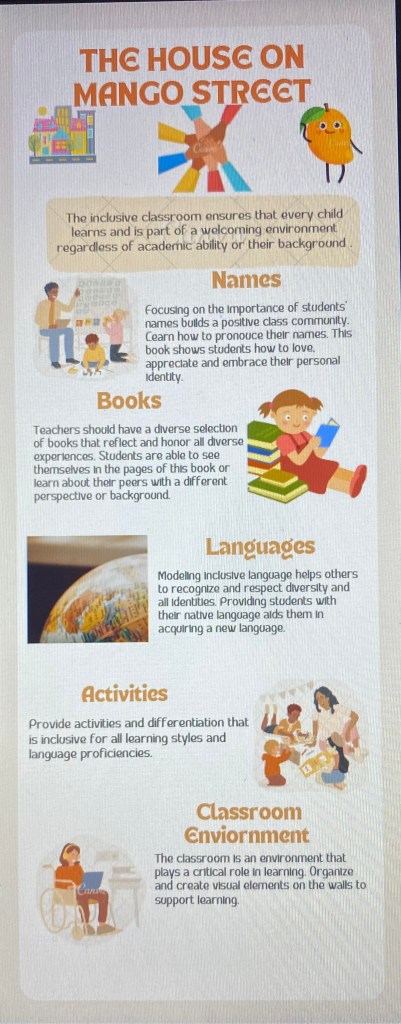
Infographic by Crystal DeMarco
EDPN 673 Methods and Materials for Teaching English as a Second Language
This course provides a historical overview of second language acquisition theories and teaching methods. Students learn how to apply current approaches, methods and techniques, with attention to the effective use of materials, in teaching English as a second language. Students will engage in the planning and implementation of standards-based ESL instruction which includes differentiated learning experiences geared to students’ needs. Emphasis is placed on creating culturally responsive learning environments. Includes 15 hours of fieldwork.
Crystal DeMarco graduated with her Bachelor’s in Education for grades 7-12 from the College of Staten Island. She is currently working towards her Master’s Degree in the TESOL Program at Touro University. Crystal continues to strive for excellence in her academics to become the best educator and role model for her students. She believes that “Education is the most powerful weapon which you can use to change the world.” – Nelson Mandela
Touro has been one of the best educational experiences in my career by far.
I will empower my students’ voices and opinions throughout instruction to show them that their education is important to me, and that their success in my classroom is my number one goal.
As a Professor for TESOL, I am immensely proud to feature outstanding student work from our MS in Teaching English to Speakers of Other Languages (TESOL) Program. New York’s linguistic diversity demands teachers who can find common ground and effectively communicate with students from different language backgrounds. Academically rigorous and practice-intensive, the 33-credit program includes 50 hours of fieldwork andsupervised student teaching experiences. Candidates that complete all coursework, fieldwork, and student teaching requirements are eligible for recommendation for ESL certification.
EDDN 637: Students will become acquainted with and practice effective approaches, methods, and strategies for teaching and evaluating English language learners in the content areas (ELA, Social Studies, Math and Science). Throughout the course, students will explore the impact of culture and language upon classroom learning. Special challenges in teaching and assessment in each content area will be discussed. Examination and analysis of curriculum materials and instructional strategies for creative teaching and learning in grades Pe-K-12. Includes content-specific lesson planning that addresses the New York State Student Content Learning Standards with emphasis on English Language Arts, English as a Second Language, and content area instruction. Course content includes demonstrations, simulated activities, and field observations in Pre-K-12 classrooms. The course also examines how the teaching of English to non-native speakers can be integrated with the teaching of cognitive skills in all content areas. Students will be offered a variety of methods and materials to integrate ESL standards throughout all content areas for classroom use. Includes 15 hours of fieldwork. Includes 15 hours of fieldwork. 3 credits
Gianna Romanelli is a math teacher in the Sewanhaka Central High School District. She loves teaching math because she strives to help her students to recognize that math doesn’t have to be boring. Gianna said: “Even though math is my passion, in my free time I enjoy boating, fishing, and gardening!”
My journey at Touro thus far has been delightful. One of my biggest worries with a fully online program is the lack of personal relationships with my professors. I can proudly say the professors at Touro have been nothing short of understanding. The TESOL program is informative and allows educators/students to learn at their own pace.
Gianna Romanelli, Touro University TESOL Candidate
As a Professor for TESOL, I am immensely proud to feature outstanding student work from our MS in Teaching English to Speakers of Other Languages (TESOL) Program. New York’s linguistic diversity demands teachers who can find common ground and effectively communicate with students from different language backgrounds. Academically rigorous and practice-intensive, the 33-credit program includes 50 hours of fieldwork andsupervised student teaching experiences. Candidates that complete all coursework, fieldwork, and student teaching requirements are eligible for recommendation for ESL certification.
EDDN 637: Students will become acquainted with and practice effective approaches, methods, and strategies for teaching and evaluating English language learners in the content areas (ELA, Social Studies, Math and Science). Throughout the course, students will explore the impact of culture and language upon classroom learning. Special challenges in teaching and assessment in each content area will be discussed. Examination and analysis of curriculum materials and instructional strategies for creative teaching and learning in grades Pe-K-12. Includes content-specific lesson planning that addresses the New York State Student Content Learning Standards with emphasis on English Language Arts, English as a Second Language, and content area instruction. Course content includes demonstrations, simulated activities, and field observations in Pre-K-12 classrooms. The course also examines how the teaching of English to non-native speakers can be integrated with the teaching of cognitive skills in all content areas. Students will be offered a variety of methods and materials to integrate ESL standards throughout all content areas for classroom use. Includes 15 hours of fieldwork. Includes 15 hours of fieldwork. 3 credits
The attached PPT was a submission for discussion board 9, EDDN 637. I believe using varying submission types such as voice tread, video, PPTs, Padlets, etc. opens up a fertile space for Touro candidates to engage with the materials and each other. I believe assessment diversity is pivotal for teachers of ELL /ML learners, to ensure a holistic view of their linguistic progress. Varied assessments capture different language domains, promoting equity and reducing learner anxiety. They provide instructors with a multifaceted perspective, enabling tailored instruction.
Dr. Jasmin (Bey) Cowin, Associate Professor and TESOL/BLE Praticum Coordinator, Touro University
Samantha Howe is a 5th-grade teacher from Long Island. After receiving her bachelor’s degree in inclusive childhood education, she was accepted into the TESOL program at Touro University. She is passionate about providing an inclusive and equitable education for all students.
The TESOL program at Touro University has already provided me with valuable insights and necessary tools to better support my multilingual students.
As a Professor for TESOL, I am immensely proud to feature outstanding student work from our MS in Teaching English to Speakers of Other Languages (TESOL) Program. New York’s linguistic diversity demands teachers who can find common ground and effectively communicate with students from different language backgrounds. Academically rigorous and practice-intensive, the 33-credit program includes 50 hours of fieldwork andsupervised student teaching experiences. Candidates that complete all coursework, fieldwork, and student teaching requirements are eligible for recommendation for ESL certification.
Ashley Ramdat will be a first-year teacher for the upcoming school year and is happy to serve as a first-grade special education teacher. She has one semester left until she graduates with her masters in TESOL and states that she “is beyond excited.”
Touro Graduate School of Education has provided me with such a rich education thus far. They have prepared me immensely in being able to create a culturally inclusive classroom and I appreciate the feedback, support, and conversations I’ve had with peers and professors.”













 Dr. J's Education Blog