Touro University TESOL Candidate Kenia Torres’ Tech Tools

EDDN 635 Curriculum Development and Classroom Management in the Technology Era

This comprehensive course builds upon the foundation of curriculum development and classroom management in the context of teaching English language learners. Expanding its horizons to embrace the digital age, the course adeptly weaves innovative technology integration into the domain of Teaching English to Speakers of Other Languages (TESOL). Crafted to empower prospective TESOL/BLE educators, the course hones in on fostering competence in designing, implementing, assessing, and reflecting within diverse language learning environments, all while capitalizing on the potential of cutting-edge technology. With a strong focus on practical application and discerning appraisal of technological tools, this course primes upcoming educators to excel amidst the ever-evolving educational landscape. Includes 10 hours of fieldwork.

Kenia Torres is a Bilingual Kindergarten teacher in the Brentwood Union Free School District. She received her Bachelor’s Degree in Child Studies with a concentration in Speech Communication from Saint Joseph’s University, a Bilingual Extension from Touro University, and is currently enrolled in a TESOL program at Touro University. Kenia is passionate about developing a classroom community that allows all children to achieve their academic and personal goals. In the future, she would like to pursue an educational leadership role to empower educators and students to catalyze school success. A quote that reflects Kenia’s vision of the educational field is: “Tell me and I forget, teach me and I remember, involve me and I learn.”- Benjamin Franklin

The assignment for EDDN 635 Curriculum Development and Classroom Management in the Technology Era was: To curate a list of technology tools that not only aid in instructional strategies and curriculum development but also facilitate community outreach and engagement.

Introduction: Briefly discuss the importance of integrating technology in education and its possible role in using it for community engagement.

Selection of Technology Tools: Choose 9 technology tools, ensuring a mix that includes tools for both educational purposes and community outreach. These tools could range from educational platforms and apps to communication and social media tools.

Tool Descriptions: Provide a concise description of each tool, highlighting its key features and the URL. Explain how each tool can be used in an educational context and for community engagement.

Practical Applications: Illustrate practical examples of how these tools can be integrated into teaching, curriculum design, and/or community outreach initiatives. Examples could include using social media for parent-teacher communication, blogs for student projects showcased to the community, or collaborative platforms for community-based projects.

Reflection and Analysis: Reflect on the potential impact of these tools on enhancing educational experiences and community relations.
Analyze any challenges or limitations in implementing these tools for both educational and outreach purposes.

Format and Submission: Choose of format of your choice – possibly a Storybook, Padlet, Flipgrid etc.

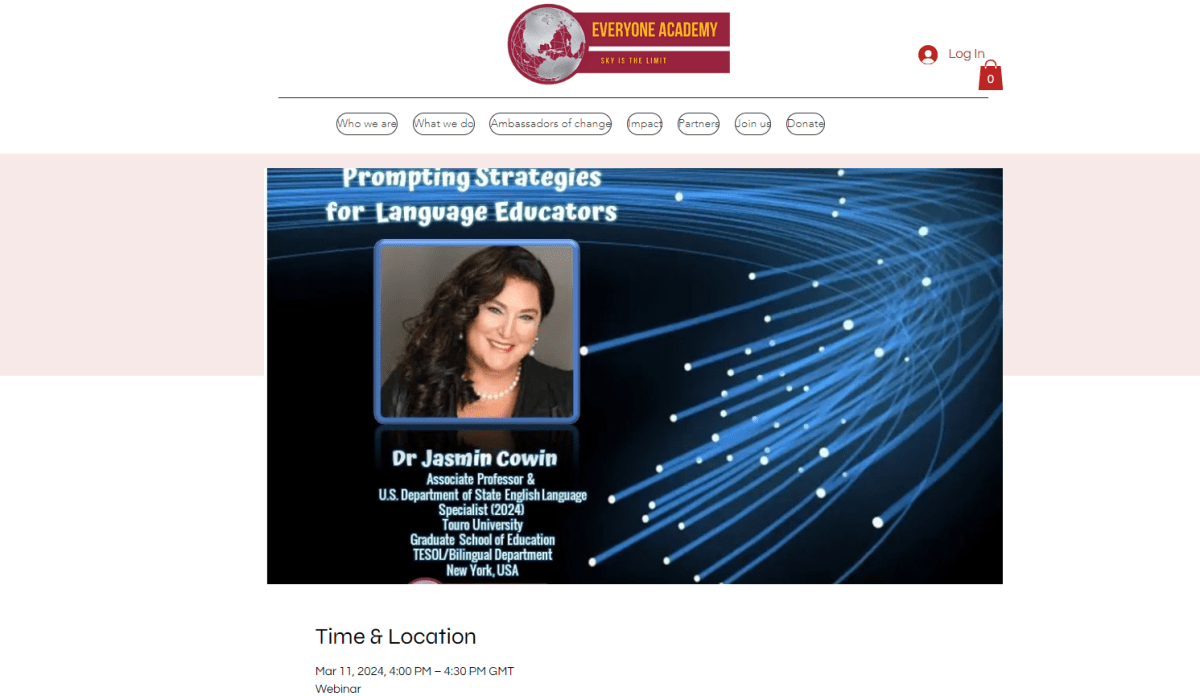
Join my webinar for Everyone Academy: Structured AI Prompting Strategies for Language Educators

At the heart of my professional journey is a commitment to transformative education, grounded in integrating concepts like Lynda Miller’s philosophy of abundance, which counters Ruby Payne’s notion of a Culture of Poverty (2005). This philosophy of abundance emphasizes viewing experiences as assets filled with positivity and optimism, particularly valuable in an often dystopian-seeming world. Aligned with the UN’s Sustainable Development Goal 4, she has contributed to initiatives like Computers for Schools Burundi, TESOL “Train the Trainer” programs in Yemen and Morocco. As an educator in the Fourth Industrial Revolution era, I prepare future teachers by incorporating innovations in education to shape worldviews and cultivate an adaptable skillset for Volatile, Uncertain, Complex, Ambiguous (VUCA) environments. Her research explores simulations for educators-in-training, AI in education and assessment, educational Metaverse applications, and educational transformation for language educators.

Through my pro-bono work, I support SDG 4.c By 2030, substantially increase the supply of qualified teachers, including through international cooperation for teacher training in developing countries, especially least developed countries and small island developing States.

Mon, Mar 11 | Webinar Time & Location Mar 11, 2024, 4:00 PM – 4:30 PM GMT (Casablanca, Morocco)

– click the link to register

Structured AI Prompting Strategies for Language Educators

https://www.everyoneacademy.org/event-details/structured-ai-prompting-strategies-for-language-educators

Dr. Jasmin Cowin (lead author) Co-Publishes “Accelerating Higher Education Transformation: Simulation-Based Training and AI Coaching for Educators-in-Training” at Springer Nature, Switzerland

I am delighted to announce the recent publication of our paper, titled “Accelerating Higher Education Transformation: Simulation-Based Training and AI Coaching for Educators-in-Training.” This paper has been featured in the conference proceedings titled “Towards a Hybrid, Flexible and Socially Engaged Higher Education,” published by Springer Nature, Switzerland.

Our transdisciplinary collaborative effort grew from the International Conference on Interactive Collaborative Learning (ICL 2023), Madrid, and signifies a significant step forward in our journey to reshape educational paradigms through the integration of cutting-edge technologies (Cowin et al., 2024).

Cowin, J., Oberer, B., Lipuma, J., Leon, C., & Erkollar, A. (2024). Accelerating Higher Education Transformation: Simulation-Based Training and AI Coaching for Educators-in-Training [ICL]. In M. E. Auer, U. R. Cukierman, E. Vendrell Vidal, & E. Tovar Caro (Eds.), Towards a Hybrid, Flexible and Socially Engaged Higher Education (CLDM_Dv; Vol. 899, pp. 532–541). Springer Nature Switzerland; /Research/Education. https://doi.org/10.1007/978-3-031-51979-6_55

Conference Presentation

Cowin, J., Oberer, B., Lipuma, J., Leon, C., & Erkollar, A. (2023, September 26). Accelerating Higher Education Transformation: Simulation-Based Training and AI Coaching for Educators-in-Training [Presentation] [Conference]. International Conference on Interactive Collaborative Learning (ICL 2023), Madrid, Spain. http://icl-conference.org/icl2023/

Paper Abstract
As the world undergoes remarkable transformations powered by Artificial Intelligence, the challenge arises for educational systems and institutions to adapt. How can we adequately equip educators-in-training to flourish in unprecedented change? The emergence of flexible, hybrid, and socially engaged learning environments has created a need for effective training methodologies that empower educators-in-training to thrive in this new paradigm. Higher education institutions need to expand aspiring educators’ human and professional potential amidst accelerating change, in line with the clarion call of the Sustainable Development Goal 4 Quality Education “By 2030, substantially increase the supply of qualified teachers, including through international cooperation for teacher training in developing countries, especially least developed countries and small island developing States” [1]. Simulation-based training coupled with Artificial Intelligence offers a solution to equip educators with the necessary skills and competencies to navigate complex real-world educational settings to succeed in classrooms of the 21st century. Simulation-based training allows educators-in-training to develop their skills and build confidence in their abilities to effectively engage with students in multifaceted classroom environments by providing a safe and controlled space for experimentation and practice. In conclusion, this paper and presentation explore the shifting teaching paradigms in higher education using simSchool and Mursion simulation platforms as examples and examine inclusive and dynamic practices that promote sustainable systems change in line with SDG 4. Quality Education, supporting educators-in-training by identifying strengths and encouraging personal and professional growth through AI feedback loops and faculty coaching.

Keywords: Artificial Intelligence, Educators-in-training, Simulation-based training, Sustainable systems change

Acknowledgments
I extend my heartfelt gratitude to my colleagues and peers and the supportive community that made this research possible. Our collaborative efforts reflect a unified vision for the future of education, one that embraces the challenges and opportunities presented by the digital age.

Disclosure statement
No conflict of interest pertains to the research presented above.

ORCID

Jasmin Cowin http://orcid.org/0000-0002-0405-8774

Birgit Oberer http://orcid.org/0000-0001-7231-7902

Alptekin Erkollar http://orcid.org/0000-0003-3670-5283

James Lipuma https://orcid.org/0000-0002-9778-3843

Cristo Leon https://orcid.org/0000-0002-0930-0179