


Teaching the Teachers of 2060: The Embodied Method Simulation
Since the arrival of Large Language Models (LLMs) I experimented and worked on designing what I consider AI-proof assignments: tasks where candidates must demonstrate their understanding of theory through practical application, which no chatbot can do for them. The Embodied Method Simulation is a prime example. Each Touro University TESOL course participant selects a single language teaching method from our course readings, such as Total Physical Response, Suggestopedia, the Silent Way, or Communicative Language Teaching, and performs it in its pure, original form. In a 6 to 7-minute video, they teach an imaginary group of multilingual learners as if the class were real: on camera, in a physical space, surrounded by realia, using their voice, gestures, and movement to bring a method’s theory to life.
The assignment asks for an embodied demonstration of pedagogy. Candidates show how a method actually works when they stand in a room with (imaginary) learners, handling materials, and moving through space. Theory earns its value there, in the moment of embodied instruction.
Why Copilot?
Alongside the performance, candidates co-create their teaching scripts with the Touro-approved Microsoft Copilot. Beginning with a person-centered, spatially grounded prompt, they engage in an iterative dialogue with AI, refining teacher talk, rehearsing simulated learner responses, and interrogating how their bodies and materials express the method’s principles. They then write a reflection analyzing what they accepted, adapted, or rejected from the AI’s suggestions.
Why build AI into an AI-proof assignment? Because the educators we certify today will still be teaching in 2060. They will spend their entire careers alongside artificial intelligence, and the essential career skill is directing these tools with professional judgment. When a candidate pushes back on Copilot’s suggestion because it violates the logic of TPR, or expands an AI-generated dialogue to better serve a newcomer learner, they are practicing exactly that skill: keeping the human teacher at the center while using AI as a thinking partner.
Kalee Fan is an early childhood special education teacher in a NYCPS. She is currently pursuing a Bilingual Education Extension to better support multilingual learners and create more equitable learning opportunities for all students. She is passionate about fostering an inclusive classroom where every child feels valued, confident, and empowered to succeed.
Quote about the Science of Reading:
“One of my biggest takeaways from studying the Science of Reading is that strong literacy instruction is both evidence-based and responsive to students’ individual needs. It has reinforced the importance of intentionally developing oral language alongside foundational reading skills so that multilingual learners can thrive academically.” Kalee Fan, Touro University TESOL Candidate
Part 1: Simulated Teaching Video
Part 2: Supporting Materials
I used a few materials to support my mini-lesson recording
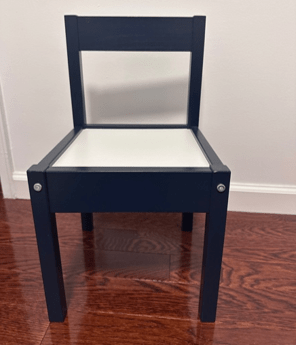
A Chair:
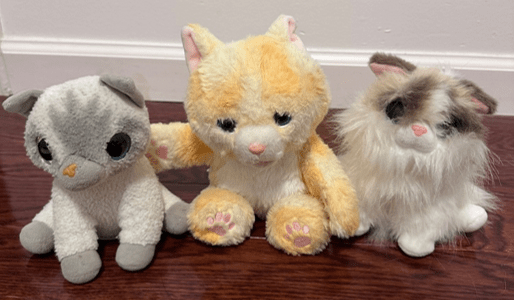
Cat Plushies:
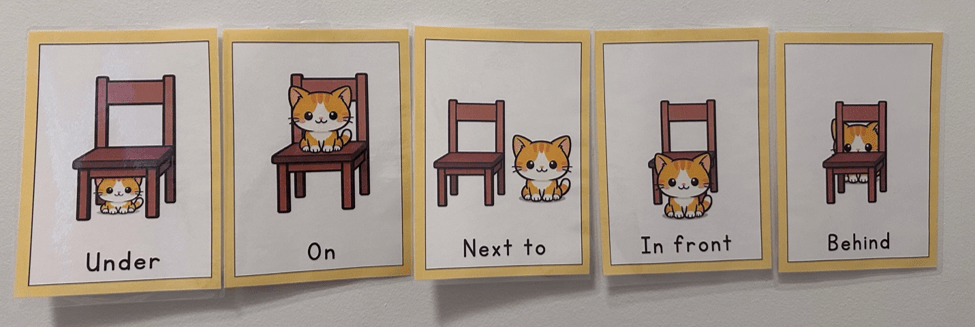
Vocabulary Cards:
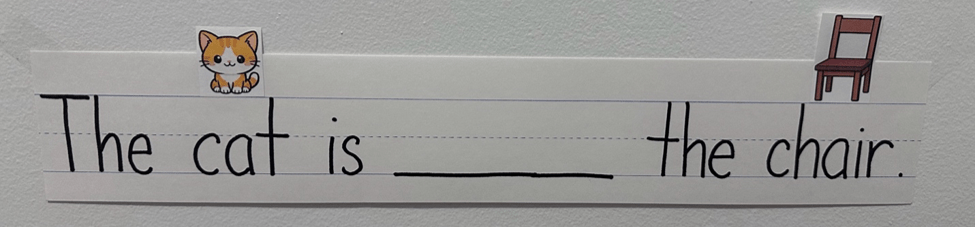
Sentence frame:
Part 3: Written Analysis and Copilot Co-Creation Reflection
Method Analysis
As an early childhood educator, I selected Total Physical Response (TPR) for my mini lesson because it aligns with the developmental needs of my kindergarten ENL students, who benefit from movement, hands-on experiences, and concrete language instruction. Developed by James Asher in the 1970s, TPR is based on the idea that language learning should resemble first language acquisition, in which children listen and respond physically long before they are expected to speak. The method creates a low-stress learning environment where learners develop comprehension through listening and movement. In a TPR classroom, the teacher gives commands and models actions while students demonstrate understanding through physical responses. The main principles of TPR include listening comprehension, physical movement, repetition, and delayed speech production. By connecting language to actions and engaging visual, auditory, and kinesthetic senses, learners gradually build understanding and confidence before producing language independently (Helbling English, n.d.).
TPR has several strengths. It lowers learners’ anxiety, increases engagement, and makes language comprehensible through concrete actions and real objects. These characteristics make it particularly effective for beginning English learners and young children (Cowin, n.d.). However, TPR also has limitations. As learners become more proficient, the method becomes less distinctive because advanced language functions and abstract concepts cannot always be represented through physical actions. In addition, reading and writing activities are often limited extensions of the oral activities in the classroom (Cowin, n.d.).
I selected TPR for my mini lesson on positional words as this topic is part of my school’s kindergarten math curriculum and provides a meaningful opportunity to connect language learning with content instruction. Positional words can be abstract for young English learners, but using TPR allows students to visualize and understand these concepts through physical movement and hands-on experiences. TPR emphasizes connecting language with actions and providing opportunities for learners to develop comprehension before producing language (Celce-Murcia et al., 2014). In my lesson, students first demonstrated their understanding by moving their bodies and a toy cat to different positions around a chair. After students had multiple opportunities to practice through physical responses, I incorporated a sentence frame, “The cat is _____ the chair,” to support oral language production. I selected a chair, cat plushies, vocabulary cards, and a sentence frame since these materials are concrete, visually accessible, and easy for young learners to manipulate. This lesson reflects the core principles of TPR by using repeated actions, multisensory experiences, and gradual language production to build students’ confidence and create an engaging, low-anxiety learning environment (Helbling English, n.d.).
Copilot Co-Creation Reflection
Before I began recording my videotaped mini lesson, I entered my initial prompt into Copilot to refine the structure and delivery of a six‑minute Total Physical Response lesson designed for Kindergarten ENL learners in a 12:1:1 bilingual special education setting. My prompt described the instructional context, the linguistic profiles of the students, and my goal of teaching spatial vocabulary using realia such as a chair and a cat plushie. Copilot generated a first draft that offered a clear introduction, a well‑sequenced modeling phase for positional vocabulary, and a strong closing routine. This initial script aligned closely with my own vision, and it helped me see how my ideas could be organized into a coherent, embodied lesson that foregrounded movement, gesture, and predictable routines. The process of reviewing this draft made me more aware of how intentional teacher talk and physical demonstration work together to support comprehension for Entering and Emerging learners.
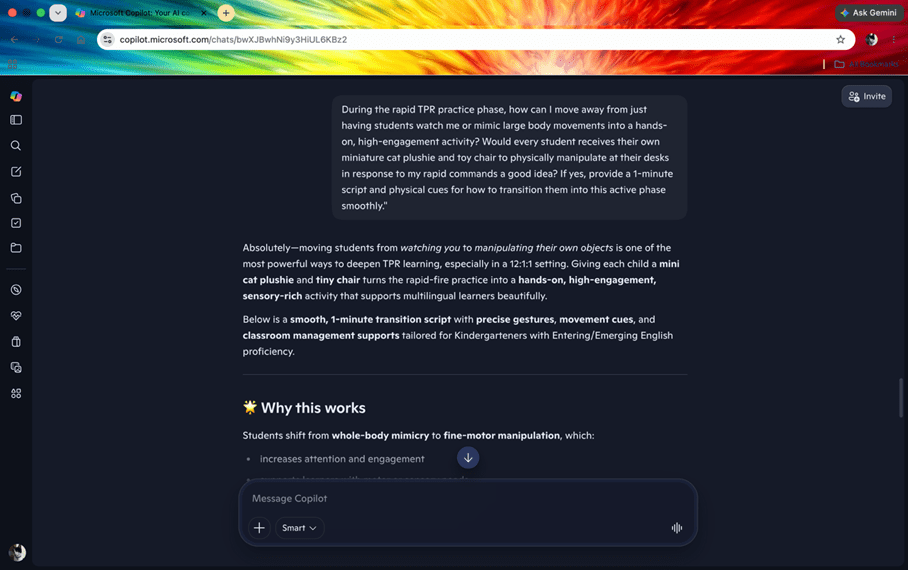
As I continued refining the lesson, I entered a second prompt asking how to shift the rapid TPR practice from simple mimicry to a more hands‑on, high‑engagement activity. I asked whether providing each student with a miniature cat plushie and toy chair would be appropriate and how to transition them smoothly into this active phase. Copilot responded with a detailed one‑minute transition script that emphasized slow pacing, clear gestures, and explicit modeling of how students should manipulate their objects. This suggestion helped me clarify my embodied role in the method. I realized that TPR is not only about demonstrating vocabulary with my own body but also about orchestrating students’ physical responses in ways that reduce cognitive load and increase autonomy. I adapted Copilot’s script by simplifying some of the language and adjusting the pacing to fit the realities of a rug‑seated Kindergarten group. I kept the core idea of using manipulatives because it aligned with my professional judgment about sensory engagement and accessibility for multilingual learners.
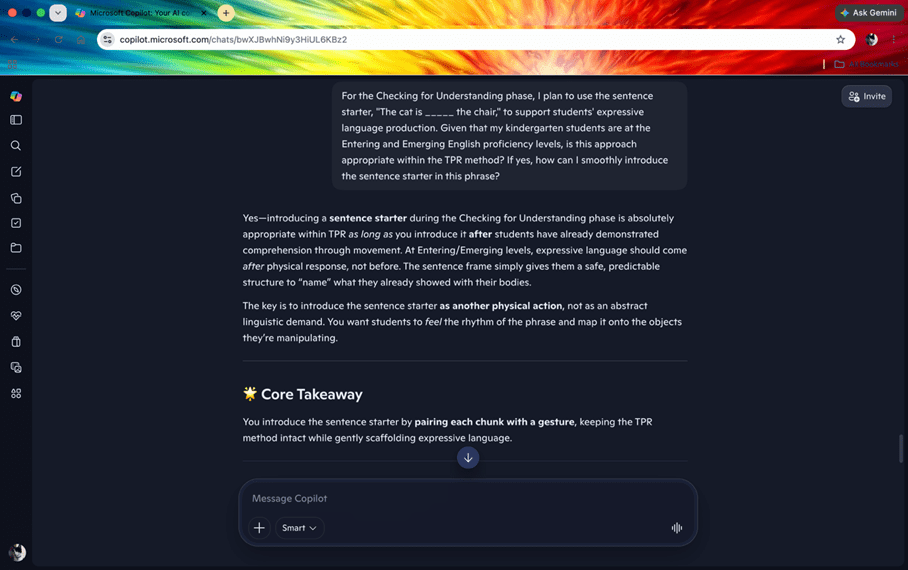
My next prompt focused on the Checking for Understanding phase, where I planned to introduce the sentence starter “The cat is ___ the chair” to support expressive language production. I asked Copilot whether this was appropriate for students at Entering and Emerging proficiency levels and how to introduce the sentence frame smoothly within the TPR method. Copilot affirmed the approach and provided a scaffolded routine that paired each chunk of the sentence with a gesture, ensuring that the language remained grounded in physical action. This helped me better understand how my embodied role could support early expressive language without overwhelming students. I adjusted the script by reducing the verbal load even further and by ensuring that students demonstrated comprehension physically before attempting any spoken output. This adaptation reflected my professional judgment about developmental readiness and the importance of maintaining TPR principles even when introducing language frames.
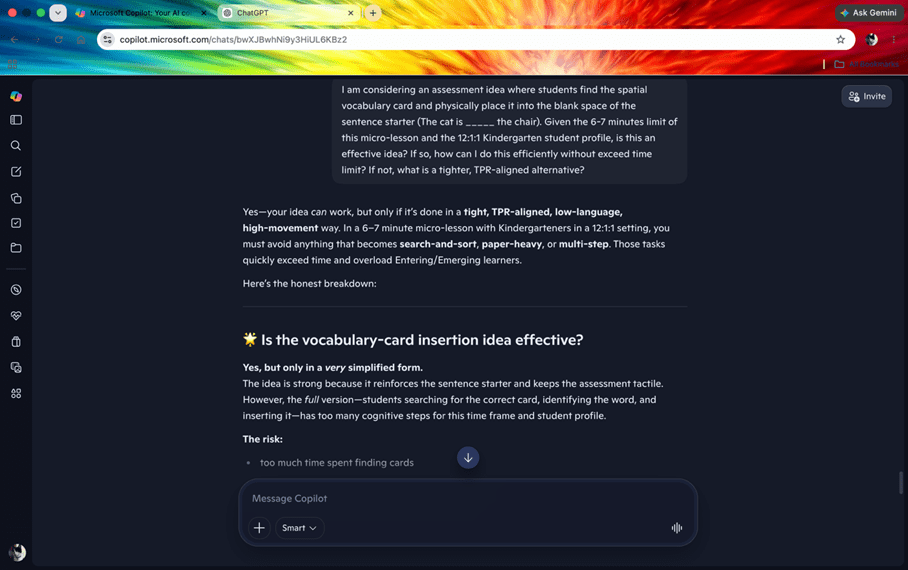
Finally, I asked Copilot about an assessment idea involving vocabulary cards that students would place into the blank space of the sentence starter. I wanted to know whether this was feasible within the six‑to‑seven‑minute time limit and appropriate for a 12:1:1 Kindergarten group. Copilot explained that the idea could work only in a highly simplified form and recommended a tighter, more TPR‑aligned alternative that removed unnecessary cognitive steps. This feedback prompted me to reconsider the assessment entirely. I rejected the original card‑search idea because it introduced too many demands for this age group and time frame. Instead, I adopted the “Touch and Tell” approach, where students physically position their mini cat and chair and then echo the sentence starter. This alternative preserved the embodied nature of TPR, respected the developmental needs of my learners, and fit smoothly within the lesson’s pacing.
Through this process, I learned how valuable it is to refine instructional decisions through cycles of questioning, reflection, and revision. Copilot helped me clarify the embodied dimensions of TPR, especially the ways teacher movement, gesture clarity, and pacing shape multilingual learners’ access to meaning. At the same time, I exercised professional judgment by adapting suggestions to fit the specific needs of my classroom, rejecting ideas that were too complex, and expanding others to strengthen linguistic accessibility. This experience reinforced the importance of designing lessons that are intentional, responsive, and grounded in both pedagogical theory and the lived realities of young ENL learners.
References:
Celce-Murcia, M., Brinton, D. M., & Snow, M. A. (Eds.). (2014). Teaching English as a second or foreign language (4th ed.). Heinle ELT.
Cowin, J. B. (n.d.). Methods and techniques in teaching ENL: Total Physical Response.
Helbling English. (n.d.). Total Physical Response [Video]. YouTube.
Microsoft Copilot. (2026). Responses generated for lesson‑planning refinement. Microsoft. https://copilot.microsoft.com


