Dr. Jasmin (Bey) Cowin, an Associate Professor at Touro University, received the 2024 Touro University CETL Faculty Fellowship for Excellence in Teaching and the Rockefeller Institute of Government awarded her the prestigious Richard P. Nathan Public Policy Fellowship (2024-2025). As a Fulbright Scholar and SIT Graduate, she was selected to be a U.S. Department of State English Language Specialist. Her expertise in AI in education is underscored by her role as an AI trainer and former Education Policy Fellow (EPFP™) at Columbia University's Teachers College. As a columnist for Stankevicius, she explores Nicomachean Ethics at the intersection of AI and education. She has contributed to initiatives like Computers for Schools Burundi, served as a resource specialist for Amity University in Uttar Pradesh, India, and participated in TESOL "Train the Trainer" programs in Yemen and Morocco. Her research interests include simulations and metaverse for educators-in-training, AI applications in education and language acquisition and teaching, and distributed ledger technologies, with a focus on her 'Education for 2060' theme.
In conclusion, my commitment extends beyond transactional interactions, focusing instead on utilizing my skills and privileges to make a positive, enduring impact on the world.
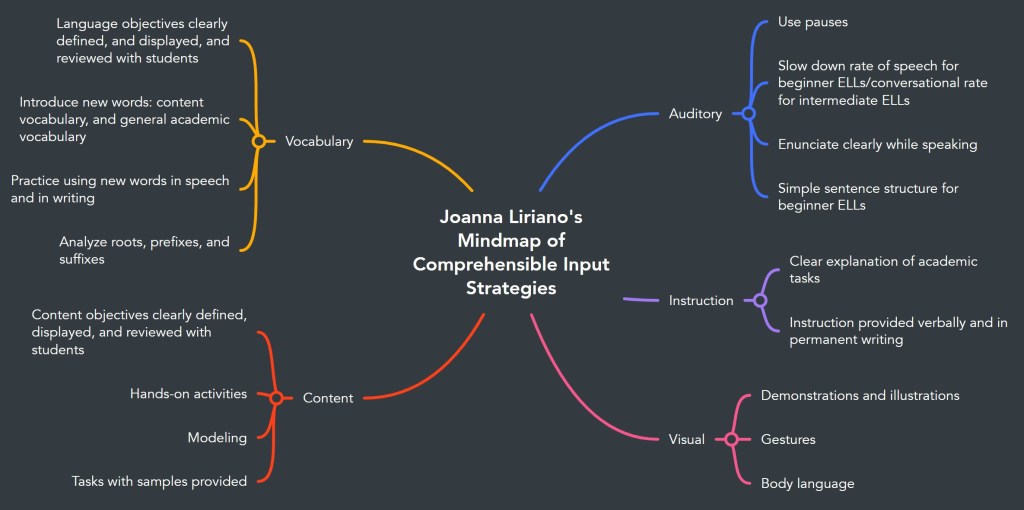
For a Discussion Board in EDDN 637 EDDN 637 Second Language Learners and the Content Areas the weekly contribution was constructing a mindmap of comprehensible input strategies and connecting the input strategies to teaching strategies. As their Professor, there is much pride to see such excellent work by my candidates.
Touro University TESOL Candidate Joanna Liriano
Joanna Liriano is a math teacher and track & field coach in South Bronx. She served the Peace Corps in Mozambique and Teach for America in NYC. Currently, she is working on her bilingual certification in Spanish, Portuguese, and French to meet the needs of her students.
Touro University TESOL Candidate Kristi Mattina
Kristi Mattina holds a Bachelor’s degree in Childhood Education and a Master’s in Special Education. In June, she completes her 11th year of employment with the NYCDOE. She is a Special Education teacher and taught in ICT and 12:1+1 settings in District 31. She also enjoys spending time with her family and two young children.
Touro University’s TESOL/ Bilingual Advanced Certificate Programs Graduate School of Education focuses on the art of The Reflective Practitioner and Reflective Journal Writing in several courses, including EDPN 671 Theory and Practice of Bilingual and Multicultural Education. The goal: To provide teacher candidates with a framework to make connections between prior knowledge and new information. The framework engages students in a systematic process to guide their ongoing reflection, a process they can internalize and practice as constructive educators. Students will be able to engage in this process to improve their teaching throughout their careers. Candidates’ reflective journal entries will be included in their final portfolio.
Patana Mehirdel, an Afghan-American currently pursues her masters in TESOL at Touro University, TESOL/BLE department.
“Growing up I have experienced peoples views and opinions about my religion, culture and language and most of them were based on politics or on biased negative news. Moving forward, my goal is to give students from diverse cultural backgrounds, such as Pakistan, Afghanistan, India, Iraq, Iran, etc. a voice and be comfortable and confident to connect their cultural and linguistic background to their learning experiences.”
Introducing AI and intelligent systems into education will have profound effects on not only assessment and administrative functions but also on faculty and learner motivation, engagement, and overall academic performance. Other areas affected will be organizational strategic planning, student acquisition, and retention, curriculum design and Personal Learning Networks.
Dr. Jasmin (Bey) Cowin, A Chain of Worlds: Education in the Age of Metaverses. The 26th World Multi-Conference on Systemics, Cybernetics and Informatics: WMSCI 2022, July 12 – 15, 2022 IMSCI 2022, vol. 3, 25-30. https://doi.org/10.54808/WMSCI2022.03 ISBN: 978-1-950492-66-4 (Volume III)
Cowin, J. (2022). A Chain of Worlds: Education in the Age of Metaverses. The 26th World Multi-Conference on Systemics, Cybernetics and Informatics: WMSCI 2022, July 12 – 15, 2022 IMSCI 2022, vol. 3, 25-30. https://doi.org/10.54808/WMSCI2022.03 ISBN: 978-1-950492-66-4 (Volume III)
The opportunity to do this assignment and try out the Canva program was truly invaluable. I will be making many more and also introducing the app to my students as a possible research end product.
Assignment Description: For this assignment, you will create an infographic for a specific group of learners (your audience). It is highly recommended that you create your infographic for the learners that you are currently teaching, or typically teach. You will know more about this group than other groups of learners, and are likely to have an easier time designing instruction for them. Integrating the infographic into one of the SIOP lessons is recommended.
Your project will be assessed on the following: Content: content is specifically tailored to ENL/ESL students for a specific grade level. Focus: All content (visual and textual) concisely complements the purpose of the infographic. Visual Appeal: Fonts, colors, layouts, & visual elements meaningfully contribute to the infographic’s ability to convey the overall message. Argument: The infographic effectively informs and convinces the reader of its intended purpose. Organization: Information is systematically organized and supports readers’ comprehension of the main message. Citation: Full bibliographic citations are included for all sources referenced Mechanics: The infographic is free of spelling or grammatical errors.
Adah Hirschfeld is a New York City Public School librarian who currently works at IS 240 in Midwood, Brooklyn. She holds a Master of Library and Information Science degree from Pratt Institute and a Master’s degree in School Administration from Touro College. She is pursuing certification in TESOL to better meet the language and literacy needs of her students.
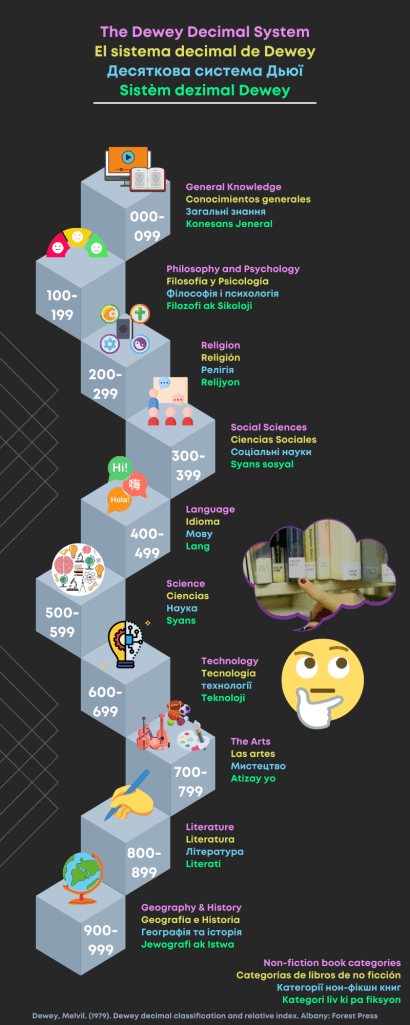
The Dewey Decimal System in English, Spanish, Ukrainian and Haitian Creole.
WHY are you designing this infographic?
I wanted to make this to post in the library so students will be able to find the categories of non-fiction books easily. I give an orientation to all the new 6th grade classes in the fall and try to encourage and foster skill and provide materials that will make my students independent library users.
HOW will this infographic serve MLs?
English, Spanish and Haitian Creole are the dominant languages in my middle school in Flatbush / Midwood, Brooklyn. I added Ukrainian because we had an influx of students when the conflict started and will have more Ukrainian speaking students in September.
WHAT are you trying to point out, teach, focus on, or reinforce?
Non-fiction books in the library are organized and shelved according to categories or subjects. Students need to know where to find books to help them with their research or reading interests. The dewey decimal system also reinforces math skills and helps students become aware that many academic terms such as decimal can be used across subjects.
WHICH language production is this infographic focusing on?
This infographic is focused on reading, but may lead to speaking discussion when explaining the system or sending students to find specific dewey numbers on the shelves.
WHERE in your lesson plan will YOU be able to use this infographic?
This infographic can be used in the mini lesson. It can also be used for independent practice with a worksheet matching Dewey call numbers to subject headings / categories.
This course provides a historical overview of second language acquisition theories and teaching methods. Students learn how to apply current approaches, methods and techniques, with attention to the effective use of materials, in teaching English as a second language. Students will engage in the planning and implementation of standards-based ESL instruction which includes differentiated learning experiences geared to students’ needs. Emphasis is placed on creating culturally responsive learning environments. Includes 15 hours of field work.
Touro University TESOL Candidate Melissa Greenfield is a first grade teacher on Long Island and committed “to making my classroom a place where students feel safe, confident and excited to learn.” She holds an initial certification in Elementary ed. (1-6) from SUNY Old Westbury and is working towards a MS in TESOL at Touro.
Ms. Greenfield wrote an exceptional DB 3 contribution, featuring strong analysis and a reflection on her classroom activity sequencing.
Teacher education programs require pathways for teacher performance assessment supporting ELT candidates completing practicum and fieldwork hours. This presentation focuses on reviewing, contrasting, and framing two distinct immersive ecosystems. Mursion and simSchool. Either platform offers immersive experiences simSchool is AI-driven while Mursion employs mixed-reality simulations. Both provide ELT teachers a platform to practice and hone the art and skill of teaching within a simulation using avatars through customized and personalized clinical experiences for language teaching.
Description
This workshop took deep dive into two very distinct teacher simulation training platforms: simSchool and Mursion. By comparing and contrasting the platforms’ respective approaches to simulation training workshop attendees be introduced to simulation-based learning and emotionally intelligent student avatar. This presentation identified, summarized, and reflected through showcasing each platforms teaching and simulation scenarios. In addition, simulation teacher performance assessment generates data. Such data aggregation offers institutions informed decision-making teacher performance through systematic reviews using data and technology to improve their language teacher education programs.
It is always a pleasure to feature exception candidate work. TESOL Candidate Kelly Broshears contributed an exceptional Discussion Board on Academic Success for Multilingual Learners for EDDN 637 – Second Language Learners and the Content Areas
In order to provide the most effective teaching, it is crucial that teachers of ELL students work off of what the student can already do and build upon their strengths. It is so often that educators work off of what students do not know and they focus on that negativity, instead of focusing on the positives of what students can already do and use that to their advantage. The assets being referred to also do not necessarily have to be academically based. According to Echevarria, et.al (2017), “these assets are related to language and cultural practices in the home… Teachers can build on these relationship roles to construct collaborative learning environments in the classroom.” (p. 7). By building off the strengths of the students, the teacher can create a more inclusive environment for students that makes all students feel like they can be successful and helps to provide the confidence they need to succeed.
Kelly Broshears, Touro University, GSE, TESOL Candidate
Kelly Broshears is a 4th semester student at Touro College and a member of the TESOL masters program. She received her undergraduate degree at Salve Regina University in Newport RI in 2019 with a major in early childhood education. “This is where I found a passion for working with ENL students. Currently, I am a kindergarten teacher for the NYC DOE in District 27.”
Discussion Board: 1 CHAP I ACADEMIC SUCCESS by Echevarria, J., Vogt, M. & Short, D. (2017). Making Content Comprehensible for English Learners: The SIOP Model. 5th Edition, Pearson.
Kelly Broshears:
WHAT Characteristics INFLUENCE ELL’s having SUCCESS IN SCHOOL?
The success of an ELL student in school can be connected to a variety of factors. There are the ones that I think of right off the bat that include the student’s prior exposure to the English language before attending school or the years the ELL student has been attending an English speaking school. However, research suggests that the characteristics that influence the school success of an ENL student goes much deeper than that. As stated earlier, knowledge of the English language is a main characteristic of student success. Another characteristic includes how deep the language proficiency is in the L1, as well as, the educational background of the student. For example, a student who is well educated in the L1 typically will have an easier time learning the L2 compared to a student who had limited access to school due to factors outside of the control of the child. If a student is more proficient in their L1 and has had more access to school in their native language, “they can transfer the knowledge they learned in their native country’s schools to the courses they are taking in the United States.” (Echevarria, Vogt & Short, 2017, p. 5) which, in turn, will more likely produce success. ELL success can also be determined on factors outside of the education realm. Some factors may include the family’s financial situation, abuse, refugee status from a potentially war-torn country, etc. As teachers of ELL students, it is incredibly important to recognize and acknowledge these characteristics when planning the best possible instruction for the individual students you work with.
2. What are some characteristics of ELL’s to consider to implement effective teaching?
As previously stated, there are so many characteristics of ELL’s that are important to consider when teaching. In order for the instruction to be effective, these characteristics must be considered. In order to provide the most effective teaching, it is crucial that teachers of ELL students work off of what the student can already do and build upon their strengths. It is so often that educators work off of what students do not know and they focus on that negativity, instead of focusing on the positives of what students can already do and use that to their advantage. The assets being referred to also do not necessarily have to be academically based. According to Echevarria, et.al (2017), “these assets are related to language and cultural practices in the home… Teachers can build on these relationship roles to construct collaborative learning environments in the classroom.” (p. 7). By building off the strengths of the students, the teacher can create a more inclusive environment for students that makes all students feel like they can be successful and helps to provide the confidence they need to succeed.
You can also use student educational backgrounds in their native languages to help implement effective teaching. Teachers can build upon the literacy skills students may have in their L1 and work off of that to transfer those skills to English. This can be done through making connections from school to their outside world by looking at various things to read like a bill or a shopping list. You can also foster effective teaching by providing many opportunities for students to use conversational English. Lastly, in order to implement effective teaching it is crucial to have students make connections to their cultures because “students do not enter schools as blank slates. Many have had life experiences that are pertinent to the curricula.” (Echevarria, Vogt & Short, 2017, p. 8). By providing children with those connections to their cultures, it can give students a chance to show their knowledge, build their confidence, and they can teach their peers while learning how the things in their native countries might be different than in the United States.
3. How can we as educators transform the education of English Language Learners/ Multilingual Learners for tomorrow’s world?
The key to transforming the education of ELL’s and ML’s for tomorrow’s world is multimodal learning. ELL students who are filling in quick and mindless worksheets are not being engaged enough and set up for success in the future. Students will need to be cognitively ready for purposeful and substantive conversations and interactions they will be having in the near future. It is an educator’s job to set these students up for this kind of success, but so often, these students are falling through the cracks because of teacher activities like simple worksheets. According to Walqui (2021), students “need to be skilled in understanding ideas, judging their validity based on evidence, and often making decisions based on inferential interpretations of the ideas and information presented in the narrative or written texts they encounter.” By providing ELL/ ML students with an opportunity to engage with text in various modalities and engage with a peer about the text, the students are then able to practice forming their own understanding and perspective on the topic, as well as, listen to and gain a peer’s perspective. Because ELL students have so much cultural knowledge to build upon that teachers can tap into, students should be well equipped to engage with others and learn from their peers. In order to transform education, we need to include these types of rich and engaging practices that will prove to be more effective in preparing students for the future than a worksheet.
4. What is one take-away from this week’s readings and how might it impact you teaching?
In my opinion, I learned a lot from this week’s reading and it was really eye opening. The biggest take-away I had from the reading is how important it is to build relationships in the classroom and be culturally responsive. I always heard professors talk about how important culturally responsive teaching is but after reading several articles and the text it is even more clear how important this is. For example, an ELL teacher in Oregon engages in home visits and pays special attention to important aspects of her students home lives so she can include these aspects into her lessons to make them more engaging and to make children have a sense of community. “Students are most engaged when they feel a personal connection to a lesson or unit, a connection that’s created in part by a teacher’s investment in culturally competent relationships.” (Kaplan, 2019). By considering all factors of an ELL students life and taking into account all of their strengths and interests, it is more likely that these students will have more success in school because the teacher is setting them up for that success with the environment he/she has cultivated.
References:
Echevarria, J., Vogt, M. & Short, D. (2017). Making Content Comprehensible for English Learners: The SIOP Model. 5th Edition, Pearson.
I really enjoyed reading your post this week and I felt like a lot of the things you mentioned resonated deeply with me and my reading this week as well. One thing that you mentioned that stood out to me was when you said about “Creating activities that sharpen all five senses and allow students to work in an interactive format will help them gain a greater understanding of both the English language and the world around them.” This jumped out to me because as a kindergarten teacher, this is the only way we really teach because it is proven that young children need that hands on and multimodal learning to help grasp new concepts. However, I know that as you go on in the years of schooling, hands on learning turns more into worksheets and textbooks which can be detrimental for an ENL student. I worry about these students because I feel that with so many teachers not having ENL training, they do not know how to differentiate for these students. This can cause these students to get lost in the shuffle. In my opinion, teachers who are struggling with teaching their ENL students should think about this: “Educators considering how to strengthen the quality of teaching for ELLs and MLs will find it provocative and productive to reflect on their own and other experts’ theories concerning how second languages are learned, how learning happens in general, what students bring to learning, and how teachers themselves learn and develop as expert professionals.” (Walqui, 2021). By reflecting and studying the theory and pedagogy behind teaching ENL students, most teachers can begin to shift their thinking and improve their practice.
I wanted to let you know that I thought your post this week was really great and I look forward to hearing your perspective throughout this course. As someone who is dual language, I think you bring a whole other side to this apart from just the teaching side that is interesting to hear. Something that you said really stood out to me. What stood out to me was when you mentioned overcrowded classrooms being an ineffective way to teach ENL students. Currently, I teach general education kindergarten and have 24 students in the room with no aide or paraprofessional. This is almost the maximum amount of students the NYC DOE allows in a kindergarten setting. I always say that this puts my students at a huge disadvantage since it becomes very loud at times and overstimulating, but this is true especially for the ENL students I have. I never thought about them potentially struggling more because of the setting so thank you for pointing that out. In a big school system like the DOE, unfortunately there is nothing we can do about the class sizes no matter how hard we fight for it. However, I really enjoyed the suggestion by Schwartz (2021), that said to use microphones in the classroom to combat this issue. She says that using a microphone “can help ELL students hear the nuances of your voice more clearly and understand you better”. This might help ENL students in a large classroom to understand different aspects of the language more clearly.
GSENN2022 aims to bring together the renowned researchers, scientists and scholars to exchange ideas, to present sophisticated research works and to discuss hot topics in the field and share their experiences on all aspects of Nanotechnology and Nanomaterials.
The GSENN2022,a 3 day event, gathered the key players of the Nanotechnology and Nanomaterials community and related sectors. This event was launched with the aim to become an established event, attracting global participants, intent on sharing, exchanging and exploring new avenues of Nanotechnology and Nanomaterials, Catalysis and Surface Process, Smart Graphene Materials, Nanoparticle enhanced spectroscopy, Nanotechnology Risk & Safety, Nanoscale structures for solar energy.
Abstract:
As part of the Fourth Industrial Revolution (4IR), the multi-disciplinary fields of Nanoscience and Nanotechnology hold the promise to profoundly change the way humanity lives, works and relates to one another. Nanoscience education, a multidisciplinary field, integrates diverse subjects such as surface science, electronics, organic chemistry, molecular biology, semiconductor physics, medicine, energy storage, engineering, microfabrication, molecular engineering, and more. Molecular sciences are poised to become a gateway to the future, promising advances from medical diagnostics to climate change. While there are nanoscience research centers such as the NSF Nanoscale Science and Engineering Networks, Materials Research Science and Engineering Centers (MRSECs), National Nanomanufacturing Networks, few educational programs exist locally and globally spanning across the full spectrum of educational levels from K–12 to postgraduate studies. Corporations, educational institutions, and education ministries alike are exploring frameworks and technological tools to facilitate STEM learning in schools and beyond. App innovation and gamification, digital literacy, VR and AR, SDP, and collaborative learning are leading educational trends in the 4IR. One characteristic that these new learning technologies share is that by enabling real-time behavior modification, knowledge transfer and learning can occur simultaneously. “The AI challenge is not just about educating more AI and computer experts, although that is important. It is also about building skills that AI cannot emulate. These are essential human skills such as teamwork, leadership, listening, staying positive, dealing with people and managing crises and conflict” [Owen, 2017: para. 2]. The US Department of Education’s mission statement focuses on promoting “student achievement and preparation for global competitiveness by fostering educational excellence and ensuring equal access” [US Department of Education, 2021].
Nanoscience and nanotechnology will change interpreting the world and reshape educational philosophies while altering the pedagogies that underlie them. Economic growth, the durability of society, and sustainability for the 21st century and beyond need to be supported through a system of education that can anticipate societal and global changes. Therefore, it will be necessary to transform the modes of delivery which are part of the operations of educational institutions worldwide. Looking forward, corporations, educational institutions, and countries must extend the scope of their collective educational ambitions beyond classic declarative learner knowledge to the nurturing of the complex and creative processes of learners, coupled with digital literacy in the fields of nanoscience and nanotechnology.
This presentation focuses on cross-curricular learning models, virtual and augmented reality labs, professional teacher development, and free educational resources aimed at promoting student awareness of nanoscience and nanotechnology as well as provide advanced learning and skills development.
Keywords: Nanoscience and Nanotechnology, educational transformation, pedagogical frameworks, 21st-century education, Fourth Industrial Revolution, Augment and Virtual reality Labs
References
Committee On Stem Education of the National Science & Technology Council. (2018, 12). Charting a Course for Success: America’s Strategy for STEM Education. Charting a Course for Success: America’s Strategy for STEM Education. from STEM-Education-Strategic-Plan.pdf
As a member of the CALL-IS Steering Committee, I am pleased to announce that the CALL- IS Newsletter is currently accepting submissions for the Summer/ Fall 2022 edition. We are looking for letters, articles, snapshots and book reviews relevant to CALL. If you need a book recommendation, please inquire . Submissions are due by June 31, 2022. Send submissions to ludry@dwci.edu .
Submission Guidelines:
Letters/ Articles
1000 – 1,750 words
have the title in ALL CAPS
list a byline: author’s name with embedded email, affiliation, city, and country
include a 50-word teaser for the Newsletter Homepage
contain no more than five citations
include a 2-to-3 sentence author biography and author photo
follow the style guidelines in the Publication Manual of the American Psychological Association, 6th edition (APA style)
be in .doc, .docx, .rtf, or .txt format
All figures, graphs, and other images should be labeled and sent as separate jpg files.
Book Reviews
650 – 1000 words in length
include a 50-word teaser for the Newsletter Homepage
include a 2-3 sentence reviewer biography and reviewer photo
follow the style guidelines in the Publication Manual of the American Psychological Association, Sixth Edition (APA Style)
be .doc or .docx, .rtf, or .txt format
All figures, graphs, and other images should be labeled and sent as separate jpg files.
Deadlines: Submissions are due by June 31, 2022. Please send submissions to ludry@dwci.edu .
AND Are You looking for an exciting opportunity for Professional Development? Why not become CALL-IS Newsletter Editor or join the CALL-IS Newsletter Editing Team. Contact Larry Udry (ludry@dwci.edu) for details. Back issues of our newsletter can be found at http://newsmanager.commpartners.com/tesolcallis/issues/
The last few weeks I reflected on several questions.
How can educators support and nurture students’ well-being and academic excellence?
What are student needs and educators responsibilities?
Where do experiences and needs of both educators and students overlap?
In this infographic, I juxtaposed students and educators and connected their perspectives and common needs within multiple contexts. The PDF has links to resources for educators wishing to explore the topics.