Cowin, J., (2023). AR, VR and XR: Multidimensional Resources for Educators In European Cultures in Business and Corporate Communication (EUCO) [poster presentation]. EUCO 2023, October 19-21, Lucerne, Switzerland.
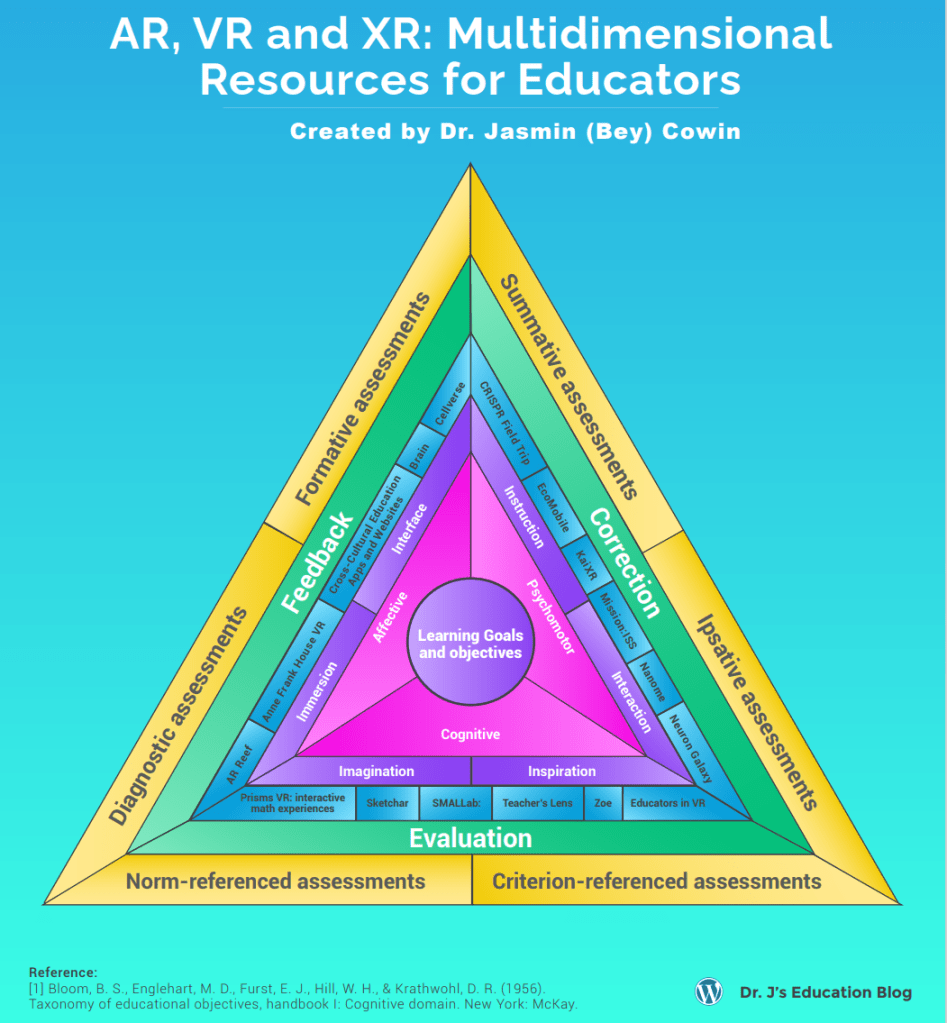

Cowin, J., (2023). AR, VR and XR: Multidimensional Resources for Educators In European Cultures in Business and Corporate Communication (EUCO) [poster presentation]. EUCO 2023, October 19-21, Lucerne, Switzerland.
Heartfelt thanks to Sunshine State TESOL for the behind-the-scenes magic in prepping for the upcoming virtual powerhouse. Having steered the ship as conference chair for NYSTESOL 2021 and been the co-pilot for Virtua-TELL ’22 and ’23, I’m well-versed in the grit and grind it entails. Here’s to a stellar conference! 🌟 Kudos to the team for their unwavering dedication. 👏
It is almost presenting time:
Saturday, Oct. 21, 9:00 AM – 9:45 AM 10:45 AM – 11:30 AM 1:30 PM – 2:15 PM STRENGTHENING COMMUNITIES OF PRACTICE THROUGH COMMUNITY ASSET MAPPING IN THE CHATGPT ERA PRESENTER: JASMIN COWIN 7- STEP VOCABULARY STRATEGY TO BRIDGE ENGLISH LANGUAGE ACQUISITION AND CONTENT LITERACY PRESENTER: YEUKAI CHIROODZA- IMEH ENGAGE ENGLISH LEARNERS IN THE POETRY WRITING PROCESS BY UTILIZING POETRY FRAMES PRESENTER: LILLIAN RAMIREZ English learners can not only write poetry, they can shine! Five Pinellas County middle schools participated in a poetry project in which students in ESOL Elective Courses wrote a poem utilizing one of two poetry frames and were then published into a poetry book. Some students created bilingual versions of their poems. In the demonstration part of this session, you will view the poetry templates and examples, the finished product, and learn about the process. Then, you will have the opportunity to create a frame and example yourself that you could use with your students. As education moves into the age of generative Artificial Intelligence, it is important to consider the role of culturally responsive pedagogies and community asset mapping for enhancing student learning and achievement and proof of work. This practice oriented session will discuss and showcase practical frameworks on ways community asset mapping can be used as an example of culturally responsive pedagogy to leverage community resources and honor student identities and lived experiences. Additionally, we will delve into the re-framing and exploration of issues related to the use of generative AI in 21st-century language teaching and the concept of student proof of work.
The 23rd interdisciplinary conference of the EUCO research network will take place in Lucerne in 2023 from October 29-21. The theme this year is “Next Generation Communication: Communication in a Changing World.” The symposium aims to bring together researchers and practitioners from different disciplines and foster a lively exchange of ideas.
I am delighted to share our collective paper abstract which grew through transdisciplinary communication with my colleagues:
The (Algorithmic) Cage
*Jasmin COWIN[1]
Department of TESOL/Bilingual Education, Graduate School of Education, Touro University, NY, 10036, U.S.A.
Cristo LEON[2]
Office of Research & Development, NJIT, Newark, NJ, 07102-1982, U.S.A.
Birgit OBERER[3]
ETCOP Institute for Interdisciplinary Research, Klagenfurt, Austria
Abstract:
This paper and presentation explore the dual role of algorithmic technologies in shaping digital communication, acting both as catalysts and barriers. We critically analyze the AI revolution’s socio-economic consequences, grounded in Yuval Noah Harari’s discourse on the emergence of a potentially ‘useless’ class and reflecting upon the predictions of Ray Kurzweil regarding human augmentation. Our investigation pivots around the pivotal questions of job displacement and the evolving definition of meaningful employment in a landscape progressively dominated by automation. The paper debates the nuanced relationship between human cognition and digital technology, juxtaposing the theories of embodied cognition and digitization. Special attention is paid to the implications of language digitization, exploring ramifications such as diminished linguistic diversity, the homogenization of expression, and the perpetuation of dominant languages. We also confront issues emanating from the digital divide and raise pressing concerns about privacy and security in an increasingly digitized society. The paper concludes by highlighting the necessity for interdisciplinary collaboration to navigate the complexities and challenges arising within digital communication spheres.
Dystopian Visions – Figure 1: Amazon patent number 20150066283 A1

Language Attrition and Desertification

As a Professor for TESOL, I am immensely proud to feature outstanding student work from our MS in Teaching English to Speakers of Other Languages (TESOL) Program. New York’s linguistic diversity demands teachers who can find common ground and effectively communicate with students from different language backgrounds. Academically rigorous and practice-intensive, the 33-credit program includes 50 hours of fieldwork and supervised student teaching experiences. Candidates who complete all coursework, fieldwork, and student teaching requirements are eligible for recommendation for ESL certification.
EDDN 637: Students will become acquainted with and practice effective approaches, methods, and strategies for teaching and evaluating English language learners in the content areas (ELA, Social Studies, Math and Science). Throughout the course, students will explore the impact of culture and language upon classroom learning. Special challenges in teaching and assessment in each content area will be discussed. Examination and analysis of curriculum materials and instructional strategies for creative teaching and learning in grades Pe-K-12. Includes content-specific lesson planning that addresses the New York State Student Content Learning Standards with emphasis on English Language Arts, English as a Second Language, and content area instruction. Course content includes demonstrations, simulated activities, and field observations in Pre-K-12 classrooms. The course also examines how the teaching of English to non-native speakers can be integrated with the teaching of cognitive skills in all content areas. Students will be offered a variety of methods and materials to integrate ESL standards throughout all content areas for classroom use. Includes 15 hours of fieldwork.
Kayla Challenor currently works as a Reading Teacher at Island Trees Memorial Middle School in Levittown, NY. She holds a master’s degree in Reading and Literacy (K-12). Passionate about furthering her education, she is currently in the process of earning her TESOL certification at Touro University. Her dedication is evident in her ongoing efforts to ensure the success of all learners.
“I am dedicated to applying our coursework knowledge into my classroom.”
Kayla Challenor, Touro University, TESOL certification candidate

As a Professor for TESOL, I am immensely proud to feature outstanding student work from our MS in Teaching English to Speakers of Other Languages (TESOL) Program. New York’s linguistic diversity demands teachers who can find common ground and effectively communicate with students from different language backgrounds. Academically rigorous and practice-intensive, the 33-credit program includes 50 hours of fieldwork and supervised student teaching experiences. Candidates who complete all coursework, fieldwork, and student teaching requirements are eligible for recommendation for ESL certification.
EDDN 637: Students will become acquainted with and practice effective approaches, methods, and strategies for teaching and evaluating English language learners in the content areas (ELA, Social Studies, Math and Science). Throughout the course, students will explore the impact of culture and language upon classroom learning. Special challenges in teaching and assessment in each content area will be discussed. Examination and analysis of curriculum materials and instructional strategies for creative teaching and learning in grades Pe-K-12. Includes content-specific lesson planning that addresses the New York State Student Content Learning Standards with emphasis on English Language Arts, English as a Second Language, and content area instruction. Course content includes demonstrations, simulated activities, and field observations in Pre-K-12 classrooms. The course also examines how the teaching of English to non-native speakers can be integrated with the teaching of cognitive skills in all content areas. Students will be offered a variety of methods and materials to integrate ESL standards throughout all content areas for classroom use. Includes 15 hours of fieldwork.
Amelia Cusack is a second-grade teacher certified in general and special education, grades 1-6, and in the process of obtaining a TESOL certification at Touro University.
I recommend Touro University to all my friends who want to become teachers. Their education programs gave me the flexibility to receive a quality education while working full-time.
Amelia Cusack, Touro University TESOL certification candidate
The following passage is an excerpt from a 4th grade workbook. The reading program is HMH: Into Reading


As a Professor for TESOL, I am immensely proud to feature outstanding student work from our MS in Teaching English to Speakers of Other Languages (TESOL) Program. New York’s linguistic diversity demands teachers who can find common ground and effectively communicate with students from different language backgrounds. Academically rigorous and practice-intensive, the 33-credit program includes 50 hours of fieldwork and supervised student teaching experiences. Candidates who complete all coursework, fieldwork, and student teaching requirements are eligible for recommendation for ESL certification.
EDDN 637: Students will become acquainted with and practice effective approaches, methods, and strategies for teaching and evaluating English language learners in the content areas (ELA, Social Studies, Math and Science). Throughout the course, students will explore the impact of culture and language upon classroom learning. Special challenges in teaching and assessment in each content area will be discussed. Examination and analysis of curriculum materials and instructional strategies for creative teaching and learning in grades Pe-K-12. Includes content-specific lesson planning that addresses the New York State Student Content Learning Standards with emphasis on English Language Arts, English as a Second Language, and content area instruction. Course content includes demonstrations, simulated activities, and field observations in Pre-K-12 classrooms. The course also examines how the teaching of English to non-native speakers can be integrated with the teaching of cognitive skills in all content areas. Students will be offered a variety of methods and materials to integrate ESL standards throughout all content areas for classroom use. Includes 15 hours of fieldwork.
Jasmeet Kaur graduated from York College in Childhood Education Grades 1-6 with honors in 2022 ( Summa Cum Laude). Currently, she is working as a Substitute teacher and pursuing a Master’s in TESOL from Touro College. Her goal is to inspire Bilingual/ Multilingual and the next generation to have confidence in their abilities and use those skills towards their success.
“Touro provided me with insight into how being Bilingual/multilingual is an asset that opens the door for opportunities and cultivates tolerance and respect for other cultures.”
Jasmeet Kaur, Touro University, TESOL Candidate
Here is the second discussion board for Module 2/EDDN 637 by Jasmeet Kaur:

Credit source: Google image
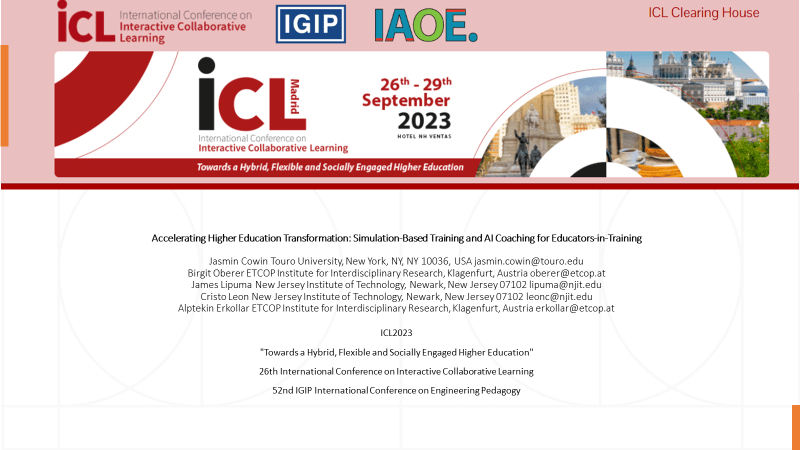
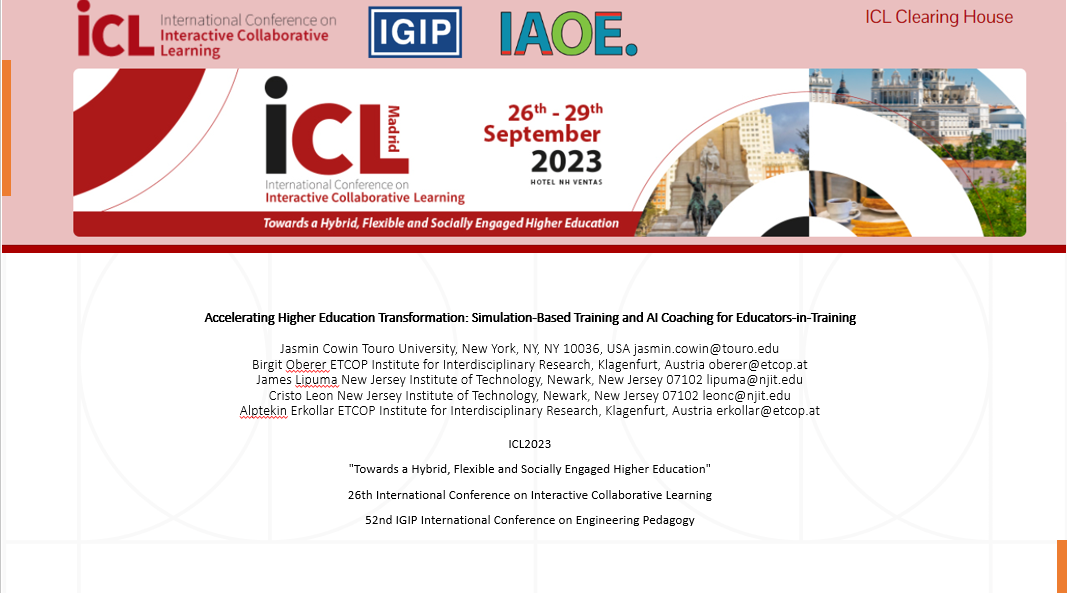
I am pleased that my presentation was received well at the International Conference on Interactive Collaborative Learning and 52nd IGIP International Conference on Engineering Pedagogy (ICL2023). This interdisciplinary conference aims to focus on the exchange of relevant trends and research results as well as the presentation of practical experiences in Interactive Collaborative Learning and Engineering Pedagogy.
Our paper’s Abstract: “Accelerating Higher Education Transformation: Simulation-Based Training and AI Coaching for Educators-in-Training.”
Abstract
This paper conducts an interdisciplinary investigation into the transformative potential of Artificial Intelligence (AI) in the realm of teacher education by integrating methodologies and frameworks from education, business admin-istration, and computer science. The rapid advancements in AI are ushering in a possible Cambrian explosion of systems transformation for educational and governmental institutions. Simulation mentoring and training are gaining traction for teacher education. The authors’ investigation into simulation-based training and AI coaching for high-leverage teacher training practices intertwines an interdisciplinary dialogue on modernizing 21st-century teacher training and the possibility of a Cambrian explosion in teacher education for higher education institutions. By examining asynchronous AI-driven simula-tion mentoring and teaching experiences and their impact on instructional teacher effectiveness, the authors frame, explore, and consider possible new resource allocations and economic implications for teacher training in higher education. Simulation tools promise to promote scalable approaches to fos-tering pedagogical expertise by incorporating research-based psychological, sensory, and cognitive domains inspired by Bloom’s educational objectives taxonomy. Using the examples of simSchool and Mursion, the authors co-construct meaning-making and hypothesize on forward-looking, scalable ed-ucator training approaches, the interplay between learning, knowledge acqui-sition, and embodied cognition, highlighting the importance of reflective practice in teacher education. AI-driven mentoring holds promise for scala-bility to achieve by 2030 the Sustainable Development Goal 4.c, aiming to “increase the supply of qualified teachers, including through international cooperation”. In conclusion, this paper will explore using AI simulations as practice arenas to stimulate and shape the dialogue between stakeholders in higher education, focusing on integrating existing best practices that will eventually change teacher education locally and globally, accelerating a higher education Cambrian explosion.
Cowin, J., Oberer, B., Lipuma, J., Leon, C., & Erkollar, A. (2023). Accelerating Higher Education Transformation: Simulation-Based Training and AI Coaching for Educators-in-Training. (Virtual Presentation, Sept. 27, 2023). 26th International Conference on Interactive Collaborative Learning and 52nd IGIP International Conference on Engineering Pedagogy (ICL2023)
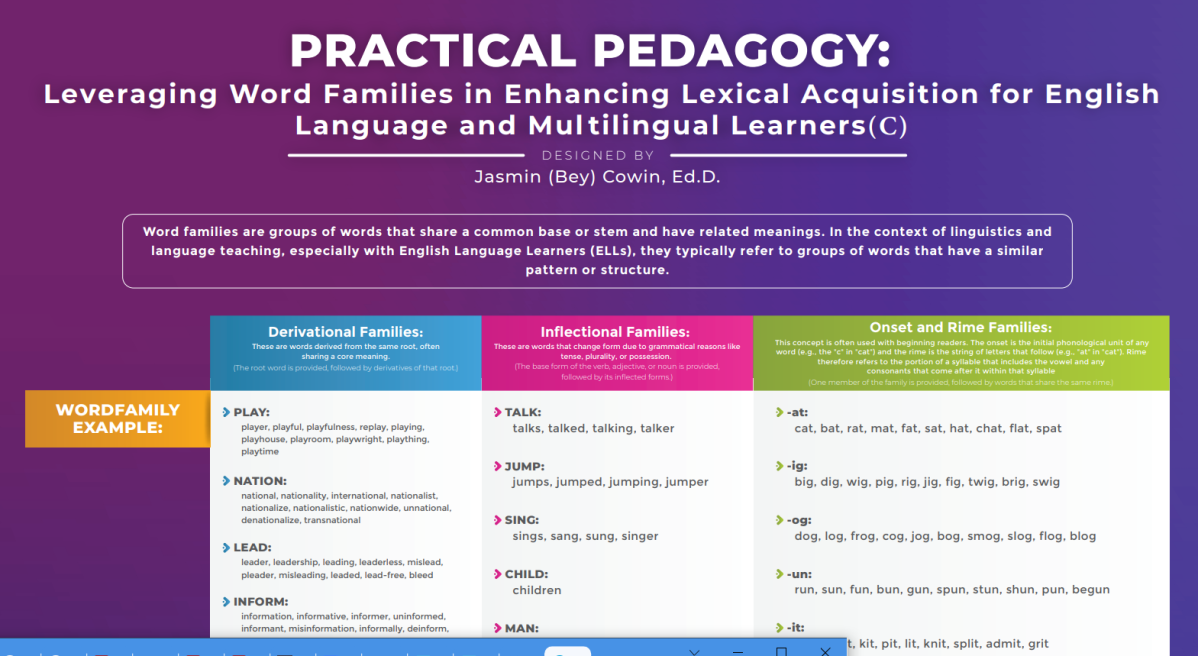
My infographic “Practical Pedagogy: Leveraging Word Families in Enhancing Lexical Acquisition for English Language and Multilingual Learners” highlights the practical application of word families—clusters of words that originate from a shared root. These clusters provide a pragmatic strategy for vocabulary development, enabling more efficient Second Language Acquisition (SLA) for English learners. Through my infographic, I aim to equip educators with a clear, actionable guide on implementing explicit vocabulary teaching.
I hope my infographic serves as more than just an illustrative tool. I envision it as a practical spotlight on the tangible benefits of word families in enhancing language retention and comprehension for English Language Learners (ELLs). By having a visual guide on pedagogical implications on vocabulary aquisition and teaching, educators are better positioned to integrate word families into their lesson plans, thereby promoting enhanced vocabulary growth among their students, regardless of their linguistic backgrounds.
I hope my infographic “Practical Pedagogy: Leveraging Word Families in Enhancing Lexical Acquisition for English Language and Multilingual Learners”will serve more than just an illustrative purpose. I hope it will be a practical spotlight on the concrete benefits of word families in boosting language retention and comprehension. By understanding these pedagogical implications, teachers are better positioned to incorporate word families into their lesson plans, fostering enhanced vocabulary growth in their students, irrespective of their linguistic backgrounds.
As a Professor for TESOL, I am immensely proud to feature outstanding student work from our MS in Teaching English to Speakers of Other Languages (TESOL) Program. New York’s linguistic diversity demands teachers who can find common ground and effectively communicate with students from different language backgrounds. Academically rigorous and practice-intensive, the 33-credit program includes 50 hours of fieldwork and supervised student teaching experiences. Candidates who complete all coursework, fieldwork, and student teaching requirements are eligible for recommendation for ESL certification.
EDDN 637: Students will become acquainted with and practice effective approaches, methods, and strategies for teaching and evaluating English language learners in the content areas (ELA, Social Studies, Math and Science). Throughout the course, students will explore the impact of culture and language upon classroom learning. Special challenges in teaching and assessment in each content area will be discussed. Examination and analysis of curriculum materials and instructional strategies for creative teaching and learning in grades Pe-K-12. Includes content-specific lesson planning that addresses the New York State Student Content Learning Standards with emphasis on English Language Arts, English as a Second Language, and content area instruction. Course content includes demonstrations, simulated activities, and field observations in Pre-K-12 classrooms. The course also examines how the teaching of English to non-native speakers can be integrated with the teaching of cognitive skills in all content areas. Students will be offered a variety of methods and materials to integrate ESL standards throughout all content areas for classroom use. Includes 15 hours of fieldwork. Includes 15 hours of fieldwork. 3 credits
Jasmeet Kaur graduated from York College in Childhood Education Grades 1-6 with honors in 2022 ( Summa Cum Laude). Currently, she is working as a Substitute teacher and pursuing a Master in TESOL from Touro College. Her goal is to inspire Bilingual/ Multilingual and the next generation to have confidence in their abilities and use those skills towards their success.
“As a multilingual individual, I began my journey at Touro College. This has been a nurturing process, and I must say, “If you wish to fly higher, Touro will provide the wings to reach your destination.””
Jasmeet Kaur, Touro University TESOL Candidate
This is our first Discussion Board of the semester:
CHAP 1. WHAT Characteristics INFLUENCE ELLs’ having SUCCESS IN SCHOOL?
Several characteristics can influence the success of English language learners (ELLs) in school such as language proficiency, cultural awareness, motivation, Home-school environment, access to resources, peer interaction, individual learning needs, cultural sensitivity, immigrant status, financial status, parental involvement, assessments and last but not least english language learning programs in school. As mentioned in the text, these characteristics can fall under different factors : English knowledge, first language (L1) knowledge, Educational background, sociocultural, emotional and economic factors and other educational categories (Echevarria et al.,2017, p.5). ELLs bring with them a wide range of educational and cultural experiences to the classroom, overlooking their linguistic differences and characteristics can impede in imparting effective learning. As Echevarria et al. ( 2017) indicates that ELLs linguistic assets and other funds of knowledge have implications for instructions, assessment and program design, further having knowledge of a student’s background and abilities in L1 language can help teachers facilitate effective instruction to promote their success in school(p.4). Thus, it is important to consider that success can vary greatly among ELLs, and individual circumstances play a significant role. Providing tailored support and resources based on each student’s needs is essential for their academic achievement.
What are some characteristics of ELLs to consider to implement effective teaching?
Although there is a range of characteristics mentioned in question 1 to be considered for ELLs’ success in school. However, Some characteristics of ELLs to consider to implement effective teaching are the educational background of ELLs such as on grade level schooling in their home country and in U.S schools, proficiency in English, proficiency in native language, and individual learning styles and needs of ELLs. For example, Asian students can have a strong academic background in science and math, however, in English, they might need English Language Development ( ELD) to become more proficient in English ( Echevarria et al., 2017, p.5). Knowing these characteristics and building on their prior experiences can help teachers implement research-based pedagogy and incorporate effective techniques and materials to cater to their individual needs and close the achievement gap.
How can we as educators transform the education of English Language Learners/ Multilingual Learners for tomorrow’s world?
Transforming the education of English Language Learners (ELLs) or Multilingual Learners (MLLs) for tomorrow’s world involves adapting teaching practices to prepare them for a globalized, technologically advanced, and culturally diverse future. Some strategies such as adapting culturally responsive teaching where ELL’s culturally relevant material, perspectives, and experiences are incorporated in the curriculum and their native language is used to transfer skills to become proficient in the English language. Michelle Ortiz suggests similar strategies for entering and emerging level ELLs in the above-given article. She suggests differentiation for these learners by adding visuals to slides, translating essential vocabulary words, and allowing students to discuss the content in their native language (Schembari, Jan 11, 2023). Developing individualized learning plans for ELLs based on their language proficiency levels, learning styles, and goals and providing differentiated instruction to meet their specific needs, transferring skills from first language to second language closes the academic achievement gaps and promotes the ELLs’ success. Research also shows that there is a direct correlation between ELLs’ success and use of a first language (Schembari, Jan 11, 2023). Thus, educators should support ELLs in maintaining their proficiency in their native language(s) alongside English. Bilingualism is a valuable skill that can enhance cognitive abilities.
https://www.workitdaily.com/help-english-language-learners/developing-lessons-that-support-newly-arrived-ells
What is one takeaway from this week’s readings and how might it impact your teaching?
This week’s reading provides me with deep insight into a range of diverse characteristics for ELLs’ success in school and factors to be considered for effective teaching. Having knowledge of all these factors and reading articles on how educators can transform the ELLs for tomorrow’s world will positively impact my teaching practice. The one big takeaway I learned is that knowing ( sociocultural, linguistic, cognitive, and academic dimensions) and building relationships with students will promote successful second language acquisition. It will lead me to implement biography-driven instruction that involves students knowing holistically to facilitate effective instruction in response to their cultural and linguistic assets and needs. Also, incorporating sheltered instruction techniques that combine language learning with academic content will help ELLs acquire language skills while mastering the subject matter. Some other methods would be to integrate technology in new ways and make it accessible to all students, being said to facilitate equitable and fair educational opportunities for students in all possible ways. Technology should be integrated into the classroom to support language learning and use educational apps, online resources, and digital platforms that can provide personalized learning experiences for ELLs. Educators should Implement project-based learning (PBL) and inquiry-based approaches. These methods promote critical thinking, problem-solving, and collaborative skills while allowing ELLs to explore topics of interest. Teaching cross-cultural competence emphasizes skills like empathy, effective communication, and an understanding of cultural nuances, which are valuable in a globalized society. Importantly, including regular assessments and content-based language instruction (CBI) or sheltered instruction techniques that combine language learning with academic content. This helps ELLs acquire language skills while mastering the subject matter. Thus, by adopting these strategies, educators can empower ELLs to thrive in tomorrow’s world, where communication skills, cultural awareness, and adaptability are increasingly vital for success.
Share a fun fact or photo of yourself.
A fun fact about me is that I know four languages ( Hindi, Punjabi, English, and Nepali). But I hate how I couldn’t teach my kids to speak my native languages at home. They know their native language but choose to talk in English because they know that their parents speak and understand English.
References
Vogt, M., Echevarria, J. J., & Short, D. J. (2017). Making content comprehensible for English learners. (5th ed.). Pearson: New York.
Schembari, J. (2023, January 11). Developing lessons that support newly arrived ELLs. Work It Daily. https://www.workitdaily.com/help-english-language-learners/developing-lessons-that-support-newly-arrived-ellsLinks to an external site..
We are pleased to announce the publication of:
Trans-Disciplinary Communication in the ChatGPT Age: A Systems Perspective
Jasmin COWIN
Department of TESOL/Bilingual Education, Graduate School of Education
Touro University, NY, 10036, U.S.A.
Birgit OBERER
ETCOP Institute for Interdisciplinary Research,
Klagenfurt, Austria
Cristo LEON
Office of Research & Development, New Jersey Institute of Technology
Newark, NJ, 07102-1982, U.S.A.
ABSTRACT
In recent years, Trans-Disciplinarity (TD) has become increasingly recognized as a critical concept in contemporary scholarship and practice, especially in the emerging field of the metaverse. Despite its growing importance, however, the precise origins and meanings of the term remain somewhat elusive, and its relationship to systems thinking is still poorly understood. Consequently, further research is needed to clarify the definition and application of transdisciplinarity and explore its connections with related concepts such as systems thinking. By doing so, we can gain a broader understanding of how transdisciplinary approaches can be used to address complex problems in a variety of contexts and how they can contribute to advancing knowledge and innovation across disciplinary boundaries.
Keywords: Trans-disciplinary communication, digital age, metaverses, systems thinking, ChatGPT, transformative technologies.
You will find our article on p. 138





 Dr. J's Education Blog