


I am grateful to our collaborative, transdisciplinary and international work with Dr. Cristo Leon, Ph.D., James Lipuma, and Mauricio Rangel-Jimenez.
🚨 “Meta-participation and ethical transparency in role-playing games: Examining AI and algorithmic influence.” Integrating artificial intelligence (AI) and other non-human participants in role-playing games (RPGs) has brought new dimensions to interactive storytelling and game design. As
AI evolves to simulate human-like interactions more convincingly, its role in games raises significant ethical questions, particularly regarding transparency and player agency. This paper critically examines these issues, focusing on the concept of the meta-participant—the programmer or author responsible for designing the AI’s decision-making algorithms—
and the implications of their invisible influence and personal bias on the gaming experience of human players.
Leon, C., Lipuma, J., Cowin, J., & Rangel-Jimenez, M. (2025). Meta-participation and ethical transparency in role-playing games: Examining AI and algorithmic influence [Peer-reviewed journal]. STEM for Success Resources(101). https://lnkd.in/eHSifda7
Category: Teaching Portfolio and Philosophy
LANGUAGE TRANSFER AND ITS ROLE IN LEARNINGENGLISH: A GUIDE FOR TESOL EDUCATORS (C) by Dr. Jasmin Cowin

TESOL/ENL and EFL professionals, I am pleased to share an infographic that surveys language transfer patterns among five commonly encountered groups in our multilingual classrooms: Ukrainian, Haitian Creole, Arabic, Urdu, and Spanish speakers. Titled Language Transfer and Its Role in Learning English, this visual aid illustrates each group’s potential positive transfers—such as Spanish-English cognates and shared SVO structures in Arabic and English—alongside likely areas of interference, complemented by targeted instructional strategies.
What distinguishes this resource is its in-depth focus on language-specific phenomena. The infographic addresses how Ukrainian speakers, already comfortable with a variant of the Latin alphabet, can make rapid gains in early literacy, yet often need focused practice differentiating English vowel contrasts. For Haitian Creole speakers, cognates derived from French (e.g., enfòmasyon and information) can aid vocabulary development, though the absence of inflected tense markers in Haitian Creole necessitates deliberate instruction in English verb conjugation. Arabic speakers, meanwhile, benefit from certain structural parallels with English but can face persistent challenges with the /p/ and /v/ phonemes; the infographic offers suggestions for minimal-pair drills to facilitate more accurate pronunciation. Urdu speakers may find vocabulary bridges through English loanwords yet need explicit guidance on word order, especially given their SOV home-language structure. Spanish speakers have an extensive network of cognates at their disposal, but can also benefit from carefully designed lessons that address interference in areas such as adjective-noun agreement or false friends.
If you are interested in enriching your understanding of how language transfer shapes English acquisition, this infographic may offer practical insights. I hope you will be able to adapt the infographic to your unique contexts and share reflections or additional ideas for fostering language transfer in action.
#TESOL #EFL #LanguageTransfer #TeachingStrategies
Announcement: Dr. Jasmin Cowin selected for the 2024-2025 CETL Faculty Fellowship at Touro University

I am honored to share that I was selected as the recipient of the 2024-2025 CETL Faculty Fellowship at Touro University. This fellowship, effective immediately and running through June 30, 2025, marks a significant milestone in my academic career, allowing me to spearhead an innovative project integrating Artificial Intelligence into our teaching practices.
Under the guidance of Prof. Dr. Shlomo Engelson Argamon, Associate Provost for Artificial Intelligence and Professor of Computer Science at Touro University, I will be developing a faculty development course on AI, set to launch in Spring 2025. This initiative aims to explore how we approach and engage with digital transformation in education.
Throughout the fellowship, I will contribute to the CETL webpage, sharing insights and resources to support my fellow faculty members and peers. Additionally, I will serve on the CETL Faculty Advisory Board, working collaboratively to enhance our collective efforts and drive educational strategies.
As I begin this fellowship, I look forward to sharing the developments and insights gained with our larger Touro University academic community. I anticipate engaging in meaningful conversations and collaborations.
Stay tuned for updates on this initiative, and join me in exploring the potential of AI in shaping the future of education at Touro University.
#CETLFellowship #AIinEducation #DigitalTransformation #TouroUniversity
Celebrating My Completion of the April 2024 Singularity Executive Program

by Dr. Jasmin (Bey) Cowin

Keep tuned for more in my upcoming column for Stankevicius.
Last week, I embarked on a transformative five-day journey in Mountainview, Silicon Valley with the Singularity Executive program that reshaped my perspective on leadership in the age of exponential technology. Through an intensive and comprehensive curriculum led by expert faculty, I learned about, engaged with, and tried out exponential technologies and envisioned their profound implications for our collective future(s).

I am still working through my reservations on the quest for an artificial intelligence that one day will surpass the human mind which I will discuss in my upcoming column for Stankevicius.
Perhaps Frank Herbert’s words (Dune 1) frame my thoughts best: “Thou shalt not make a machine in the likeness of a human mind.” My cautionary stance is rooted in the fear of losing control over such technologies and the unpredictable consequences such technologies will have on humanity. I believe that aspects of our human experience should remain unique and sacred.

Dr. Jasmin (Bey) Cowin
Engaging in hands-on workshops, thought-provoking presentations, and lively debates with my incredible cohort, we explored ethical considerations arising from technology’s exponential advancement. Together with our Singularity experts we discussed and debated what it means to be human, the value of human judgment, and the risks associated with blurring the line between human consciousness and artificial constructs.
Keep tuned for more in my upcoming column for Stankevicius.
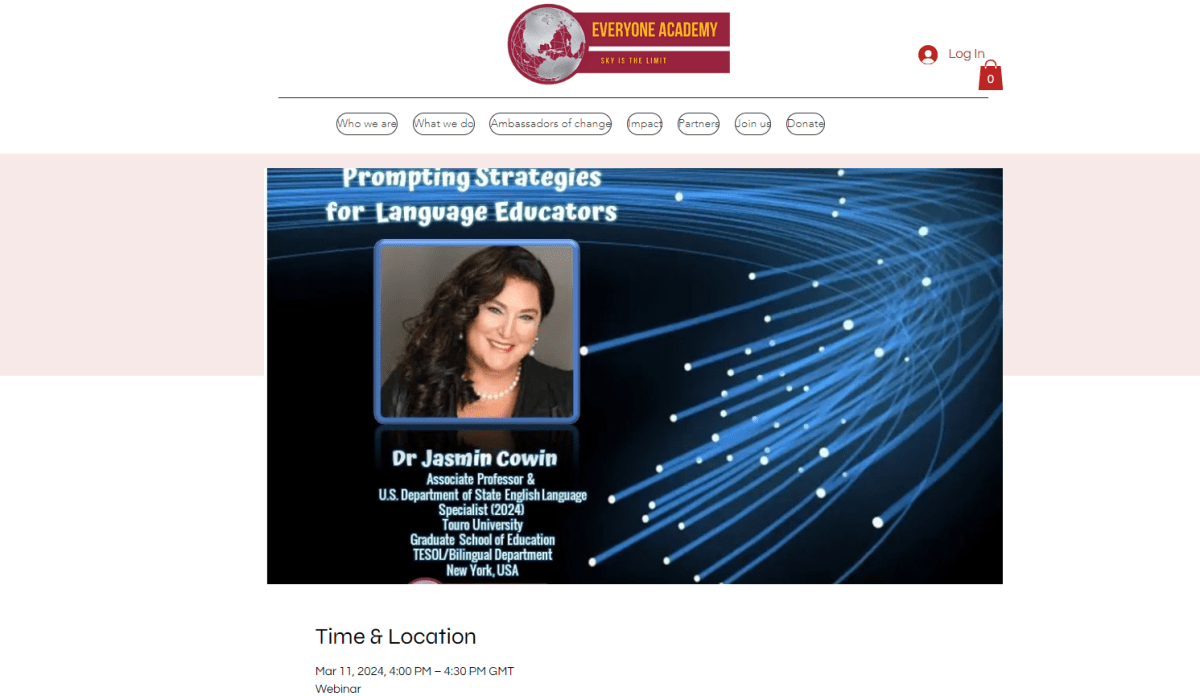
Dr. Cowin presents “Structured Prompting for Teachers of English as a New Language/English as a Foreign Language” for Everyone Academy – Morocco, Moderator: Aziz Soubai March 11th, 2024

I am an Associate Professor at Touro University, a Fulbright Scholar, an SIT Graduate, a U.S. Department of State English Language Specialist (2024) in Assessment and Artificial Intelligence, and a former Education Policy Fellow (EPFP™) at Columbia University, Teachers College. I regularly write on ‘Insights at the Intersection of AI and Education,’ for Stankevicius. At the heart of my professional journey is a commitment to transformative education, grounded in integrating concepts like Lynda Miller’s philosophy of abundance, which counters Ruby Payne’s notion of a Culture of Poverty (2005). This philosophy of abundance emphasizes viewing experiences as assets filled with positivity and optimism, particularly valuable in an often dystopian-seeming world. Aligned with the UN’s Sustainable Development Goal 4, I have contributed to initiatives like Computers for Schools Burundi, TESOL “Train the Trainer” programs in Yemen and Morocco. As an educator in the Fourth Industrial Revolution era, I prepare future teachers by incorporating innovations in education to shape worldviews and cultivate an adaptable skillset for Volatile, Uncertain, Complex, Ambiguous (VUCA) environments. My research explores simulations for educators-in-training, AI in education and assessment, educational Metaverse applications, and educational transformation for language educators.
“Rather than remain fixed in familiar practices, we will need to harness an agile, growth-oriented mindset. Now is the time for courage, vision, and perseverance.”
Dr. Jasmin (Bey) Cowin
I am happy to share my virtual workshop session: “Structured Prompting for Teachers of English as a New Language/English as a Foreign Language” for Everyone Academy – Morocco, moderator: Aziz Soubai March 11th, 2024
The Zoomlink with passcode is nested in the PDF.
Join my webinar for Everyone Academy: Structured AI Prompting Strategies for Language Educators
At the heart of my professional journey is a commitment to transformative education, grounded in integrating concepts like Lynda Miller’s philosophy of abundance, which counters Ruby Payne’s notion of a Culture of Poverty (2005). This philosophy of abundance emphasizes viewing experiences as assets filled with positivity and optimism, particularly valuable in an often dystopian-seeming world. Aligned with the UN’s Sustainable Development Goal 4, she has contributed to initiatives like Computers for Schools Burundi, TESOL “Train the Trainer” programs in Yemen and Morocco. As an educator in the Fourth Industrial Revolution era, I prepare future teachers by incorporating innovations in education to shape worldviews and cultivate an adaptable skillset for Volatile, Uncertain, Complex, Ambiguous (VUCA) environments. Her research explores simulations for educators-in-training, AI in education and assessment, educational Metaverse applications, and educational transformation for language educators.
“Rather than remain fixed in familiar practices, we will need to harness an agile, growth-oriented mindset. Now is the time for courage, vision, and perseverance.”
Dr. Jasmin (Bey) Cowin
Through my pro-bono work, I support SDG 4.c By 2030, substantially increase the supply of qualified teachers, including through international cooperation for teacher training in developing countries, especially least developed countries and small island developing States.
Mon, Mar 11 | Webinar Time & Location Mar 11, 2024, 4:00 PM – 4:30 PM GMT (Casablanca, Morocco)
– click the link to register
Structured AI Prompting Strategies for Language Educators
Dr. Jasmin (Bey) Cowin publishes Generative Künstliche Intelligenz in Bildung, Forschung und Industrie: Die Philebus-Triade? in HMD Praxis der Wirtschaftsinformatik, Springer
Cowin, J.B. Generative Künstliche Intelligenz in Bildung, Forschung und Industrie: Die Philebus-Triade?. HMD (2024). https://doi.org/10.1365/s40702-024-01055-6
Zusammenfassung
Platos Dialog „Philebus“ erforscht ausführlich die Theorie der Formen und die Suche nach Wahrheit durch philosophische Diskussionen zwischen Sokrates und Philebus. Zentrale Prinzipien beinhalten das Erreichen eines Gleichgewichts zwischen Weisheit und Vergnügen, was Sokrates als Weg zum „guten Leben“ argumentiert. Dieses Papier stützt sich auf den philosophischen Rahmen der Philebus-Triade als Linse, durch die die Schnittstellen und Synergien zwischen den drei Bereichen Weisheit, Vergnügen und dem guten Leben betrachtet werden. Durch die Verwendung dieses philosophischen Modells, versucht die Autorin, die Komplexitäten und das Chaos einer beschleunigenden, unkontrollierten und unerforschten technologischen Evolution zu interpretieren und zu durchdringen. Ihre These argumentiert, dass die generative Künstliche Intelligenz (KI), betrachtet durch die Philebus-Triade – ein Konzept aus den platonischen Dialogen, das eine harmonische Verbindung zwischen verschiedenen Aspekten der Realität symbolisiert – einen zusammenhängenden Rahmen darstellt. Die Autorin stellt eine komplexe Verbindung zwischen den zentralen philosophischen Grundsätzen in den platonischen Dialogen und den möglichen Konsequenzen einer atavistischen generativen KI in den Bildungs-, Forschungs- und Industriesektoren her. Durch die Verknüpfung dieser Konzepte entsteht eine Reflexion über die Konvergenz von philosophischem Gedankengut und modernster Technologie. Die Synthese dieser Ideen unterstreicht die zeitlose Natur der philosophischen Untersuchung, um dringende Fragen unserer technologischen Ära zu beantworten.
Schlüsselwörter: Philebus-Triade · Platonischer Dialog · Atavistische Generative KI · Philosophisch-technologische Konvergenz
Abstract:
Generative Artificial Intelligence in Education, Research and Industry: the Philebus Triad? Abstract Plato’s dialog “Philebus” explores in detail the theory of forms and the search for truth through philosophical discussions between Socrates and Philebus. Central principles include achieving a balance between wisdom and pleasure, which Socrates argues is the path to the ‘good life’. This paper draws on the philosophical framework of the Philebus Triad as a lens through which the interfaces and synergies between the three areas of Wisdom, Pleasure, and the Good Life are viewed. By using this philosophical model, the author attempts to interpret and penetrate the complexities and chaos of an accelerating, uncontrolled and unexplored technological evolution. Her thesis argues that generative Artificial Intelligence (AI), viewed through the Philebus triad—a concept from the Platonic dialogues that symbolizes a harmonious connection between different aspects of reality—represents a cohesive framework. The author establishes a complex link between the central philosophical principles in the Platonic dialogues and the potential consequences of atavistic generative AI in the education, research and industrial sectors. By linking these concepts, a reflection on the convergence of philosophical thought and cutting-edge technology emerges. The synthesis of these ideas underscores the timeless nature of philosophical inquiry to answer pressing questions of our technological era.
Keywords: Philebus Triad · Platonic Dialogue · Atavistic Generative AI · Philosophical-Technological Convergence
Neuralink as key to unlocking universal communication? By Dr. Jasmin (Bey) Cowin for Stankevicius

I am pleased to share my newest publication:
Cowin, J. (Touro University) (2024, March 5). Neuralink as key to unlocking universal communication? Stankevicius. Retrieved from https://stankevicius.co/tech/neuralink-as-key-to-unlocking-universal-communication/
Dr. Jasmin Cowin (lead author) Co-Publishes “Accelerating Higher Education Transformation: Simulation-Based Training and AI Coaching for Educators-in-Training” at Springer Nature, Switzerland
I am delighted to announce the recent publication of our paper, titled “Accelerating Higher Education Transformation: Simulation-Based Training and AI Coaching for Educators-in-Training.” This paper has been featured in the conference proceedings titled “Towards a Hybrid, Flexible and Socially Engaged Higher Education,” published by Springer Nature, Switzerland.
Our transdisciplinary collaborative effort grew from the International Conference on Interactive Collaborative Learning (ICL 2023), Madrid, and signifies a significant step forward in our journey to reshape educational paradigms through the integration of cutting-edge technologies (Cowin et al., 2024).
Cowin, J., Oberer, B., Lipuma, J., Leon, C., & Erkollar, A. (2024). Accelerating Higher Education Transformation: Simulation-Based Training and AI Coaching for Educators-in-Training [ICL]. In M. E. Auer, U. R. Cukierman, E. Vendrell Vidal, & E. Tovar Caro (Eds.), Towards a Hybrid, Flexible and Socially Engaged Higher Education (CLDM_Dv; Vol. 899, pp. 532–541). Springer Nature Switzerland; /Research/Education. https://doi.org/10.1007/978-3-031-51979-6_55
Conference Presentation
Cowin, J., Oberer, B., Lipuma, J., Leon, C., & Erkollar, A. (2023, September 26). Accelerating Higher Education Transformation: Simulation-Based Training and AI Coaching for Educators-in-Training [Presentation] [Conference]. International Conference on Interactive Collaborative Learning (ICL 2023), Madrid, Spain. http://icl-conference.org/icl2023/
Paper Abstract
As the world undergoes remarkable transformations powered by Artificial Intelligence, the challenge arises for educational systems and institutions to adapt. How can we adequately equip educators-in-training to flourish in unprecedented change? The emergence of flexible, hybrid, and socially engaged learning environments has created a need for effective training methodologies that empower educators-in-training to thrive in this new paradigm. Higher education institutions need to expand aspiring educators’ human and professional potential amidst accelerating change, in line with the clarion call of the Sustainable Development Goal 4 Quality Education “By 2030, substantially increase the supply of qualified teachers, including through international cooperation for teacher training in developing countries, especially least developed countries and small island developing States” [1]. Simulation-based training coupled with Artificial Intelligence offers a solution to equip educators with the necessary skills and competencies to navigate complex real-world educational settings to succeed in classrooms of the 21st century. Simulation-based training allows educators-in-training to develop their skills and build confidence in their abilities to effectively engage with students in multifaceted classroom environments by providing a safe and controlled space for experimentation and practice. In conclusion, this paper and presentation explore the shifting teaching paradigms in higher education using simSchool and Mursion simulation platforms as examples and examine inclusive and dynamic practices that promote sustainable systems change in line with SDG 4. Quality Education, supporting educators-in-training by identifying strengths and encouraging personal and professional growth through AI feedback loops and faculty coaching.
Keywords: Artificial Intelligence, Educators-in-training, Simulation-based training, Sustainable systems change
Acknowledgments
I extend my heartfelt gratitude to my colleagues and peers and the supportive community that made this research possible. Our collaborative efforts reflect a unified vision for the future of education, one that embraces the challenges and opportunities presented by the digital age.
Disclosure statement
No conflict of interest pertains to the research presented above.
ORCID
Jasmin Cowin http://orcid.org/0000-0002-0405-8774
Birgit Oberer http://orcid.org/0000-0001-7231-7902
Alptekin Erkollar http://orcid.org/0000-0003-3670-5283
James Lipuma https://orcid.org/0000-0002-9778-3843
Cristo Leon https://orcid.org/0000-0002-0930-0179
Dr. Cowin receives Online Teaching Certification from the Department of Online Education, Touro University

In the Department of Online Education, at Touro University, a group of skilled instructional designers and seasoned online educators collaborates with Touro faculty members to assist in the creation, modification, and updating of their online courses.
Online Teaching Certification
Description:
This faculty and staff development badge is awarded upon completion of the Module Making and Online Course Creation Workshops through Touro University (NY). The workshops represent 16 contact hours and 20 PDUs of content. Certification good for three years of end date of workshop series. This badge is internally accepted inside the TCUS system.
issued on: Jan 9, 2024 at 12:02 PM |Expires on Jan 9, 2027 at 12:02 PM

