The CALL-IS Team & Proposal Invitation for the Electronic Village, TESOL 2024 in Tampa, FL March 21-23, 2024

As a member of the CALL-IS Team, I want to share our call for proposals and invite you to submit a proposal for the Electronic Village at TESOL 2024. The call for proposals will be open between October 15 and December 15, 2023. We look forward to a dynamic exchange of ideas and practical insights during the Digital Dive & Tinkering with Technology sessions at TESOL 2024. Submit your proposal here: https://call-is.org/ev/

TESOL International Convention & Expo: With thousands of attendees, hundreds of education sessions, and 50+ exhibits, the TESOL International Convention & Expo is the largest professional development event in English language teaching.

The convention offers a wide range of engaging professional development opportunities to English language teaching (ELT) professionals at all levels worldwide. In lively interactive sessions, you’ll develop a global perspective through the exchange of ideas, research, and practices. Gain knowledge about current trends in the field while expanding your professional network.

You’ll also have the opportunity to connect with English language teaching-related companies and organizations at the English Language Expo! Learn about the latest products, publications, services, and resources in the field.

Dr. Jasmin (Bey) Cowin Presents: Accelerating Higher Education Transformation: Simulation-Based Training and AI Coaching for Educators-in-Training for 26th International Conference on Interactive Collaborative Learning

I am pleased that my presentation was received well at the International Conference on Interactive Collaborative Learning and 52nd IGIP International Conference on Engineering Pedagogy (ICL2023). This interdisciplinary conference aims to focus on the exchange of relevant trends and research results as well as the presentation of practical experiences in Interactive Collaborative Learning and Engineering Pedagogy.

Our paper’s Abstract: “Accelerating Higher Education Transformation: Simulation-Based Training and AI Coaching for Educators-in-Training.”

Abstract
This paper conducts an interdisciplinary investigation into the transformative potential of Artificial Intelligence (AI) in the realm of teacher education by integrating methodologies and frameworks from education, business admin-istration, and computer science. The rapid advancements in AI are ushering in a possible Cambrian explosion of systems transformation for educational and governmental institutions. Simulation mentoring and training are gaining traction for teacher education. The authors’ investigation into simulation-based training and AI coaching for high-leverage teacher training practices intertwines an interdisciplinary dialogue on modernizing 21st-century teacher training and the possibility of a Cambrian explosion in teacher education for higher education institutions. By examining asynchronous AI-driven simula-tion mentoring and teaching experiences and their impact on instructional teacher effectiveness, the authors frame, explore, and consider possible new resource allocations and economic implications for teacher training in higher education. Simulation tools promise to promote scalable approaches to fos-tering pedagogical expertise by incorporating research-based psychological, sensory, and cognitive domains inspired by Bloom’s educational objectives taxonomy. Using the examples of simSchool and Mursion, the authors co-construct meaning-making and hypothesize on forward-looking, scalable ed-ucator training approaches, the interplay between learning, knowledge acqui-sition, and embodied cognition, highlighting the importance of reflective practice in teacher education. AI-driven mentoring holds promise for scala-bility to achieve by 2030 the Sustainable Development Goal 4.c, aiming to “increase the supply of qualified teachers, including through international cooperation”. In conclusion, this paper will explore using AI simulations as practice arenas to stimulate and shape the dialogue between stakeholders in higher education, focusing on integrating existing best practices that will eventually change teacher education locally and globally, accelerating a higher education Cambrian explosion.

Cowin, J., Oberer, B., Lipuma, J., Leon, C., & Erkollar, A. (2023). Accelerating Higher Education Transformation: Simulation-Based Training and AI Coaching for Educators-in-Training.  (Virtual Presentation, Sept. 27, 2023). 26th International Conference on Interactive Collaborative Learning and 52nd IGIP International Conference on Engineering Pedagogy (ICL2023)

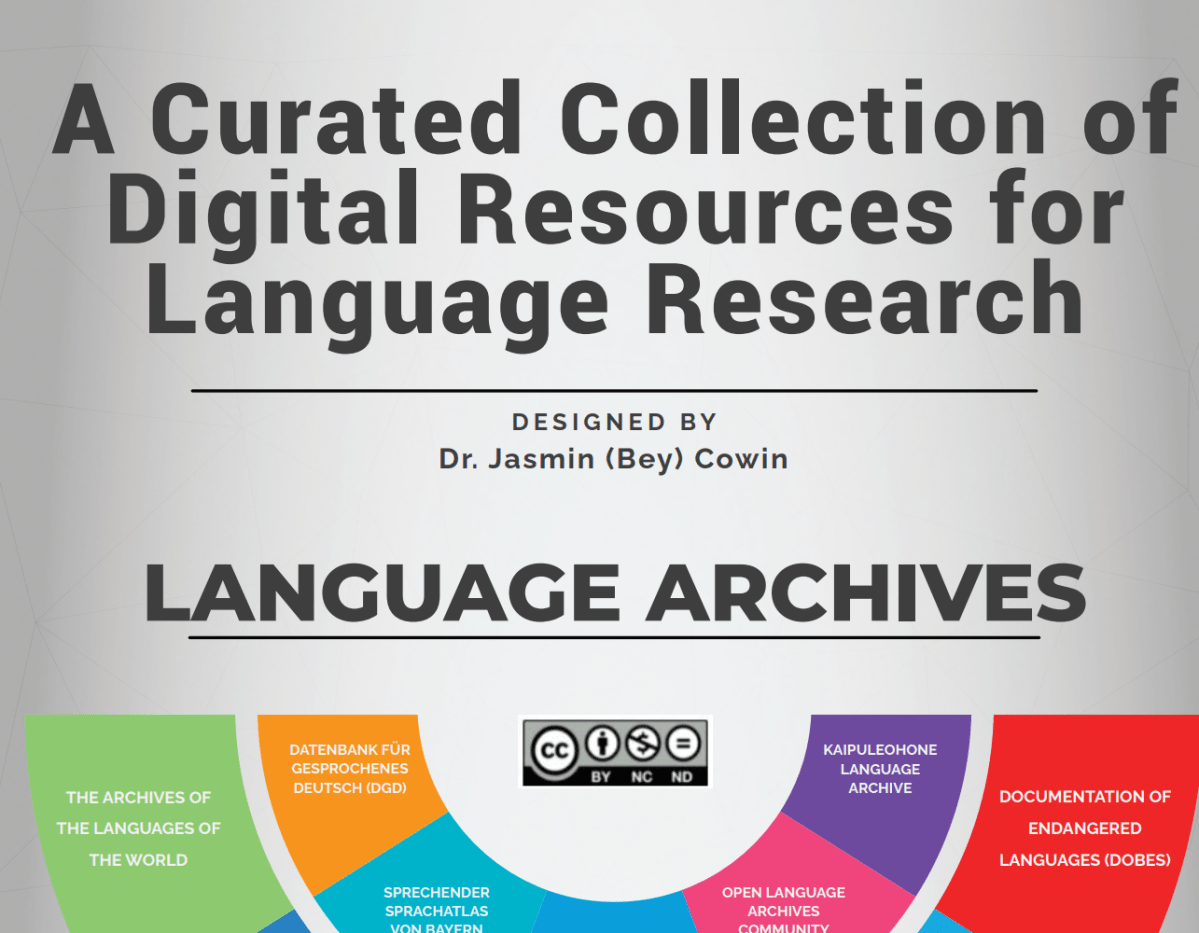
A Curated Collection of Digital Resources for Language Research by Dr. Jasmin (Bey) Cowin

This infographic strives to synthesize and clarify a collection of digital resources designed for linguistic research. It brings together a range of tools and language archives with a focus on enhancing productivity and insight into academic research on languages. By compiling these resources in one place, my goal is to make it easier for linguists, computational linguists, cognitive scientists, students, language teachers and researchers, and others exploring language to find and utilize the assets that will be most valuable for their work.

Overall, my infographic intends to showcase the digital resources that can empower investigations into linguistics and offer shortcuts for discovering and leveraging such freely available assets. By outlining some of the available tools and materials, I aim to promote more efficient, comprehensive, and insightful research practices among scholars studying language from various perspectives and with diverse objectives. Whether looking to find real-world examples of syntax patterns, or uncover endangered languages, this guide endeavors to point researchers towards the most relevant and useful digital assets for their work.

Dr. Jasmin (Bey) Cowin, Dr. Birgit Oberer and Cristo Leon on “Trans-Disciplinary Communication in the ChatGPT Age: A Systems Perspective” for The 17th International Multi-Conference on Society, Cybernetics and Informatics: IMSCI 2023

We are pleased to announce that our paper was accepted for presentation for The 17th International Multi-Conference on Society, Cybernetics and Informatics: IMSCI 2023©, September 12 – 15, 2023

About the Conference
“Informatics and Cybernetics (communication and control) are having an increasing impact on societies and in the globalization process that is integrating them. Societies are trying to regulate this impact, and adapt it to their respective cultural infra-structures. Societies and cultures are in reciprocal co-adaptations with Information and Communication Technologies. Synergic relationships might emerge in this co-adaptation process by means of positive and negative feedback loops, as well as feedforward ones. This would make the whole larger than the sum of its parts, generating emergent properties in the parts involved as well as in the whole coming forth. The academic, private, and public sectors are integrating their activities; multi-disciplinary groups and inter-disciplinary teams are being formed, and collaborative research and development projects are being organized in order to facilitate and adequately orient the design and implementation of the feedback and the feedforward loops, so the synergic relationships are socially positive and personally human.”

It was a pleasure to work with my colleagues in a true collaborative spirit and academic exchange through the lens of trans-disciplinarity and its implications for contemporary scholarship and practice. Thank you to Dr. Birgit Oberer from the ETCOP Institute for Interdisciplinary Research, Klagenfurt, Austria, and Cristo Leon from the Office of Research & Development, New Jersey Institute of Technology, Newark.

Our paper is titled:

“Trans-Disciplinary Communication in the ChatGPT Age: A Systems Perspective”

ABSTRACT
In recent years, Trans-Disciplinarity (TD) has become increasingly recognized as a critical concept in contemporary scholarship and practice, especially in the emerging field of the metaverse. Despite its growing importance, however, the precise origins and meanings of the term remain somewhat elusive, and its relationship to systems thinking is still poorly understood. Consequently, further research is needed to clarify the definition and application of transdisciplinarity and explore its connections with related concepts such as systems thinking. By doing so, we can gain a broader understanding of how transdisciplinary approaches can be used to address complex problems in a variety of contexts and how they can contribute to advancing knowledge and innovation across disciplinary boundaries.
Keywords: Trans-disciplinary communication, digital age, metaverses, systems thinking, ChatGPT, transformative technologies.

Dr. Jasmin Cowin Appointed as Associate Professor at Touro University, Graduate School of Education

Touro University Graduate School of Education, Alan Kadish 📢 I am thrilled to announce my appointment as Associate Professor at Touro University! I am deeply honored and grateful to President Alan Kadish for this incredible opportunity. I would also like to express my heartfelt appreciation to Nelly C Lejter Morales, Dean of the Graduate School of Education and Associate Provost for Special Projects, as well as my former Chair Olga DeJesus-Diaz, and current Chair SEONGSHIN KIM, supportive colleagues Timothy Bellavia, Charity M. Dacey, PhD, Chikezie Ozuzu, Laurie Bobley and many others at the Graduate School of Education who helped me grow professionally during my last five years at GSE. Your guidance and belief in my abilities have been instrumental in this achievement. I am excited to continue to contribute to Touro University’s mission of academic excellence, fostering a dynamic learning environment, conducting meaningful research, and shaping the next generation of scholars and leaders. Thank you to everyone who has supported me on this journey, and I look forward to engaging in fruitful collaborations within the academic community.

Dr. Cowin presents “Promoting Ethical Behavior in Higher Education: Integrating Anti-Cheating and Anti-Plagiarism Strategies in Curriculum Design” at the Amity Institute of Education, Amity University, Noida, India.

I am pleased to share today’s experience as a presenter at the Amity Institute of Education, Amity University, Noida, India, where I conducted a free webinar on “Promoting Ethical Behavior in Higher Education: Integrating Anti-Cheating and Anti-Plagiarism Strategies in Curriculum Design.” As an educator with a personal commitment to Sustainable Development Goal 4.c By 2030, “substantially increase the supply of qualified teachers, including through international cooperation for teacher training…”, I am honored to contribute to such transdisciplinary conversations.


Amity University holds a distinguished reputation as a government-recognized institution, established by an act of the State Legislature and accredited by the University Grants Commission (UGC). This recognition underscores the university’s dedication to providing quality education and fostering academic excellence.

Webinar Focus: Ethical Behavior in Higher Education:
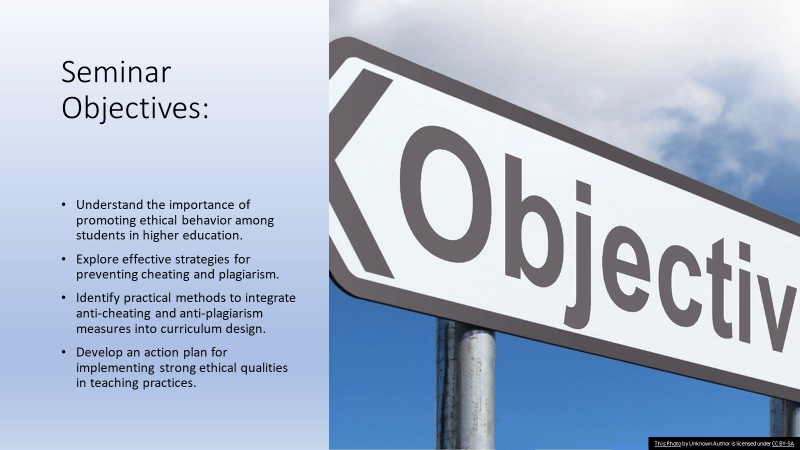
During the webinar Promoting Ethical Behavior in Higher Education: Integrating Anti-Cheating and Anti-Plagiarism Strategies in Curriculum Design, I had the privilege of addressing an audience interested in exploring strategies to foster ethical behavior among students in higher education. Cheating is a topic that raises significant ethical concerns in academic settings, and the use of AI can potentially complicate the situation further. While AI technology offers both benefits and opportunities, its misuse for cheating purposes is a serious violation of academic integrity. It is imperative to incorporate proactive measures into curriculum design to effectively address these issues through practical strategies.

Slide by Dr. Jasmin Cowin

International Collaboration: An Exciting Prospect:
One of the most intriguing prospects arising from this webinar is the planned international collaboration. I am pleased to announce a forthcoming collaborative article that will feature contributions from highly regarded faculty members at the Amity Institute of Education, Amity University. This collaboration will provide a diverse and comprehensive perspective on the integration of anti-cheating and anti-plagiarism strategies, enriching the academic discourse on ethical behavior in higher education.

Cowin, J. (2023, June 15). Promoting Ethical Behavior in Higher Education: Integrating Anti-Cheating and Anti-Plagiarism Strategies in Curriculum Design [webinar]. Amity Institute of Education, Amity University, Noida, Sec-125, India.

Completion of Module Making Workshop with the Department of Online Education!

I completed the Module Making Workshop with the Department of Online Education at Touro University.

In order to teach online courses as an instructor at Touro College,I wanted to learn more about how to elevate setting up course modules for your online course(s). The Module Making Workshop is a 4-week course guided me through the essential components of creating an online module including creating measurable learning objectives, adding critical design elements (e.g., headers), and creating a logical flow to course content.

The components of this workshop adhere to the standards outlined in Touro’s Rubric for Online Education, which is the instrument used to evaluate the quality of online courses at Touro.

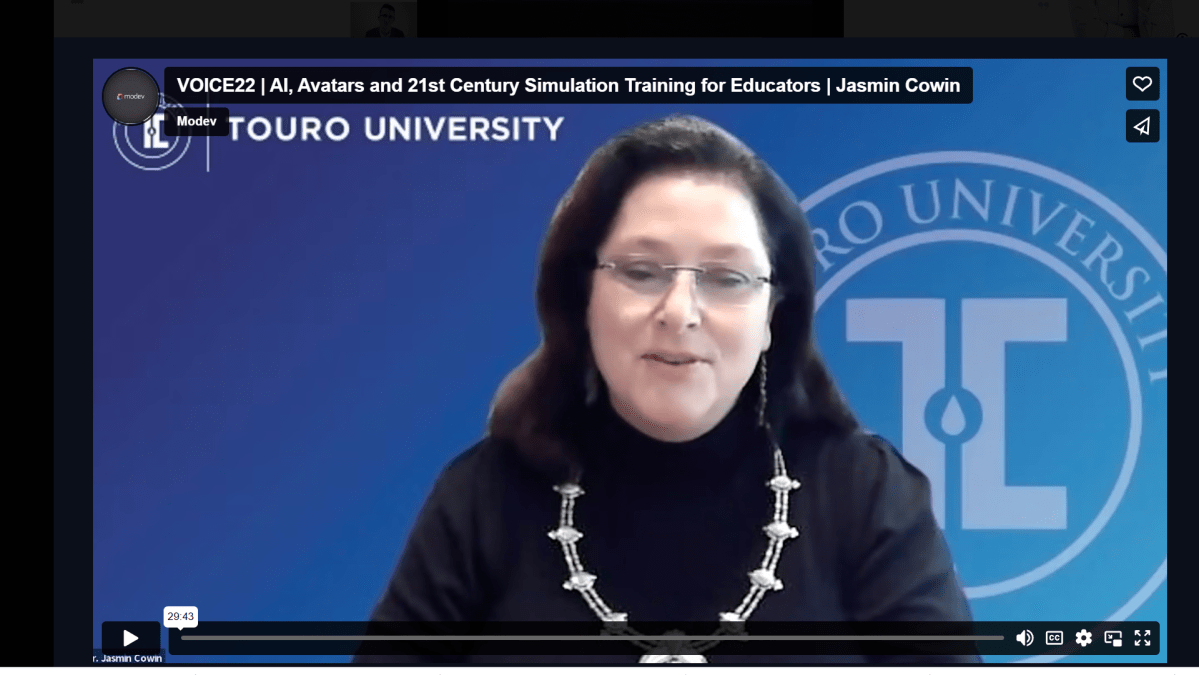
Touro University Online Summit 22 Presentation  by Jasmin Cowin, Ed.D. on “AI, Avatars and 21st Century Simulation Training for Educators”

AI and intelligent systems are positioned to become change agents in education through ushering in profound changes in institutional administrative and teaching functions, systemic strategic planning, and program planning. Post-pandemic, the explosive growth of fully-accredited online degrees has also reached teacher education programs. However, any online teacher education program needs alternative pathways to support teacher candidates in their online journey at Touro University and towards teacher certification. This lightening talk focused on alternative meeting, teaching and advising spaces in metaverses such as Agora World. Meeting in such alternative, closed-loop spaces fosters positive faculty-candidate interaction, provides pathways for collaborative experiences, nurtures self-efficiacy, and the ability to partner authentically through talking, presenting, debating within groups in a constructed safe metaverse space.

VOICE22 on Demand Session Recordings: Dr. Jasmin (Bey) Cowin – AI, Avatars and 21st Century Simulation Training for Educators

Session recordings are now available to watch On Demand. Keynotes, interviews and panel discussions from top brands explore real world examples of those successfully integrating conversational AI and automation to drive innovation throughout their organizations. Catch any sessions you may have missed or watch your favorites again! You can register here to get access to VOICE22 and my presentation recording from Agora World:

Dr. Jasmin (Bey) Cowin – AI, Avatars and 21st Century Simulation Training for Educators

AI and intelligent systems are positioned to become change agents in education through ushering in profound changes in institutional administrative functions, systemic strategic planning, and program planning. Post-pandemic, the explosive growth of fully-accredited online degrees has also reached teacher education programs. However, any online program in teacher education needs alternative pathways to support teacher candidates who are required to complete practicum and fieldwork hours.

This lightning talk focuses on reviewing, contrasting, and framing two distinct immersive ecosystems. Mursion and simSchool. While both platforms offer immersive experiences simSchool is AI-driven while Mursion employs mixed reality simulations. Both provide preservice teachers a platform to practice and rehearse the art and skill of teaching within a controlled simulation setting using avatars. Insights on evidence-based practices by teacher candidates are generated through data from both AI and candidates’ in-world experiences. Such data aggregation offers institutions informed decision-making through a systematic review using technology to improve teacher education programs.

Presenting at the TESOL 2023 International Convention & English Language Expo in Portland, Oregon, USA

Together with my dear colleagues and peers Ching-Ching Lin, Ed. D. and Nikki Bell we will be presenting on our NYS TESOL e-book project “Enacting culturally responsive pedagogies through community assets mapping: A NYS TESOL Story,” which has been included in the TESOL 2023 convention program, held on 21–24 March in Portland, Oregon, USA.

Join a global community of English language professionals for the TESOL 2023 Convention & English Language Expo, 21-24 March!

Through engaging in-person events, you will be able to:

  • Connect with our global community of English language professionals. 
  • Choose from 900 in-person sessions.
  • Access 200 virtual sessions. That’s right, in-person registration includes access to the Virtual Convention!   
  • Interact with exhibitors showcasing the latest ELT products and services.
  • Press reset and get away from your classroom or office.