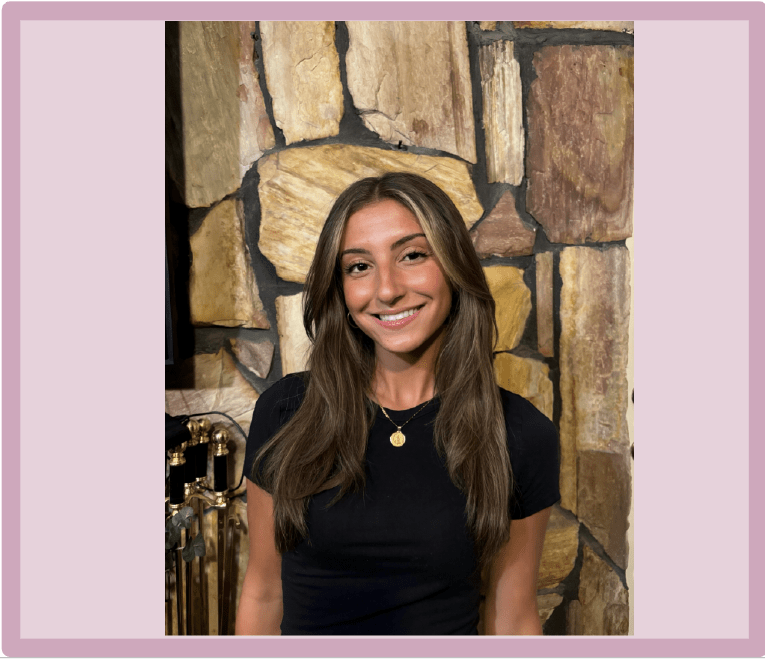
Touro University TESOL Candidate Ishrat Jahan’s Discussion Board “On Teaching Fairness” forEDDN 637


The MS in Teaching English to Speakers of Other Languages (TESOL) Program 
helps NYS-certified PreK-12 teachers more effectively teach and communicate with a diverse student population. If you have questions about our admissions requirementscertification guidelines, or transfer credits, feel free to contact us.

I believe that highlighting an exemplary discussion board post does more than celebrate one candidate’s success; it sets a visible, attainable standard that shows the whole course cohort what thoughtful, well-developed thinking looks like in practice. When I feature one of my candidates’ work on my blog, I want them to feel that the often invisible labor of reflection, synthesis, and pedagogical reasoning behind a strong post has truly been seen. I also believe that celebrating progress, not just polished perfection, builds a culture where candidates learn from and encourage one another rather than viewing the discussion board as a box to check. Ultimately, I share this work because I want my future educators to know their voices matter, modeling the same encouraging, growth-oriented feedback I hope they will one day offer their own students.Beyond the present cohort, my blog also serves as a living repository, offering future students clear and exemplary models to draw inspiration from as they develop their own voices.

Ishrat Jahan: I earned my Bachelor of Science in Childhood Education with a bilingual extension in Bangla. I currently work in an elementary school dual-language classroom, supporting students from diverse cultural backgrounds and varying levels of English proficiency. To strengthen my ability to support multilingual learners and expand my professional knowledge, I am pursuing a master’s degree in TESOL at Touro University, where the flexible schedule and practical coursework have helped prepare me to better meet students’ academic and language needs. 

“My journey at Touro has helped me better understand the importance of supporting multilingual learners through meaningful, equitable, and culturally responsive instruction.” 

Ishrat Jahan, Touro University TESOL Candidate

EDDN 637 Module 1

Discussion Board Post

1. What are some characteristics of ELL’s to consider to implement effective teaching?

There are many characteristics of ELLs to consider when implementing effective teaching. First, teachers need to understand that all ELLs are not the same, so they should not be taught in the exact same way because ELLs come to the classroom with different English proficiency levels, first languages, family situations, schooling experiences, interrupted schooling, cultural backgrounds, literacy skills in their home language, and academic strengths. The SIOP chapter clearly states that “all English learners in schools are not alike” (Echevarria et al., 2017). This means that students should receive support based on their individual needs. For example, if a student attended school in a different country and is literate in their first language, they may not need the same support as a student who has had no previous schooling, interrupted schooling, or limited literacy experiences.

 In my view, effective teaching starts with knowing the whole student, not just their English level, because every student comes to the classroom with some knowledge. If the teacher already knows the student’s background, they can build from there. For example, if a student already understands a concept in their home language, the teacher can use that existing knowledge to build further understanding instead of reteaching everything from the beginning. This connects to the idea that “when teachers know students’ backgrounds and native-language abilities, they can choose better materials and instructional strategies” (Echevarria et al., 2017). This means that teachers need to understand students as a whole, including their language, culture, and learning history, to make content accessible and effective.

2. On Teaching Fairness: Considering the concept of fairness in education, how can TESOL educators ensure equitable classroom practices for multilingual learners?  Provide specific examples from the P–3 Multilingual Learning Toolkit to support your response.

Fairness in education does not mean giving every student the exact same thing. To me, fairness means giving students the specific supports they need to succeed by providing opportunities to access learning and show what they know. This is very important for multilingual learners because it values their home language, culture, and prior knowledge instead of viewing them as barriers. The P-3 Multilingual Learning Toolkit explains that learning and using key words in a child’s home language “shows respect and interest” and helps children feel valued (New Venture Fund, n.d.). A practical example would be labeling classroom objects in English and students’ home languages, inviting students to teach the class or their partner a word from their home language, or previewing important vocabulary in both languages when possible. In addition, teachers can create equitable classroom practices by using different approaches to support and assess students fairly. The Toolkit explains that multilingual learners’ language and content skills may be “distributed across English and the home language” (New Venture Fund, n.d.). This means that a student may understand a concept, but they may not yet be able to fully explain their thinking in English. If they are unable to explain their ideas in English, that does not mean they are not strong students. It means they need different support. Teachers can use different approaches to help students demonstrate their understanding through oral responses, pointing, drawings, partner discussions, group discussions, sentence starters, and home-language support when needed. The Toolkit also states that assessment should be “linguistically, culturally, and developmentally appropriate” (New Venture Fund, n.d.) because fairness should measure what students already know, not only how much English they can produce at that moment.

3. SIOP and Structured Literacy Introduction and Practical Application: Reflect on your initial understanding of the SIOP model. How does the approach outlined in the SIOP at a Glance Practical Guide enhance both content and language instruction? Identify one SIOP component and one structured literacy approach from the structured literacy map you believe is particularly impactful for multilingual learners and justify your choice with a practical example.

My initial understanding of the SIOP model is that it helps teachers plan lessons so multilingual learners can understand both the content and the language needed to succeed. After reviewing the SIOP at a Glance Practical Guide, I realized that creating a SIOP lesson is not just about simplifying a lesson. Instead, it is about making instruction explicit, intentional, clear, and accessible for everyone. The guide shows that an effective lesson should include clear content and language objectives, vocabulary support, comprehensible input, background knowledge, interaction, practice, and assessment. This approach supports content instruction because students are not just being given information; they are being supported step by step through hands-on activities, visuals, modeling, and connections to their experiences. It also supports language learning by giving students opportunities to speak, listen, read, and write with clear vocabulary and sentence practice in meaningful ways.

One SIOP component I find important is building background because it connects students’ culture, first language, and existing knowledge to new learning. For example, before teaching a lesson about culture, I could ask students to talk about their culture, teach key vocabulary, show pictures, bring in items, and connect the English words to words they may know in their first language. This helps students feel confident and comfortable before learning new content. One structured literacy approach I think is important is explicit and systematic vocabulary instruction because when teachers preteach and directly teach important words, it benefits multilingual learners instead of assuming they will understand the words from the context. For example, if students are learning about culture, I would introduce key words like food, belief, and tradition using vocabulary cards, anchor charts, student-friendly definitions, pictures, examples, sentence starters, and gestures before asking students to read and write. Before asking them to complete the work, I would explicitly model using sentence starters such as “In my culture, I celebrate_____ becaue_____,” and “A special food from my culture is______”. After that, students could share more about their culture by creating their own sentence with the whole class or with a partner. This makes the lesson clear, meaningful, and supportive for multilingual learners because students are learning grammar, vocabulary, speaking, and writing in an organized way. 

4. Supports for Multilingual Learners: Based on your review of the SUPPORTS FOR MULTILINGUAL LEARNERS document and the structured literacy map, discuss two specific strategies or resources you could incorporate into a SIOP lesson plan to strengthen language acquisition for multilingual learners. How would these strategies directly support student literacy, engagement, and academic success?

Based on my review of the Supports for Multilingual Learners document and the structured literacy map, two specific strategies or resources I could incorporate into a SIOP lesson plan to strengthen language acquisition for multilingual learners are differentiated language supports and intentional vocabulary resources that connect language with grade-level content. The  Supports for Multilingual Learners document explains that multilingual learners and English learners have different proficiency levels and educational backgrounds, so teachers should avoid a “one-size-fits-all approach” (Mavrogordato et al., 2024). In a SIOP lesson, this could mean using visuals, partner discussions, sentence starters, and small-group instruction based on students’ needs. Another strategy is using instructional resources that build English while still giving students access to grade-level content. The Supports for Multilingual Learners document states that “translations, eBooks, intentional vocabulary development, and the use of definitions and cognates” can support language development and help multilingual learners and English learners access lessons (Mavrogordato et al., 2024). This means that using instructional resources, teachers can still teach the same content while using different supports. For example, in an ELA  lesson on tradition, I could pre-teach key vocabulary with interactive cards, pictures, and gestures, include cognates when possible, and let students practice the words through speaking, reading, and writing.

These strategies directly support student literacy, engagement, and academic success because students are learning in meaningful ways that include comprehension, vocabulary, and academic language in context. They also increase engagement and provide opportunities for students to engage in learning without feeling lost or shy. Most importantly, they support academic success by helping multilingual learners access the same meaningful content as their classmates while still developing English.   

References

Echevarría, J., Vogt, M. E., & Short, D. J. (2017). Making content comprehensible for English learners: The SIOP model (5th ed.). Pearson.

 Kim, S. (n.d.). SIOP at a glance: A practical guide for beginners. Touro University Graduate School of Education.

Mavrogordato, M., Bartlett, C., Callahan, R., DeMatthews, D., & Izquierdo, E. (2024). Supports for multilingual students who are classified as English learners. EdResearch for Action. https://files.eric.ed.gov/fulltext/ED656680.pdf

New Venture Fund. (n.d.). Multilingual Learning Toolkit. https://touro.instructure.com/courses/162930/files/14412119/download?download_frd=1

Module 2

  1. In Teaching Scenarios, Chapter 2 p. 43 on, pay attention to the lessons of Mr. Cullen, Mr. Ryan, and Ms. Sauerbraun on each of the Lesson Preparation features. What did you learn?  How did reading the lesson scenarios give you insight into the SIOP model? Did you notice any Science of Reading (SoR)  or structured literacy approaches? You must quote directly from the textbook to support your statements.

After reading Chapter 2 teaching scenarios, I learned that lesson preparation is very important in the SIOP model because it supports students’ success. Another way to say this is that lesson preparation affects how clearly students understand both the content and the language of the lesson. If lesson preparation is strong, it increases the chances of student success. Echevarria et al. (2017) state that “lesson planning is critical to both a student’s and a teacher’s success” (p.28). This means that lesson planning affects not only students but also teachers because it serves as a roadmap for effective teaching. It helps make learning meaningful and organized, and it shows that SIOP is not just a checklist. I understand that lesson preparation helps ensure English learners can access grade-level content through necessary components such as clear objectives, vocabulary support, scaffolds, and meaningful activities. Another important thing I learned is that teachers should have high expectations for English learners because students come to the classroom with background knowledge. Teachers should provide the right tools and support so students can still work with grade-level content regardless of their English proficiency. Echevarria et al. (2017) state that teachers should not use “watered-down curricula” because this can create a learning gap between English learners and native English speakers (p. 29). This means teachers should not lower their expectations or remove the main content for English learners. Instead, they should provide the right support and adapt the lesson based on students’ needs. For example, teachers can give students visuals, vocabulary support, and scaffolded outlines, just like Ms. Chen did in her lesson for her English learners. Instead of changing or removing the main content, she adapted the lesson based on students’ needs, and English learners were still learning about the same content as the rest of the class.

The lesson scenarios from all three teachers gave me a clearer picture of what strong SIOP instruction looks like in practice. The lessons showed how clear, explicit, and meaningful activities can make instruction more effective. For example, when I looked at Ms. Chen’s lesson, I found it to be a strong SIOP lesson because her lesson was explicit, clearly displayed both content and language objectives, used picture books, outlines, maps, and a jump-start mini lesson to support her English learners. Her lesson preparation was careful and purposeful, which helped her instruction and helped her students understand what they were learning. This showed me that effective preparation helps students know what they are learning and how they will use language to show understanding. Echevarria et al. (2017) explain that “content objectives need to be written in terms of what students will learn or do; they should be stated simply, orally and in writing” (p. 31). This stood out to me because lessons should be student-centered. Students,  especially multilingual learners, need to understand the purpose of the lesson and what they will do or learn before they can fully participate.

Besides that, I also noticed several Science of Reading and structured literacy connections in Chapter 2. I noticed the use of outlines, graphic organizers, sentence starters, adapted texts, and audio-supported text. In structured literacy, there are many important areas to consider, such as explicit vocabulary instruction, morphemes, semantics, and clarifying context. One example I noticed was explicit vocabulary instruction, which connects to structured literacy because students need direct and systematic instruction in vocabulary and language structures. Echevarria et al. (2017) explain that language objectives may focus on “students’ vocabulary, new words and concepts, or teaching word structure” (p. 36). This connects to structured literacy because it helps students organize information, understand vocabulary, and build reading comprehension.

Overall, the lesson scenarios helped me see that the SIOP model becomes effective when teachers plan intentionally, consider students’ needs, and support them with the right tools so English learners can meet the lesson goal, and help them learn the same content as their native English- language peers without removing the main content. After reading Chapter 2, I learned that a strong lesson includes clear content and language objectives, differentiated support, meaningful activities, and opportunities for students to listen, speak, read, and write. As the chapter summary states, SIOP teachers should “teach the academic language of their subject explicitly and use different techniques to make new information accessible to English learners” (Echevarria et al., 2017, p. 68). This gave me a better understanding that the SIOP model works best when teachers support both content learning and language development at the same time with correct support.

a. After looking at this infographic, connect the infographic with your reading in this module – how would you connect Lesson preparation with the Science of Reading and structured literacy?

After looking at the Science of Reading infographic, I noticed a strong connection between SIOP lesson preparation, the Big 6, and structured literacy. When I looked at the infographic, I noticed several important areas of literacy development, including phonics, vocabulary, phonological awareness, oral language, fluency, and comprehension. The infographic states that oral language is the foundation because “speaking and listening “ are the bases of literacy (Cowin, n.d.). This connects to lesson preparation because it allows teachers to create opportunities for all students, including multilingual learners, to listen, speak, read, and write while also learning grade-level content. It also allows teachers to intentionally connect literacy, language objectives, and content before instruction begins because strong lesson preparation requires teachers to plan ahead of time. Echevarria et al. (2017) explain that “lesson planning is critical to both a student’s and a teacher’s success” (p. 28). This means lesson preparation is important for both students’ and teachers’ success because it supports clear instruction. This connects to structured literacy because, according to the structured literacy infographic, instruction should be explicit, systematic, and scaffolded (International Dyslexia Association, 2025). I also noticed that SIOP lesson preparation supports the Science of Reading because it includes background knowledge, comprehension, vocabulary development, and oral language. From the readings, I understand that multilingual learners need rich, grade-level content paired with clear communication, not watered-down lessons. Teachers must provide clear and accessible explanations while keeping academic materials challenging for language learners without lowering academic standards. This connects to Chapter 2’s idea that teachers should not use “watered-down curricula,” but should instead provide scaffolds so English learners can still access grade-level content (Echevarria et al., 2017, p. 29). This idea also reflects on the lesson plan because, in a lesson plan, it might mean using visuals, modeling sentence starters, pre-teaching vocabulary, adapting text, and providing opportunities for students to listen, speak, read, and write. 

The structured literacy infographic also connects strongly to lesson preparation because it describes effective instruction as explicit, sequential, multimodal, systematic, and scaffolded (International Dyslexia Association, 2025). This idea connects with the SIOP lesson preparation model because teachers must plan language and content objectives, vocabulary, assessments, meaningful activities, scaffolds, and adapted instruction for different proficiency levels. For example, if I am teaching a lesson about feelings, I would plan a content objective such as, “Students will identify a character’s feeling,” and a language objective such as, “Students will describe a character’s feeling using sentence starters, such as, ‘The character is feeling _________.’” This supports multilingual learners because they are learning both ELA content and the academic language and vocabulary needed to explain their thinking. From the infographic and SIOP lesson model, I learned that teachers should not assume students already know academic language or literacy skills on their own. Instead, teachers need to directly teach and model these skills for students. Symons (2016) explains that multilingual learners bring important strengths to the classroom and that “linguistic diversity is an asset” (p. 14 ). She also explains that teachers should “create opportunities for students to use oral language, to hear language, to read language, and to write for authentic, academic purposes” (Symons, 2016, p.15). This connects to lesson preparation and the Science of Reading because teachers need to plan lessons while keeping students’ cultures, home languages, and background knowledge in mind, while oral language, vocabulary, and comprehension are all important parts of literacy development. Kramer et al. (2010) also explain the importance of clear language objectives. Their reading helped me understand that SIOP lessons should include academic language functions, not just vocabulary, because language objectives help teachers focus on what students need to do with language. In a SIOP lesson plan, teachers should not only write content objectives, but also language objectives to help students practice vocabulary, sentence structure, oral language, and comprehension in an explicit and organized way.

Overall, I would connect lesson preparation with the Science of Reading and structured literacy by saying that strong lesson planning makes literacy instruction meaningful and purposeful for students. Each of these plays an important role in effective instruction because SIOP lesson preparation helps teachers plan how multilingual learners can access both content and language. Structured literacy explains how instruction should be delivered, and the Science of Reading informs teachers about what students need for literacy development. 

  1. b. Find one article/website on SoR and share it in your DSB with a link, and in 3 sentences, share what you learned or questions you have.

One helpful website I found is Reading Rockets: Science of Reading: https://www.readingrockets.org/classroom/evidence-based-instruction/science-reading. Reading Rockets explains that the Science of Readingis grounded in research and evidence from multiple fields, including quantitative and qualitative studies, education, linguistics, and psychology. It gives important insight into effective classroom practices. One important thing I learned is that the Science of Reading is not based on only one study, but on multiple research studies about how students learn to read, write, and spell (Reading Rockets, n.d.). Although children learn to talk naturally, reading needs to be taught. I also learned that SoR does not only focus on phonics; it also includes fluency, comprehension, vocabulary, and oral language, which strongly connect to multilingual learners. In addition to explicit literacy instruction, multilingual learners also need to build academic language and background knowledge. However, one question I still have is: in a busy classroom, what is the best way for teachers to incorporate fluency, vocabulary, oral language, comprehension, and meaningful content-based discussions in a single lesson every day? How can teachers balance phonics and decoding instruction with enough time for all these areas to work together in the classroom?

References

Cowin, J. (n.d). Science of reading: Big 6 + instructional framework: Foundations, instruction, and equity in literacy development [Infographic].

Echevarría, J., Vogt, M. E., & Short, D. J. (2017). Making content comprehensible for English learners: The SIOP model (5th ed.). Pearson.

International Dyslexia Association. (2025). Structured literacy: An approach grounded in the science of reading [Infographic]. https://touro.instructure.com/courses/162930/files/14739441?module_item_id=5896649

Kramer, D. B., Lundgren, C., & Mabbott, A. S. (2010). Relating language objectives to Bloom’s taxonomy: How to talk to your mainstream colleagues about language objectives. https://touro.instructure.com/courses/162930/files/14412166?module_item_id=5777220

Reading Rockets. (n.d.). Science of reading. https://www.readingrockets.org/classroom/evidence-based-instruction/science-reading?utm_source=chatgpt.com

Symons, C. (2016). Meeting the needs of linguistically diverse students in the mainstream classroom. Michigan Reading Journal, 49(1), Article 4.  https://touro.instructure.com/courses/162930/files/14412163?module_item_id=5777217

Touro University TESOL Candidate Marissa Diveris’ Fieldwork for EDPN 673 – Methods and Materials for Teaching English as a Second Language

EDPN 673 Methods and Materials for Teaching English as a Second Language

This course provides a historical overview of second language acquisition theories and teaching methods. Students learn how to apply current approaches, methods and techniques, with attention to the effective use of materials, in teaching English as a second language. Students will engage in the planning and implementation of standards-based ESL instruction which includes differentiated learning experiences geared to students’ needs. Emphasis is placed on creating culturally responsive learning environments. Includes 15 hours of field work.

Marissa Diveris is a high school social studies ENL teacher with four years of teaching experience. She earned her undergraduate degree in History Secondary Education from St. Joseph’s University and is completing her master’s degree in TESOL at Touro University. Her professional interests include multilingual learner advocacy, culturally responsive teaching, and making rigorous social studies content accessible through intentional language supports and scaffolding.

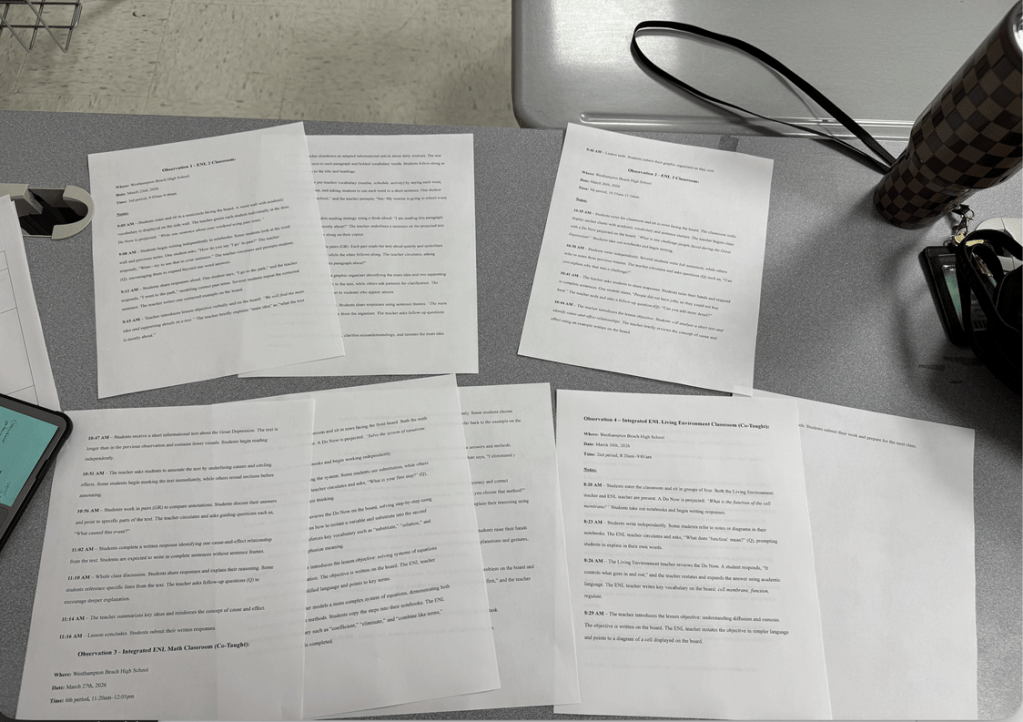
This fieldwork project focused on observing and analyzing instructional practices used to support English Language Learners (ELLs) across a variety of classroom settings. The observations took place in a suburban high school setting with diverse English learners across grade levels. Observations were conducted in four classrooms, including ENL and integrated co-teaching environments in social studies, mathematics, and science. In addition, interviews were conducted with two teachers and two English learners to gain insight into both instructional approaches and student experiences. The purpose of this fieldwork was to examine how educators adapt instruction to meet the linguistic and academic needs of diverse learners, while also promoting engagement and language development. Through the combination of classroom observations and interviews, several key themes emerged, including the use of scaffolding, the role of academic language, the importance of student interaction, and the need to balance support with increasing independence. These findings provide valuable insight into effective practices for supporting English learners and have important implications for my own teaching as an ENL social studies educator. This analysis will examine how these themes emerged across both instructional practices and student experiences.

“My journey through the TESOL program at Touro strengthened both my instructional practices and my understanding of multilingual learners as assets within the classroom. The program challenged me to think more critically about equity, language development, and the importance of creating rigorous but accessible learning experiences for all students.”

Marissa Diveris, Touro University TESOL Candidate

Fieldnotes

Touro University TESOL Candidate Shu Jun Li’s Exemplary Instructional Material Critique & Redesign with Infographic & Fieldwork Reflection


EDPN 673 Methods and Materials for Teaching English as a Second Language

The fieldwork for EDPN 673 reflects our departments practice-based and evidence-centered orientation emphasized by Association for Advancing Quality in Educator Preparation because it requires TESOL candidates to demonstrate professional learning through documented clinical engagement rather than through abstract discussion alone. Candidates must observe multilingual classrooms, conduct interviews, maintain transcripts and observational notes, analyze instructional practices, and connect findings to professional standards and course readings. The assignment therefore evaluates how candidates apply pedagogical knowledge within authentic educational settings.

A major strength of the assignment is its emphasis on structured professional observation. Candidates are required to document descriptive, reflective, and analytic notes focused on instructional strategies, classroom interaction, differentiation, assessment, and use of materials and technology. This framework supports the development of pedagogical reasoning because candidates must move beyond surface description and examine why teachers make particular instructional choices for multilingual learners. Such observational training is central to TESOL preparation because effective ESOL teaching depends upon the ability to recognize language supports, learner participation patterns, and culturally responsive instructional practices within dynamic classroom contexts.

The assignment also aligns closely with AAQEP expectations concerning evidence quality and candidate performance. Candidates must maintain interview notes or recordings, provide transcript excerpts, document interview settings, and furnish observation notes upon request. This creates a form of accountability grounded in authentic clinical evidence rather than solely in polished written products. The assignment assesses whether candidates can gather, interpret, and synthesize practice-based evidence in ways consistent with professional educator preparation.

Finally, the assignment demonstrates our Touro University, TESOL/BLE departments’ clinically rich approach to educator preparation because it requires sustained engagement with classroom realities, systematic documentation, and reflective analysis. Rather than assessing knowledge through isolated examinations or generalized discussion, the fieldwork measures how our TESOL candidates interpret instructional practice, analyze evidence, and connect observation to professional decision-making in multilingual educational environments.

Fieldnotes by Touro University TESOL Candidate Shu Jun Li

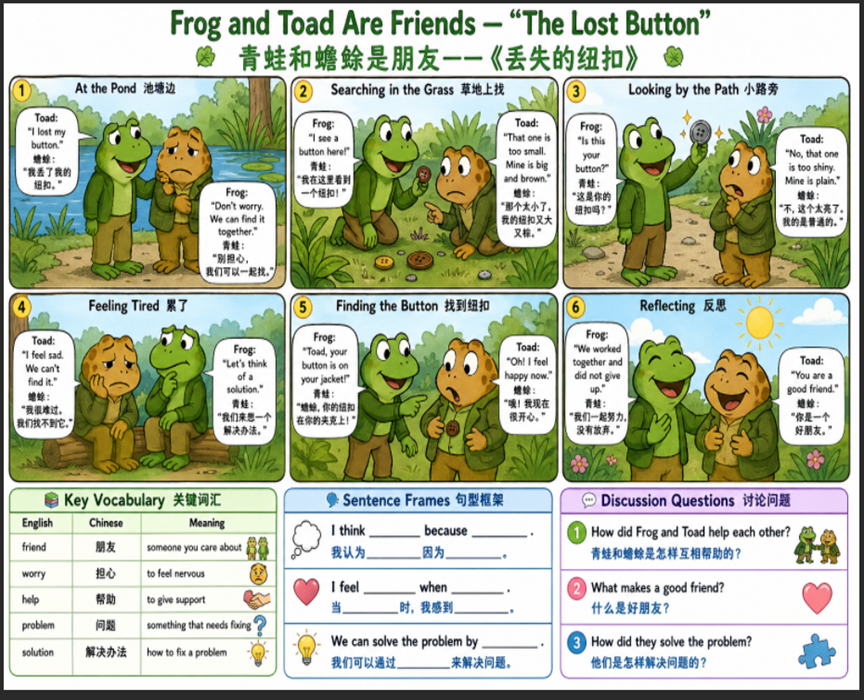
Using Copilot in EDPN 673 helped me better understand how technology can support bilingual and multilingual learners through differentiated and scaffolded instruction. I learned that AI tools can help create visual supports, lesson ideas, and language activities that make learning more accessible and engaging for students. At the same time, the course taught me the importance of critically reviewing and adapting AI-generated materials to ensure they are culturally responsive and aligned with students’ learning needs. This experience strengthened my confidence in using technology as a meaningful instructional support tool.

Shu Jun Li Touro University TESOL Candidate

Touro TESOL Candidate Gianna Luna’s Exemplary EDPN 673 Methods and Materials for Teaching English as a Second Language Projects

EDPN 673 Methods and Materials for Teaching English as a Second Language

This course provides a historical overview of second language acquisition theories and teaching methods. Students learn how to apply current approaches, methods and techniques, with attention to the effective use of materials, in teaching English as a second language. Students will engage in the planning and implementation of standards-based ESL instruction which includes differentiated learning experiences geared to students’ needs. Emphasis is placed on creating culturally responsive learning environments. Includes 15 hours of field work.

“One of my biggest takeaways from this course was learning about a variety of resources and strategies that I can use to better guide my instruction and make learning more meaningful and accessible for a wide range of learners. This course also encouraged me to experiment with resources and technology tools that I had never used before, such as Copilot and creating infographics, which helped expand my creativity and thought process when designing instruction. This course helped me become more reflective and intentional in planning lessons that support both language development and academic growth for multilingual learners.”

Gianna Luna, Touro University TESOL Candidate, EDPN 673

Gianna Luna is an Inclusive Childhood Education teacher and graduate student in the TESOL program at Touro University. She currently works as a consultant teacher in an elementary school setting, providing push-in and small-group support to students with diverse learning and language needs. She is passionate about creating inclusive and supportive learning environments that help multilingual learners build confidence and academic skills.

Using Copilot throughout this assignment helped me realize how supportive technology tools can be during the lesson planning and design process. It encouraged me to experiment with resources I had never used before, such as creating infographics and using AI to brainstorm differentiated instructional ideas. I found that Copilot helped guide my thinking, organization, and creativity while still allowing me to personalize materials by redesigning them to meet the needs of my learners. This experience showed me how technology can be used as a meaningful support tool when designing accessible and engaging instruction for multilingual learners.

My experience in the TESOL program at Touro University has helped me become a more reflective and intentional educator. Throughout this course, I learned how to better support multilingual learners through meaningful scaffolds, and I also gained confidence experimenting with new instructional resources and technology tools that I can continue using in my future classroom.

Gianna Luna – Touro TESOL Candidate, EDPN 673


Gianna Luna – EDPN 673

Touro University TESOL Candidate Jonida Lepuroshi’s Fieldwork for EDPN 673 Methods and Materials for Teaching English as a Second Language

EDPN 673 Methods and Materials for Teaching English as a Second Language

The fieldwork for EDPN 673 reflects our departments practice-based and evidence-centered orientation emphasized by Association for Advancing Quality in Educator Preparation because it requires TESOL candidates to demonstrate professional learning through documented clinical engagement rather than through abstract discussion alone. Candidates must observe multilingual classrooms, conduct interviews, maintain transcripts and observational notes, analyze instructional practices, and connect findings to professional standards and course readings. The assignment therefore evaluates how candidates apply pedagogical knowledge within authentic educational settings.

A major strength of the assignment is its emphasis on structured professional observation. Candidates are required to document descriptive, reflective, and analytic notes focused on instructional strategies, classroom interaction, differentiation, assessment, and use of materials and technology. This framework supports the development of pedagogical reasoning because candidates must move beyond surface description and examine why teachers make particular instructional choices for multilingual learners. Such observational training is central to TESOL preparation because effective ESOL teaching depends upon the ability to recognize language supports, learner participation patterns, and culturally responsive instructional practices within dynamic classroom contexts.

The assignment also aligns closely with AAQEP expectations concerning evidence quality and candidate performance. Candidates must maintain interview notes or recordings, provide transcript excerpts, document interview settings, and furnish observation notes upon request. This creates a form of accountability grounded in authentic clinical evidence rather than solely in polished written products. The assignment assesses whether candidates can gather, interpret, and synthesize practice-based evidence in ways consistent with professional educator preparation.

Finally, the assignment demonstrates our Touro University, TESOL/BLE departments clinically rich approach to educator preparation because it requires sustained engagement with classroom realities, systematic documentation, and reflective analysis. Rather than assessing knowledge through isolated examinations or generalized discussion, the fieldwork measures how our TESOL candidates interpret instructional practice, analyze evidence, and connect observation to professional decision-making in multilingual educational environments.

Jonida Lepuroshi is a Special Education teacher for students in grades K–2 and currently works in an elementary school in Manhattan, New York. She is pursuing an Advanced Certificate in TESOL at Touro University, where she focuses on supporting multilingual learners and ensuring they have access to curriculum materials without language barriers. Her goal is to create an inclusive and culturally responsive learning environment that supports both academic and language development for all students.

Jonida Lepuroshi: In Course EDPN 673, I learned about historical and current second language acquisition theories and how to apply different instructional methods to support English Language Learners and multilingual learners. The course emphasized planning standards-based, differentiated instruction and creating culturally responsive classrooms. I also gained practical and effective strategies for curriculum development, selecting appropriate materials, and designing assessments that support both language growth and academic achievement

My Touro journey has deepened my understanding of culturally responsive
teaching and strengthened my commitment to supporting multilingual learners
through accessible and meaningful instruction.”

Jonida Lepuroshi, Touro University TESOL Candidate

Touro University TESOL Candidate Anastasios Panagiotidis’ EDPN-673 Instructional Material Critique & Redesign with Infographic

EDPN 673 Methods and Materials for Teaching English as a Second Language

This course provides a historical overview of second language acquisition theories and teaching methods. Students learn how to apply current approaches, methods and techniques, with attention to the effective use of materials, in teaching English as a second language. Students will engage in the planning and implementation of standards-based ESL instruction which includes differentiated learning experiences geared to students’ needs. Emphasis is placed on creating culturally responsive learning environments. Includes 15 hours of field work.

I designed the Instructional Material Critique & Redesign with Infographic assignment in direct alignment with my concept of ‘Education for 2060’ and its implications for teacher education in multilingual and technologically evolving classrooms. My focus within ‘Education for 2060’ is not simply the inclusion of emerging technologies in coursework, but the preparation of teacher candidates who can think critically, act reflectively, and maintain pedagogical intentionality within increasingly complex educational environments. This assignment reflects my belief that future TESOL educators must be prepared to evaluate instructional materials analytically, redesign curriculum responsively, and engage artificial intelligence through informed professional judgment rather than passive dependence.

The Instructional Material Critique & Redesign with Infographic positions AI as a pedagogical instrument that must remain secondary to teacher cognition, disciplinary expertise, and reflective decision-making. Candidates are required to identify instructional challenges, critique AI-generated outputs, revise materials through TESOL and WIDA frameworks, and justify redesign choices in relation to multilingual learner needs. In this way, the assignment preserves cognitive rigor and metacognitive engagement while simultaneously acknowledging that AI will remain part of future educational practice. Within my conception of Education for 2060, teacher education must prepare candidates not merely to use technological tools, but to interrogate them critically, adapt them responsibly, and align them with equitable instructional goals.

My emphasis on multimodal redesign and visual instructional supports is also informed by the Science of Reading and its attention to language comprehension, vocabulary development, background knowledge, and meaningful access to complex texts. For multilingual learners, literacy development requires intentional scaffolding that integrates oral language, academic discourse, visual representation, and culturally responsive instructional design. By requiring candidates to adapt materials according to WIDA proficiency levels and create multimodal supports for learners, the assignment reinforces the understanding that literacy instruction in TESOL contexts is both cognitive and sociocultural.

Ultimately, this assignment embodies my vision of ‘Education for 2060’ by positioning teacher education as intellectually rigorous, critically reflective, technologically informed, and fundamentally human-centered. The project is designed to ensure that future TESOL educators retain ownership of pedagogical reasoning even as AI becomes increasingly integrated into educational systems. Rather than diminishing professional expertise, the assignment requires candidates to strengthen their analytical capacities, deepen their metacognitive awareness, and develop the reflective habits necessary for equitable multilingual learner instruction in future educational contexts.

My TESOL teacher candidate, Anastasios Panagiotidis, submitted exemplary work showcasing his specialty as an Earth and Space Science teacher!

Anastasios Panagiotidis proudly serves the South Huntington Union Free School District as an Earth and Space Science teacher and recently obtained his tenure at Walt Whitman High School. He is passionate about creating engaging, student-centered lessons that emphasize inquiry, collaboration, and real-world connections. Anastasios strongly believes that curiosity is at the root of all learning and strives to create experiences that encourage students to ask questions, think critically, and actively engage with science. His goal is to help students develop a lasting interest in science that extends beyond the classroom. He also uses artificial intelligence as a tool to strengthen instructional materials, support differentiated instruction, and create more accessible learning experiences for multilingual learners.

Touro University Candidate Dionysia Di Meo’s Discussion on Practice and Application for EDDN 637


The MS in Teaching English to Speakers of Other Languages (TESOL) Program 
helps NYS-certified PreK-12 teachers more effectively teach and communicate with a diverse student population

If you have questions about our admissions requirementscertification guidelines, or transfer credits, feel free to contact us.

The EDDN 637 Differentiated Assessment

The EDDN 637 Discussion Board on Practice and Application with a Focus on Differentiated Assessment connects the principles of differentiation to the practical work of classroom teaching by focusing on lesson planning, authentic student products, reflection, and multimodal explanation. It is also a low-stakes grade preparation for a larger assignment later in the semester and serves as a knowledge check for me, the faculty. The answers my candidates provide are helpful for my commentary focused on the upcoming assignment. A central feature of the assignment is the use of anonymized student products. These products provide concrete evidence of how differentiation functions in practice. Rather than discussing differentiation only in theory, the assignment requires analyzing real student work and demonstrates how assessment can be adjusted while maintaining meaningful learning goals.

Dionysia Di Meo is an experienced educator and NYS‑licensed bilingual (Greek) Speech‑Language Pathologist specializing in pediatric language/phonological disorders, dysphagia, and Autism Spectrum Disorders. She has extensive experience in Early Intervention, holds TSSLD certification, and is pursuing an Advanced Certificate in TESOL at Touro University. An aspiring polyglot, she is learning Italian, Spanish, and Turkish, and teaches Greek Language, History, and Culture at a National Blue Ribbon School.

Through Touro’s TESOL program, I learned that the most powerful classrooms are built on scaffolds, not shortcuts – meeting Multilingual Learners where they are and believing in where they can go.

Dionysia Di Meo, Touro University TESOL Candidate

Featuring my teacher candidates’ work in my TESOL blog is an intentional pedagogical practice that recognizes them as emerging professionals whose ideas, reflections, and instructional designs deserve visibility within the field. It makes the complex process of becoming a TESOL educator visible by showcasing how candidates connect coursework, theory, fieldwork, and multilingual learner advocacy in authentic classroom contexts. Most importantly, it positions my candidates not simply as students completing assignments, but as capable, praxis-oriented future educators whose developing expertise, creativity, and professional voices contribute meaningfully to the broader educational community. Below is the exemplary DB submitted by my candidate Dionysia Di Meo:

Touro University TESOL Candidate Jeannine Pepe on Literacy Development: Focus on Reading Method: Content-Based Instruction and Content and Language Integrated Learning (CLIL) and WIDA

EDPN 673 Methods and Materials for Teaching English as a Second Language

This course provides a historical overview of second language acquisition theories and teaching methods. Students learn how to apply current approaches, methods and techniques, with attention to the effective use of materials, in teaching English as a second language. Students will engage in the planning and implementation of standards-based ESL instruction which includes differentiated learning experiences geared to students’ needs. Emphasis is placed on creating culturally responsive learning environments. Includes 15 hours of field work.

Jeannine Pepe is a 48-year-old educator with 26 years of teaching experience. For over 20 years, she worked in ENL classroom settings, developing a strong commitment to supporting multilingual learners. Through her continued work with this population, she recognized the importance of further formalizing her training and expanding her instructional strategies. This led her to pursue advanced study, and she found her way to Touro University, whose TESOL program closely aligns with her professional goals and passion for supporting English language learners.

Dr. Jasmin Cowin: “This discussion board is an important component of candidate learning because it connects theory, reflective practice, and field-based inquiry within the context of literacy development for multilingual learners. Through engagement with WIDA Can Do Descriptors, candidates critically examine how language proficiency frameworks can inform the selection of appropriate reading materials and support differentiated assessment practices for ELLs/MLs across varying proficiency levels. These discussions encourage candidates to make pedagogically informed decisions that are responsive to learners’ linguistic and academic needs.

In addition, the graphic organizer activity promotes reflective professional growth by asking candidates to identify specific areas for improvement in L2 reading instruction. This process aligns with reflective teaching practices emphasized in TESOL teacher education, where gradual, intentional refinement of instructional strategies supports long-term professional development. Sharing these reflections with peers also fosters collaborative learning and the exchange of effective instructional practices.

The inclusion of field notes and classroom observations further strengthens the discussion board as a site of qualitative inquiry and practitioner research. By documenting and analyzing authentic classroom interactions, candidates deepen their understanding of literacy instruction, classroom dynamics, and the experiences of multilingual learners. These activities foster analytical, reflective, and research-oriented dispositions central to effective TESOL practice.

Jeannine Pepe’s Discussion Board submission

DB 8 Literacy Development: Focus on Reading Method: Content-Based Instruction and Content and Language Integrated Learning (CLIL) and WIDA

1. How could the WIDA Can Do descriptors help you in choosing reading materials for teaching your ELL’s/MLs? https://wida.wisc.edu/teach/can-do/descriptors

The WIDA Can Do Descriptors provide examples of what language learners can do at various stages of English language development in listening, speaking, reading, and writing.  (WIDA, n.d.)  The descriptors help teachers build on strengths rather than lower expectations.  It focuses on what students can do rather than what they cannot yet do.  This helps teachers to match texts to students’ language abilities.  It pairs materials based on their ability level, not grade level.   Instead of just guessing what the right choice for a student is, this aligns the material to their actual ability.  It assists with differentiated instruction, which I find to be challenging when you have students at all different ability levels. The descriptors show specific reading behaviors, such as sequencing, so when choosing material, you are selecting texts that are based on skills they are ready to practice, not overwhelm them.  The descriptors help teachers to differentiate the same text for different learners.   It helps you to decipher what supports to pair with the same story at different proficiency levels.  The goal is not to “water down” content, but to keep all students engaged with the same concepts at different language levels.   The descriptors can help you look at an activity you plan to do with your English-speaking students, then scale it back for ELL students so that they are still interacting with the academic content, just at a simplified level. It also provides appropriate supports so all learners can access grade-level content while developing their language skills.  Everyone studies the same topic, but the reading materials may vary.  Using the WIDA Can Do Descriptors ensures that multilingual learners have equitable access to grade-level content, even as their English proficiency continues to develop (WIDA, n.d.).

2. How could the WIDA Can Do descriptors help you create differentiation for the reading assessment of your ELL’s//MLs?

The WIDA Can Do Descriptors help teachers differentiate reading assessments by identifying what multilingual learners can do at different levels of English proficiency.  Instead of providing a single assessment for all, these descriptors allow you to “scale back” or modify the way a student demonstrates understanding of the same academic content.  Teachers can use the descriptors to write unique, level-specific language expectations for a single reading task.  Instead of giving everyone the same test, teachers can adjust it to each student’s language ability.  For example, beginners might work with shorter texts, visuals, or matching activities, while more advanced students can answer deeper questions or analyze the text.  Supports like sentence frames or word banks can be added to help students show what they understand.  The main idea is that everyone is learning the same content, but the way they access it and show their understanding looks a little different. This makes the assessment fairer and allows students to succeed based on their strengths rather than their English proficiency (WIDA, n.d.). 

3.  Chapter 12: Use and upload (you can also take a photo) a graphic organizer of your choice to showcase five areas you would like to improve in your teaching of L2 reading that you have learned about in this chapter. Choose one thing at a time, and focus on improving that aspect of your teaching. Share with others what you are doing to become a better teacher of reading. Remember that it will take time to fully develop the ability to integrate improvements into your teaching.  Celce-Murcia, Marianne; Brinton, Donna M.; Snow, Marguerite Ann. Teaching English as a Second or Foreign Language (p. 186). Heinle ELT. Kindle Edition

As I continue to develop as a teacher, I want to improve my teaching of reading to multilingual learners. I have learned that effective reading instruction involves more than just decoding—it requires helping students understand meaning, use strategies, and connect to the text. Based on this, I have identified several areas I would like to improve in my teaching, including differentiation, background knowledge, balancing decoding and meaning, gradual release, and text selection.

One area I want to improve is differentiating reading instruction based on my students’ language levels.  I have learned that not all students can access the same text or respond in the same way, especially in an ENL classroom.  To improve, I will adjust both the reading materials and the tasks. I will adjust the text difficulty and provide scaffolds when necessary.  For example, I can provide beginners with visuals or matching activities, while more advanced students can complete harder and more complex tasks.  This will help all students work on the same content while still being supported at their level.

Another area I want to improve is how I build background knowledge before reading. I have realized that students understand texts better when they can connect to what they already know. To improve, I will take more time before reading to ask questions, have discussions, and use visuals or real-life examples. For instance, before a lesson on weather and climate, I can ask students about their own experiences and show pictures to help them make connections.  As I work to improve how I build background knowledge, I recognize that “comprehension depends on the reader’s background knowledge” (Celce-Murcia et al., 2014), underscoring the importance of activating students’ prior experiences before reading.

I also want to improve how I balance teaching decoding skills with helping students understand meaning.  Sometimes students focus too much on sounding out every word, losing the overall meaning of the text.  To improve, I will encourage students to use context clues and to look at the bigger picture rather than stopping at every unknown word.  For example, in my kindergarten classrooms, we used “Skippy the Frog”.  Readers were taught to “skip it, skip it” (skip the word), read to the end of the sentence to gather clues, and then hop back to try the word again. I will model how to determine the meaning of a sentence and remind students that understanding the main idea is more important than knowing every word.

Another area I want to improve is my use of the gradual release of responsibility.  I know it is important to move from teacher modeling to student independence, but I want to be more intentional with this process.  I tend to “overhelp”.  I hate to see my students struggle, and sometimes I assist too quickly.  To improve, I will first model reading strategies, then guide students as we practice together, and finally allow them to try independently.  This will help students build confidence and become more independent readers over time.

The last area I want to improve is differentiating reading instruction based on my students’ language levels. The WIDA Can Do Descriptors help guide this by showing what students can do at different levels of English proficiency. To improve, I will adjust both the reading materials and the tasks. For example, beginners may require visuals or other forms of support, while more advanced students can explain ideas or answer deeper questions. Again, this will allow all students to work on the same content while being supported at their own level.  

Overall, becoming a better teacher of L2 reading will take time and practice. The areas I’ve identified will help me better support my students. By working on one area at a time and using tools like the WIDA Can Do Descriptors, I can continue to grow and help my students become more confident readers.

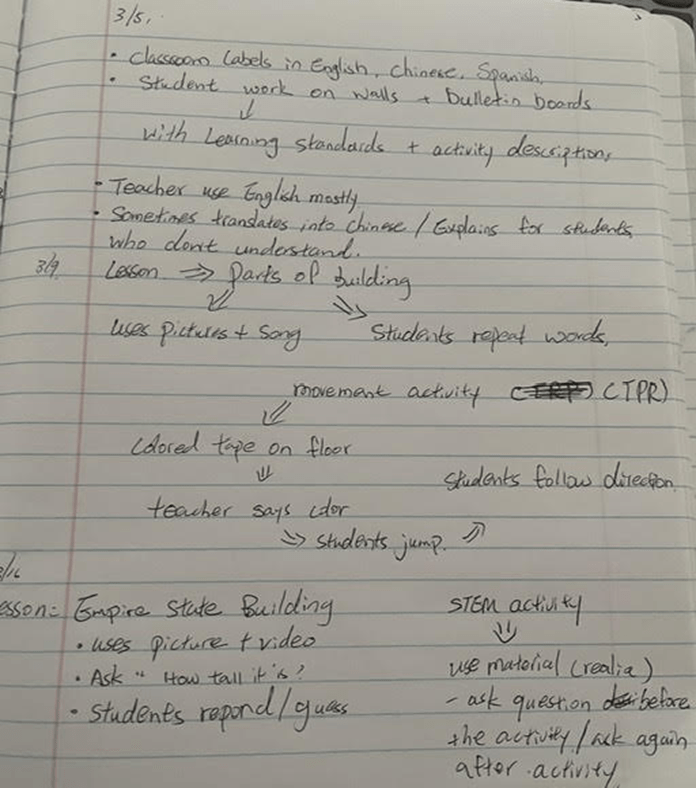
4.  You are sharing one excerpt of your field notes for your fieldwork project – either one of your observations or interviews.  Please anonymize any interviews.  THIS IS A REQUIREMENT.  You may take a photo of your field notes, which you can take by hand. Field notes and observations are essential tools in qualitative research for understanding classroom dynamics. Observations involve systematically watching and recording behaviors, interactions, and environments in real-time, while field notes are written accounts that capture details, interpretations, and reflections. These tools help document context, patterns, and insights that may not be evident in quantitative data.

2-25-26

Setting

My first observational setting was at Uquenock Elementary School in West Islip.  I was greeted by the principal upon my arrival.  She briefly described her school to me.  Oquenock Elementary School is the district’s only ENL school.  She mentioned to me that they get a lot of new ENL students in January and February.  That is when their school calendar ends, unlike the one in America.  She informed me that there are two ENL teachers in the building.  The teacher that I will be working with serves students in kindergarten, first, and second grade, and she speaks fluent Spanish.  Her colleague takes care of the third, fourth, and fifth-grade students.  She explained that Spanish was not the predominant language in their school, but Turkish and Urdu were.  The building was decorated beautifully for Valentine’s Day, P.S. I Love You Day, and for Foreign Language Week!  It was so welcoming and inviting.  When I arrived at my teacher’s room, I was equally impressed with how it was arranged.  She had a print-rich classroom.  Everything was labeled in English for the students to see.  I observed a pocket chart with word families and sentence structure cards.  It appears the children are working on forming sentences and CLOZE activities.  Fundations cards were displayed, and there were numerous bulletin boards.  There was a Good Manners board, an alphabet chart, a vowel poster, color and shape displays, and a positive reinforcement board with slogans like “You Sparkle.”  I noticed a birthday chart and student names to create a warm, personal environment.  I saw a diversity poster, an emotions chart, visual instructions on how to write a sentence, and descriptions of what an author and an illustrator are.  Fiction and nonfiction book descriptions were displayed, days-of-the-week vocabulary were presented, and all objectives were clearly stated for each grade on a whiteboard.  The teacher had a kidney-shaped table for small-group work with students, along with four neatly lined desks in front of a smartboard.  She occupied half of a classroom and had plenty of space to instruct her students.  

Present Findings: Discuss the pedagogical approaches, strategies, materials, and assessment methods observed and their effectiveness.  Analyze Teacher & Student Feedback.

When I arrived, the teacher was working one-on-one with a second-grade student.  She was struggling with a writing piece.  She had difficulty forming a complete sentence and sounding out words.  She had a Level 2 reader in front of her to use as a reference for her reader response activity.  A lot of guidance and support was needed, and she was getting it in a quiet, distraction-free area.  

The teacher was giving intensive, individualized scaffolding, including: linguistic support – helping the student form a complete sentence (syntax/grammar), Phonological support – guiding her to sound out words (decoding/phonics), Cognitive support – helping her understand what to write in response to the text, and Emotional support – working in a quiet space to reduce anxiety and build confidence. In terms of scaffolding, the teacher was breaking the task into manageable parts. She was helping to build one sentence at a time.  She was supporting word-by-word decoding and gradually releasing responsibility.  

This interaction reflects Vygotsky’s concept of the Zone of Proximal Development, the space between what a student can do independently and what they can accomplish with assistance.  The teacher provided scaffolding to help the student complete a task she could not do independently. With guided assistance, modeling, and prompting, the student developed her sentence-writing skills in a supportive learning environment.  (Vygotsky, 1978) The student responded positively to this type of instruction, as she engaged with the task and produced a written response with support. Although she initially struggled to form complete sentences and decode words independently, the teacher’s support enabled her to actively participate in the learning process. The student demonstrated effort by attempting to sound out words and construct sentences, indicating a willingness to take risks in a supportive environment.  There is evidence of formative assessment occurring during the one-on-one interaction. The teacher is informally assessing the student’s ability to construct complete sentences and apply phonics skills while writing. 

Sample Field Notes From Interviews:

References:

Celce-Murcia, M., Brinton, D. M., & Snow, M. A. (2014). Teaching English as a second or foreign language (4th ed.). National Geographic Learning / Heinle Cengage Learning.

Vygotsky, L. S. (1978). Mind in society: The development of higher psychological processes. Harvard University Press.

WIDA. (n.d.). Can Do descriptors. Retrieved March 31, 2026, from https://wida.wisc.edu/teach/can-do/descriptors

Touro University TESOL Candidate Madison Derwin’s Presentation on Writing Review & Assessment


EDDN 637 Second Language Learners and the Content Areas

Students will become acquainted with and practice effective approaches, methods, and strategies for teaching and evaluating English language learners in the content areas (ELA, social studies, math and science). Throughout the course, students will explore the impact of culture and language on classroom learning. Special challenges in teaching and assessment in each content area will also be discussed. Includes 15 hours of field work.

Madison Derwin holds a Bachelor’s Degree in Inclusive Childhood Education from SUNY Cortland. She works as a 4th-grade teacher’s assistant at an elementary school on Long Island. Her goal as an educator is to provide a safe and engaging learning environment where students of all abilities are empowered to reach their full potential while growing academically, socially, and emotionally. hHer favorite quote is:

“Education is the passport to the future, for tomorrow belongs to those who prepare for it today.” Malcolm X

Touro University TESOL Candidate Maria Quiroz SIOP’s Practice and Application Discussion Board

EDDN 637 Second Language Learners and the Content Areas

Students will become acquainted with and practice effective approaches, methods, and strategies for teaching and evaluating English language learners in the content areas (ELA, social studies, math and science). Throughout the course, students will explore the impact of culture and language on classroom learning. Special challenges in teaching and assessment in each content area will also be discussed. Includes 15 hours of field work.

Maria Quiroz is a Spanish teacher at John Adams High School in New York City. She is currently pursuing a Master’s degree in TESOL at Touro University, where she focuses on supporting multilingual learners through effective instructional strategies. Her work emphasizes creating engaging, inclusive, and language-rich classroom environments.

Exemplary Discussion Board 7 Practice and Application submission for EDDN 637 Second Language Learners and the Content Areas

Prof. Jasmin Cowin: This Discussion Board submission is exemplary because it demonstrates a clear and applied understanding of the SIOP model through the integration of hands-on practice, structured application tasks, and attention to multiple language domains. It is further strengthened by the effective use of direct textual evidence to support instructional decisions and by the analytical treatment of teaching scenarios, which moves beyond description to evaluation. The discussion of writing samples is particularly well developed, as it connects proficiency levels to observable learner performance, reflecting a grounded understanding of second-language development.

  1. Textbook Chapter 7 Practice and Application (p. 182-203): What activities are you planning to provide for your students in your SIOP lesson to apply content and language knowledge? Support your statement by quoting directly from the text with the page number.

In my SIOP lesson, I plan to use hands-on practice and meaningful application tasks so students can build content understanding while also using academic language. First, I will include manipulatives or visual models that students can touch, move, and use to demonstrate new concepts. The chapter explains that “students have a greater chance of mastering content concepts and skills when they are given multiple opportunities to practice in relevant, meaningful ways” (p. 185).

Next, I will design an application task that asks students to use the new concept in a new way, such as explaining a process to a partner using sentence frames, creating a short written explanation, or acting out a concept and describing it orally. This matches the idea that for students learning a new language, application matters because “discussing and ‘doing’ make the abstract concepts more concrete” (p. 187).

I will also plan for students to use more than one language domain in the same lesson, so they practice speaking, listening, reading, and writing connected to the same objective. The chapter states that for SIOP instruction, “practice and application tasks should also aim for practice of all four language skills: reading, writing, listening, and speaking” (p. 183).

2. Teaching scenarios, starting on p. 193 – discuss your takeaways from the teaching scenarios and quote directly from the text with the page number.

My key takeaway from the teaching scenarios is that practice and application must be active and structured, so students do not stay passive. In Mrs. Bertoni’s lesson, students listened, repeated, copied, and then were expected to complete homework independently, but they did not get guided opportunities to practice and apply the concepts in class. The discussion makes this point clearly: “Listening to a teacher read is not a practice activity” (p. 198).

In contrast, Mr. Sherbiny’s lesson shows what strong SIOP Practice and Application looks like. Students used hands-on materials, practiced the language frames aloud, read a text, wrote sentences, and applied concepts through examples and demonstrations. The scenario analysis highlights that “students used manipulatives in small groups to demonstrate revolution and rotation and practiced language frames to explain the concepts” (p. 198).

Mrs. Aliheri’s lesson reminded me that interactive activities still need careful scaffolding. Even though she used a video and tried word cards, the task did not set students up for success because there were missing supports and unclear steps. The text explains that “her planning was poor, as was the execution of the task” (p. 198). Overall, these scenarios reinforced that SIOP practice must be hands-on and guided, and application must require students to use both content knowledge and language in a supportive structure.

3. Choose one grade-level writing sample to build your understanding of the different writing competencies and levels at your teaching level.  Choose 3 writing samples of your grade level and discuss how they are similar/not similar to what you see your ELL/ML students produce in your writing assessments. Select a writing sample below. INCLUDE A SCREENSHOT of the writing sample because neither your peers nor I will be able to guess what you are analyzing!

https://www.learnalberta.ca/content/eslapb/writing_samples.htmlLinks to an external site. 

For this part, I selected three Grades 7–9 writing samples at Level 1, Level 3, and Level 5 from the LearnAlberta Writing Assessment Exemplars to understand differences in writing competencies across proficiency levels.

Level 1 shows very basic writing control. The writing is short, repetitive, and relies on simple sentence patterns. Ideas are listed more than developed, and there are frequent grammar errors that affect clarity. This looks similar to what I see when my beginner language learners write, even in my Spanish classroom. At early stages, students often depend on repeated sentence starters and basic vocabulary because they are still building control of word order and sentence structure.

Level 3 shows growth in development and organization. The student writes a longer response, attempts to explain reasons, and includes more detail. Sentences are longer and more complete, and the ideas connect more logically, even if there are still noticeable language errors. This is similar to what I see when students move from novice to more intermediate performance in a second language. They take more risks with language and expand their ideas, but they still need support with accuracy and cohesion.

Level 5 shows stronger control of extended writing. The response is longer, more organized, and includes explanations and examples. Vocabulary is more varied, and sentences show more complexity, even though some grammar issues remain. This resembles what I see in my more advanced language learners, who can sustain an argument or explanation and elaborate their ideas with more independence.

References

Echevarría, J., Vogt, M. E., & Short, D. J. (2017). Making content comprehensible for English learners: The SIOP model(5th ed.). Pearson.

Alberta Education. (n.d.). Writing assessment exemplars: Grades 7–9. LearnAlberta. https://www.learnalberta.ca/content/eslapb/writing_samples.html