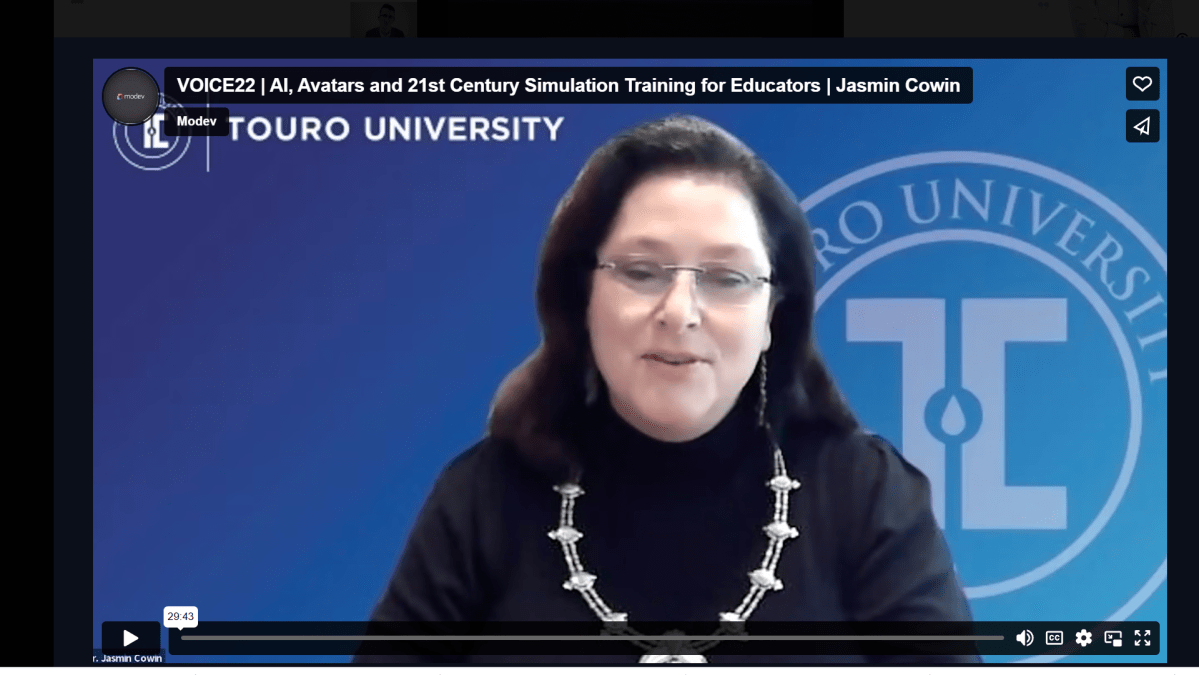
I look forward to being a session chair and presenter on the topic of Empowering Educators for the 21st Century: Discovering the Potential of Immersive Technologies and AI for Simulation Training at the WorldCALL2023 conference, A CALL in Critical Times
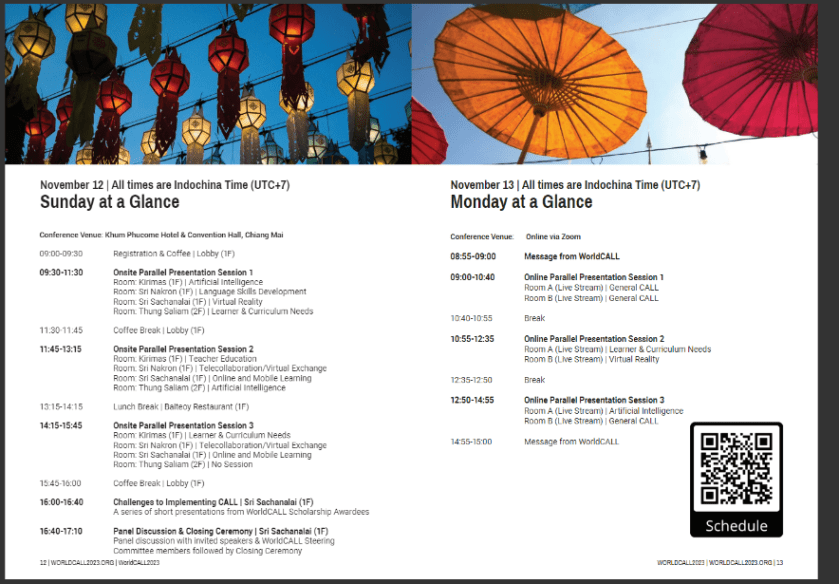
November 09-13, 2023 | Held in Chiang Mai, Thailand (and online)
Welcome to The 6th WorldCALL Conference (WorldCALL2023), held in partnership with The International Academic Forum (IAFOR), and in association with the Computer Assisted Language Instruction Consortium (CALICO), Confédération Européenne des Centres de Langues de l’Enseignement Supérieur (CercleS), the European Association for Computer-Assisted Language Learning (EUROCALL), the International Association for Language Learning Technology (IALLT), the Korea Association of Multimedia-Assisted Language Learning (KAMALL), and the Japan Association for Language Education and Technology (JLET).
WorldCALL is the worldwide professional association for teachers and educators interested in Computer Assisted Language Learning (CALL). WorldCALL aims to enhance computer-assisted language teaching and learning in the global community by bringing together educators from around the world. As an international association, WorldCALL provides a worldwide platform for the promulgation of innovative research, development and practice in education and training; enhances the opportunities for knowledge and skills transfer to nations currently underserved in the area of CALL; and serves as a forum for exchanging information and forging professional relationships among educators, researchers and industry leaders from around the world. WorldCALL has held an international conference every five years since its first conference in Australia in 1998. Since then, conferences have been held in Canada in 2003, Japan in 2008, Scotland in 2013, and Chile in 2018.We look forward to seeing you in Chiang Mai, Thailand and online!
Professor Ana Gimeno
Chair, of the WorldCALL 2023 Conference Steering Committee
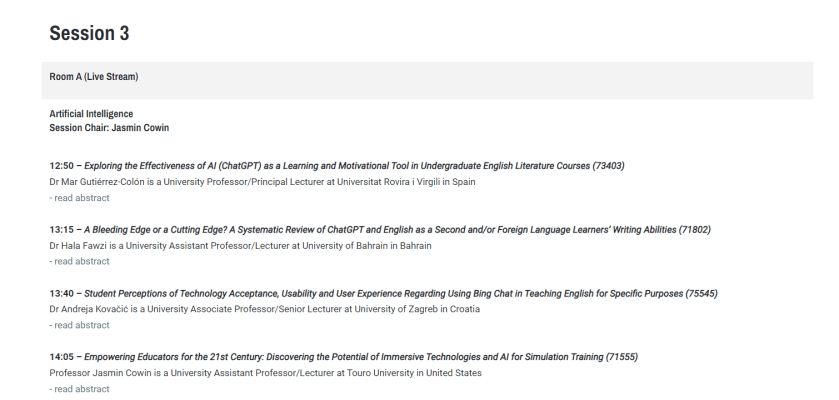
Empowering Educators for the 21st Century: Discovering the Potential of Immersive Technologies and AI for Simulation Training (71555)
Session Information: Artificial Intelligence
Session Chair: Jasmin Cowin
Monday, 13 November 2023 14:05
Session: Session 3
Room: Room A (Live Stream)
Presentation Type: Live-Stream Presentation
The integration of Artificial Intelligence (AI) and intelligent systems into teacher education programs has become an area of increasing interest in recent years. In light of the rapid growth of online degrees, alternative pathways to support teacher candidates in completing required practicum and fieldwork hours have become increasingly critical. This presentation explores the potential benefits of using immersive simulation training to meet the need of diverse teacher education programs and their aspiring teacher candidates.
Immersive simulations offer teacher candidates personalized clinical experiences tailored to their content specialization to develop and refine their teaching skills via customized simulation scenarios. Teaching simulations provide a safe and controlled environment in which teacher candidates can apply and reflect on content delivery, professional skills, pedagogical knowledge, and unique student challenges. By integrating AI and intelligent systems into simulations, teacher candidates can receive targeted feedback and coaching, accelerating their professional growth and development.
This proposal compares and contrasts two distinct immersive ecosystems, Mursion and simSchool, each providing either a unique AI-driven or a mixed-reality simulation experience. Both platforms offer a range of tools and resources for designing and delivering simulations that mimic real-world classroom scenarios. These simulations allow teacher candidates to practice and refine their teaching strategies and techniques, such as questioning techniques, classroom management, and student engagement.
In addition, the use of simulation platforms holds the potential to improve institutional administrative functions, elevate departmental strategic planning, foster targeted accreditation development, and integrate curricular and syllabi planning through data aggregation leading to data-informed decision-making. Simulation platforms collect and analyze data on teacher candidates’ performance, providing valuable insights into teacher candidates’ knowledge of students and student learning, knowledge of content and instructional planning, instructional practice, learning environments, possible bias’, and the use of assessment measuring student learning.
To demonstrate the potential of immersive simulations this presentation includes a “live” field trip into a teacher training simulation. This interactive experience will provide participants with an opportunity to observe and engage in a simulation that replicates a real-world classroom scenario, highlighting the benefits and potential of an immersive simulation for teacher education.
Abstract Summary
This proposal explores the integration of AI and intelligent systems into teacher education programs, specifically through the use of immersive simulation training. Immersive simulations offer teacher candidates personalized clinical experiences tailored to their content specialization to develop and refine their teaching skills through customized simulation scenarios. Through these immersive simulations, teacher candidates can apply and reflect on teaching methods, professional skills, and pedagogical knowledge in a safe and controlled environment. This presentation compares and contrasts two distinct immersive ecosystems, Mursion and simSchool, which provide unique AI-driven and mixed-reality simulation experiences. In addition, the use of simulation platforms has the potential to improve institutional administrative functions, strategic planning, supporting accreditation pathways, and program planning through data aggregation and informed decision-making. The presentation will include a “live” field trip into a teacher training simulation.
Authors:
Jasmin Cowin, Touro University, United States
About the Presenter(s)
Professor Jasmin Cowin is a University Associate Professor/Lecturer at Touro University in the United States