


EDPN 673 Methods and Materials for Teaching English as a Second Language
This course provides a historical overview of second language acquisition theories and teaching methods. Students learn how to apply current approaches, methods and techniques, with attention to the effective use of materials, in teaching English as a second language. Students will engage in the planning and implementation of standards-based ESL instruction which includes differentiated learning experiences geared to students’ needs. Emphasis is placed on creating culturally responsive learning environments. Includes 15 hours of field work.
Jeannine Pepe is a 48-year-old educator with 26 years of teaching experience. For over 20 years, she worked in ENL classroom settings, developing a strong commitment to supporting multilingual learners. Through her continued work with this population, she recognized the importance of further formalizing her training and expanding her instructional strategies. This led her to pursue advanced study, and she found her way to Touro University, whose TESOL program closely aligns with her professional goals and passion for supporting English language learners.
Dr. Jasmin Cowin: “This discussion board is an important component of candidate learning because it connects theory, reflective practice, and field-based inquiry within the context of literacy development for multilingual learners. Through engagement with WIDA Can Do Descriptors, candidates critically examine how language proficiency frameworks can inform the selection of appropriate reading materials and support differentiated assessment practices for ELLs/MLs across varying proficiency levels. These discussions encourage candidates to make pedagogically informed decisions that are responsive to learners’ linguistic and academic needs.
In addition, the graphic organizer activity promotes reflective professional growth by asking candidates to identify specific areas for improvement in L2 reading instruction. This process aligns with reflective teaching practices emphasized in TESOL teacher education, where gradual, intentional refinement of instructional strategies supports long-term professional development. Sharing these reflections with peers also fosters collaborative learning and the exchange of effective instructional practices.
The inclusion of field notes and classroom observations further strengthens the discussion board as a site of qualitative inquiry and practitioner research. By documenting and analyzing authentic classroom interactions, candidates deepen their understanding of literacy instruction, classroom dynamics, and the experiences of multilingual learners. These activities foster analytical, reflective, and research-oriented dispositions central to effective TESOL practice.
Jeannine Pepe’s Discussion Board submission
DB 8 Literacy Development: Focus on Reading Method: Content-Based Instruction and Content and Language Integrated Learning (CLIL) and WIDA
1. How could the WIDA Can Do descriptors help you in choosing reading materials for teaching your ELL’s/MLs? https://wida.wisc.edu/teach/can-do/descriptors
The WIDA Can Do Descriptors provide examples of what language learners can do at various stages of English language development in listening, speaking, reading, and writing. (WIDA, n.d.) The descriptors help teachers build on strengths rather than lower expectations. It focuses on what students can do rather than what they cannot yet do. This helps teachers to match texts to students’ language abilities. It pairs materials based on their ability level, not grade level. Instead of just guessing what the right choice for a student is, this aligns the material to their actual ability. It assists with differentiated instruction, which I find to be challenging when you have students at all different ability levels. The descriptors show specific reading behaviors, such as sequencing, so when choosing material, you are selecting texts that are based on skills they are ready to practice, not overwhelm them. The descriptors help teachers to differentiate the same text for different learners. It helps you to decipher what supports to pair with the same story at different proficiency levels. The goal is not to “water down” content, but to keep all students engaged with the same concepts at different language levels. The descriptors can help you look at an activity you plan to do with your English-speaking students, then scale it back for ELL students so that they are still interacting with the academic content, just at a simplified level. It also provides appropriate supports so all learners can access grade-level content while developing their language skills. Everyone studies the same topic, but the reading materials may vary. Using the WIDA Can Do Descriptors ensures that multilingual learners have equitable access to grade-level content, even as their English proficiency continues to develop (WIDA, n.d.).
2. How could the WIDA Can Do descriptors help you create differentiation for the reading assessment of your ELL’s//MLs?
The WIDA Can Do Descriptors help teachers differentiate reading assessments by identifying what multilingual learners can do at different levels of English proficiency. Instead of providing a single assessment for all, these descriptors allow you to “scale back” or modify the way a student demonstrates understanding of the same academic content. Teachers can use the descriptors to write unique, level-specific language expectations for a single reading task. Instead of giving everyone the same test, teachers can adjust it to each student’s language ability. For example, beginners might work with shorter texts, visuals, or matching activities, while more advanced students can answer deeper questions or analyze the text. Supports like sentence frames or word banks can be added to help students show what they understand. The main idea is that everyone is learning the same content, but the way they access it and show their understanding looks a little different. This makes the assessment fairer and allows students to succeed based on their strengths rather than their English proficiency (WIDA, n.d.).
3. Chapter 12: Use and upload (you can also take a photo) a graphic organizer of your choice to showcase five areas you would like to improve in your teaching of L2 reading that you have learned about in this chapter. Choose one thing at a time, and focus on improving that aspect of your teaching. Share with others what you are doing to become a better teacher of reading. Remember that it will take time to fully develop the ability to integrate improvements into your teaching. Celce-Murcia, Marianne; Brinton, Donna M.; Snow, Marguerite Ann. Teaching English as a Second or Foreign Language (p. 186). Heinle ELT. Kindle Edition
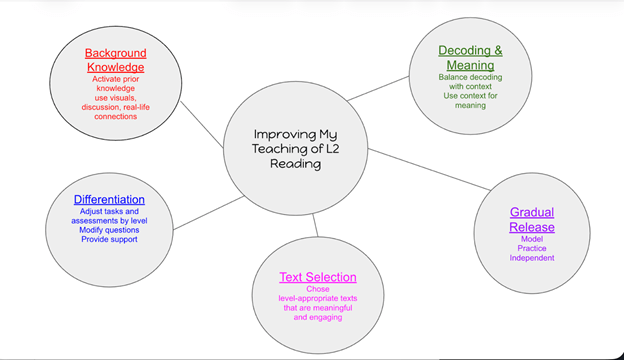
As I continue to develop as a teacher, I want to improve my teaching of reading to multilingual learners. I have learned that effective reading instruction involves more than just decoding—it requires helping students understand meaning, use strategies, and connect to the text. Based on this, I have identified several areas I would like to improve in my teaching, including differentiation, background knowledge, balancing decoding and meaning, gradual release, and text selection.
One area I want to improve is differentiating reading instruction based on my students’ language levels. I have learned that not all students can access the same text or respond in the same way, especially in an ENL classroom. To improve, I will adjust both the reading materials and the tasks. I will adjust the text difficulty and provide scaffolds when necessary. For example, I can provide beginners with visuals or matching activities, while more advanced students can complete harder and more complex tasks. This will help all students work on the same content while still being supported at their level.
Another area I want to improve is how I build background knowledge before reading. I have realized that students understand texts better when they can connect to what they already know. To improve, I will take more time before reading to ask questions, have discussions, and use visuals or real-life examples. For instance, before a lesson on weather and climate, I can ask students about their own experiences and show pictures to help them make connections. As I work to improve how I build background knowledge, I recognize that “comprehension depends on the reader’s background knowledge” (Celce-Murcia et al., 2014), underscoring the importance of activating students’ prior experiences before reading.
I also want to improve how I balance teaching decoding skills with helping students understand meaning. Sometimes students focus too much on sounding out every word, losing the overall meaning of the text. To improve, I will encourage students to use context clues and to look at the bigger picture rather than stopping at every unknown word. For example, in my kindergarten classrooms, we used “Skippy the Frog”. Readers were taught to “skip it, skip it” (skip the word), read to the end of the sentence to gather clues, and then hop back to try the word again. I will model how to determine the meaning of a sentence and remind students that understanding the main idea is more important than knowing every word.
Another area I want to improve is my use of the gradual release of responsibility. I know it is important to move from teacher modeling to student independence, but I want to be more intentional with this process. I tend to “overhelp”. I hate to see my students struggle, and sometimes I assist too quickly. To improve, I will first model reading strategies, then guide students as we practice together, and finally allow them to try independently. This will help students build confidence and become more independent readers over time.
The last area I want to improve is differentiating reading instruction based on my students’ language levels. The WIDA Can Do Descriptors help guide this by showing what students can do at different levels of English proficiency. To improve, I will adjust both the reading materials and the tasks. For example, beginners may require visuals or other forms of support, while more advanced students can explain ideas or answer deeper questions. Again, this will allow all students to work on the same content while being supported at their own level.
Overall, becoming a better teacher of L2 reading will take time and practice. The areas I’ve identified will help me better support my students. By working on one area at a time and using tools like the WIDA Can Do Descriptors, I can continue to grow and help my students become more confident readers.
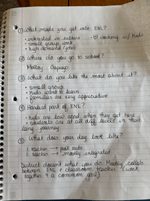
4. You are sharing one excerpt of your field notes for your fieldwork project – either one of your observations or interviews. Please anonymize any interviews. THIS IS A REQUIREMENT. You may take a photo of your field notes, which you can take by hand. Field notes and observations are essential tools in qualitative research for understanding classroom dynamics. Observations involve systematically watching and recording behaviors, interactions, and environments in real-time, while field notes are written accounts that capture details, interpretations, and reflections. These tools help document context, patterns, and insights that may not be evident in quantitative data.
2-25-26
Setting
My first observational setting was at Uquenock Elementary School in West Islip. I was greeted by the principal upon my arrival. She briefly described her school to me. Oquenock Elementary School is the district’s only ENL school. She mentioned to me that they get a lot of new ENL students in January and February. That is when their school calendar ends, unlike the one in America. She informed me that there are two ENL teachers in the building. The teacher that I will be working with serves students in kindergarten, first, and second grade, and she speaks fluent Spanish. Her colleague takes care of the third, fourth, and fifth-grade students. She explained that Spanish was not the predominant language in their school, but Turkish and Urdu were. The building was decorated beautifully for Valentine’s Day, P.S. I Love You Day, and for Foreign Language Week! It was so welcoming and inviting. When I arrived at my teacher’s room, I was equally impressed with how it was arranged. She had a print-rich classroom. Everything was labeled in English for the students to see. I observed a pocket chart with word families and sentence structure cards. It appears the children are working on forming sentences and CLOZE activities. Fundations cards were displayed, and there were numerous bulletin boards. There was a Good Manners board, an alphabet chart, a vowel poster, color and shape displays, and a positive reinforcement board with slogans like “You Sparkle.” I noticed a birthday chart and student names to create a warm, personal environment. I saw a diversity poster, an emotions chart, visual instructions on how to write a sentence, and descriptions of what an author and an illustrator are. Fiction and nonfiction book descriptions were displayed, days-of-the-week vocabulary were presented, and all objectives were clearly stated for each grade on a whiteboard. The teacher had a kidney-shaped table for small-group work with students, along with four neatly lined desks in front of a smartboard. She occupied half of a classroom and had plenty of space to instruct her students.
Present Findings: Discuss the pedagogical approaches, strategies, materials, and assessment methods observed and their effectiveness. Analyze Teacher & Student Feedback.
When I arrived, the teacher was working one-on-one with a second-grade student. She was struggling with a writing piece. She had difficulty forming a complete sentence and sounding out words. She had a Level 2 reader in front of her to use as a reference for her reader response activity. A lot of guidance and support was needed, and she was getting it in a quiet, distraction-free area.
The teacher was giving intensive, individualized scaffolding, including: linguistic support – helping the student form a complete sentence (syntax/grammar), Phonological support – guiding her to sound out words (decoding/phonics), Cognitive support – helping her understand what to write in response to the text, and Emotional support – working in a quiet space to reduce anxiety and build confidence. In terms of scaffolding, the teacher was breaking the task into manageable parts. She was helping to build one sentence at a time. She was supporting word-by-word decoding and gradually releasing responsibility.
This interaction reflects Vygotsky’s concept of the Zone of Proximal Development, the space between what a student can do independently and what they can accomplish with assistance. The teacher provided scaffolding to help the student complete a task she could not do independently. With guided assistance, modeling, and prompting, the student developed her sentence-writing skills in a supportive learning environment. (Vygotsky, 1978) The student responded positively to this type of instruction, as she engaged with the task and produced a written response with support. Although she initially struggled to form complete sentences and decode words independently, the teacher’s support enabled her to actively participate in the learning process. The student demonstrated effort by attempting to sound out words and construct sentences, indicating a willingness to take risks in a supportive environment. There is evidence of formative assessment occurring during the one-on-one interaction. The teacher is informally assessing the student’s ability to construct complete sentences and apply phonics skills while writing.
Sample Field Notes From Interviews:

References:
Celce-Murcia, M., Brinton, D. M., & Snow, M. A. (2014). Teaching English as a second or foreign language (4th ed.). National Geographic Learning / Heinle Cengage Learning.
Vygotsky, L. S. (1978). Mind in society: The development of higher psychological processes. Harvard University Press.
WIDA. (n.d.). Can Do descriptors. Retrieved March 31, 2026, from https://wida.wisc.edu/teach/can-do/descriptors


