On July 12, 2024, the EU issued Regulation (EU) 2024/1689, known as the EU AI Act, marking a significant milestone as the first extensive AI regulation globally. This regulation emerged over three years after its initial draft by the EU Commission in April 2021. The AI Act establishes a broad, sector-independent regulatory framework designed to set the standard for AI governance within the EU. This framework is expected to influence both local and global companies and global legislative approaches. Importantly, the AI Act’s scope extends beyond the EU; it applies to entities worldwide that might not be physically present in any EU member state but engage with the EU market. This represents the culmination of a lengthy legislative process, with the Act set to be enforced starting on August 2, 2024. Higher Education Institutions (HEIs) should familiarize themselves with the implications of this regulation, understand their responsibilities, and prepare for compliance by the designated date. This series of blogs exclusively written for Stankevicius by the author aims to highlight the critical aspects of the AI Act that HEI organizations need to grasp to ensure they are ready for the upcoming regulatory changes, specifying important deadlines for meeting these new requirements.
Click on the link below to read the complete article.
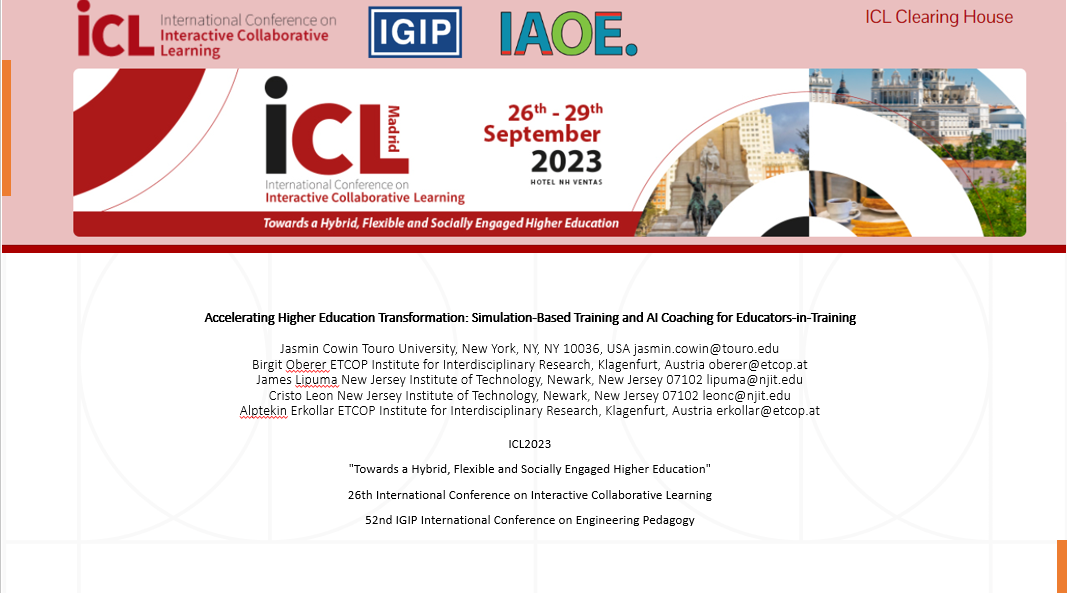
I am pleased that my presentation was received well at the International Conference on Interactive Collaborative Learning and 52nd IGIP International Conference on Engineering Pedagogy (ICL2023). This interdisciplinary conference aims to focus on the exchange of relevant trends and research results as well as the presentation of practical experiences in Interactive Collaborative Learning and Engineering Pedagogy.
Our paper’s Abstract: “Accelerating Higher Education Transformation: Simulation-Based Training and AI Coaching for Educators-in-Training.”
Abstract This paper conducts an interdisciplinary investigation into the transformative potential of Artificial Intelligence (AI) in the realm of teacher education by integrating methodologies and frameworks from education, business admin-istration, and computer science. The rapid advancements in AI are ushering in a possible Cambrian explosion of systems transformation for educational and governmental institutions. Simulation mentoring and training are gaining traction for teacher education. The authors’ investigation into simulation-based training and AI coaching for high-leverage teacher training practices intertwines an interdisciplinary dialogue on modernizing 21st-century teacher training and the possibility of a Cambrian explosion in teacher education for higher education institutions. By examining asynchronous AI-driven simula-tion mentoring and teaching experiences and their impact on instructional teacher effectiveness, the authors frame, explore, and consider possible new resource allocations and economic implications for teacher training in higher education. Simulation tools promise to promote scalable approaches to fos-tering pedagogical expertise by incorporating research-based psychological, sensory, and cognitive domains inspired by Bloom’s educational objectives taxonomy. Using the examples of simSchool and Mursion, the authors co-construct meaning-making and hypothesize on forward-looking, scalable ed-ucator training approaches, the interplay between learning, knowledge acqui-sition, and embodied cognition, highlighting the importance of reflective practice in teacher education. AI-driven mentoring holds promise for scala-bility to achieve by 2030 the Sustainable Development Goal 4.c, aiming to “increase the supply of qualified teachers, including through international cooperation”. In conclusion, this paper will explore using AI simulations as practice arenas to stimulate and shape the dialogue between stakeholders in higher education, focusing on integrating existing best practices that will eventually change teacher education locally and globally, accelerating a higher education Cambrian explosion.
Cowin, J., Oberer, B., Lipuma, J., Leon, C., & Erkollar, A. (2023). Accelerating Higher Education Transformation: Simulation-Based Training and AI Coaching for Educators-in-Training. (Virtual Presentation, Sept. 27, 2023). 26th International Conference on Interactive Collaborative Learning and 52nd IGIP International Conference on Engineering Pedagogy (ICL2023)


 Dr. J's Education Blog