The spark behind this design stems from my observation that conventional grammar instruction often creates artificial boundaries between grammatical elements rather than highlighting their interconnected functions. By reconceptualizing grammar as a system of terminal elements, auxiliary elements, modifiers, and connectors, I sought to create a visual metalinguistic tool that would facilitate deeper cognitive engagement with language structures across varying proficiency levels.
Theoretical Foundations: An Integrated Approach
The four-component model deliberately integrates complementary theoretical perspectives:
The Dependency Perspective: Drawing from Tesnière’s (1959) seminal work, this framework emphasizes relational characteristics over categorical classifications. Terminal elements establish semantic foundations upon which auxiliary elements construct grammatical meaning, modifiers refine conceptual boundaries, and connectors create hierarchical relationships—mirroring the valency patterns and dependency structures that Tesnière identified as fundamental to syntactic organization.
The Functional Perspective: Halliday’s Systemic Functional Grammar provides the theoretical underpinning for examining how each component serves specific communicative purposes. Terminal elements primarily fulfill ideational functions; auxiliary elements negotiate interpersonal dimensions through tense, mood, and aspect; modifiers enhance textual richness; and connectors organize logical coherence between propositions—all operating simultaneously across what Halliday termed the “metafunctions” of language.
The Structural Perspective: From Chomskyan X-bar theory, this model adapts the concept of hierarchical constituency. The classification systematically maps onto phrase structure configurations where terminal elements function as heads, auxiliary elements as functional projections, modifiers as adjuncts, and connectors as complementizers and relational markers—creating a bridge between transformational grammar and functional applications.
1. Enhanced Sentence Analysis Teachers can guide students in breaking down sentences by identifying:
Terminal elements (primary content words)
Auxiliary elements (grammatical markers for tense, aspect, etc.)
Modifiers (descriptive elements that refine meaning)
Connectors (elements that establish relationships)
2. Comparative Language Analysis The focus on function rather than form makes this approach useful for:
Comparing how grammatical functions manifest across different languages
Helping multilingual students connect new structures to familiar concepts
Discussing similarities and differences between L1 and English grammar
Understanding the complexity of syntax in children’s texts is essential for TESOL educators, as it unbundles the cognitive load multilingual learners face when decoding seemingly simple sentences. The infographic Encountering Complexity: Syntax Analysis in The Very Hungry Caterpillar is designed to help educators appreciate the intricate linguistic demands embedded in a classic children’s text.
By analyzing the sentence, “One Sunday morning the warm sun came up and – pop! – out of the egg came a tiny and very hungry caterpillar,” this infographic unpacks the nuanced interplay of grammatical components that may challenge multilingual learners (MLs). My analysis underscores the sophistication hidden within children’s literature and its implications for language acquisition. I wanted to highlight the layered complexity of the sentence through a detailed syntactic breakdown.
Section 1 categorizes elements like adverbial phrases, noun phrases, and verb phrases, explaining their functions and interactions.
Section 2 visualizes the sentence’s structure using a “Sentence Tree,” mapping two interconnected clauses to reveal how they contribute to the sentence’s flow and meaning.
Section 3 offers a granular analysis of each phrase, employing color-coding to differentiate grammatical categories such as determiners, adjectives, nouns, and verbs. These insights allow teachers to see how even a brief sentence integrates multiple linguistic elements, requiring learners to simultaneously process temporal, spatial, and descriptive details.
Syntax analysis is critical for TESOL educators, as it emphasizes the cognitive demands placed on MLs when engaging with texts. For MLs, processing a sentence like this involves not only vocabulary comprehension but also navigating complex syntactic relationships, such as interjections, modifiers, and clause coordination. By recognizing the intricacies in children’s literature, TESOL teachers can better scaffold learning experiences, create targeted interventions, and develop strategies to reduce cognitive overload while fostering language development. My infographic serves as a reflective tool for my students at Touro University to approach children’s texts with a deeper awareness of the linguistic challenges faced by MLs.
At the heart of my professional journey is a commitment to transformative education, grounded in integrating concepts like Lynda Miller’s philosophy of abundance, which counters Ruby Payne’s notion of a Culture of Poverty (2005). This philosophy of abundance emphasizes viewing experiences as assets filled with positivity and optimism, particularly valuable in an often dystopian-seeming world. Aligned with the UN’s Sustainable Development Goal 4, she has contributed to initiatives like Computers for Schools Burundi, TESOL “Train the Trainer” programs in Yemen and Morocco. As an educator in the Fourth Industrial Revolution era, I prepare future teachers by incorporating innovations in education to shape worldviews and cultivate an adaptable skillset for Volatile, Uncertain, Complex, Ambiguous (VUCA) environments. Her research explores simulations for educators-in-training, AI in education and assessment, educational Metaverse applications, and educational transformation for language educators.
“Rather than remain fixed in familiar practices, we will need to harness an agile, growth-oriented mindset. Now is the time for courage, vision, and perseverance.”
Dr. Jasmin (Bey) Cowin
Through my pro-bono work, I support SDG 4.c By 2030, substantially increase the supply of qualified teachers, including through international cooperation for teacher training in developing countries, especially least developed countries and small island developing States.
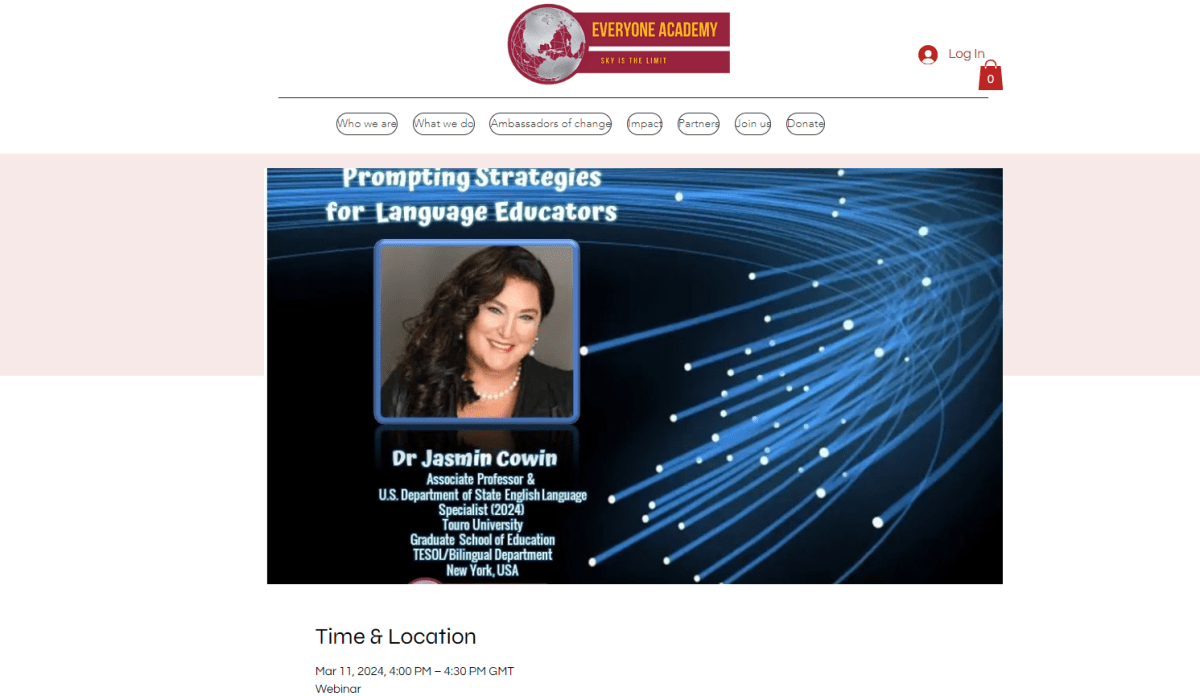
Mon, Mar 11 | Webinar Time & Location Mar 11, 2024, 4:00 PM – 4:30 PM GMT (Casablanca, Morocco)
– click the link to register
Structured AI Prompting Strategies for Language Educators
I am humbled and excited to serve the U.S. Department of State in the capacity of English Language Specialist.
The English Language Specialist Program is the premier opportunity for leaders in the field of teaching English to speakers of other languages (TESOL) to enact meaningful and sustainable changes in the way that English is taught abroad. Through projects developed by U.S. Embassies in more than 80 countries, English Language Specialists work directly with local teacher trainers, educational leaders, and ministry of education officials to exchange knowledge, build capacity, and establish partnerships benefiting participants, institutions, and communities in the United States and overseas. Since 1991, the English Language Specialist Program has supported in-country, virtual, and mixed projects in which hundreds of TESOL scholars and educators promote English language learning, enhance English teaching capacity, and foster mutual understanding between the U.S. and other countries through cultural exchange. During their projects, English Language Specialists may conduct intensive teacher training, advise ministries of education or participate in high-level educational consultations, and offer plenary presentations at regional, national, or international TESOL conferences. These projects are challenging and those selected represent the best of the U.S. TESOL community. In return, the program provides professional development opportunities to help participants experience different cultures and build skills that can greatly enhance their TESOL careers at home. English Language Specialists are counted among the more than 50,000 individuals participating in U.S. Department of State exchange programs each year. The Specialist Program is administered by the Center for Intercultural Education and Development at Georgetown University.
As a Professor for TESOL, I am immensely proud to feature outstanding student work from our MS in Teaching English to Speakers of Other Languages (TESOL) Program. New York’s linguistic diversity demands teachers who can find common ground and effectively communicate with students from different language backgrounds. Academically rigorous and practice-intensive, the 33-credit program includes 50 hours of fieldwork andsupervised student teaching experiences. Candidates who complete all coursework, fieldwork, and student teaching requirements are eligible for recommendation for ESL certification.
EDDN 637: Students will become acquainted with and practice effective approaches, methods, and strategies for teaching and evaluating English language learners in the content areas (ELA, Social Studies, Math and Science). Throughout the course, students will explore the impact of culture and language upon classroom learning. Special challenges in teaching and assessment in each content area will be discussed. Examination and analysis of curriculum materials and instructional strategies for creative teaching and learning in grades Pe-K-12. Includes content-specific lesson planning that addresses the New York State Student Content Learning Standards with emphasis on English Language Arts, English as a Second Language, and content area instruction. Course content includes demonstrations, simulated activities, and field observations in Pre-K-12 classrooms. The course also examines how the teaching of English to non-native speakers can be integrated with the teaching of cognitive skills in all content areas. Students will be offered a variety of methods and materials to integrate ESL standards throughout all content areas for classroom use. Includes 15 hours of fieldwork. Includes 15 hours of fieldwork. 3 credits
Jasmeet Kaur graduated from York College in Childhood Education Grades 1-6 with honors in 2022 ( Summa Cum Laude). Currently, she is working as a Substitute teacher and pursuing a Master in TESOL from Touro College. Her goal is to inspire Bilingual/ Multilingual and the next generation to have confidence in their abilities and use those skills towards their success.
“As a multilingual individual, I began my journey at Touro College. This has been a nurturing process, and I must say, “If you wish to fly higher, Touro will provide the wings to reach your destination.””
Jasmeet Kaur, Touro University TESOL Candidate
This is our first Discussion Board of the semester:
CHAP 1. WHAT Characteristics INFLUENCE ELLs’ having SUCCESS IN SCHOOL? Several characteristics can influence the success of English language learners (ELLs) in school such as language proficiency, cultural awareness, motivation, Home-school environment, access to resources, peer interaction, individual learning needs, cultural sensitivity, immigrant status, financial status, parental involvement, assessments and last but not least english language learning programs in school. As mentioned in the text, these characteristics can fall under different factors : English knowledge, first language (L1) knowledge, Educational background, sociocultural, emotional and economic factors and other educational categories (Echevarria et al.,2017, p.5). ELLs bring with them a wide range of educational and cultural experiences to the classroom, overlooking their linguistic differences and characteristics can impede in imparting effective learning. As Echevarria et al. ( 2017) indicates that ELLs linguistic assets and other funds of knowledge have implications for instructions, assessment and program design, further having knowledge of a student’s background and abilities in L1 language can help teachers facilitate effective instruction to promote their success in school(p.4). Thus, it is important to consider that success can vary greatly among ELLs, and individual circumstances play a significant role. Providing tailored support and resources based on each student’s needs is essential for their academic achievement.
What are some characteristics of ELLs to consider to implement effective teaching? Although there is a range of characteristics mentioned in question 1 to be considered for ELLs’ success in school. However, Some characteristics of ELLs to consider to implement effective teaching are the educational background of ELLs such as on grade level schooling in their home country and in U.S schools, proficiency in English, proficiency in native language, and individual learning styles and needs of ELLs. For example, Asian students can have a strong academic background in science and math, however, in English, they might need English Language Development ( ELD) to become more proficient in English ( Echevarria et al., 2017, p.5). Knowing these characteristics and building on their prior experiences can help teachers implement research-based pedagogy and incorporate effective techniques and materials to cater to their individual needs and close the achievement gap.
How can we as educators transform the education of English Language Learners/ Multilingual Learners for tomorrow’s world?
Transforming the education of English Language Learners (ELLs) or Multilingual Learners (MLLs) for tomorrow’s world involves adapting teaching practices to prepare them for a globalized, technologically advanced, and culturally diverse future. Some strategies such as adapting culturally responsive teaching where ELL’s culturally relevant material, perspectives, and experiences are incorporated in the curriculum and their native language is used to transfer skills to become proficient in the English language. Michelle Ortiz suggests similar strategies for entering and emerging level ELLs in the above-given article. She suggests differentiation for these learners by adding visuals to slides, translating essential vocabulary words, and allowing students to discuss the content in their native language (Schembari, Jan 11, 2023). Developing individualized learning plans for ELLs based on their language proficiency levels, learning styles, and goals and providing differentiated instruction to meet their specific needs, transferring skills from first language to second language closes the academic achievement gaps and promotes the ELLs’ success. Research also shows that there is a direct correlation between ELLs’ success and use of a first language (Schembari, Jan 11, 2023). Thus, educators should support ELLs in maintaining their proficiency in their native language(s) alongside English. Bilingualism is a valuable skill that can enhance cognitive abilities.
What is one takeaway from this week’s readings and how might it impact your teaching? This week’s reading provides me with deep insight into a range of diverse characteristics for ELLs’ success in school and factors to be considered for effective teaching. Having knowledge of all these factors and reading articles on how educators can transform the ELLs for tomorrow’s world will positively impact my teaching practice. The one big takeaway I learned is that knowing ( sociocultural, linguistic, cognitive, and academic dimensions) and building relationships with students will promote successful second language acquisition. It will lead me to implement biography-driven instruction that involves students knowing holistically to facilitate effective instruction in response to their cultural and linguistic assets and needs. Also, incorporating sheltered instruction techniques that combine language learning with academic content will help ELLs acquire language skills while mastering the subject matter. Some other methods would be to integrate technology in new ways and make it accessible to all students, being said to facilitate equitable and fair educational opportunities for students in all possible ways. Technology should be integrated into the classroom to support language learning and use educational apps, online resources, and digital platforms that can provide personalized learning experiences for ELLs. Educators should Implement project-based learning (PBL) and inquiry-based approaches. These methods promote critical thinking, problem-solving, and collaborative skills while allowing ELLs to explore topics of interest. Teaching cross-cultural competence emphasizes skills like empathy, effective communication, and an understanding of cultural nuances, which are valuable in a globalized society. Importantly, including regular assessments and content-based language instruction (CBI) or sheltered instruction techniques that combine language learning with academic content. This helps ELLs acquire language skills while mastering the subject matter. Thus, by adopting these strategies, educators can empower ELLs to thrive in tomorrow’s world, where communication skills, cultural awareness, and adaptability are increasingly vital for success.
Share a fun fact or photo of yourself. A fun fact about me is that I know four languages ( Hindi, Punjabi, English, and Nepali). But I hate how I couldn’t teach my kids to speak my native languages at home. They know their native language but choose to talk in English because they know that their parents speak and understand English.
References
Vogt, M., Echevarria, J. J., & Short, D. J. (2017). Making content comprehensible for English learners. (5th ed.). Pearson: New York.
As a Professor for TESOL, I am immensely proud to feature outstanding student work from our MS in Teaching English to Speakers of Other Languages (TESOL) Program. New York’s linguistic diversity demands teachers who can find common ground and effectively communicate with students from different language backgrounds. Academically rigorous and practice-intensive, the 33-credit program includes 50 hours of fieldwork andsupervised student teaching experiences. Candidates that complete all coursework, fieldwork, and student teaching requirements are eligible for recommendation for ESL certification.
EDPN 673 Methods and Materials for Teaching English as a Second Language
This course provides a historical overview of second language acquisition theories and teaching methods. Students learn how to apply current approaches, methods and techniques, with attention to the effective use of materials, in teaching English as a second language. Students will engage in the planning and implementation of standards-based ESL instruction which includes differentiated learning experiences geared to students’ needs. Emphasis is placed on creating culturally responsive learning environments. Includes 15 hours of field work.
Bio
Natalie Spirkina serves as a second-grade special education teacher working in a public school in Brooklyn, NY. She is passionate about providing students with individualized instruction that will best meet their diverse needs. After working in the DOE for 11 years, she decided to enroll in Touro University’s TESOL program.
My time at Touro University is providing me with the tools and knowledge of the best practices to implement in the classroom and support English Language learners in developing their reading, writing, speaking and listening skills.





 Dr. J's Education Blog