


From a TESOL teacher education perspective, this discussion board is not a routine comprehension check. It is a structured rehearsal of evidence-based instructional decision making, with a clear emphasis on how assessment is conceptualized, enacted, and interpreted within the SIOP Model.
In EDDN 637 Second Language Learners and the Content Areas, Touro University, GSE TESOL candidates will become acquainted with and practice effective approaches, methods, and strategies for teaching and evaluating English language learners in the content areas (ELA, social studies, math, and science). Throughout the course, students will explore the impact of culture and language on classroom learning. Special challenges in teaching and assessment in each content area will also be discussed. Includes 15 hours of field work.
First, the prompt requires candidates to translate theory into assessable classroom practice. When candidates identify activities from Practice and Application (Short et al., 2017), they are not simply listing strategies. They are implicitly addressing a core assessment question: What observable student behaviors will demonstrate both content understanding and language development? In this sense, activities function as embedded formative assessments. For example, when a candidate plans structured interaction, hands-on tasks, or application exercises, they are defining opportunities where student language output becomes measurable evidence. The requirement to cite the text with page numbers reinforces that these decisions are anchored in a validated instructional framework rather than intuition.
Second, the teaching scenarios component develops interpretive assessment literacy. By analyzing classroom scenarios and quoting directly, candidates practice identifying where instruction succeeds or fails in generating usable evidence of learning. This is critical for professional growth because effective TESOL educators must move beyond asking whether an activity occurred to evaluating whether it elicited language that can be assessed. The scenarios model how instructional moves produce or limit student output, which, in turn, determines the quality of the formative assessment data available to the teacher.
Third, the writing sample analysis is the most explicit assessment task. Here, candidates engage in diagnostic assessment and calibration. By selecting three grade-level samples and comparing them to their own multilingual learners, candidates confront a central professional challenge: distinguishing between developmental language variation and instructional gaps. The requirement to include a screenshot is not procedural. It functions as evidence validation, ensuring that claims about student writing are grounded in observable data rather than generalized impressions. This mirrors professional expectations in TESOL contexts, where assessment claims must be tied to artifacts.
Equally important, this task builds comparative judgment, a key but often underdeveloped skill. Candidates must analyze similarities and differences across samples, which supports their ability to place student performance along a continuum rather than in binary categories. This directly informs instructional planning, particularly in aligning writing tasks with language proficiency levels.
Finally, the discussion board as a whole cultivates assessment coherence. Candidates are required to connect three domains that are often treated separately:
- Instructional design (SIOP activities)
- Observational analysis (teaching scenarios)
- Student evidence (writing samples)
In Shobha Kunjbeharry’s well-developed response, these elements converge into a unified understanding: instruction produces evidence, evidence informs assessment, and assessment drives instructional refinement. In my view, this is the central professional shift the assignment is designed to produce. It moves candidates away from viewing assessment as an endpoint and toward understanding it as an embedded, continuous process within TESOL pedagogy.
A candidate who engages this discussion board at such a high level is therefore not only demonstrating comprehension of the SIOP model but is actively developing the capacity to design, elicit, interpret, and justify assessment evidence in linguistically diverse classrooms.
Biography: Shobha Kunjbeharry is a TESOL graduate student at Touro University with a strong focus on supporting culturally and linguistically diverse English Language Learners. As an educator, I amshe is passionate about creating inclusive, engaging, and language-rich learning environments that promote academic success for all students. Her work emphasizes literacy development, vocabulary instruction, and culturally responsive teaching practices.
My Journey at Touro University has strengthened my commitment to teaching multilingual learners by giving me tools to connect language, culture, and academic success in meaningful ways to make sense of the science of reading in today’s classroom.
Shobha Kunjbeharry, TESOL graduate student at Touro University
- Textbook Chapter 7 Practice and Application (p. 182-203): What activities are you planning to provide for your students in your SIOP lesson to apply content and language knowledge? Support your statement by quoting directly from the text with the page number.
Planning tasks so that students can experience new knowledge in various ways by practicing with new materials is the goal that encourages higher thinking order (Short et al, pg. 183, 2017). Activities that will build on students’ background knowledge and enhance practice time, while allowing both practice and application, incorporating all four language skills: reading, writing, listening, and speaking.
Using Sentence stems and language frames to help students articulate thoughts and ideas is an activity that will advance student proficiency in English, linking language functions pg. 184. This activity helps students move from using simple sentences to a more detailed expression, for example, “I believe that _” to the more detailed “In my opinion, _ is right/wrong because _,” and finally to the more complex form (Short et al, pg. 184, 2017).
Hands-on materials and manipulatives provide students with practice with new knowledge. “Students have greater chances of mastering content and concept skills when they are given multiple opportunities to practice in relevant, meaningful ways.” (Short et al, pg. 185, 2017). Using practice-enhancing sessions with manipulatives and guidance with feedback helps students know how well they are doing. Handson’s strategies that incorporate counting, classifying, stacking, experimenting with, observing, rearranging, and dismantling are helpful for English Learners to learn materials. An example shared in chapter 7 is that an individual in a math class should have practice with paper and pen before they can draw geometric shapes as a content objective (Short et al, pg. 186, 2017). These activities help to reduce language load for students, thus providing concrete knowledge through experience.
- Teaching scenarios, starting on p. 193 – discuss your takeaways from the teaching scenarios and quote directly from the text with the page number.
The three teaching scenarios highlight the importance of how different instructional approaches impact multilingual learners’ language development, engagement, and understanding of the content.
Mrs. Bertoni’s lesson demonstrates that modelling alone is not enough; students need active participation, discussion, and hands-on experience to understand content and language objectives. She used visuals and oral explanation without a practice activity. “Students were mostly passive while they copied her illustrations from the board. Listening to a teacher read is not a practice activity” (Short et al, pg.198, 2017).
Mr. Sherbiny’s Lesson demonstrates meaningful content of language application and practice with the strongest example of effective instruction because it integrates hands-on learning and student interaction. He uses manipulatives in small settings and checks for understanding by “each group drawing to show movement and shared with the class pg.198. He also asked students to raise their hands when they hear a key term during a low literacy whole classroom read-aloud from the science textbook (Short et al, pg. 195, 2017). He uses students in demonstrations of the sun, moon, and earth with manipulatives to represent each in different sizes with sentence frames to support comprehension, pg. 195. This leads to thinking and using real-life examples where something rotates and revolves. This lesson incorporates all language domains of listening, speaking, reading, and writing, giving it a comprehensive teaching approach that supports deeper learning for multilingual learners.
Mrs. Aliheri’s lesson is lacking proper scaffolding and effective implementation.She attempted to use technology, but did not provide enough support for what students see in the video. She asked students, “When you see a revolution, I want you to raise one finger. When you see a rotation, raise two fingers.” Students were confused, and she replayed the clip again pg. 196. The word card activity provided was confusing and quickly executed, which shows poor planning pg. 197. I do believe she had a good activity to help understand the difference between rotation and revolution. Still, she did not provide enough activity to practice new knowledge and demonstrate with examples. Her only background knowledge was a video clip in which students did not receive scaffolded instructional support to comprehend what they saw (Short et al, 2017). Students did some partner reading and asked students to make sentences using manipulatives, but due to a lack of scaffolding, students could not pg. 200.
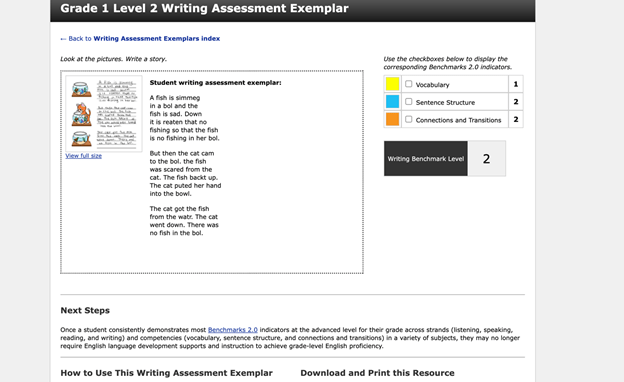
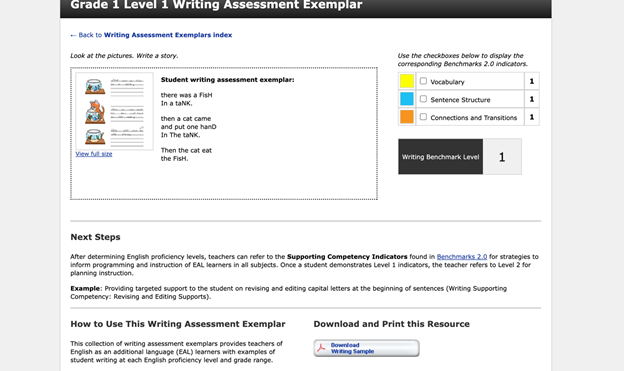
- Choose one grade-level writing sample to build your understanding of the different writing competencies and levels at your teaching level. Choose 3 writing samples of your grade level and discuss how they are similar/not similar to what you see your ELL/ML students produce in your writing assessments. Select a writing sample below. INCLUDE A SCREENSHOT of the writing sample because neither your peers nor I will be able to guess what you are analyzing! https://curriculum.learnalberta.ca/cdn/resources/m/eslapb/writingsamples/grade1_level3.html
The writing sample chosen is Grade 1, Level 3. The analysis of the chosen writing sample shows that students can write multiple sentences to form a simple story using vocabulary familiar to the topic. Students demonstrate emerging grammar and sentence structure with some errors, for example, “It raining to much”, “She not get wet.” It shows organizations and the sequencing of ideas. Students at level 3 can produce simple sentences and connect ideas, but with some errors. Similarities are that ML students can produce simple sentences, show phonetic spelling (to, too), make grammatical errors (verb tense, syntax, semantics), and rely on familiar topics with visuals. Differences at levels 1 and 2 may produce shorter responses and depend on teacher guidance with limited vocabulary. Students in all three levels completed words, sentences, and connecting ideas. Using explicit instructions and scaffolds such as sentence frames, word banks, repetition, and visual prompts will be a great benefit to help students move to complex sentences and accurate writing.

Reference:
Alberta. (n.d.). Supporting English as an Additional Language Learners. Tools, Strategies, and Resources. https://curriculum.learnalberta.ca/cdn/resources/m/eslapb/writing_samples.html
Short et al. (2017). Making Content Comprehensible for English Learners. THE SIOP MODEL. Pearson.


