


EDDN 637 Second Language Learners and the Content Areas
Students will become acquainted with and practice effective approaches, methods, and strategies for teaching and evaluating English language learners in the content areas (ELA, social studies, math and science). Throughout the course, students will explore the impact of culture and language on classroom learning. Special challenges in teaching and assessment in each content area will also be discussed. Includes 15 hours of field work.
Maria Quiroz is a Spanish teacher at John Adams High School in New York City. She is currently pursuing a Master’s degree in TESOL at Touro University, where she focuses on supporting multilingual learners through effective instructional strategies. Her work emphasizes creating engaging, inclusive, and language-rich classroom environments.
“My journey at Touro has helped me connect theory to real classroom practice, allowing me to better support my multilingual learners. I have grown as an educator by learning how to design lessons that build both content knowledge and language skills. This program has strengthened my confidence and commitment to teaching diverse students.” Maria Quiroz, Touro University TESOL Candidate
Exemplary Discussion Board 7 Practice and Application submission for EDDN 637 Second Language Learners and the Content Areas
Prof. Jasmin Cowin: This Discussion Board submission is exemplary because it demonstrates a clear and applied understanding of the SIOP model through the integration of hands-on practice, structured application tasks, and attention to multiple language domains. It is further strengthened by the effective use of direct textual evidence to support instructional decisions and by the analytical treatment of teaching scenarios, which moves beyond description to evaluation. The discussion of writing samples is particularly well developed, as it connects proficiency levels to observable learner performance, reflecting a grounded understanding of second-language development.
- Textbook Chapter 7 Practice and Application (p. 182-203): What activities are you planning to provide for your students in your SIOP lesson to apply content and language knowledge? Support your statement by quoting directly from the text with the page number.
In my SIOP lesson, I plan to use hands-on practice and meaningful application tasks so students can build content understanding while also using academic language. First, I will include manipulatives or visual models that students can touch, move, and use to demonstrate new concepts. The chapter explains that “students have a greater chance of mastering content concepts and skills when they are given multiple opportunities to practice in relevant, meaningful ways” (p. 185).
Next, I will design an application task that asks students to use the new concept in a new way, such as explaining a process to a partner using sentence frames, creating a short written explanation, or acting out a concept and describing it orally. This matches the idea that for students learning a new language, application matters because “discussing and ‘doing’ make the abstract concepts more concrete” (p. 187).
I will also plan for students to use more than one language domain in the same lesson, so they practice speaking, listening, reading, and writing connected to the same objective. The chapter states that for SIOP instruction, “practice and application tasks should also aim for practice of all four language skills: reading, writing, listening, and speaking” (p. 183).
2. Teaching scenarios, starting on p. 193 – discuss your takeaways from the teaching scenarios and quote directly from the text with the page number.
My key takeaway from the teaching scenarios is that practice and application must be active and structured, so students do not stay passive. In Mrs. Bertoni’s lesson, students listened, repeated, copied, and then were expected to complete homework independently, but they did not get guided opportunities to practice and apply the concepts in class. The discussion makes this point clearly: “Listening to a teacher read is not a practice activity” (p. 198).
In contrast, Mr. Sherbiny’s lesson shows what strong SIOP Practice and Application looks like. Students used hands-on materials, practiced the language frames aloud, read a text, wrote sentences, and applied concepts through examples and demonstrations. The scenario analysis highlights that “students used manipulatives in small groups to demonstrate revolution and rotation and practiced language frames to explain the concepts” (p. 198).
Mrs. Aliheri’s lesson reminded me that interactive activities still need careful scaffolding. Even though she used a video and tried word cards, the task did not set students up for success because there were missing supports and unclear steps. The text explains that “her planning was poor, as was the execution of the task” (p. 198). Overall, these scenarios reinforced that SIOP practice must be hands-on and guided, and application must require students to use both content knowledge and language in a supportive structure.
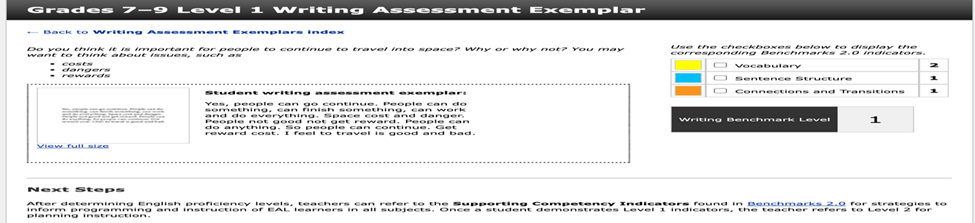
3. Choose one grade-level writing sample to build your understanding of the different writing competencies and levels at your teaching level. Choose 3 writing samples of your grade level and discuss how they are similar/not similar to what you see your ELL/ML students produce in your writing assessments. Select a writing sample below. INCLUDE A SCREENSHOT of the writing sample because neither your peers nor I will be able to guess what you are analyzing!
https://www.learnalberta.ca/content/eslapb/writing_samples.htmlLinks to an external site.
For this part, I selected three Grades 7–9 writing samples at Level 1, Level 3, and Level 5 from the LearnAlberta Writing Assessment Exemplars to understand differences in writing competencies across proficiency levels.
Level 1 shows very basic writing control. The writing is short, repetitive, and relies on simple sentence patterns. Ideas are listed more than developed, and there are frequent grammar errors that affect clarity. This looks similar to what I see when my beginner language learners write, even in my Spanish classroom. At early stages, students often depend on repeated sentence starters and basic vocabulary because they are still building control of word order and sentence structure.
Level 3 shows growth in development and organization. The student writes a longer response, attempts to explain reasons, and includes more detail. Sentences are longer and more complete, and the ideas connect more logically, even if there are still noticeable language errors. This is similar to what I see when students move from novice to more intermediate performance in a second language. They take more risks with language and expand their ideas, but they still need support with accuracy and cohesion.
Level 5 shows stronger control of extended writing. The response is longer, more organized, and includes explanations and examples. Vocabulary is more varied, and sentences show more complexity, even though some grammar issues remain. This resembles what I see in my more advanced language learners, who can sustain an argument or explanation and elaborate their ideas with more independence.


References
Echevarría, J., Vogt, M. E., & Short, D. J. (2017). Making content comprehensible for English learners: The SIOP model(5th ed.). Pearson.
Alberta Education. (n.d.). Writing assessment exemplars: Grades 7–9. LearnAlberta. https://www.learnalberta.ca/content/eslapb/writing_samples.html


