Touro University TESOL Candidate Crystal DeMarco’s Differentiated Instructional Lesson Planning. This “before” and “after” lesson planning assignment highlights the incorporation of instructional activities approximately midterm in our TESOL EDDN-637 course. Such personalized assignments show “proof-of-work” in the age of ChatGPT and focus on the practical application of course knowledge in the daily instructional TESOL/BLE teacher repertoire.
Teaching English to Speakers of Other Languages New York is a state that speaks many languages. We need teachers who can find the common ground. Touro University offers TESOL & Advanced Certificates in Teaching English to Speakers of Other Languages (TESOL) Program helps NYS-certified PreK-12 teachers more effectively teach and communicate with a diverse student population.
Crystal DeMarco is a candidate in the TESOL Graduate Program at Touro University. She completed her undergraduate degree at the College Of Staten Island where she earned her Bachelor’s degree in Secondary Education in Social Studies. Crystal DeMarco writes that she “loves teaching, and learning new innovative ways to create an engaging curriculum for my students!”
The assignment description:
Differentiated Instructional Activity Assignment
The differentiated instruction definition refers to an approach to education whereby teachers make changes to the curriculum and the way they teach to maximize the learning of every student in the class (IRIS Center, 2021). This is not a singular strategy but a framework that educators can utilize. Carol Ann Tomlinson also notes that in differentiated instruction, the teacher anticipates the varying levels of students’ interests, readiness, and learning profiles. Subsequently, they can provide diverse ways of learning, enabling students to learn without being anxious because academic tasks are too difficult for them or being unmotivated because assignments are not challenging for them (ASCD, 2011). However, differentiated instruction is not the same as individualized instruction.
practice (how teachers deliver instruction to students),
process (how the lesson is designed for students),
products (the kinds of work products students will be asked to complete),
content (the specific readings, research, or materials, students will study),
assessment (how teachers measure what students have learned), and
grouping (how students are arranged in the classroom or paired up with other students).
You will submit both the original content lesson and plan and the lesson plan with differentiated instructional activities, with a reflection of your professional growth completing this assignment. Your product for Differentiated Instructional Activity Assignment will be:
A paper including the original lesson plan/differentiated lesson plan with all materials
3-4 minute video showcasing (this means you are pretend teaching) one specific aspect of one Differentiated Instructional Activity – your video submission must be a link, not a file. You may use YuJa, Screencast-O-Matic or any other tool. You can also upload your file to Google drive and share that link. No files which need to be downloaded to view will be accepted.
The interdependent relationships between Complexity, Informatics and Cybernetics are continuously expanding and generating theoretical and technological synergies. Both Complexity Science and Cybernetics share similar concepts and theories. Informatics and Cybernetics are increasingly interconnected through computing, communications and control technologies, and some authors perceive them as essentially the same with different emphasis, orientation or names. The field of Complexity Science and Informatics mutually support each other in both theory and practice.
IMCIC 2023 is an international forum aimed at bringing together scientists, engineers, researchers, consultants, theoreticians and practitioners in the fields of Complexity, Informatics and Cybernetics. The IMCIC 2023 Organizing Committee considers hihg-impact research articles from different disciplines, as well as multi-, inter- and trans-disciplinary research, studies, reflections, programs and projects.
Touro University offers TESOL & Advanced Certificates in Teaching English to Speakers of Other Languages (TESOL) Program helps NYS-certified PreK-12 teachers more effectively teach and communicate with a diverse student population.
The assignment: Text Analysis & Critique Assignment Description
Following discussion on the cognitive and linguistic demands of the content areas, you will apply these ideas by closely analyzing a chapter, or an aspect of one content-area text currently in use or recommended by New York State/BOE. Upon analysis of underlying concepts, you will develop a thesis and purpose of your analysis. You will sequence your ideas with evidence from the text supporting important points. Your Critique will feature substantial, logical, and concrete development of ideas describing what makes that concept or section challenging for ELLs. Length: 3-4-page paper (typed, double-spaced, 12-point font) please see grading rubric.
Demonstrate an understanding of various text analysis techniques in relation to educational content-area texts.
In written form effectively articulate, evaluate and critique educational content-area texts concepts using professional TESOL language, theory and standards.
Ask questions from the view of an ELL/ESL learner that can be meaningfully answered using content-area text analysis.
Evaluate evidence; interpret data such as: ELL students cannot glean meaning from context when they have too many words to decipher.
Express yourself effectively on graduate level writing
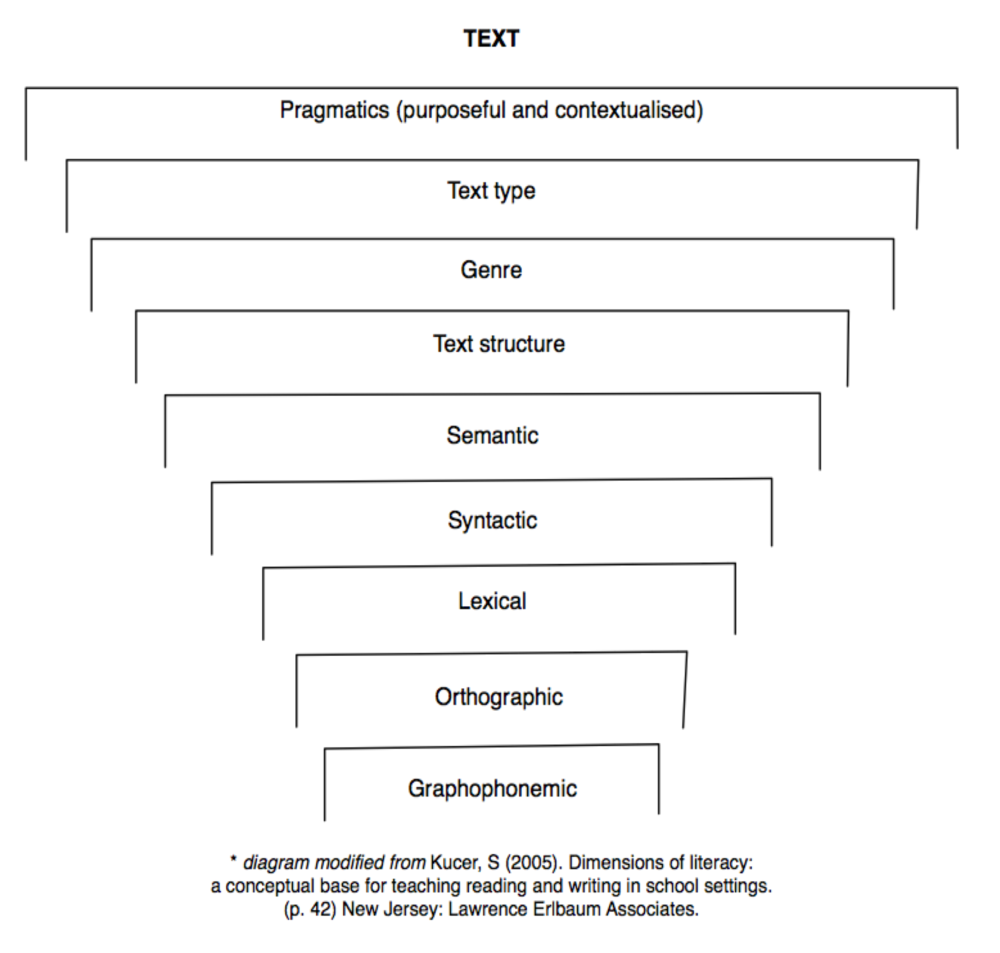
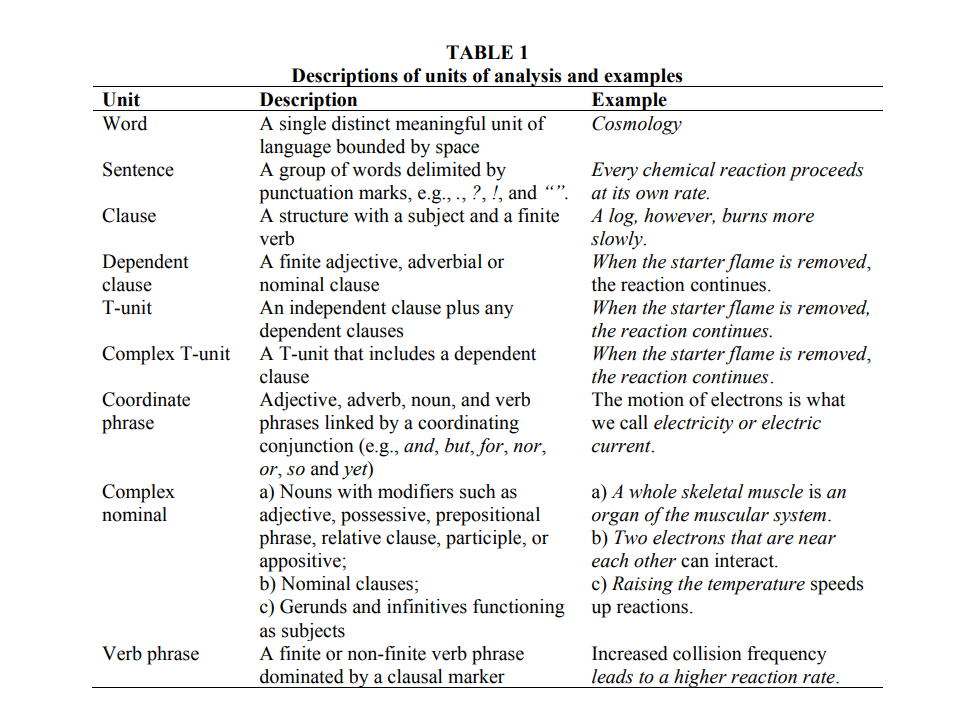
By analyzing lexical density of the text, come to a conclusion whether the text is informative and difficult or not.
Classroom teachers need to help ELLs build background knowledge and teach unfamiliar vocabulary before presenting a new concept. Some specific challenges that ELLs face when reading new material include the following:
Comprehending a text that contains a large number of unknown words. Students cannot glean meaning from context when they have too many words to decipher.
Understanding text that includes a profusion of idioms, figurative language, imagery, and symbolism.
Using homonyms and synonyms.
Deciphering regional U.S. dialects.
Grasping literary terms such as antagonist, protagonist, and denouement.
Understanding the cultural background depicted in a literary piece.
Recognizing correlations between letters and sounds. ELLs may come from a language background where the sound/symbol correspondence is very different from that of English.
Comprehending the meaning of a text. ELLs will often memorize the rules for decoding written English and read fluently; however, they do not understand what they have read.
Touro University TESOL candidate Dayna Stechel is from Queens, NY, and is in her 3rd semester at Touro University. She attended SUNY New Paltz for her undergraduate degree in early childhood and childhood education. She is substitute teaching in the NYC public elementary schools.
Lexile Levels and ATOS Levels are used to analyze texts and books. Both of these systems, as well as others, determine the readability of a text. “ATOS is a measure of readability—in other words, a readability formula designed to guide students to appropriate-level books. ATOS takes into account the most important predictors of text complexity—average sentence length, average word length, and word difficulty level” (ATOS, 2022). When analyzing this text, Chapter 3, Models of The Earth, using the ATOS Levels, I analyzed a section discussing topographic maps.
Teaching English to Speakers of Other Languages New York is a state that speaks many languages. We need teachers who can find common ground. The Teaching English to Speakers of Other Languages (TESOL) Program helps NYS-certified PreK-12 teachers more effectively teach and communicate with a diverse student population.
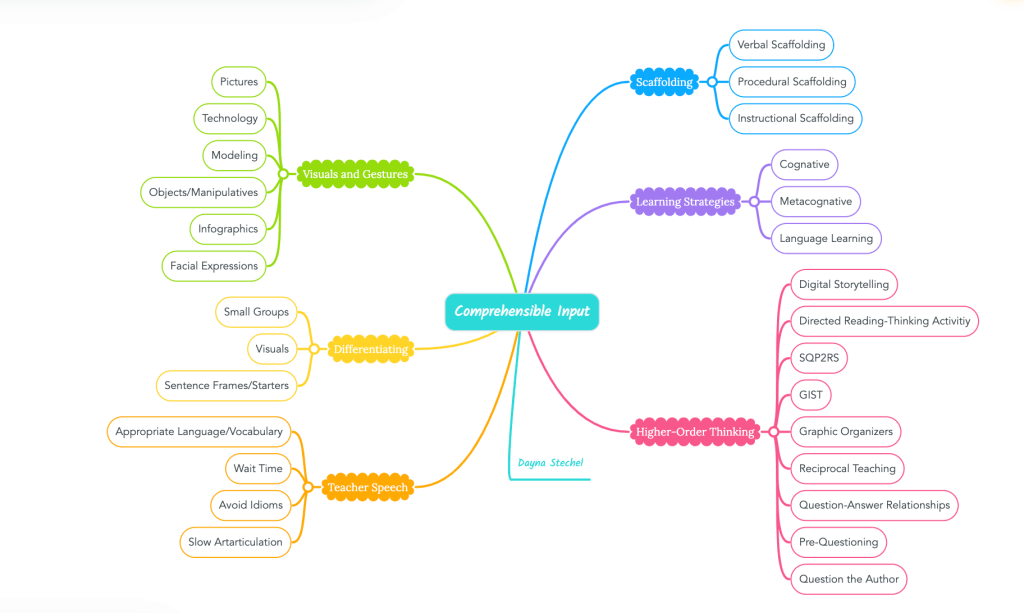
This week’s DB is constructing a mindmap of comprehensible input strategies AND connecting those to teaching strategies. Share the mindmap in your DB as a screenshot. You need to include your name in the mindmap, title it, and show the connections of comprehensible input strategies to YOUR teaching IN your CLASSROOM. Make sure you include all sources in your mind map.
Dayna Stechel is from Queens, NY, and is close to completing her Masters in TESOL at Touro University. She attended SUNY New Paltz for her undergraduate degree in early childhood and childhood education. She works as an elementary substitute teacher for NYC public schools.
Teaching English to Speakers of Other Languages New York is a state that speaks many languages. We need teachers who can find common ground. The Teaching English to Speakers of Other Languages (TESOL) Program helps NYS-certified PreK-12 teachers more effectively teach and communicate with a diverse student population.
This week’s DB is constructing a mindmap of comprehensible input strategies AND connecting those to teaching strategies. Share the mindmap in your DB as a screenshot. You need to include your name in the mindmap, title it, and show the connections of comprehensible input strategies to YOUR teaching IN your CLASSROOM. Make sure you include all sources in your mind map
Alexa Armentano is a candidate in the TESOL Graduate program at Touro University. She attended Hofstra University for her undergrad where she earned a dual degree in Early Childhood Education and Childhood Education and a Psychology degree. Fun fact! She coaches the Commack High School dance team. Her mindmap showcases different comprehensible input strategies.
One of the earliest examples of generative AI was the “Markov Chain”, a statistical method developed by Russian mathematician Andrey Markov in the early 1900s. Markov chains are a “fairly common, and relatively simple, way to statistically model random processes. They have been used in many different domains, ranging from text generation to financial modeling. A popular example is r/SubredditSimulator, which uses Markov chains to automate the creation of content for an entire subreddit.” Devin Soni
The first successful generative AI algorithm was developed in the 1950s by computer scientist Arthur Samuel, who created the Samuel Checkers-Playing Program an early example of a method now commonly used in artificial intelligence (AI) research, that is, to work in a complex yet understandable domain.
One of the early breakthroughs in generative AI was the development of Restricted Boltzmann Machines (RBMs). “It was invented in 1985 by Geoffrey Hinton, then a Professor at Carnegie Mellon University, and Terry Sejnowski, then a Professor at Johns Hopkins University.” RBMs are a type of neural network that can learn to represent complex data distributions and generate new data based on that distribution. In 2014, a team of researchers from the University of Toronto introduced the Generative Adversarial Network (GAN) framework. Jason Brownlee in A Gentle Introduction to Generative Adversarial Networks (GANs). “Generative modeling is an unsupervised learning task in machine learning that involves automatically discovering and learning the regularities or patterns in input data in such a way that the model can be used to generate or output new examples that plausibly could have been drawn from the original dataset.”
Recently, generative AI and ChatGPT have been in the news, discussed at conferences, used by students, and feared by Professors due to the generation of content that can be indistinguishable from that created by humans. Both Google’s BERT and GPT-3, are big language models and have been referred to as “stochastic parrots” because they produce convincing synthetic text devoid of any human-like comprehension. A “stochastic parrot” is, in the words of Bender, Gebru, and colleagues, “a system for randomly stitching together sequences of language forms” that have been seen in the training data “according to probabilistic knowledge about how they join, but without any reference to meaning.”
This infographic is an attempt to visualize the timeline of Generative AI Programs and ChatGPT.
I decided to create this hyperlinked resource to better support my teacher candidates in their graduate research at Touro University, TESOL/BLE Department. I wanted to create a visually attractive, clickable one-sheet PDF for a robust, practical resource collection to guide my candidates as they are preparing to write their research papers and case studies.
The resource areas are categorized into Professional Language Organizations and Journals (dark purple), Research Centers and Institutes (light blue), Proficiency and Language Services (green), Teaching Ideas (orange), Resources for Foreign Language Instruction and ESL Education (magnet), and Culturally Responsive Teaching (light purple). There are multitudes of resources and I am sure I missed important ones!
The International Institute of Informatics and Cybernetics, IIIC through The Inter-National Association FOR Trans-Disciplinary Communication AFTC is planning a Special Issue FOR “Trans-Disciplinary Communication”
The objectives are 1) to support a written dialogue related to the Foundation of the International Association FOR “Trans-Disciplinary Communication”, 2) to potentially support the elaboration of a founding collective document, and/or 3) a special issue of the journal related to the notion “Transdisciplinary Communication” which have two main meaning implied by the context in which the notion is used: 3a) the “Transdisciplinary Communication” required for communicating members of a multidisciplinary team working in the context of trans-disciplinarity and/or transdisciplinary research, and 3b) the “Transdisciplinary Communication” related to communicating authors with readers from different disciplines. speakers for a multidisciplinary audience, or even with the Society in General. The latter is the second sense of the etymological meaning of the prefix ‘trans-”, i.e., across and beyond. Accordingly, based on these two etymological senses, “Trans-Disciplinary Communication” means acrossdisciplines and/or beyond them. The first relates academics from different disciplines and the second relates Academy to Society at Large. The latter requires to use of the natural language being spoken in each country.
In my online courses, starting the semester, I facilitate student discussions using Canvas Discussion Boards. Questions focusing on readings help students with critical analysis of the readings. Course progression starts folding in tech tools such as voicethread, videos, mind maps, infographics, etc. I believe discussion boards create opportunities and set the stage for active learning, developing critical thinking and writing skills relevant to the course subject. To nurture graduate writing skills, my discussion boards are required to use APA style referencing. This gives students an opportunity to engage in graduate writing and peer feedback. Jake LaNasa contributed a well-researched and thoughtful discussion board, which I am proud to showcase.
Jake LaNasa is currently a permanent substitute teacher at California Avenue School in the Uniondale School District. H received his bachelor’s degree in Childhood Education, in December of 2021 and has been subbing ever since.
I became a teacher because my mother and many other family members are teachers. My mother would come home from work every day with a smile on her face and I knew that is what I wanted for my future.
Jake LaNasa, Touro University, candidate in the TESOL/Bilingual department, Graduate School of Education
Question: CHAP 1. WHAT Characteristics INFLUENCE ELLs’ having SUCCESS IN SCHOOL?
In order for ELLs to have success in schools, the teacher must build background knowledge and vocabulary as well as hands-on experience that enhance their understanding of the content. Teachers should also offer access to websites in the student’s native language in order to facilitate any language barriers. The more prepared the teacher is the higher chance of student success. This is not only the job of the teacher but of the schools, districts, and or universities to take action and implement this framework for all ELLs and students. Educators have to be aware of their students’ diverse backgrounds. The students bring cultural and educational experiences to the classroom that will have implications for assessment, program design, and instruction. Understanding the students’ funds of knowledge is incredibly important in constructing effective techniques.
Question: What are some characteristics of ELLs to consider to implement effective teaching?
No Ell is the same. The more aware the teacher is of this information, the easier it will be to implement proper teaching techniques. Many Ell’s come from different geographic locations which will present challenges. Many school districts have not served large numbers of ELLs in the past, meaning the school’s academic progress toward ELLs is not well established. This not well-established progress will reflect on some schools not having appropriate curricula and or resources available for Ells. Many teachers are also untrained in how to meet the needs of their Ell students, the teacher must know and understand the students’ backgrounds and abilities in their native language in order for the teacher to incorporate effective materials and techniques in their instructional practices. ELLs enter American schools with a range that varies widely in language proficiency. Many characteristics of ELLs affect the way they learn and their ability for second language acquisition. These characteristics include the students’ educational background, socioeconomic status, age of arrival, personal experiences while traveling to America, and their parents’ education level. As educators, we must push the need for English language development (ELD) in order for the students to transfer their knowledge in their native language into English as they become more proficient with it.
I feel it is important to explain to the students that making mistakes is natural and teachers should not scrutinize students for grammatical correctness early on.
Jake LaNasa, Touro University, candidate in the TESOL/Bilingual department, Graduate School of Education
Educators must assure that the ELLs and SIFE students are getting the best educational opportunities possible. Districts should be integrating technology and revisiting their models of teaching ELLs to make sure their best practices are up to date with the growing and changing Ell population. The most important aspect is ensuring the Ell students are receiving equitable representation in their schools. Introducing TESOL techniques will transform the education of Ells by increasing students’ linguistic knowledge across multilingual contexts through research, standards, professional development/learning, and advocacy. To reach the students and transform their learning we must value their home language and culture to draw them into learning a new language altogether. The student’s home language will facilitate and bridge the gap between learning a completely new language. I feel it is important to explain to the students that making mistakes is natural and teachers should not scrutinize students for grammatical correctness early on. The students must receive feedback strategically in order for the students to not feel as though they cannot successfully acclimate to the new language and give up. Educators should be involving families in their student’s education path. If the families are involved and participate in their children’s education, this may lead to a greater chance of success as students will feel empowered. Students have to feel comfortable in the classroom during lessons, teachers can add more visuals, translate essential vocabulary, and allow students to collaborate in their native language during discussions. The classroom must be a safe environment. If the children do not feel safe, their ability to learn is fragmented and much more difficult. Implementing the SIOP model will also transform the education of Ells. The SIOP model consists of eight instructional strategies that will help educators in their lesson design and delivery. The SIOP model involves building background, lesson preparation, interaction, practice and application, lesson delivery, strategies, comprehensible input, and review and assessment. This model has a strong research base that has been tested across grade levels and subject areas. Implementing this model has proven to improve academic literacy for ELL students. With more teachers using this model, the future of Ell students is very bright.
Question: What is one takeaway from this week’s readings and how might it impact your teaching?
Something that stood out to me is the fact that ELLs are either over or under-represented in special education. Many districts and schools struggle to distinguish between a learning disability and a delay in developing second language acquisition. Even if students are correctly identified, districts may have trouble providing services to bilingual special education educators. After reading this it changes my perspective of Ells in special education. This motivates me to meet with special education teachers in my building and discuss how they identify ELLs in special education and what services or scaffolds they have in place for them. I never want to misidentify a student and I believe that many students are. Some students have delays in language acquisition, but it does not mean they should be in a special education classroom.
Question: Share a fun fact or photo of yourself.
A fun fact about me is I work in the Uniondale school district where there is an overwhelming and continually growing amount of Ell students. I am taking these courses in order to further my knowledge of Ells and TESOL which in turn will make me a more qualified and proficient teacher in this school district. I am excited to obtain new knowledge and apply it to my Ell students every week.
I am pleased that my thoughts on “The Mitzvah of Mezzuzah and Metaverses” were featured in the Israel Herald. I believe it is time to engage in transdisciplinary discussions and explore the potential implications of dynamic simulation environments for Jewish educators, instructional designers, metaverse curators, and users to ensure Jewish principles are honored.








 Dr. J's Education Blog