Dr. Jasmin (Bey) Cowin publishes: The European AI Act 2024: A Threat to International Academic Collaboration for Higher Education Institutions?

Fundamentals of The European AI Act 2024

by Dr. Jasmin (Bey) Cowin

On July 12, 2024, the EU issued Regulation (EU) 2024/1689, known as the EU AI Act, marking a significant milestone as the first extensive AI regulation globally. This regulation emerged over three years after its initial draft by the EU Commission in April 2021. The AI Act establishes a broad, sector-independent regulatory framework designed to set the standard for AI governance within the EU. This framework is expected to influence both local and global companies and global legislative approaches. Importantly, the AI Act’s scope extends beyond the EU; it applies to entities worldwide that might not be physically present in any EU member state but engage with the EU market. This represents the culmination of a lengthy legislative process, with the Act set to be enforced starting on August 2, 2024. Higher Education Institutions (HEIs) should familiarize themselves with the implications of this regulation, understand their responsibilities, and prepare for compliance by the designated date. This series of blogs exclusively written for Stankevicius by the author aims to highlight the critical aspects of the AI Act that HEI organizations need to grasp to ensure they are ready for the upcoming regulatory changes, specifying important deadlines for meeting these new requirements.

Click on the link below to read the complete article.

Cowin, J. (2024, July 17). The European AI Act 2024: A Threat to International Academic Collaboration for Higher Education Institutions? Stankevicius. retrieved from https://stankevicius.co/world/the-european-ai-act-2024-a-threat-to-international-academic-collaboration-for-higher-education-institutions/

Expanding my AI Knowledge with Google’s AI Essentials Course

Today, I completed Google’s AI Essentials course to build upon my existing AI knowledge. As someone who believes in continuous learning, I found the course to be a valuable resource for professionals looking to enhance their AI skill set.
The course content was comprehensive, covering a wide range of topics from foundational concepts to practical applications of AI in the workplace. The hands-on exercises and real-world examples helped reinforce the learning material and provided opportunities to apply newfound knowledge.
One notable aspect of the course was its emphasis on the responsible and ethical use of AI. It provided a framework for understanding potential biases, inaccuracies, and security risks associated with AI and offered guidance on mitigating these issues.

The course content was comprehensive, covering a wide range of topics from foundational concepts to practical applications of AI in the workplace, with many aspects directly transferable to higher education and my field: teacher preparation and second language acquisition. The hands-on exercises and real-world examples helped reinforce the learning material and provided opportunities to apply newfound knowledge. The course provided insights into prompt engineering and its potential to streamline workflows and inspire creative solutions. This skill can greatly augment tasks and improve efficiency in various industries.
Throughout the course, I acquired several key skills that are applicable to both my academic work and teaching:

  • Augmenting tasks with AI: Learning how to effectively integrate AI into my workflow to enhance productivity and performance.
  • Critical thinking: Developing the ability to critically evaluate AI tools and their potential impacts on projects and decision-making processes.
  • Iterative thinking: Understanding the importance of iterative problem-solving when working with AI, refining solutions based on feedback and results.
  • Prompt engineering: Mastering the art of crafting precise and effective prompts to guide AI models in generating desired outputs.
  • Confronting AI challenges: Gaining awareness of potential biases, inaccuracies, and security vulnerabilities associated with AI systems and developing strategies to mitigate these concerns.

However, it is essential to recognize that learning AI is an ongoing process. The field is constantly evolving, and staying up-to-date requires a personal commitment to continuous learning about and exploration of new AI tools. As AI technologies advance at a rapid pace, those of us who wish to remain competitive in the field must actively seek out opportunities to expand our knowledge and skill set. This may involve attending conferences, participating in online courses, engaging with AI communities, and experimenting with emerging AI platforms to stay at the forefront of this exponentially transformative industry. And in my case, this meant using the 4th of July to complete the course.

Dr. Jasmin (Bey) Cowin published Sentient AI or Modern Myth? Anthropic’s Claude 3 Opus, Talos and the Golem of Prague

Cowin, J. (2024, April 29). Sentient AI or Modern Myth? Anthropic’s Claude 3 Opus, Talos and the Golem of Prague. Stankevicius. https://stankevicius.co/tech/sentient-ai-or-modern-myth-anthropics-claude-3-opus-talos-and-the-golem-of-prague/

Daniel Dinello, in his apocalyptic book “Technophobia!” forecasts, “Like a viral infection, technology develops into an autonomous, invasive force that expands and fulfills its dangerous potential by flourishing in the societal medium of corporate, military, and religious sustenance. Voracious in its urge to possess and engulf, technology is a parasite that frequently undermines human integrity—invisibly infiltrating, manipulating, seizing control, and mutating its human host to support its own survival and evolution. Like a virus, technology metamorphoses itself, because of unintended and uncontrollable consequences, progressively transforming the human world in the wake of its own modern changing structure.” (Dinello, 2006, p. 247)

For more, click on my column and read!

Dinello, Daniel. Technophobia!: Science Fiction Visions of Posthuman Technology, New York, USA: University of Texas Press, 2006. https://doi.org/10.7560/709546

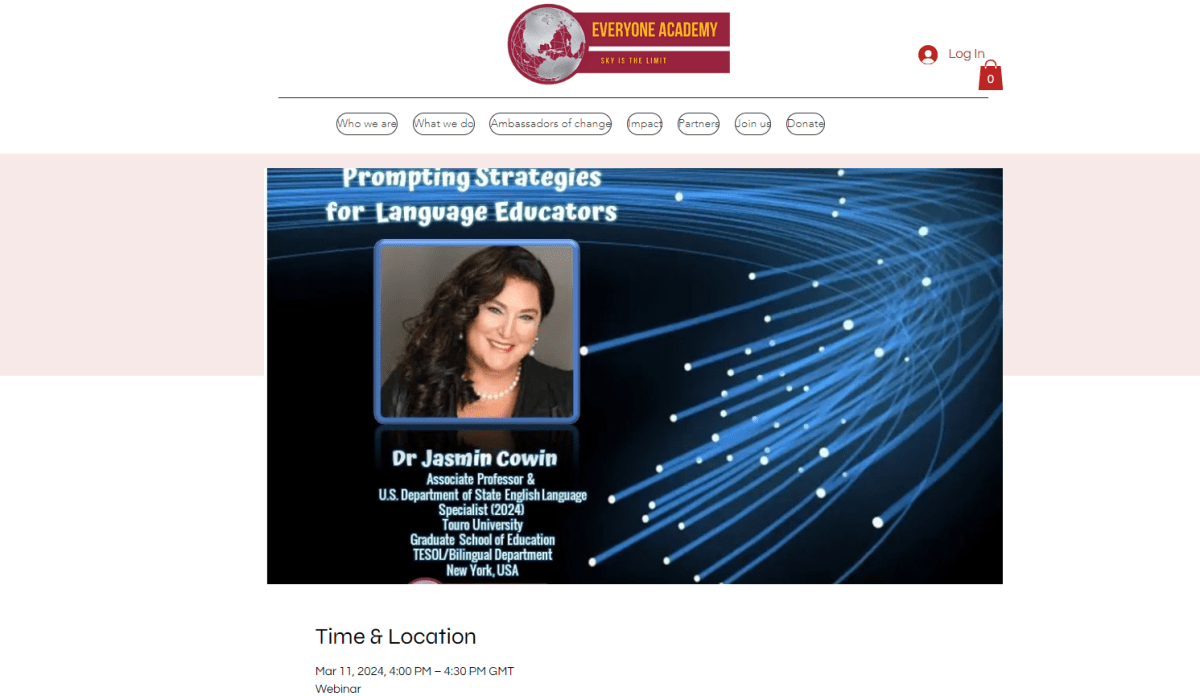
Join my webinar for Everyone Academy: Structured AI Prompting Strategies for Language Educators

At the heart of my professional journey is a commitment to transformative education, grounded in integrating concepts like Lynda Miller’s philosophy of abundance, which counters Ruby Payne’s notion of a Culture of Poverty (2005). This philosophy of abundance emphasizes viewing experiences as assets filled with positivity and optimism, particularly valuable in an often dystopian-seeming world. Aligned with the UN’s Sustainable Development Goal 4, she has contributed to initiatives like Computers for Schools Burundi, TESOL “Train the Trainer” programs in Yemen and Morocco. As an educator in the Fourth Industrial Revolution era, I prepare future teachers by incorporating innovations in education to shape worldviews and cultivate an adaptable skillset for Volatile, Uncertain, Complex, Ambiguous (VUCA) environments. Her research explores simulations for educators-in-training, AI in education and assessment, educational Metaverse applications, and educational transformation for language educators.

Through my pro-bono work, I support SDG 4.c By 2030, substantially increase the supply of qualified teachers, including through international cooperation for teacher training in developing countries, especially least developed countries and small island developing States.

Mon, Mar 11 | Webinar Time & Location Mar 11, 2024, 4:00 PM – 4:30 PM GMT (Casablanca, Morocco)

– click the link to register

Structured AI Prompting Strategies for Language Educators

https://www.everyoneacademy.org/event-details/structured-ai-prompting-strategies-for-language-educators

Dr. Jasmin Cowin (lead author) Co-Publishes “Accelerating Higher Education Transformation: Simulation-Based Training and AI Coaching for Educators-in-Training” at Springer Nature, Switzerland

I am delighted to announce the recent publication of our paper, titled “Accelerating Higher Education Transformation: Simulation-Based Training and AI Coaching for Educators-in-Training.” This paper has been featured in the conference proceedings titled “Towards a Hybrid, Flexible and Socially Engaged Higher Education,” published by Springer Nature, Switzerland.

Our transdisciplinary collaborative effort grew from the International Conference on Interactive Collaborative Learning (ICL 2023), Madrid, and signifies a significant step forward in our journey to reshape educational paradigms through the integration of cutting-edge technologies (Cowin et al., 2024).

Cowin, J., Oberer, B., Lipuma, J., Leon, C., & Erkollar, A. (2024). Accelerating Higher Education Transformation: Simulation-Based Training and AI Coaching for Educators-in-Training [ICL]. In M. E. Auer, U. R. Cukierman, E. Vendrell Vidal, & E. Tovar Caro (Eds.), Towards a Hybrid, Flexible and Socially Engaged Higher Education (CLDM_Dv; Vol. 899, pp. 532–541). Springer Nature Switzerland; /Research/Education. https://doi.org/10.1007/978-3-031-51979-6_55

Conference Presentation

Cowin, J., Oberer, B., Lipuma, J., Leon, C., & Erkollar, A. (2023, September 26). Accelerating Higher Education Transformation: Simulation-Based Training and AI Coaching for Educators-in-Training [Presentation] [Conference]. International Conference on Interactive Collaborative Learning (ICL 2023), Madrid, Spain. http://icl-conference.org/icl2023/

Paper Abstract
As the world undergoes remarkable transformations powered by Artificial Intelligence, the challenge arises for educational systems and institutions to adapt. How can we adequately equip educators-in-training to flourish in unprecedented change? The emergence of flexible, hybrid, and socially engaged learning environments has created a need for effective training methodologies that empower educators-in-training to thrive in this new paradigm. Higher education institutions need to expand aspiring educators’ human and professional potential amidst accelerating change, in line with the clarion call of the Sustainable Development Goal 4 Quality Education “By 2030, substantially increase the supply of qualified teachers, including through international cooperation for teacher training in developing countries, especially least developed countries and small island developing States” [1]. Simulation-based training coupled with Artificial Intelligence offers a solution to equip educators with the necessary skills and competencies to navigate complex real-world educational settings to succeed in classrooms of the 21st century. Simulation-based training allows educators-in-training to develop their skills and build confidence in their abilities to effectively engage with students in multifaceted classroom environments by providing a safe and controlled space for experimentation and practice. In conclusion, this paper and presentation explore the shifting teaching paradigms in higher education using simSchool and Mursion simulation platforms as examples and examine inclusive and dynamic practices that promote sustainable systems change in line with SDG 4. Quality Education, supporting educators-in-training by identifying strengths and encouraging personal and professional growth through AI feedback loops and faculty coaching.

Keywords: Artificial Intelligence, Educators-in-training, Simulation-based training, Sustainable systems change

Acknowledgments
I extend my heartfelt gratitude to my colleagues and peers and the supportive community that made this research possible. Our collaborative efforts reflect a unified vision for the future of education, one that embraces the challenges and opportunities presented by the digital age.

Disclosure statement
No conflict of interest pertains to the research presented above.

ORCID

Jasmin Cowin http://orcid.org/0000-0002-0405-8774

Birgit Oberer http://orcid.org/0000-0001-7231-7902

Alptekin Erkollar http://orcid.org/0000-0003-3670-5283

James Lipuma https://orcid.org/0000-0002-9778-3843

Cristo Leon https://orcid.org/0000-0002-0930-0179