Touro University TESOL Candidate Oralia Lainez-Tutka’s Instructional Material Critique & Redesign with Infographic

EDPN 673: Methods and Materials for Teaching English as a Second
Language
: The Instructional Material Critique & Redesign with Infographic assignment prepares Touro University TESOL candidates to critically evaluate and adapt instructional materials for multilingual learners across diverse educational contexts. The assignment structure addresses specific TESOL and AAQEP standard requirements while developing essential professional competencies our graduates need in the field.
The dual-material analysis requirement ensures candidates develop expertise in material evaluation across developmental levels, addressing TESOL Standard 2 by requiring deep analysis of how language acquisition intersects with academic content delivery. Candidates must demonstrate understanding of developmental language trajectories and their implications for instructional material selection, a core competency for effective TESOL practice.
The WIDA PRIME protocol integration provides candidates with industry-standard evaluation tools currently used by school districts nationwide for material adoption decisions. This practical application directly aligns with AAQEP Standard 1’s emphasis on evidence-based practice while ensuring our graduates can contribute meaningfully to curriculum adoption processes in their professional contexts.
The non-negotiable criteria assessment develops candidates’ capacity to identify and address systemic barriers that multilingual learners face in accessing grade-level content. This component operationalizes TESOL Standard 3 by requiring examination of cultural representation and linguistic accessibility, while AAQEP Standard 2’s equity focus is addressed through critical analysis of how materials support or hinder multilingual learner success.
The redesign component transforms theoretical knowledge into practical application through differentiated material adaptation. Candidates must operationalize TESOL Standard 5 by creating instructionally sound modifications that maintain academic rigor while providing appropriate linguistic scaffolding across proficiency levels. This authentic assessment demonstrates candidate impact on multilingual learner outcomes, satisfying AAQEP Standard 3 requirements.
The infographic creation simultaneously addresses AAQEP’s technology integration competency requirements and develops visual literacy skills essential for multilingual learner instruction. Candidates must demonstrate proficiency with digital design tools while creating pedagogically sound visual supports that enhance comprehension for diverse learners. This component ensures graduates can effectively integrate educational technology to improve multilingual learner outcomes while building practical skills for immediate classroom application.
This assignment ensures our graduates possess both analytical expertise and practical competencies necessary for effective multilingual learner instruction.

Oralia Lainez-Tutka is a middle school Spanish teacher on Staten Island. Coming from a Spanish-speaking household, she is proud to be a first-generation college graduate now pursuing her master’s in TESOL at Touro College. She’s also a mom to a bilingual toddler, which makes this journey even more meaningful to her. She’s currently in her third semester.

I am already applying new scaffolding strategies and techniques in my teaching.  I’ve learned a lot so far during my Touro journey and am truly enjoying the learning process. I feel well supported by my professors and the program as a whole. 

Oralia Lainez-Tutka, TESOL Master’s Candidate, Touro University

Touro University TESOL Candidate Maria Fernandez on Assessment and Professional Responsibilities

MS in Teaching English to Speakers of Other Languages: New York is a state that speaks many languages. We need teachers who can find the common ground.The MS in Teaching English to Speakers of Other Languages (TESOL) Program helps NYS-certified PreK-12 teachers more effectively teach and communicate with a diverse student population.

Maria Fernandez is a former English Language Learner who enjoys exploring other cultures through travel whenever possible. Currently, she serves as a 12:1:1 special education teacher in District 75, where she brings enthusiasm and dedication to her teaching practice.

In EDDN 637 Second Language Learners and the Content Area students will become acquainted with and practice effective approaches, methods, and strategies for teaching and evaluating English language learners in the content areas (ELA, social studies, math and science). Throughout the course, students will explore the impact of culture and language on classroom learning. Special challenges in teaching and assessment in each content area will also be discussed. Includes 15 hours of field work.

One of the discussion boards asks:

  1. What is your responsibility AS A TESOL PROFESSIONAL in terms of Initial Assessment of Language Proficiency?
    Demonstrate by showing realia the difference between formal and informal assessment. You can take photos of anonymized assessment types from YOUR classroom. For example, if you used Kahoot, or a test or an exit ticket.
    2.How do YOU assess student progress and learning for your ELLs? Take ONE of the realia student samples from telpas-annotated-examples-of-student-writing.pdf and assess the example using academic TESOL terms. Include a photo of your example in your presentation.
    What are ways to provide specific constructive affirmations to students to keep them progressing and motivated? (Think about technology tools too, badges etc.) share at least one link, hand-out, exit ticket, or other realia to an assessment tool you use in your professional practice. (Take a photo!)

Maria Fernandez’s contribution shows her attention to detail and depth of contribution.

Lauren Eisenman a Master’s Degree Candidate for TESOL at Touro University on Instructional Materials & Redesign

Publishing my students’ work in a blog or other professional outlet is a deliberate choice to affirm their professional identities and position them as active contributors to the TESOL field. It highlights the professionalism, academic rigor, and exceptional quality of our program, while honoring the dedication and intellectual engagement our TESOL teacher candidates at Touro University bring to their work. By showcasing their scholarship publicly, I want to reinforce my commitment to cultivating educators who are prepared to shape and elevate the discourse around multilingual education.

Lauren Eisenman is a third-grade teacher who has been teaching for the past four years in a diverse school district. She currently holds a Bachelor’s Degree in English and Elementary Education and a Teacher of Students with Disabilities Endorsement from Monmouth University. She is enrolled to receive her Master’s Degree in TESOL at Touro University in order to enhance her teaching practices and better support Culturally and Linguistically Diverse (CLD) students in her classroom.

Touro University has empowered me to better support multilingual learners through meaningful, research-based instruction. The program has strengthened my understanding of language acquisition and culturally responsive teaching. I feel more confident and equipped to meet the diverse needs of my students.

Lauren Eisenman, Master’s Degree Candidate for TESOL at Touro University

New York is a state that speaks many languages. We need teachers who can find the common ground. Request Info ApplySchool CatalogSchool Catalog (opens in a new tab) The MS in Teaching English to Speakers of Other Languages (TESOL) Program helps NYS-certified PreK-12 teachers more effectively teach and communicate with a diverse student population. Academically rigorous and practice-intensive, the 33-credit program includes 5-15 hours of fieldwork embedded in each course and at least 10 days or 50 hours of supervised student teaching experience. Candidates that complete all coursework, fieldwork, and student teaching requirements are eligible for recommendation for ESL certification. Online courses are available, and students can transfer up to twelve credits from previous graduate-level study toward our requirements. Students pursuing an Advanced Certificate in TESOL may apply their credits toward the Master’s degree. Completion of the program makes you eligible for New York State certification as a TESOL teacher for PreK-12. If you have questions about our admissions requirementscertification guidelines, or transfer credits, feel free to contact us. Contact Wanda Agosto
Program Associate for TESOL & Teaching Literacy
wanda.agosto@touro.eduwanda.agosto@touro.edu (opens in a new tab)
646-777-9296 or Seong-Shin Kim, Ph.D.
Program Chair for TESOL, Bilingual Programs & Teaching Literacy
seongshin.kim@touro.edu
646-777-9857

Sara Sylaj, Advanced TESOL Certificate Candidate at Touro University on Differentiated Assessment

Our advanced certificates lead to NYSED certification in specialized areas and an extension/annotation on your NYS teaching credentials.

The extra credits can make all the difference, and specialization can help make you a more marketable, knowledgeable, and well-rounded educator.

Intensive, focused coursework and hands-on learning are benchmarks of the advanced certificate programs at the Graduate School of Education. We unite pedagogical theory and classroom practice, explore innovative teaching and outreach methods, and emphasize culturally responsive instruction.

Pursuing an advanced certificate is an ideal—and affordable—way for experienced teachers and educational personnel to strengthen their expertise in a specific area, from program development for gifted children to teaching English Language Learners with disabilities.

Most programs require 12-15 credits, inclusive of fieldwork. Upon successful completion, you’ll be eligible for an extension/annotation on your New York State teaching credentials, and your earned credits can apply to an additional salary differential.

With advanced certification, not only will you be able to more effectively and compassionately serve diverse student populations, you’ll increase your value as an educator and improve your career prospects.

Teaching English to Speakers of Other Languages (TESOL)

Our 15-credit Advanced Certificate in TESOL will allow you to expand your teaching to ESL or strengthening your capacities to serve a diverse student body. Evening, Sunday, and online courses are available.

Sara Sylaj was born in Albania and moved to the U.S at the age of 12. She holds a master’s degree in Italian education from Hunter College and is seeking an advanced TESOL certificate at Touro University. She currently work as a substitute teacher in the NYC DOE.

My experience at Touro University has been fruitful and productive, learning about different strategies and tools I can use to meet English learners’ language and academic needs and help them build confidence in their abilities as they acquire new knowledge in different content areas.

Sara Sylaj, Advanced TESOL certificate candidate at Touro University

The assignment: Differentiated Assessment Using Authentic Student Products with Emphasis on The Practices and Principles of Differentiation

Assignment Objectives:

Understand and integrate principles of differentiation into assessment techniques.
Modify existing lesson plans to incorporate differentiated assessments using authentic student products.
Integrate and discuss anonymized student products, focusing on differentiating assessment based on readiness, interest, and learning profile.
Reflect on the practices and principles of differentiation and its impact on multilingual learners.

Paper:

Present both the original and modified lesson plans.
In-depth discussion on the integration of anonymized student products and their relevance to differentiated assessment.
Application of the differentiated strategies suchas Graphic Organizers, RAFTs, Choice Grids, VAK Tasks, etc. to provide clarity on the execution of differentiated assessment.

Video: Produce a 2-4 minute video presenting a chosen aspect of differentiated assessment, specifically showing how a student’s anonymized product illustrates YOUR PERSONALIZED differentiation in action.

Assignment Reflection:

Reflect on your understanding and application differentiation FOR ELLs/MLs.
Discuss how differentiated assessment, grounded in student readiness, interest, and learning profile, impacts multilingual learners.
Evaluate YOUR practices, challenges, and successes in implementing differentiation. Please note that you will write your reflection from an I-perspective, with explicit references to your work and professional growth.

Touro University TESOL Candidate Anastasios Panagiotidis on Complex Texts and Addressing Challenges for ELLs/MLs in the Content Area

EDDN 637 Second Language Learners and the Content Areas

Students will become acquainted with and practice effective approaches, methods, and strategies for teaching and evaluating English language learners in the content areas (ELA, social studies, math and science). Throughout the course, students will explore the impact of culture and language on classroom learning. Special challenges in teaching and assessment in each content area will also be discussed. Includes 15 hours of field work.

Anastasios Panagiotidis states that he is “a high school Earth Science teacher who proudly serves the South Huntington Union Free School District. As I enter my tenure year at the age of 25 my love and compassion towards the culturally and academically diverse student population have inspired me to craft lessons that not only target individual student needs but make learning relatable to the world outside of school. This is all in hopes that each student, regardless of language or academic abilities, can reach their highest possible potential through my instruction. 

The assignment description: Text Analysis & Critique
Analyzing Complex Texts and Addressing Challenges for ELLs/MLs in the Content Area

Objective:

The objective of this assignment is to deepen your understanding of the cognitive and linguistic demands of complex texts in the content areas and to analyze a specific chapter or aspect of a content-area text currently used or recommended by the New York State/BOE. By closely examining the underlying concepts, you will develop a thesis and purpose for your analysis. You will critically evaluate the challenges that make the selected concept or section difficult for ELLs and provide substantial, logical, and concrete development of ideas in your critique.

Analyzing text complexity for English Language Learners (ELL) and Multilingual Learners (ML) requires a comprehensive approach that takes into account various factors. You can begin by examining the linguistic demands of the text, including vocabulary, sentence structure, and discourse patterns, ensuring they align with the proficiency levels of the students. Additionally, you, the teacher should consider the cultural and background knowledge necessary to comprehend the text, as well as the cognitive processes required, such as inference or critical thinking. Furthermore, evaluating the organization and coherence of the text, along with its purpose and intended audience, allows you, the teacher to gauge its appropriateness and relevance for ELL/ML learners. By conducting a thorough analysis of text complexity, you can make informed decisions about instructional strategies, adaptations, and scaffolding techniques to support their students’ language development and comprehension skills.

Deliverables:

Analysis of a Chapter or Aspect: Select a chapter or aspect of a content-area text and thoroughly analyze its complex nature. Identify and explain the quantitative elements, qualitative factors, and reader and task considerations that contribute to its complexity.

Development of Thesis and Purpose: Based on your analysis, develop a clear and concise thesis statement that reflects the main idea or argument of your analysis. State the purpose of your analysis, outlining the specific goals and objectives you aim to achieve.

Linguistic analysis which involves examining the linguistic features and demands of a text in order to determine its suitability for language learners. It focuses on various aspects of the text, including vocabulary, sentence structure, and discourse patterns, with the aim of aligning them with the proficiency levels of the students. Here’s a breakdown of these elements:

  1. Vocabulary: The analysis considers the range and complexity of words used in the text. It examines whether the vocabulary is appropriate for the students’ language proficiency level, taking into account factors such as word frequency, difficulty, and relevance to the topic. It also considers the presence of idiomatic expressions, figurative language, and specialized terminology that might pose challenges for learners.
  2. Sentence structure: The analysis looks at the complexity and variety of sentence structures employed in the text. It considers factors such as sentence length, grammatical structures (e.g., verb tenses, conditionals, relative clauses), and syntactic complexity. The aim is to ensure that the sentence structures are within the grasp of the students’ language proficiency level, allowing for gradual progression and challenges appropriate to their abilities.
  3. Discourse patterns: This aspect of linguistic analysis examines how ideas and information are organized and presented in the text. It includes analyzing discourse markers (e.g., conjunctions, transitional phrases) that indicate relationships between ideas, as well as cohesive devices (e.g., pronouns, repetition, referencing) that connect sentences and paragraphs. The analysis ensures that the text’s discourse patterns are comprehensible and aligned with the students’ proficiency levels, promoting their understanding of the text’s overall structure and coherence.

Jennifer Taranto, Touro University TESOL Master’s Candidate on Mindmaps and Technology Tools

EDDN 635 Curriculum Development and Classroom Management in the Technology Era

This comprehensive course builds upon the foundation of curriculum development and classroom management in the context of teaching English language learners. Expanding its horizons to embrace the digital age, the course adeptly weaves innovative technology integration into the domain of Teaching English to Speakers of Other Languages (TESOL). Crafted to empower prospective TESOL/BLE educators, the course hones in on fostering competence in designing, implementing, assessing, and reflecting within diverse language learning environments, all while capitalizing on the potentials of cutting-edge technology. With a strong focus on practical application and discerning appraisal of technological tools, this course primes upcoming educators to excel amidst the ever-evolving educational landscape. Includes 10 hours of field work.

Jennifer Taranto, is currently enrolled in the Touro University TESOL master’s program. She earned a bachelor’s degree from Touro University in June 2023 and secured a teaching position immediately under a special education license. Now, in her second year of teaching, she approaches each day with a sense of gratitude and fulfillment. She shares: “This is my second year teaching, and every morning when I walk into my room, I feel extremely blessed and grateful.”

Touro is not just about learning facts, but about learning how to think, grow, and navigate the journey of becoming who I was meant to be.

Jennifer Taranto, Touro University TESOL master’s candidate

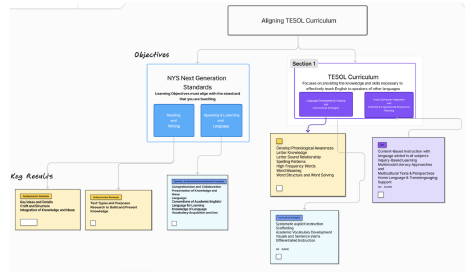
Jennifer Taranto: This was my first time creating a mind map. The assignment was to align NYS Next Generation Standards to the TESOL Curriculum. For aspiring ENL teachers, understanding how to align the NYS Next Generation Standards with TESOL instruction is crucial for delivering effective, meaningful, and legally compliant instruction. This alignment helps create an inclusive classroom where English learners can develop language proficiency while mastering grade-level academic content, ultimately setting them up for long-term success.

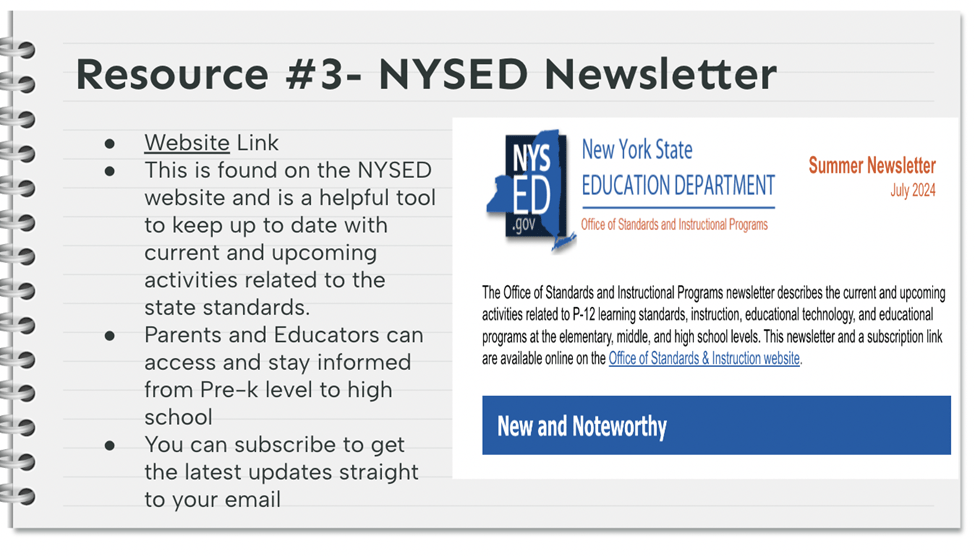
Jennifer Taranto: For this Padlet assignment in EDDN 635, I curated 9 favorite Tech tools. Each resource is broken down into descriptions, educational use, community engagement, and challenges. By completing this Padlet assignment, educators and students gain a well-rounded perspective on educational technology, learning how to leverage tech tools for student success, foster community connections, and navigate challenges. It is a valuable resource for future classroom integration and professional growth in a technology-driven educational landscape.

The Four-Part Functional Grammar Classification: A Practical Approach to Language Acquisition by Dr. Jasmin (Bey) Cowin

In the field of Second Language Acquisition (SLA), traditional approaches to teaching grammar often emphasize memorization of parts of speech and grammatical rules, without adequately connecting language structure to practical communication. My Four-Part Functional Grammar Classification infographic presents an alternative that transforms the conceptualization and teaching of grammar for language educators.

My framework shifts focus from viewing grammar as a set of abstract rules to understanding it as a functional system serving communication purposes. By categorizing grammatical elements according to their communicative functions rather than traditional parts of speech, my model creates a more intuitive approach to language learning and teaching. This aligns with contemporary methodologies like Task-Based Language Teaching (TBLT) and Communicative Language Teaching (CLT), prioritizing meaningful language use over memorization.

The model recognizes that languages vary in how they express grammatical relationships. Analytic languages such as Mandarin Chinese, Vietnamese, and to a significant degree English, rely primarily on word order, function words, and contextual cues to convey meaning. These languages exhibit minimal inflection, with words remaining relatively unchanged regardless of their grammatical roles. In contrast, synthetic languages like Latin, Russian, and Turkish employ morphological systems with prefixes, suffixes, and internal word changes to express grammatical relationships, allowing for flexibility in word order.

In my opinion, the framework accurately highlights how grammar operates in service of conveying ideas. It encourages learners to see language structures not as isolated rules but as tools for meaning-making. Such an approach can help students discern the interconnectedness of grammatical features and more readily apply them in authentic communicative contexts. However, as with any model, practical classroom application may require adjustments based on learners’ needs or language-specific nuances.

Each component serves a specific purpose:

  1. Terminal Elements comprise core lexical items that form the foundation of meaning in sentences. These include nouns, main verbs, and key adjectives—elements without which a sentence would lack substance. In the sentence “The dog runs,” “dog” (noun) and “runs” (verb) constitute the essential Terminal Elements carrying the fundamental meaning. Without either, the communicative purpose would be compromised.

2. Auxiliary Elements encompasses grammatical support structures that modify aspects of the Terminal Elements, such as tense, mood, voice, or aspect. These include helping verbs, modals, auxiliary verbs, and determiners. In “The dog has been running,” the auxiliary elements “has” and “been” create the present perfect progressive tense, adding temporal and aspectual information to the core meaning.

3. Modifiers consist of elements that refine or limit the meaning of Terminal Elements. These include adjectives, adverbs, participles, and modifying phrases. In “The small dog runs quickly,” the adjective “small” modifies the noun “dog,” while the adverb “quickly” modifies the verb “runs.” Modifiers enhance precision in communication without altering the fundamental meaning.

4. Connectors encompass relational elements that establish connections between words, phrases, or clauses. These include conjunctions, prepositions, and relative pronouns. In “I stayed home because it was raining,” the conjunction “because” establishes a causal relationship between two clauses, demonstrating how Connectors create coherence within and between sentences.

In implementing the Four-Part Functional Grammar Classification, educators can foster a deeper understanding of language by highlighting the interplay of its communicative elements. Instead of treating grammar as a discrete set of prescriptive rules, instructors integrate Terminal Elements, Auxiliary Elements, Modifiers, and Connectors into lesson designs that reflect authentic language use. This approach promotes increased learner engagement with meaning-making processes, as students actively observe how these functional categories intersect to convey nuanced ideas. By contextualizing grammar within real-world communication, educators encourage learners to perceive linguistic forms as interconnected tools that support coherent expression rather than isolated technicalities.

Moreover, the model’s applicability to both analytic and synthetic languages underscores its potential for unifying diverse linguistic backgrounds. Identifying functional similarities across distinct language systems can stimulate positive transfer, enabling learners to draw on their existing linguistic repertoires more strategically. Future pedagogical investigations may explore how this classification influences long-term language development, particularly in multilingual contexts where cross-linguistic awareness is vital. Emphasizing the functional essence of grammar aligns with contemporary SLA perspectives by foregrounding communication as the driving force behind language instruction, thereby challenging educators to replace traditional rule-based models with pedagogies that prioritize meaningful, context-rich engagement.

Touro University TESOL Candidate Ivelisse Martinez’s Technology Field Experience on Technology

Teaching English to Speakers of Other Languages

New York is a state that speaks many languages. We need teachers who can find the common ground.

The MS in Teaching English to Speakers of Other Languages (TESOL) Program helps NYS-certified PreK-12 teachers more effectively teach and communicate with a diverse student population.

Academically rigorous and practice-intensive, the 33-credit program includes 5-15 hours of fieldwork embedded in each course

The outlined field experience for EDDN 635 Curriculum Development and Classroom Management in the Technology Era is AI-resistant because it involves components that require direct human interaction, practical observation, and context-specific reflection that cannot be adequately replicated or performed by AI. Here’s a detailed breakdown of why this field experience ensures the authenticity of candidates’ engagement:

  1. Dual Observational Role
    Classroom Observation: Observing educators working with English Language Learners (ELLs) or bilingual students requires attention to the nuances of teaching strategies, classroom dynamics, and student interactions.
    Library Observation: Observing how technology supports literacy development in a library setting involves recognizing non-verbal interactions, how students engage with resources, and the librarian’s role—all tasks requiring human presence and contextual understanding.
  2. Interviews with ICT Specialists and Educators
    Conducting interviews demands human interaction skills, including the ability to ask follow-up questions, interpret verbal and non-verbal cues, and build rapport with interviewees.
    The responses gained from interviews are context-dependent and tied to the unique policies, practices, and challenges of the specific school or district, further grounding the experience in local realities.
  3. Reflection and Synthesis
    Reflection Paper: Writing a paper based on observations and interviews requires critical thinking, personal insights, and the ability to synthesize information from varied experiences. This process is inherently human and tied to individual perspectives.
    Multimedia Presentation: Creating a presentation involves selecting and interpreting data, integrating visuals, and crafting a narrative that demonstrates deep understanding. These tasks necessitate creativity and critical analysis unique to the candidate.
  4. Time Log and Deliverables
    Keeping a time log and taking observation notes are tasks tied to the candidate’s direct presence and engagement in specific activities. AI cannot generate authentic records of these experiences.
    The requirement for notes, interviews, and multimedia outputs ensures that the candidate participates actively and generates original content based on their unique experiences.
  5. Practical, Contextual Learning
    Observing technology use in real classrooms and libraries exposes candidates to the complex, real-world application of digital tools. This type of learning requires adaptability, contextual awareness, and the ability to assess practical challenge.
  6. TESOL and Digital Education Principles
    The experience aligns with principles of TESOL and digital education, emphasizing the strategic integration of technology to meet linguistic and academic needs. Candidates must demonstrate their ability to observe, analyze, and apply these principles in a practical, context-specific manner.

    The EDDN 635 field experience is rooted in direct, human-centric engagement with educators, students, and environments. It emphasizes real-world interaction, critical reflection, and contextualized learning—all elements that demand active participation and cannot be substituted with AI tools. The requirement for personalized insights and tangible deliverables ensures that candidates engage meaningfully, fostering skills and knowledge essential for their professional growth in TESOL and digital education.

Ivelisse Martinez has a bachelor’s degree in Education from Brooklyn College and is currently pursuing a master’s degree in TESOL at Touro University. She is passionate about empowering young learners, particularly those learning English as a second language. Inspired by her own teachers as a child, she sees a reflection of herself in many of her students, understanding firsthand the challenges and joys of learning a new language. As a former ELL, her goal is to inspire and support the next generation of learners on their educational journey.

Teaching is a way of giving back the inspiration and support you once received, guiding others to see their potential and know that every challenge is a stepping stone toward success.

Ivelisse Martinez, Touro University TESOL Candidate

Touro University TESOL Candidate Ivelisse Martinez’s Teaching Resources for TESOL Teachers

Teaching English to Speakers of Other Languages (TESOL) [MS]
We offer a Master of Science in TESOL appropriate for NYS-certified PreK-12 teachers interested in expanding their teaching fields to ESL or strengthening their capacities to serve a diverse student body. Evening, Sunday, and online courses are available.

Teaching English to Speakers of Other Languages

New York is a state that speaks many languages. We need teachers who can find the common ground.

The MS in Teaching English to Speakers of Other Languages (TESOL) Program helps NYS-certified PreK-12 teachers more effectively teach and communicate with a diverse student population.

Academically rigorous and practice-intensive, the 33-credit program includes 5-15 hours of fieldwork embedded in each course and at least 10 days or 50 hours of supervised student teaching experience. Candidates that complete all coursework, fieldwork, and student teaching requirements are eligible for recommendation for ESL certification.

Ivelisse Martinez holds a bachelor’s degree in Education from Brooklyn College and is currently pursuing a master’s degree in TESOL at Touro University. She is passionate about empowering young learners, particularly those learning English as a second language. Inspired by her own teachers as a child, she sees a reflection of herself in many of her students, understanding firsthand the challenges and joys of learning a new language. As a former ELL, her goal is to inspire and support the next generation of learners on their educational journey.

So far I have been able to observe in both an ENL pullout classroom and ENL push-in periods. I notice the difference between the teacher when she has access to her materials and room versus a push-in period where the room is shared with the classroom teacher.The teacher has to use various tools depending on the setting but one tool that stays consistent for instance is the use of the pocket talk. The pocket talk device allows the teacher to translate in real time, two way translation and access to 84 plus languages all in one small device. (Here is the link to the device Pocket Talk).”

“Teaching is a way of giving back the inspiration and support you once received, guiding others to see their potential and know that every challenge is a stepping stone toward success.

Ivelisse Martinez, Touro University TESOL Candidate

Touro University TESOL Candidate Zeynep Yildirim on Communicative Language Teaching

Teaching English to Speakers of Other Languages (TESOL) [MS]
We offer a Master of Science in TESOL appropriate for NYS-certified PreK-12 teachers interested in expanding their teaching fields to ESL or strengthening their capacities to serve a diverse student body. Evening, Sunday, and online courses are available.

Teaching English to Speakers of Other Languages

New York is a state that speaks many languages. We need teachers who can find the common ground.

The MS in Teaching English to Speakers of Other Languages (TESOL) Program helps NYS-certified PreK-12 teachers more effectively teach and communicate with a diverse student population.

Academically rigorous and practice-intensive, the 33-credit program includes 5-15 hours of fieldwork embedded in each course and at least 10 days or 50 hours of supervised student teaching experience. Candidates that complete all coursework, fieldwork, and student teaching requirements are eligible for recommendation for ESL certification.

Zeynep Yildirim: As a dedicated general education teacher, she is passionate about fostering an inclusive classroom where all students can thrive. Currently expanding her expertise in TESOL, she aims to better support English Language Learners and enhance their educational experience. Her goal is to integrate this specialized knowledge into her teaching practice to ensure every student has the opportunity to succeed.

As a professor, I am pleased to endorse her as an outstanding student whose dedication and skill set in supporting English Language Learners (ELLs) are exemplary. She demonstrates not only a strong foundation in analytical and practical skills but also deep insights into the unique needs of ELL students. Her commitment to her studies is matched by her drive to make a meaningful impact in the field. Her impressive ability to integrate theoretical knowledge with actionable strategies makes her exceptionally well-prepared to serve and advocate for ELLs, contributing to their academic growth and overall success. Our Touro University TESOL students are exceptional!

My journey at Touro College is more than academic—it’s a path of discovery, resilience, and dedication. Each day, I’m not just learning; I’m evolving, ready to bring meaningful change to the lives of those I teach.

Zeynep Yildirim, Touro University TESOL Candidate

MINI LESSON VIDEO LINK

Zeynep Yildirim’s Mini Lesson on Communicative Language Teaching