As an Associate Professor for the Touro University TESOL/BLE Department, I am immensely proud to feature outstanding student work from our MS in Teaching English to Speakers of Other Languages (TESOL) Program. New York’s linguistic diversity demands teachers who can find common ground and effectively communicate with students from different language backgrounds. Academically rigorous and practice-intensive, the 33-credit program leads candidates who complete all coursework, and fieldwork to recommendation for ESL certification.
BIO: Emily Georgoulakos is enrolled in the TESOL master’s program at Touro University. She is certified in General and Special Education from Birth to 6th grade. Emily teaches in a 1st-grade self-contained (15:1) classroom in a district with a diverse and inclusive population.
My journey at Touro University in the TESOL program has been a valuable and positive experience as I have been able to develop professionally and personally. I have been able to grow as an educator to support students of all cultural backgrounds and individual needs. I have significantly developed an understanding of the importance of culturally relevant education and environmental inclusivity. I can implement this into my future practices by creating a positive and welcoming environment and integrating students’ culture.
As an Associate Professor for the Touro University TESOL/BLE Department, I am immensely proud to feature outstanding student work from our MS in Teaching English to Speakers of Other Languages (TESOL) Program. New York’s linguistic diversity demands teachers who can find common ground and effectively communicate with students from different language backgrounds. Academically rigorous and practice-intensive, the 33-credit program leads candidates who complete all coursework, and fieldwork to recommendation for ESL certification.
Touro University has made it possible for me to be a full-time educator while also pursuing my master’s degree. The professors in the Touro GSE have been accommodating, knowledgeable, and incredibly helpful in my teaching journey, and I look forward to continuing my master’s degree.
Understand the significance of content, process, and product differentiation. Modify an existing content lesson plan YOU delivered to ELL/ML students: Integrate proactive adjustments based on student readiness, interest, and learning profiles.
Discuss anonymized student products as tangible evidence of differentiation in assessment. These products should align with differentiation principles, taking into account students’ readiness, interests, and learning profiles.
Align the assignment with the provided assessment criteria and integrate concepts and practices from “Classroom Practices for Multilingual Learners and English Language Learners” and “The Next Generation English Language Arts Learning Standards”
I was struck with the authentic reflection of Baily Konen:
“After teaching this lesson and differentiating it for my ELL/ML students, I’ve realized that some of my practices that I have used in the past may not have been appropriate for my English Language learners. It is important for educators to understand that their ELL/ML students can all learn in different ways, and that often it’s not that the student does not understand, but rather that they were never put in a position to succeed from the beginning of the lesson. It is not fair to expect a student that is a fluent English speaker and a student that is an emergent English Language learner to be able to complete the same academic tasks during a lesson.”
Bio: Bailey Konen is a graduate student at Touro University and a teacher in a Long Island school district. He completed his undergraduate degree at the State University of New York at Geneseo with a Bachelor of Science in Childhood/Early Childhood Education. B has always had a passion for working with children and is constantly trying to learn more about how he can help all of his students succeed.
As a Professor for TESOL, I am immensely proud to feature outstanding student work from our MS in Teaching English to Speakers of Other Languages (TESOL) Program. New York’s linguistic diversity demands teachers who can find common ground and effectively communicate with students from different language backgrounds. Academically rigorous and practice-intensive, the 33-credit program includes 50 hours of fieldwork andsupervised student teaching experiences. Candidates that complete all coursework, fieldwork, and student teaching requirements are eligible for recommendation for ESL certification.
Alexandria Galvez is a first-year teacher leading a bilingual 1st-grade classroom. She is glad to have the opportunity to work with English Language Learners and finds herself learning from them every day. Her time at Touro has been marked by the acquisition of valuable knowledge regarding effective strategies for classroom use. Her favorite quote: “The capacity to learn is a gift; the ability to learn is a skill; the willingness to learn is choice.” -Brian Herbert
Differentiated Instructional Activity Assignment
In this assignment, teachers of English Language Learners (ELL) or Multilingual Learners (ML) will explore and implement differentiated instructional activities to maximize the learning of every student in their class. Using the provided Tools for High-Quality Differentiated Instruction: An ASCD Action Tool, teachers will modify an existing content lesson plan to incorporate differentiation strategies in various aspects of instruction. The assignment requires the submission of a paper including the original and differentiated lesson plans, along with all materials, and a 2-4 minute video showcasing one specific aspect of a differentiated instructional activity. The assignment aims to facilitate professional growth and reflection on implementing differentiated instruction.
As I reflect on my completion of the Differentiated Instructional Activity, I am now more aware of my own strengths in terms of recognizing what works for me as the educator and strategies that work for English Language Learners in order to differentiate. For example, using whiteboards as a way to quickly assess student understanding is an engaging hands-on strategy that students enjoy using because it is considered “fun” instead of using regular pencil and paper.
Alexandria Galvez, Touro University TESOL Candidate
As a Professor for TESOL, I am immensely proud to feature outstanding student work from our MS in Teaching English to Speakers of Other Languages (TESOL) Program. New York’s linguistic diversity demands teachers who can find common ground and effectively communicate with students from different language backgrounds. Academically rigorous and practice-intensive, the 33-credit program includes 50 hours of fieldwork andsupervised student teaching experiences. Candidates that complete all coursework, fieldwork, and student teaching requirements are eligible for recommendation for ESL certification.
In this assignment, teachers of English Language Learners (ELL) or Multilingual Learners (ML) will explore and implement differentiated instructional activities to maximize the learning of every student in their class. Using the provided Tools for High-Quality Differentiated Instruction: An ASCD Action Tool, teachers will modify an existing content lesson plan to incorporate differentiation strategies in various aspects of instruction. The assignment requires the submission of a paper including the original and differentiated lesson plans, along with all materials, and a 2-4 minute video showcasing one specific aspect of a differentiated instructional activity. The assignment aims to facilitate professional growth and reflection on implementing differentiated instruction.
I am proud to showcase the outstanding work of Touro University TESOL candidate Samantha Howe on the Differentiated Instructional Activity Assignment in my blog. Her commitment to enhancing the learning experiences of English Language Learners and Multilingual Learners through tailored instructional strategies has been remarkable. The thoughtfulness, creativity, and dedication she demonstrated while modifying her lesson plan and crafting her reflection exemplify her potential as a future TESOL educator who prioritizes inclusivity and student-centered learning.
The TESOL program at Touro University has already provided me with valuable insights and necessary tools to better support my multilingual students.
Samantha Howe, Touro University TESOL candidate
Touro University TESOL candidate Samantha Howe is a 5th-grade teacher from Long Island. After receiving her bachelor’s degree in inclusive childhood education, she was accepted into the TESOL program at Touro University. She is passionate about providing an inclusive and equitable education for all students.
Course Description This course provides an understanding of basic linguistic concepts and their applications for TESOL instruction. Students will be introduced to the essential concepts of language development and modern linguistic components that are relevant to first and second language pedagogy. Specific concepts include: phonetics, phonology, morphology, semantics, syntax, pragmatics, discourse analysis, and the nature of regional and social variations in English and the relationship between dialects and ethnic identity. Students will explore the origins, diversity, and functions of human languages, in addition to the relationship between language and society. Students will also study key concepts of sociolinguistics in order to gain a solid understanding of the social and cultural dimensions of language. Includes 10 hours of fieldwork. 3 credits
Marie-Nansie Victor’s personal introduction: My name is Marie-Nansie Victor. I immigrated to the United States from Haiti about two decades ago. I am married and blessed with four children. Currently, I work as a paraprofessional for the New York City Board of Education. I received an associate degree in Liberal Arts from Kingsborough Community College, and I went to York College where I graduated with a bachelor’s degree in French. I am now working toward an Advanced Certificate in TESOL at Touro College after completing a master’s degree in Early Childhood Education (General and Special Education.) Even though I have a busy life between work, school, and family, I manage to find time for some of my favorite hobbies like cooking, baking, and reading. With the help and support of my instructors, I successfully complete all my assignments. Soon I will be working as a teacher. I have a passion for teaching, and I hope to inspire all my students.
Michele Goldin is an Assistant Professor of Bilingual Education and TESOL at Touro University Graduate School of Education. She received her Ph.D. in Bilingualism and Second Language Acquisition from Rutgers University. Her research broadly focuses on child bilingualism. As a heritage speaker of Spanish herself, she strives to increase our understanding of bilingual development with direct implications for successful academic outcomes, language policy and pedagogy, as well as bilingual and dual-language education.
Difficult Words for Multilingual Learners
First, I will divide the class into four heterogeneous groups, and each group will discuss one of the words written on a different color card. Then a member of the group, most likely an ELL, will share with the class, while the other members will assist and support him/her.
Touro University’s Graduate School of Education Advanced Certificate in TESOL Candidate Marie-Nansie Victor
As the TESOL Practicum Coordinator it is always exciting to showcase Digital Portfolios for EDDN 680.
Project Description
The purpose of creating and maintaining an electronic portfolio is for Touro TESOL/Bilingual teacher candidates to reflect on their course of study at Touro College and create a digital repository of their work done during the program. The portfolio includes a statement of the teacher candidates’ goals, philosophy of education, and files which showcase the candidates best work.
Touro College TESOL faculty Dr. Ching-Ching Lin who prior to her Touro appointment, taught Social Studies (both general education and Chinese-bilingual) and ESL at the secondary levels for more than 14 years. As a transnational and multilingual learner herself, she embraces asset-based approaches and additive multilingualism in instructional designs. Her goal as a teacher as well as a teacher educator is to build and support a classroom environment where diversity in thought, culture, and traits is viewed as positive assets, where ample opportunities are created for students to share their learning experiences, strengths, backgrounds, interests, and needs and where real life/authentic connections and representations from diverse cultures and life experiences are deeply interwoven into student-centered cooperative learning.
Ms. Amanda Innamorato teaches at the elementary level for the NYC Department of Education in District 21. She got her Bachelor’s Degree in Childhood Education from St. Francis College and worked on getting her Masters in TESOL at Touro College. Her goal as a teacher is to support all students in reaching their individual goals. Ms. Innamorato wrote:
Looking at my graduation cap it reads “teaching is a work of heart.” This quote resonates deeply because teaching is not just a job, it’s a game changer. A teacher’s impact is significant to each individual student in their classroom. This leads to my first belief which is in the theory of Asset Approach to Learning. Students need to be viewed as an asset to the classroom with individual strengths and diverse cultural backgrounds.
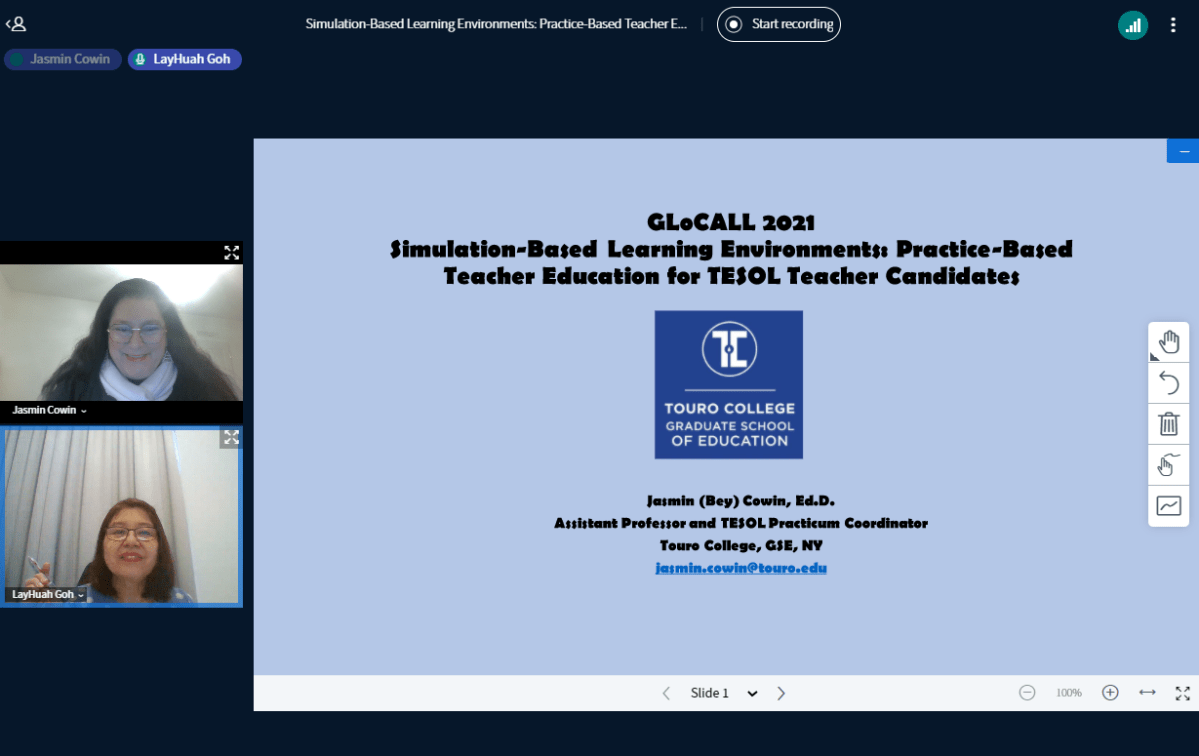
It was a great pleasure to present today my research on “Simulation-Based Learning Environments: Practice-Based Teacher Education for TESOL Teacher Candidates” at the GLoCALL 2021 Conference. My presentation and research focused on reviewing, contrasting, and framing two different virtual training environments for TESOL educators searching for additional opportunities to offer interactive field and practicum experiences: simSchool and Mursion.
What is GLoCALL 2021?
GLoCALL 2021 is an international academic conference focused on the use of computer technology for language learning (CALL). GLoCALL conferences have been held annually since 2007 in various countries across Asia. When is GLoCALL 2021? The GLoCALL 2021 conference will be held 16th-18th December 2021. The GLoCALL 2021 conference is held online with online sessions presented via the website.
Plenary and Invited Speakers
Every GLoCALL conference features plenary presentations and workshops by internationally renowned CALL experts. This year the invited speakers are:
Dr. Wong Su Luan (Universiti Putra Malaysia)
Dr. Deborah Healey (University of Oregon, USA)
Dr. Mark Pegrum (University of Western Australia)
Dr. Pramela Krish (Universiti Kebangsaan, Malaysia)
Prof. Gordon Bateson (Kochi University of Technology, Japan)
The Touro College TESOL/Bilingual Program course EDPN-673 – Methods and Materials for Teaching English as a Second Language provides a historical overview of second language acquisition theories and teaching methods. Students learn how to apply current approaches, methods, and techniques, with attention to the effective use of materials, in teaching English as a second language. Students engage in the planning and implementation of standards-based ESL instruction which includes differentiated learning experiences geared to students’ needs. Emphasis is placed on creating culturally responsive learning environments. Includes 15 hours of fieldwork.
One assignment is the Materials Critique & Redesign where candidates will: (1) prepare a written critique description of the material or resource, analyzing its effectiveness for ELLs and (2) based on your analysis, redesign one section/activity of the original material so that it meets the need of ELLs. The materials chosen will promote culturally and linguistically responsive classrooms and instructional practices.
Ashley Cosenza:
Touro TESOL/Bilingual candidate Ashley Cosenza submitted an exemplary project. She is receiving her Master’s degree in Teaching English as a Second Language in Spring 2022. She is in her second to last semester at Touro College with Professor Cowin. Ms. Cosenza, “I enjoy learning different strategies to include in my 5th-grade classroom for students to learn the English language. It is important to me to deliver each lesson in such a way to captivate ELLs in each subject.”
Dr. Al Ghurbani, Sana’a, Yemen and I were honored to present at the conference “Fulbright at 75: Celebrating a Legacy of Global Friendships.”
“For 75 years, the Fulbright Program has engaged passionate and accomplished students, scholars, artists, teachers, and professionals of all backgrounds. We believe that by living and learning together with people from different countries and cultures we can shape a more positive vision for our communities and our world. A hallmark of the Fulbright Program has been its longstanding commitment to Diversity and Inclusion (D&I). We strive to ensure that Fulbright reflects and values the diversity of U.S. society and societies. Equally important to diversity is inclusion. Fulbright takes steps to ensure that the Program’s diverse participants have successful and rewarding exchange experiences.” US Fulbright Program – Diversity & Inclusion (fulbrightonline.org)