Please join us to learn about Touro College Graduate School of Education’s Open House for TESOL and Bilingual Certification


Please join us to learn about Touro College Graduate School of Education’s Open House for TESOL and Bilingual Certification
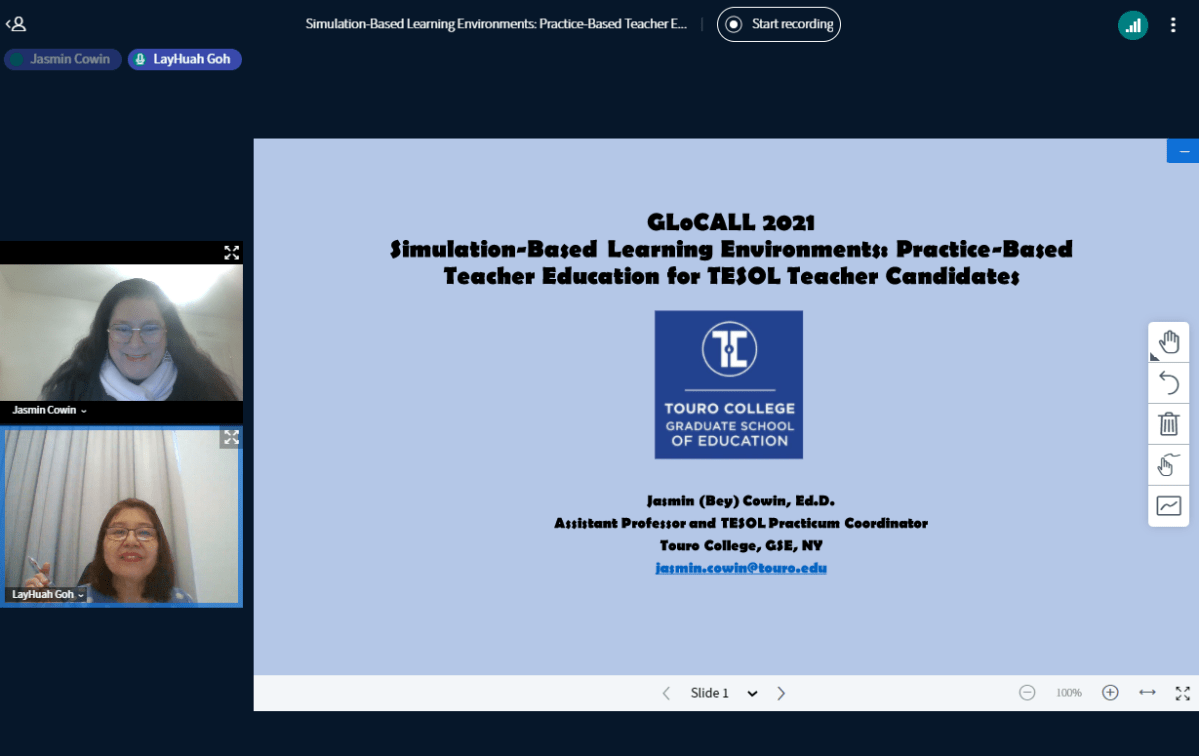
It was a great pleasure to present today my research on “Simulation-Based Learning Environments: Practice-Based Teacher Education for TESOL Teacher Candidates” at the GLoCALL 2021 Conference. My presentation and research focused on reviewing, contrasting, and framing two different virtual training environments for TESOL educators searching for additional opportunities to offer interactive field and practicum experiences: simSchool and Mursion.
What is GLoCALL 2021?
GLoCALL 2021 is an international academic conference focused on the use of computer technology for language learning (CALL). GLoCALL conferences have been held annually since 2007 in various countries across Asia. When is GLoCALL 2021? The GLoCALL 2021 conference will be held 16th-18th December 2021. The GLoCALL 2021 conference is held online with online sessions presented via the website.
Plenary and Invited Speakers
Every GLoCALL conference features plenary presentations and workshops by internationally renowned CALL experts. This year the invited speakers are:
The Touro College TESOL/Bilingual Program course EDPN-673 – Methods and Materials for Teaching English as a Second Language provides a historical overview of second language acquisition theories and teaching methods. Students learn how to apply current approaches, methods, and techniques, with attention to the effective use of materials, in teaching English as a second language. Students engage in the planning and implementation of standards-based ESL instruction which includes differentiated learning experiences geared to students’ needs. Emphasis is placed on creating culturally responsive learning environments. Includes 15 hours of fieldwork.
One assignment is the Materials Critique & Redesign where candidates will: (1) prepare a written critique description of the material or resource, analyzing its effectiveness for ELLs and (2) based on your analysis, redesign one section/activity of the original material so that it meets the need of ELLs. The materials chosen will promote culturally and linguistically responsive classrooms and instructional practices.
Ashley Cosenza:
Touro TESOL/Bilingual candidate Ashley Cosenza submitted an exemplary project. She is receiving her Master’s degree in Teaching English as a Second Language in Spring 2022. She is in her second to last semester at Touro College with Professor Cowin. Ms. Cosenza, “I enjoy learning different strategies to include in my 5th-grade classroom for students to learn the English language. It is important to me to deliver each lesson in such a way to captivate ELLs in each subject.”
What is GLoCALL 2021? GLoCALL 2021 is an international academic conference focusing on the use of computer technology for language learning (CALL). GLoCALL conferences have been held annually since 2007 in various countries across Asia.
When is GLoCALL 2021? The GLoCALL 2021 conference will be held 16th-18th December 2021. Details of important dates are listed on the Important dates page.
Where will GLoCALL 2021 be held? The GLoCALL 2021 conference will be held online with online sessions presented via the website.
Abstract
Simulation-Based Learning Environments: Practice-Based Teacher Education for TESOL Teacher Candidates
Jasmin (Bey) Cowin, Ed.D.
Touro College, GSE
Post-pandemic, teacher education programs across the globe are searching for alternative pathways addressing practicum and fieldwork completion for teacher candidates. Simulation-based learning (SBL) with emotionally intelligent student avatars no longer seems a futuristic endeavor. Organizations focusing on medicine, nursing education, aviation, corporate work safety training, and the military have used simulations for years, enabling trainees to make decisions based on best industry standards through practice in virtual environments. With the growing diverse population in US schools, it is essential for Teaching English as a Second Language (TESOL) teachers to practice incorporation of culturally responsive pedagogy and providing a safe environment for English Language Learners (ELLs). This presentation focuses on reviewing, contrasting, and framing two different virtual training environments for TESOL educators searching for additional opportunities to offer interactive field and practicum experiences: simSchool and Mursion. The presentation and paper will identify, illustrate, and interpret practice-based teacher education (PBTE) and SBL. PBTE illustrates high-level teaching practices, with a specific focus on situated context of use. A PBTE model in SBL can engage TESOL teacher candidates in task-based approaches and help candidates to solidify their knowledge of the distinctions between teaching approaches, methods and techniques.
Keywords: Simulation-based learning, practice-based teacher education, simSchool, Mursion, practice-based teacher education, avatars, practicum.
Dr. Al Ghurbani, Sana’a, Yemen and I were honored to present at the conference “Fulbright at 75: Celebrating a Legacy of Global Friendships.”
“For 75 years, the Fulbright Program has engaged passionate and accomplished students, scholars, artists, teachers, and professionals of all backgrounds. We believe that by living and learning together with people from different countries and cultures we can shape a more positive vision for our communities and our world. A hallmark of the Fulbright Program has been its longstanding commitment to Diversity and Inclusion (D&I). We strive to ensure that Fulbright reflects and values the diversity of U.S. society and societies. Equally important to diversity is inclusion. Fulbright takes steps to ensure that the Program’s diverse participants have successful and rewarding exchange experiences.” US Fulbright Program – Diversity & Inclusion (fulbrightonline.org)
Context and Overview
The focus in the Touro TESOL course EDDN 637 Second Language Learners and the Content Areas is on practicing effective approaches, methods, and strategies for teaching and evaluating English language learners in the content areas (ELA, social studies, math and science). Teacher candidates are required to design a sheltered instruction lesson following the Sheltered Instruction Observation Protocol (SIOP) Model, a research-based and validated instructional model that has proven effective in addressing the academic needs of English learners throughout the United States. Candidates need to explain how and why they’ve decided on the specific lesson content and language needs to be addressed. Activities focus on assessing student needs before, during and upon lesson completion to enhance future instructional planning. An outstanding SIOP lesson plan was submitted by Touro TESOL candidate Eva Sipe.
Eva Sipe, a 3rd Grade NYC Public School Teacher in Brooklyn, NY, has taught Special Education since 2005 and taught English Language Learners since 2016. She received her Undergraduate Diploma and Master’s Degrees in Comparative Religions and Philosophy at the Catholic University of Lublin in her native country, Poland. She received her Dual Master in General and Special Education from Touro College and her Advanced TESOL Certificate from Adelphi University. She is currently pursuing an Advanced Certificate in Bilingual Education at Touro College to better serve the bilingual population of students at her school.

As a Professor preparing my teacher candidates for the 21st Century technology integration comes up often. Yet, what does that really mean? For the EDDN 636 Linguistic Structure of the English Language, I had my teacher candidates complete a project: design an infographic and incorporate this into their required SIOP lesson plan. My candidate Evelyn Ramos delivered an innovative, well designed bilingual infographic. Once she laminated it and used it in her class, several other teachers in her school approached her to also receive a copy for themselves. In addition, her students now want to create their own infographics.
Evelyn Ramos: I am a Brentwood High School graduate and graduated 11 out of my class of 450 with honors in 2009. I started my bachelor’s degree in Queens College and later transferred to SUNY College at Old Westbury earning a dual bachelor’s degree in Adolescence Education Spanish (7-12) and Spanish Language, Hispanic Literature and Culture; I graduated in 2016 with Cum Laude honors. My teaching career started two years ago in 2017 at Brentwood Union Free School district as a bilingual language teacher. Currently, I am teaching Home Language Arts to 7th & 8th graders at East Middle school, choosing to return to Brentwood to give back to the community that gave so much to me. I started my graduate degree at Touro College, TESOL and Bilingual Department in 2017 and will graduate in June 2020 with a Master’s degree in TESOL. I have accomplished all this being a mother to two beautiful girls, a wife, daughter, and granddaughter.
Evelyn Ramos EDDN 636 Infographics
The target audience for this project are 7th grade ELA/ENL class. Students are in a Bilingual/ENL program. Class size is 18 students; 10 students are transitioning and 8 are emerging. The class is a stand-alone ENL/ELA class. Students receive two 45-minute periods of ELA/ENL.
The topic of the infographic using the different parts of speech: Noun, Verb and adjectives. There will be a focus on using adjectives to describe people and place using color, size and appearance.
The intended learning outcomes for this project are the following:
Students will be able identify adjectives orally and label the parts of speech in a sentence. Students will be to write a description of a monster or spooky place using adjectives. Students will be able to identify an adjective in a sentence. What type of infographic will you create (comparison, flow chart, timeline, etc.)?
The infographic I created is a flowchart to help the information flow one from another.
At first it was hard to choose a background because I did not want to a background or template that had to much. I choose bright colors and the color code I will be using in my lesson is a color code used within my department to teach the parts of speech. Blue for nouns, green for verbs and red for adjectives. I also used different fonts for each part of speech. As I introduce the different groups of adjectives, I used a different font for each but kept the color red to show that they are all adjectives. When it came to the writing, I kept it simple and comprehensible for my ELL learners. I also used pictures that provided clear written and visual examples of each topic mentioned. I also translated the infographic into Spanish.
The infographic allows students to review the parts of speech. Students need to understand how each part of speech is used in a sentence. Learning the basic parts of speech will help ELLs in their writing. Students do not only see parts of speech in ELA, this is a concept that will be used throughout all content areas and across curriculum.
I really enjoyed creating my infographic. On a pedagogical point of view, infographic is great to use with all learners, especially ELLs. They are effective because you are able to provide the content in written form with visuals packing the big ideas into a small space. Students will become engaged in learning with this mean of presentation. An infographic presents information in a compelling way that catches the learner’s eye. Also, infographics are much easier to read and follow. This allows for information to be more comprehensible to the learner. Students will be able to retain the information easily because it captures their attention and none of their teachers are using infographic in the classroom. Allowing the students to create their infographic in class would be a way to incorporate technology and in the classroom. However, making an infographic can be challenging and time-consuming. Creating an infographic can be an end of the unit project. I am able to use the infographic in a bilingual classroom by creating the graph in both languages. By providing a translated version to an Entering or emerging students I am scaffolding the content to meet their needs.
I learned that using a digital resource limit the amount of copies needed in the classroom. The infographic can be displayed on the smart board. Shared with the students through remind or class dojo. Also, I am able to share the infographic not only with my students but my parents and colleagues. The resources are endless. Students really love and enjoy using infographics.


 Touro
 TESOL Candidate Evelyn Ortiz is a certified bilingual teacher (Spanish speaking) working in the Wyandanch school district. She has worked for more than three years as a third-grade bilingual teacher in Wyandanch. Ms. Ortiz states that: “I love working with ENL, CLD students and I pursuing my master’s in TESOL at Touro College so that I can better support my students with new strategies and methods.”
The assignment guidelines: Infographics
CAEP: Standard 1: CONTENT AND PEDAGOGICAL KNOWLEDGE 1.5 Providers ensure that completers model and apply technology standards as they design, implement
and assess learning experiences to engage students and improve learning; and enrich professional practice. CAEP
For this assignment, you will create an infographic for a specific group of learners (your audience). I highly recommend that you create your infographic for the learners that you are currently teaching, or typically teach. You will know more about this group than other groups of learners and are likely to have an easier time designing instruction for them.
Here Ms. Ortiz’s assignment submission and infographic:
Infographic Documentation
The intended audience for this infographic are parents. In the Wyandanch school district we have both Bilingual education and ESL education. I think that it is important for parents to know the differences between the two programs so that there aren’t any misconceptions for the program expectations that their child may be enrolled in.
The infographic created falls into the category of educational. It can also be a compare/contrast infographic.
I decided to include bullet points of sentences so that the information is short and concise.
5. What design decisions did you make in terms of: Text – font, colors, white space, and so on – I chose three different fonts: Oswald, Arvo and Advent Pro Medium. The top of the page there is white margin and then there are two colored columns, the left side is magenta and the right side is purple. The left side has font colors in yellow, white and black. The right side has font colors in light blue, white and black. The left side represents Bilingual Education and the right side represents ESL education.
Text reduction – how did you translate text into a graphic form? I took the most important points and created short and simple sentences and organized it by bullet points.
Color – The main background color is magenta and purple. The fonts are yellow, light blue, black and white.
Pictures/graphics – I chose a picture of child that is surrounded by educational images. The child looks happy and excited. The books below her say “never stop learning” on the bind. I like that there is a clock, a globe and a lightbulb in the background. The clock represents time, the globe represents diversity and the lightbulb represents innovative ideas and learning. There is also a question mark and a music symbol. The students should be curious with their learning and encouraged to ask and answer questions to gain a better understanding of academic content and the world around them. The music symbol represents harmony and music. The students can learn content through rhythm and music.
The pedagogical benefits of creating and using infographics and that it can be used to summarize a topic. The infographic can be used to organize information that makes it more meaningful and comprehensible to understand. The audience is able to get the gist of a topic and learn important facts by reading an infographic. Infographics are also very colorful and can be a visual aid to comprehend a topic. Not only can an infographic be used to education, it also could be used to persuade and used for advertisement. Infographics can also be incorporated into the classroom, especially at the Middle School and High School level. I chose to give the students at the HS level during my practicum hours, an infographic to represent what they have learned about the topic, which was Selena.
Some of the challenges of using infographics is that it is sometimes difficult to compact the information into a one page infographic. In addition, creating an infographic is not difficult however, people who are not tech-savvy may find it a bit challenging to create one at first. When I assigned an infographic as an assignment I had to show the students step by step how to sign in, edit text/images and how to choose a template. The beginning stages takes a lot of patience but then it eventually gets easier to create. The activity may be challenging but the students eventually enjoyed it.
I learned that teaching with digital content could be appealing to the intended audience. Looking at an infographic can be more captivating than looking at a worksheet of information. An infographic can be accompanied with visuals and the most important points and or information which would not be overwhelming for ELLs.
I might use this infographic with parents and colleagues. There are parents who believe that their student is a bilingual program that is an additive or maintenance program when indeed, it a transitional program. The priority of the program is to get the students to “test out of bilingual” program which means to get them to reach commanding. Many students who do not have phonics base in Spanish do not get the opportunity to build those skills in their native language, the goal is to start in English even though there is evidence to support the idea that teaching both may aid L2 acquisition. By the third to fifth grade, it is difficult to start teaching them sight words and phonics in their language when they have entered such a rigorous grade. The parents think that the bilingual program teaches Spanish, however, we teach content in Spanish it is not intended to build them up from scratch like the dual language and or two-way program does.
References
YourDictionary. (2016, June 2). ESL vs. Bilingual Education. Retrieved from https://esl.yourdictionary.com/about-esl/esl-vs-bilingual-education.html.
Many experts on student-centered online learning agree that the discussion board is the place where some of the most important learning can happen. Robust Discussion Board contributions not only show an engagement with the material read but also analysis and reflection. This requires thoughtfully crafted questions by facilitators for candidates to respond to.
Many experts on student-centered online learning agree that the discussion board is the place where some of the most important learning can happen. Robust Discussion Board contributions not only show an engagement with the material read but also analysis and reflection. This requires thoughtfully crafted questions by facilitators for candidates to respond to.
Marissa Leis is a graduate student at the TESOL program at Touro College. “My goal is to continue my education to get new strategies to better assist my students in a forever changing world.”
Understanding Second Language Acquisition by Lourdes Ortega – Class Discussion for Chapter 3: Cross-linguistic Influences
From reading Ortega and thinking about your own experience/observations as a teacher and a learner, how can an L1 negatively influence an L2 (e.g., L1 Mandarin Chinese and L2 English)? What about the other way around (e.g., L1 English and L2 Mandarin Chinese)? Are there any interesting asymmetries? (The Contrastive Analysis Hypothesis would predict reciprocal influences.) In your written response, please choose two languages to exemplify your discussion.
A way in which Mandarin Chinese can negatively influence English would be in writing. In Chinese, there are different characters used that can sometimes represent more than one letter which is different from how we write in English.
From reading Ortega and thinking about your own experience/observations as a teacher and a learner, how does L1 positively influence L2 (e.g., L1 Arabic and L2 English)? What about the other way around (e.g., L1 English and L2 Arabic)? Are there any interesting asymmetries? (Contrastive Analysis Hypothesis would predict reciprocal influences.) In your written response, please choose two languages to exemplify your discussion.
From my experience, L1 has positively influenced L2 in the sense that both languages require a noun and a verb. This basic knowledge of sentence structure is beneficial when learning a new language because it gives you a simple template to create sentences. This, depends on the language. I can only speak for learning Italian. I know that other languages have different sentence structures.
The text explains the differences between learning pronoun placements in French and English. Someone learning English rarely shows difficulty learning this placement however it is the opposite when learning French if you are a native English speaker. “By contrast, for L1 English learners of French, the learning of what is essentially the same difference but in the opposite direction poses much more difficulty, and the error Je vois les is indeed attested.” (Ortega 32) The reason for this is in fact similarities of the two languages that causes the confusion. Since the languages are similar, this leads to misconceptions.
What other issues, such as language universals, complicate crosslinguistic influence? And how is it that sometimes, even if negative transfer occurs, it does not result in ungrammaticality? Please give examples to support your claims.
When a language is similar in the way the words are arranged, this can cause confusion and misconceptions which leads to a hindrance in learning the language. Language universals can also complicate language acquisition. They can also lead to new learnings about L1. “There are also attested occasions where the benefits accrue from rather abstract similarities, as when a grammatical category in the L1 sheds light on a different grammatical category in the L2, thus facilitating the discovery and learning of the new category.” (Ortega 43) If a student is learning about grammatical likeness in L1 and L2, this can result in the student learning more about their native language and the rules.
Even if a negative transfer occurs, this does not always result in ungrammaticality because students sometimes remember the sentence structures. If they are pronouncing a word incorrectly, it does not affect the grammar of the sentence.
How can understanding these phenomena better inform our understanding of cross-linguistic influence? Please give examples to support your claims.
Understanding these phenomenons can help me in my teaching methods. Before reading this chapter I thought that having a language that is similar in its grammatical form will cause the language to be more easily understood and acquired. After reading this chapter, I realized that this can actually have the opposite effect. When instructing students, I will first become acquainted with their native language and focus on the similarities and differences. For similar characteristics, I will point out how English is similar and the small ways in which it may be different. I will focus my Sheltered Instruction curriculum around these issues and common misconceptions. If I know that in French the pronoun comes before the verb, then I will work on questions techniques in my lesson. I will gear my lessons so that they revolve around these techniques.
What do you think of Michael Long’s Interaction Hypothesis? What type(s) of corrective feedback do you use the most, do you think that is the best to use? How does this affect your students?
According to Michael Long’s Interaction Hypothesis, language learners learn from comprehensible input which requires them to determine and draw meaning from interactions. I believe that this is beneficial for language learners. When learning something new, it is important to understand the meaning of what you are doing or saying. This promotes a deeper understanding and will allow the learner to remember what they are learning. A comparison of this would be when one is learning math. If the math problem is on paper, a student may be able to do it. When the time comes for the student to generalize the information and execute it to a real-life situation, it may be more difficult. When the student is allowed to perform the math problem a few times during a real-life situation such as measuring the perimeter of a yard to buy fencing, this will create a true and deeper understanding that the student will remember long term. The same goes for learning language. If a student is studying vocabulary words on flash cards, they may remember the words temporarily. If students are spoken to and are required to find out the meaning of a sentence, they will most likely have a long-lasting understanding of the information.
A way to use this with the students is to repeat a sentence in L2 and allow the student to interpret the meaning of the sentence along with the vocabulary that is used. A method that is effective is TPR. (Total Physical Response) This method allows students to use their whole body to act out words and phrases that create a lasting impression. As a teacher, I can recite actions and phrases in L2 and have the students act out the action after I model it.
Work Cited:
Ortega, L. (2009). Chapter 1-3: Introduction. In Second Language Acquisition (pp. 1–50). New York, NY: Hodder Education.
Assignment Purpose TESOL STANDARD 3: PLANNING AND IMPLEMENTING INSTRUCTION 3.e. Candidates use and adapt relevant materials and resources, including digital resources, to plan lessons for ELLs, support communication with other educators, school personnel, and ELLs and to foster student learning of language and literacies in the content areas. Analysis and implementation into teacher practice of websites specific to TESOL Field.
Lissette Lara earned her Bachelor Degree from City College of New York in Bilingual Childhood Education. Currently, she pursues her Masters in TESOL at Touro College. This is her third year teaching 5th grade in a bilingual class.
Assignment Purpose TESOL STANDARD 3: PLANNING AND IMPLEMENTING INSTRUCTION 3.e. Candidates use and adapt relevant materials and resources, including digital resources, to plan lessons for ELLs, support communication with other educators, school personnel, and ELLs and to foster student learning of language and literacies in the content areas. Analysis and implementation into teacher practice of websites specific to TESOL Field.
Lissette Lara’s website collection and description for classroom activities:
Website – Go Noodle – https://app.gonoodle.com/
This website provides SEL and Mindfulness, Sensory and Motor Skills, Curricular, School Life videos that usually last about two to four minutes. These videos require exercising or dance and sing along with the songs. Or help the students with skip counting are reading strategies. The students can take a yoga or breathing break. Gonoodle offers kids an opportunity to act silly or learn the coping skills they need in life. The bottom line is that it helps the students relax and focus on classroom lessons. “The benefits of physical fitness and relaxation on learning are well documented, and GoNoodle provides teachers with a fun, interactive way to get students moving” (Common Sense Education). One of the weaknesses of Gonoodle that if you don’t have steady internet connection it won’t work.
I use these videos early in the morning when students arrive from lunch or any time the schools need a mental break. When I play the videos, I turn on the closed caption so that my ELL are able to read along with the song. I have also noticed that this helps them understand what is being said. After several times of listening to the song, they can sing along with the song. I believe this activity helps students because they practicing different parts of language such as speaking, reading and listening. It is stated that “watching short videos on art, music, dance, science or other relevant themes reciting rhymes, jokes, and poetry using music, rhythm, songs, tongue twisters, or a mnemonic device that reinforces the meanings of challenging words” help develop language skills for Entering and Emerging students (Best Practices for Teaching ESL: Speaking, Reading, and Writing). These practices are beneficial for all students who would need to take The New York State English as a Second Language Achievement Test (NYSESLAT) because there are listening and speaking components on the test.
Flocabulary – https://www.flocabulary.com/
Flocabulary is one of the websites I use the most in my classroom. Flocabulary videos are “hip-hop videos and creativity tools give teachers new ways to captivate students while engaging them in academically rigorous content” (Flocabulary.com). The website includes learning videos in different areas of content. Teachers can find lessons on math, reading, writing, science, social students and vocabulary content. These videos are a great tool to connect with prior knowledge or to reinforce topics covered in class. Along with the video lesson, the website a list of vocabulary, a reading passage related to the video lesson and lyrics to the songs, which could be printed for students.
I utilize these videos during my lesson to build understanding or connect with students’ prior learning. For example, in 5th grade, our first unit in math is place value. The student have prior experience with place value (one, tens, hundreds, thousands…) but not right of the decimal (tenths, hundredths thousandths). Before my lessons, I would hand out the vocabulary words to my ELL and struggling students, review with them to ensure they understand. Then I would play the video reinforcing what I just taught my small group students. By using these strategies of pre-teaching vocabulary, I’m setting up my students for success. “SIOP teachers increase attention to vocabulary instruction across the curriculum so students become effective readers, writers, speakers, and listeners. My students who are learning the language will have an entry point because they will able to use the vocabulary words in their writing and speaking with peers. In addition, prior visual support for students who may different learning styles and need another point of view of the content being taught.
Reading A-Z – https://www.readinga-z.com
Reading A –Z that offers leveled text for students. This program offers on-line text with comprehension questions. Students are able to read along with the text using the audio feature the program provides. Teacher enter their students’ name and assign them with a user name and password. Students can log on at school or at home. Teachers can track students’ progress, review the comprehension question scores. Once have read and pass test, the program automatically levels the student to the next level. One of the benefits of this program is that they can use a range of device to use it, for example, it can be downloaded to PC and Apple computers, tablets and phone. One disadvantage of the program is that the student needs internet at home to access the program.
As an educator of ELL and different levels, using this program during reading ensures that every student is reading. Most of my students are reading between M-U reading levels, however I have two students that are entering student and are reading at D and K levels. In my school, we dedicate one hour for independent reading. During this time, I designate a place in my room where they can go with a computer (each) log on and read. Students are encouraged to read English text, but they can also read text in Spanish. I believe that listening to the text more than once and reading the text to each helps with comprehension, pronunciation and development of language. I also use this program because it prepares to for future assignments and test they will need to take in the future. “Audiobooks also help students engage in text and gain exposure to more words, ultimately improving vocabulary, comprehension and critical thinking skills.” (Moran). In addition to practice their reading, this students begin to develop independency and ownership over their learning.
CommonCore Lit – https://www.commonlit.org
I accidentally found this website late last year when looking for text for my small groups. I believe its’s a new website. This website offers different types of text such as essays, poems, short reads at grade level. One of the features of the website is that you can select text based on grade, genre, and common core standards. Teachers decide whether to assign text to the whole class or to individual students. The time I’ve used it, I search for text that address standards my students are struggling. The website also offers text in Spanish for ELL students. A weakness of the website the need to add more text for 5th and 6th level.
Like I mentioned earlier, texts are accompanied by common core aligned questions. The main reason I use it is that my students will be taking the ELA State Exam. The structure of the questions are similar to the ones on the state exam. I believe that if the students have opportunities to practice these questions and become familiar they will know how to answer the question on the test.
I try to incorporate text during science, social studies, read loud and small groups. I model for the class how I close read the article, keeping in mind what the question is asking me to answer. I give the students the opportunity to discuss and explain their thinking with their partners. I believe that giving children a chance to discuss because answer allows them to explore answers.
Brain Pop – https://www.brainpop.com
Brainpop is a website that offers animated video on a range of topics which include quizzes, games and additional activities. The topics are geared for grades 3-12 in areas of ELA, math, science, social studies, health, art and technology. The main characters of the videos are Moby and Tim. Teachers or students search a topic and an animated video (three –five minute) explains describes or analyzes the topic. Some of the activities Brainpop offers are sorting tasks, vocabulary review and interactive games. Just like many of the websites mentioned earlier, teachers can search video using state common core standards. Brainpop has several subgroups that are more specific to students’ needs. For example, Brainpop Jr, Brainpop Espanol, BrainPop ESL.
In my class I usually utilize Brainpop to provide additional information for my students on a topic we are learning in class. I usually play the video three times to ensure we understand the topic. The first time, I tell the class we are just watching to get an overview on the topic. I put prompts that promote discussion (What was this really about, what makes you think this, What in the video makes you think this?) The second time, I have the students take notes on certain parts of the video, during this time the students are practicing their listening and writing skills. Once they have finished the video, I ask the students to turn and talk again. However, this time around they need to share what new information have they learned. Again, displaying prompt to encourage discussion (Before I thought,______ now I know _______, I realized that __________). The last time we watch we try to make connection throughout the video, or practice summarizing skills. I would send the students back to their seats have them writing about the topic. I believe the more opportunities ELL practice reading, writing, listening and speaking language the higher chances they will have to develop L2.
Kahoot – https://kahoot.com/
Wow, finally my favorite website to use with my students. Kahoot is highly engaging and interactive. This program offers quizzes or teacher-specific made quizzes in which students compete one on one or in teams. Teachers create a free account and search through quizzes on related topic or standards. Once teacher selects the quiz, teacher displays quiz pin. Students need a laptop or tablet to join the online quiz. Next, students create a username and enter the game. Teacher begins the game when all students have logged on. The question is displayed on the smartboard for all students to read with four possible answers. Students use their computers to enter their response. Once all students have answered, the score board displays who is in the leading, and shows the correct answer. If I were to say the only negative thing about Kahoot is that teacher needs to have enough laptops or tablets for all students or enough for students to share.
I use Kahoots during all content area, but mostly in math. Using Kahoot is a quick assessment that I can use to identify who are my students who need extra help. For my entering and emerging ELL I have them work with partners at the beginning, but usually by the end of the year they are playing independent. I choose quizzes which address heavily tested standards in math and ELA.
Citation
Gonoodle Review For Teachers, Ericka D https://www.commonsense.org/education/website/gonoodle
Best Practices For Teaching Esl: Speaking, Reading, and Writing, https://www.mastersinesl.org/teaching-esl/best-practices-for-teaching-esl-speaking-reading-and-writing/
Components Of the Siop Model, https://www.janaechevarria.com/?page_id=55
7 Ways Audiobooks Benefit Students Who Struggle with Reading, Kimberley Moran – https://www.weareteachers.com/audiobooks-benefit-students