


The MS in Teaching English to Speakers of Other Languages (TESOL) Program helps NYS-certified PreK-12 teachers more effectively teach and communicate with a diverse student population. If you have questions about our admissions requirements, certification guidelines, or transfer credits, feel free to contact us.
I believe that highlighting an exemplary discussion board post does more than celebrate one candidate’s success; it sets a visible, attainable standard that shows the whole course cohort what thoughtful, well-developed thinking looks like in practice. When I feature one of my candidates’ work on my blog, I want them to feel that the often invisible labor of reflection, synthesis, and pedagogical reasoning behind a strong post has truly been seen. I also believe that celebrating progress, not just polished perfection, builds a culture where candidates learn from and encourage one another rather than viewing the discussion board as a box to check. Ultimately, I share this work because I want my future educators to know their voices matter, modeling the same encouraging, growth-oriented feedback I hope they will one day offer their own students.Beyond the present cohort, my blog also serves as a living repository, offering future students clear and exemplary models to draw inspiration from as they develop their own voices.
My name is Shobha Kunjbeharry, a TESOL graduate student at Touro University, committed to supporting multilingual students through equitable and engaging instruction. My interests include curriculum design, language development, culturally responsive teaching, and the integration of technology and Artificial Intelligence to enhance learning outcomes. I strive to improve my knowledge to create an inclusive educational environment that empowers students to achieve academic success while valuing their linguistic and cultural strengths.
“Through studying curriculum mapping and AI Integration, I have learned that effective curriculum design requires both intentional planning and reflective analysis. AI serves as an analytical partner in examining standard alignment, identifying gaps, and supporting decision-making for instruction. However, the need for educators’ expertise is not eliminated but rather becomes expanded, bringing the best outcomes for everyone.” Shobha Kunjbeharry,
Moduel 1 – DB 1
Part 1: Curriculum Design vs. Instructional Design
Grade 3 ELA/ENL Unit Using Dear Primo: A Letter to My Cousin
| Curriculum design | Instructional design |
| Establishes the unit focusing on context Dear Primo by comparing perspectives across cultures | Teacher plans daily lessons using read aloud, partner discussions, small groups, and graphic organizers. |
| Alignment to NY State Next Generation 3R2, 3R3 and 3R6 (NYSED, 2017). | Selection of strategies such as background knowledge, sentence frames, Think-Pair-Share, and Role Play. |
| Central goals of summarizing, identifying main ideas and narrators, and comparing setting. | Allocation of vocabulary activities and close reading task. Background uses of key vocabulary words and make personal connections. Provides scaffolding opportunities such as visuals, modeling, slow speech and bilingual support. |
| Determine and define sequence of learning throughout the unit with expected outcomes for students and assessments | Developing and designing formative activities to student population such as exit tickets and comprehension questions. |
Part 2: Your Own Reading First (3-4 sentences)
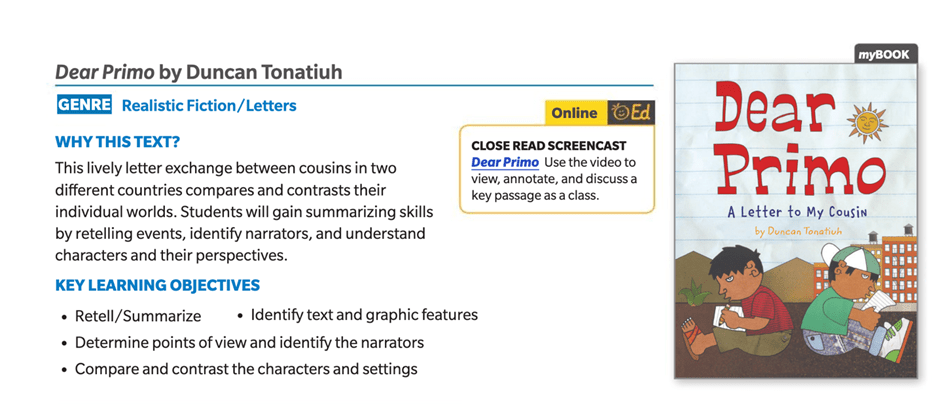
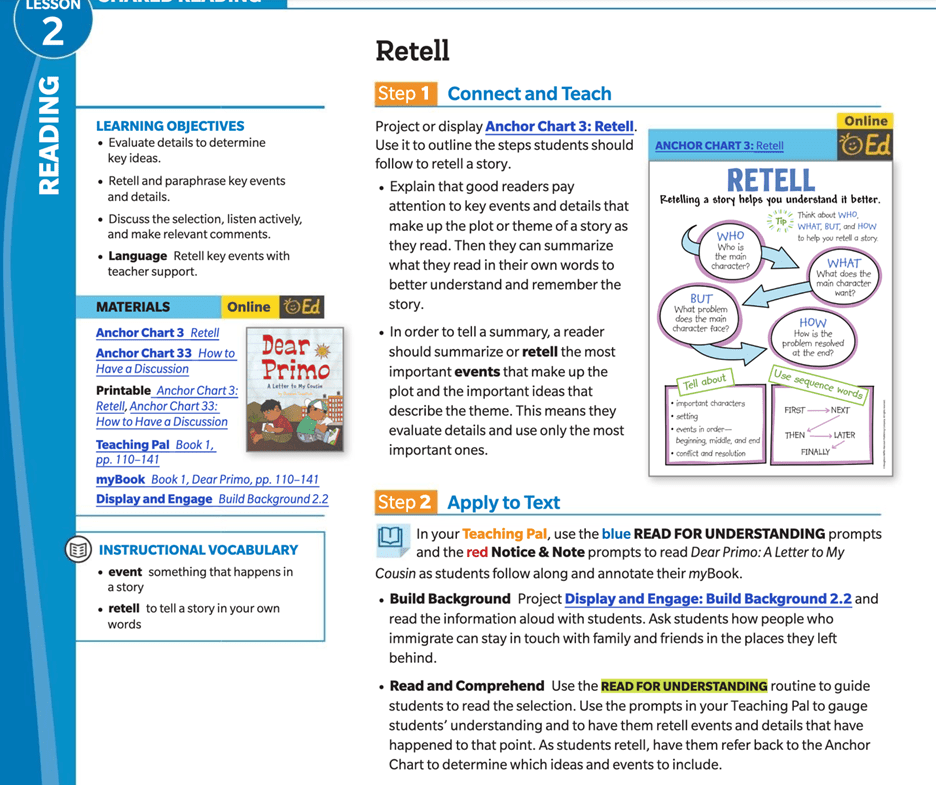
I reviewed the HMH curriculum for Grade 3, which focuses on the unit Dear Primo: A Letter to My Cousin. This unit emphasizes comparing experiences, cultures, and different perspectives through literary texts. The learning objectives for students are to help them identify themes, analyze characters, and make connections between their own lives and the lives of others. The expectations for students are to use evidence from texts to support their comprehension and participate in oral discussions and writing.
Part 3: AI- Generated Summary
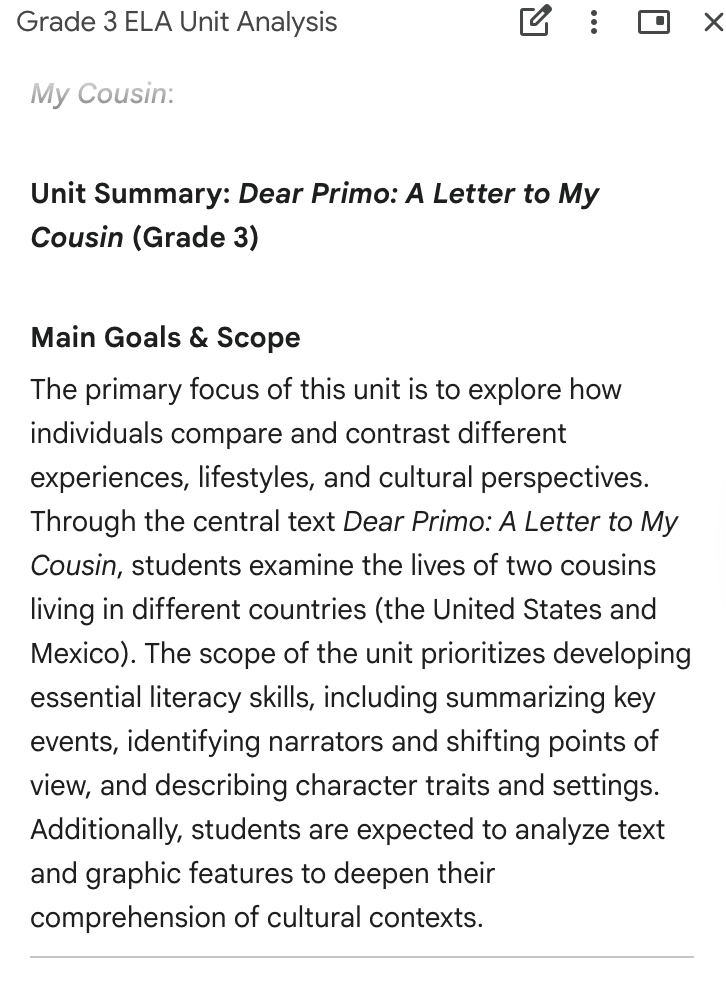
The main goal and scope of this unit are to explore how individuals compare different experiences, lifestyles, and cultural perspectives. Through the central text Dear Primo, students examine the lives of two cousins living in different countries (the US and Mexico). The scope of the unit prioritizes developing essential literacy skills, including summarizing key events, identifying narrators and shifting points of view, and describing character traits and settings. Additionally, students are expected to analyze text and graphic features to deepen their comprehension of cultural contexts. Two highly relevant alignments to the New York State Next Generation ELA Learning Standards include:
- 3R2: Determine a theme or central idea and explain how it is supported by key details; summarize portions of a text.
- Application: This matches the unit’s core requirement for students to track repeated details across the letters to summarize the text and determine the overarching theme of cultural connection.
- 3R6: Discuss how the reader’s point of view or perspective may differ from that of the author, narrator, or characters in a text.
- Application: Because the book is written in an epistolary (letter-sharing) format, this standard directly addresses the instructional focus on identifying different narrators and comparing characters’ distinct perspectives.
Part 4: Compare and Critique (4-6 Sentences)
My analysis and AI Summary share similar objectives because they both identified comparing perspectives, summarized events, and understanding the narrators and characters’ primary goals. The confirmation of standards was shared by AI for 3R2 and 3R6, and not 3R3. One difference was AI sharing the challenges for multilingual learning, which is the dual load of cultural schema and contrastive vocabulary. MLs require extensive support to bridge the vocabulary gap when making connections to their own lives into formal English academic writing and discussion. Recommendations for scaffolds aligned with support: I include sentence frames and visuals, but AI uses the keyword “culturally responsive scaffolding”. AI expanded my thinking about language support for ENLs and MLs; however, Specific directions and files to understand the unit I will be using were required in the search to get the best outcomes using AI as an analytical partner.
Peer responses.
#1 Hi J.,
You shared a great comparison on your critique versus AI critique. You mentioned AI gives you a better depth into the Unit and is not oversimplified as your summary. I agree that using AI to deepen our knowledge and expand on what we offer to students can be helpful in teaching and preparing them with a wide scope of content areas. When students are given more information that is appropriate to their Grade level and proficiency, they can grasp sufficient information to bring understanding of the object, which is a positive influence on the best outcomes for all students.
Thanks, Shobha
#2 Hi T.,
You shared some great information on identifying curriculum design and instructional design. These two go hand in hand and significantly increase participation and productivity of students’ outcomes. You also shared great instructional methods to encourage student outcomes by providing opportunities for scaffolding, which is an important component for multilingual learners. Emphasizing culturally responsive teaching is essential for English Language Learners, which helps them to connect using background knowledge and make meaningful connections. A key point in your analysis and AI that I thought is imperative is the inclusion of family relationships; this is a big part of students’ outcomes and creates a sense of belonging and motivation to learn in an environment that values community.
Thanks, Shobha
#3 Hi M.,
“Curriculum design tells teachers what and when to teach a topic. Instructional design allows teachers to create lessons, supplement the curriculum, and deliver instruction.” These two sentences stand out to me and hit exactly the difference between these two topics and how they go hand in hand with each other. I watched a video shared by our professor on the 4 Ts of Curriculum Design framework, which includes Topic, Task, Target, and Text (EL Education, 2018). These are 4 simple concepts for how to design a curriculum and build knowledge for students. This framework works in an interrelationship, helping teachers connect and create the scaffolding. To simplify it, the curriculum offers the ingredients to a standard, and teachers use those ingredients based on individual outcomes in proportion to students’ expectations.
Thanks, Shobha
Reference:
EL Education. (2018). Curriculum Design: The 4 Ts. Touro University. YouTube Video.
Houghton Mifflin Harcourt. (2020). HMH Into Reading: Grade 3 teacher’s Guide. Houghton Mifflin Harcourt.
NYSED. (2017). New York Next Generation English Language Arts Learning Standards. https://www.nysed.gov/sites/default/files/programs/standards-instruction/nys-next-generation-ela-standards.pdf


