

Tag: ESL
ESL and Schemata and VW’s
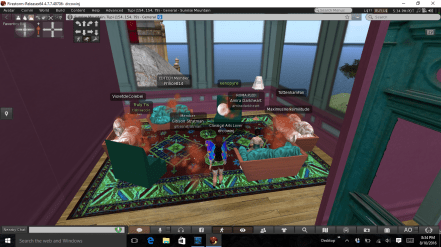
 Exploring new technological resources such as Virtual Worlds and their unique environments new dimensions of the formative process break current space-temporal barriers by opening up the ESL teaching field. The contexts within the Virtual Worlds (VW) requires thoughts about how ESL participants learn, the interaction between participants, teachers and ‘drop-ins’ or visitors. One of the questions I have formed is: How do international ESL learners interact with their peers and their instructors in a VW?
New demands in fluency and real-life response time makes new complex learning approaches appear. Classroom ESL teaching has a synchronous response tied to a physical student presence, participation, and scaffolded testing. Learning, as a social process, improves to the person, interrogates it, situates it in front of the people who surrounds him and about himself, at the same time that it lets the development and the learning of people and organizations. Communication is established, thus, the central act of human life (Cortese, 2004).
VW’s unique delivery of both synchronous and asynchronous learning is the relation of a social and shared perspective. Exploring, sharing and learning in a VW opens up new venues of student network collaborations. Generally, ESL language acquisition cannot be understood without this social and perspective.The questions to be explored with further reading and going VW are: Is there a successful schemata for ESL in VW? If yes, what does it look like>? What is the experience for the students? What is the learning philosophy of the creator of the ESL VW environments?
“The Phoenix Firestorm Project: Virtual Worlds, JokaydiaGrid and Second Life” Teaching ESL in OpenSym Grids
An accepted paper by Jasmin B. Cowin, Ed.D. for the TESOL Conference, November 3rd and 4th, 2016 in Syracuse, New York.
I am embarking on a journey of discovery with critical questions in my mind: How does an ESL facilitator put virtual environments to practical use? The purpose of my paper and presentation encompasses several areas which I will explore in future blogs. An essential element will be describing and analyzing my experience as the avatar ‘Muse Terpsichore’ in virtual worlds during my online summer “Games and Simulations” course at Marlboro College for Professional and Graduate Studies in Brattleboro, VT. Another component will focus on describing and comparing the virtual worlds of Jokaydia Grid and Second Life. Immersed in these virtual environments I will investigate their suitability for ESL education with a closer look at areas such as experiential learning, fluency practice, virtual classroom meetings, grammar, and storytelling. I look forward to an in-depth exploration into content availability and suitability for independent, guided, synchronous and asynchronous student-teacher interaction and collaboration. Finally, I want to examine the difference between the student and administrator view of virtual environments. How does a virtual world look like to an administrator or student? What set-up work is necessary to stage for a successful learning experience? What skills does an administrator or student need to successfully implement and engage in a virtual learning component?
I hope you will check in often to read about my ambitious journey into the alternate universes and creative teaching possibilities within virtual worlds.

