Students will become acquainted with and practice effective approaches, methods, and strategies for teaching and evaluating English language learners in the content areas (ELA, social studies, math and science). Throughout the course, students will explore the impact of culture and language on classroom learning. Special challenges in teaching and assessment in each content area will also be discussed. Includes 15 hours of field work.
Anastasios Panagiotidis is a dedicated high school Earth Science teacher serving the South Huntington Union Free School District. As he approaches his tenure year at the age of 25, he recognizes that his career is still in its early stages. However, his passion for education and commitment to fostering a supportive and inclusive learning environment drive his work every day. Inspired by the culturally and academically diverse student population he teaches, he strives to design engaging, student-centered lessons that not only address individual needs but also connect learning to real-world contexts. His ultimate goal is to ensure that every student, regardless of their language proficiency or academic abilities, has the opportunity to reach their fullest potential under his instruction.
Touro University contributes to the tools, knowledge, and wisdom I strive to acquire as I continue to develop and mature as an educator, while allowing me the opportunity to broaden my horizons in a wide variety of areas relative to the rapidly evolving field of education.
Anastasios Panagiotidis, Touro University TESOL candidate
The SIOP Model: An Essential Framework for ESL Instruction by Prof. Dr. Jasmin Cowin
The Sheltered Instruction Observation Protocol (SIOP) is a research-based instructional model designed to support English Learners (ELs) in developing both content knowledge and English language proficiency simultaneously. Developed by Echevarria, Vogt, and Short, the SIOP model provides a structured approach to lesson planning and delivery, ensuring that ELs receive comprehensible input and meaningful language support across content areas.
As a TESOL educator, understanding and implementing the SIOP model is essential for effective ESL instruction. The model provides a structured yet flexible framework that ensures ELs have equitable access to academic content while simultaneously developing their language proficiency. By integrating language and content instruction, teachers can create an inclusive classroom environment that promotes both linguistic and cognitive development for English Learners.
The SIOP Model: Components and Structure
The SIOP framework consists of eight interrelated components that guide teachers in designing effective lessons for ELs:
Lesson Preparation
Clearly defined content and language objectives
Use of supplementary materials to support comprehension
Meaningful activities that integrate both content and language practice
Building Background
Explicitly linking students’ background knowledge to new content
Connecting past learning experiences to new concepts
Introducing and reinforcing key vocabulary
Comprehensible Input
Adjusting speech for EL proficiency levels
Using clear explanations of academic tasks
Incorporating visuals, gestures, and realia to support understanding
Strategies
Teaching students learning strategies to support comprehension
Encouraging metacognitive awareness and self-monitoring of learning
Scaffolding tasks through teacher modeling, guided practice, and peer collaboration
Interaction
Promoting student-to-student discourse using structured peer interactions
Designing opportunities for extended academic conversations
Encouraging collaborative learning experiences
Practice & Application
Providing hands-on learning experiences
Integrating reading, writing, speaking, and listening activities
Allowing ELs to apply language skills in meaningful contexts
Lesson Delivery
Ensuring objectives are clearly communicated and met
Keeping students engaged and maintaining an appropriate pace
Aligning instruction with student needs
Review & Assessment
Regularly reviewing key concepts and vocabulary
Conducting formative assessments to monitor comprehension
Providing feedback to guide language and content development
Anastasios Panagiotidis’ Discussion Board provides excellent insight into Building Background.
Literacy [MS] The Master of Literacy program prepares teachers to become Literacy Specialists who work with students with reading and writing difficulties. The program includes ample field experience and leads to certification in both Birth – Grade 6 and Grades 5 – 12. Classes are offered online, as well as on site in Bay Shore in the evenings.
Alissa Fernstrom is currently a Teaching Assistant for a Special Education classroom in the Herricks School District. She completed her undergraduate dual degree in Early Childhood and Childhood Education at Molloy College, graduating in 2018. Afterward, she took graduate courses through Queens College to obtain her Special Education certification before selecting Touro University to obtain her Masters in Literacy. In addition to teaching in the classroom, she teaches dance, which allows her to share one of her life-long passions with others.
My time here at Touro has not been traditional, but the flexibility of the online program coupled with the supportive professors and staff, have made my journey to obtain my Masters in Literacy one I will forever be grateful for.
Alissa Fernstrom, Masters in Literacy, Touro University
Part I
a. Identify techniques for connecting students’ personal experiences and past learning to lesson concepts.
“It is a widely accepted notion among experts that a learner’s “schemata”—knowledge of the world—provides a basis for understanding, learning, and remembering facts and ideas found in texts” (Vogt, M., Echevarria, J.J., & Short, D. J., 2016, p.72). This fact is important to consider as a teacher, specifically of ENL students, because every learner comes into the classroom with their own set of knowledge that can be tapped into and utilized to help them better understand the new content being taught. One technique to connect students’ past experience with new lesson concepts is the use of anticipation guides. These guides consist of a number of statements that students can agree or disagree with based on their background knowledge of the topic being taught. This serves not only to activate their prior knowledge, but also to set a purpose for what they are to learn during the lesson. These questions should also be revisited at the end of a lesson in order to address any misconceptions and help students make new connections. Another technique that should be used when activating prior knowledge is culturally responsive teaching. Since students from different cultures will have vastly different experiences from their peers, it is important to consider that the way in which they will react to new information may not align with the way their peers do. It has been “questioned whether we can assume that students from every subculture will have the same experience with, or emotional reaction to a story or article, or whether we should expect the same outcomes from them” (Vogt, M., Echevarria, J.J., & Short, D. J., 2016, p.73). Teachers must consider that a student’s reading comprehension may be affected by their prior experiences or background knowledge and may not interpret a situation in the expected way. This is why culturally responsive teaching is a very important technique to utilize with ENL students.
b. List 2 elements of academic language and describe their importance for English learners.
”Academic language involves the use of more sophisticated sentence structures and forms of expression than are found in everyday conversation” (Vogt, M., Echevarria, J.J., & Short, D. J., 2016, p.76). This language is commonly seen in the content subject areas and leads to academic success. This type of language can be broken down into two specific groups, content vocabulary and general academic vocabulary. Content vocabulary “are the key words and terms associated with a particular topic being taught” (Vogt, M., Echevarria, J.J., & Short, D. J., 2016, p.76). These words are normally found in bold in the informational texts students read about a topic. They also include the words students need to know in order to share their thinking about a topic, such as character and setting. General academic vocabulary “are academic words and phrases students must learn because they are used in all academic disciplines” (Vogt, M., Echevarria, J.J., & Short, D. J., 2016, p.77). These types of words are not normally explicitly taught, but should be since they are words commonly seen in every academic setting. These words may have multiple meanings depending on the content being explored and can cause issues for ENL students. These words also help students to understand how information may be provided to them and how they are expected to interact with it. Both types of academic language are important and should be taught when working with ENL students.
Part II
a. Describe 1 activity YOU used during this week to introduce key academic subject-specific vocabulary for your ENL students. (p 76/77) divide your academic vocabulary using words from these three groups: content vocabulary, general academic vocabulary, word parts: roots and affixes?
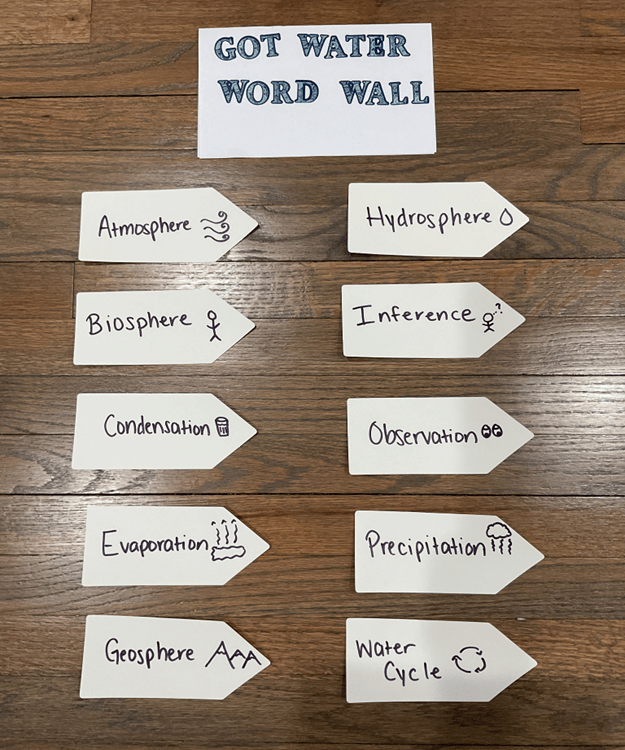
This week, I introduced academic subject-specific vocabulary to my 5th grade class, of which one student is an ENL student. We started a new science topic entitled “Got Water?” which focuses on the different spheres of the earth, specifically water. The way in which I introduced these words was by providing students with a list of the words and a picture to accompany each that they glued into their science notebooks. The pictures served as a great way for not only my ENL student, but for all students in my special education room, to create a concrete picture in their mind of what each word meant. Once students had their list, we went through each word one by one, giving students a chance to share their own background knowledge and build upon the definition I had given by using the word in a sentence. This allowed all students to participate and utilize the new vocabulary in a way that was familiar to them. We also talked about the prefixes on some of the words and had students share other words they knew of that started in a similar way. This further helped students to solidify the meaning of these new words.
general academic vocabulary: observation, inference, cycle
roots and affixes: hydro-, bio-
b. Describe 1 activity YOU used during this week to introduce general academic or language function vocabulary for your ENL students (p 76/77).
In our reading unit, students are working on a culminating project with their fantasy novels. The general academic words that were introduced and utilized this week to start this project were compare, contrast, and support your answer. The overall task is for students to pick two elements of a fantasy book and compare and contrast how these elements are seen in the class read aloud and their independent book. In order for students to effectively complete the assignment, they first had to understand what these general academic words mean. I started by simply writing both words on the board and having students use any prior knowledge they had about each word to create their own definition. Since these students are in 5th grade, they had all, including my ENL student, been exposed to these words and were quickly able to come up with definitions as a class. They also identified that we could use a venn diagram to help us compare and contrast the two books. Utilizing charts is a great way to help all students organize their thinking. Finally, we discussed what it means to support your answer. We first compared it to our math lessons when we are always asked to show our work. Students were able to make the connection that the work supports our answer and that in the case of reading, the words in the book are our support. This helped them to realize that supporting their answers in reading meant going back into the text.
c. Use one of the methods described (p 82 – 88) in YOUR classroom and describe what happened – please include a photo of any of YOUR realia/anchor chart/game cards.
The method I chose to utilize with my class is a word wall. A word wall is a place for relevant content words to be displayed in alphabetical order. “These words are revisited frequently throughout the lesson or unit, and students are encouraged to use them in their writing and discussions” (Vogt, M., Echevarria, J.J., & Short, D. J., 2016, p.85-86). I decided that a word wall could be a great way to display our new science words for students. I noticed that once the words were visible to students at all times, they were more likely to use the words when answering questions, not only during our science lessons, but making connections back to them throughout the entire day. For example, students spoke about how our predictions at the end of our chapter in reading were really inferences because we were using what we saw in the book to make a guess as to what would happen. This was so amazing to see as a teacher and hearing students that are both in special education and ENL utilize such sophisticated language in an appropriate way showed me how impactful such a simple vocabulary method could be.
C Vogt, M., Echevarria, J. J., & Short, D. J. (2016). Making content comprehensible for English Learners. (5th ed.). Pearson: New York.
Students will become acquainted with and practice effective approaches, methods, and strategies for teaching and evaluating English language learners in the content areas (ELA, social studies, math and science). Throughout the course, students will explore the impact of culture and language on classroom learning. Special challenges in teaching and assessment in each content area will also be discussed. Includes 15 hours of field work.
“As I begin my journey at Touro, I aspire to grow as an educator, enhancing my effectiveness and inspiration for my students along the way.”
Alexandra Olivo, Touro University, TESOL Candidate
Alexandra Olivo is a second-year teacher and graduate student from Long Island, New York. Through her advanced studies, she aims to bring creative approaches to the classroom and create an engaging and supportive learning environment where students can succeed. Alexandra said, “I am committed to student growth and empowering students to reach their full potential.”
Ms. Olivo submitted an exemplary Discussion Board:
Identify techniques for connecting students’ personal experiences and past learning to lesson concepts.
After reading, I better understand how students can benefit from connecting personal experiences and past learning to continue learning new concepts and hit target objectives. I found that on page 74 of Making Content Comprehensible for English Learners, KWL charts can help classes brainstorm about a topic, which can be helpful when grasping what students know and what they will learn. There is one disadvantage of this technique because, as mentioned on page 74, “some English learners have little or no prior knowledge about a content topic,” so teachers should be aware that choosing the right topic for their KWL can have a difference in how much information they receive from students. For example, if you are teaching a writing lesson about favorite holidays, choose a widely celebrated holiday rather than “Fourth of July,” which is only celebrated in The United States of America. Another technique discussed in this chapter is implementing information students have learned in new lessons. Integrating knowledge helps students to see the connections and think back to resources such as anchor charts and vocabulary. Just this past week, I was teaching an ELA lesson. Although the objective differed from the prior day, I connected the lessons because the language used was in the readings and the strategy we were implementing. (Echevarría et al., 2017)
List 2 elements of academic language and describe their importance for English learners.
One element of academic language I will describe is using and implementing “Content Vocabulary.” Content vocabulary is described in Chapter 3 as “…keywords and terms associated with a particular topic being taught” (Echevarría et al., 2017). This is important for English learners because they may not know these terms in their first language, which means they may be unable to use that knowledge to help them understand the meaning of English. In general, I find that in my second-grade classroom, content and vocabulary are difficult for most students but harder for ELLs because they struggle to comprehend the meaning of words. A great way to implement content vocabulary for my ELL students is to have my general education students help describe what the word means by shouting out words based on a student-friendly definition I provide. I also show visuals to help students understand what these words represent. They can connect with their peers, explaining and using visuals to grasp content vocabulary. The second element of academic language described is “General academic Vocabulary.” This is where students have to understand words used across multiple content areas. Although content vocabulary is essential for students to know what we are learning about, I find that general academic vocabulary works hand in hand and sometimes may be more critical. This is because students used general vocabulary to conversate with me, other teachers, and their peers. Without this, they cannot understand lesson objectives, assignment directions, social cues, and other essential aspects of daily language. ELLs may not have words equivalent to English terms. Therefore, it is vital to make sure we are scaffolding ways for these students to learn this discourse, such as visuals in the classroom, describing and explaining the meaning, and using context clues.
Jana, Echevarria; Vogt MaryEllen; Short Deborah J.. Making Content Comprehensible for English Learners (SIOP Series) (p. 100). Pearson Education. Kindle Edition.
Describe 1 activity YOU used during this week to introduce key academic subject-specific vocabulary for your ENL students. (p 76/77) divide your academic vocabulary using words from these three groups: content vocabulary, general academic vocabulary, word parts: roots and affixes?
This week, my students were introduced to key academic vocabulary in math. The unit we are currently working on is adding and subtracting within 20. We used the activity of a word wall displayed in the front of the classroom. This was the first time I was showing students this resource, and I built the word wall with them rather than displaying it for them to view independently. I decided to pull all students to the carpet to go through each word and have students try to remember what the terms meant if they had heard them in first grade. This sparked some curiosity in my ELLs. As we put up each word, I describe it and then discuss it together, especially when we see it in either addition or subtraction problems.
Content Vocabulary: sum, equation, difference,
General academic vocabulary: describe, write, draw, word parts: none used for this lesson.
Jana, Echevarria; Vogt MaryEllen; Short Deborah J.. Making Content Comprehensible for English Learners: The SIOP Model (SIOP Series) (p. 100). Pearson Education. Kindle Edition.
Describe 1 activity YOU used during this week to introduce general academic or language function vocabulary for your ENL students (p 76/77)
One activity I used this week to introduce general academic language was a vocabulary word wall, but I changed this activity by adding an act-it-out activity. As a class, during ELA, we discussed five new words: describe, “presenter, explain, observe, and listen. We began by saying each word aloud and predicting what these words mean in our classroom. Then, I provided them with a definition, and we read it together, repeating it after me. Following this, we acted out each one to provide a visual, and I chose a few students who accurately portrayed it to show the class. This helped my ENL students because they repeated the word multiple times and then connected it to whatever the acting-out move was. A few students had a live “aha” moment during the word presenter. The ELA reading for that day was science-based, and these words helped guide students through the vocabulary content.
Use one of the methods described (p 82 – 88) in YOUR classroom and describe what happened. Please include a photo of any of YOUR realia/anchor chart/game cards.
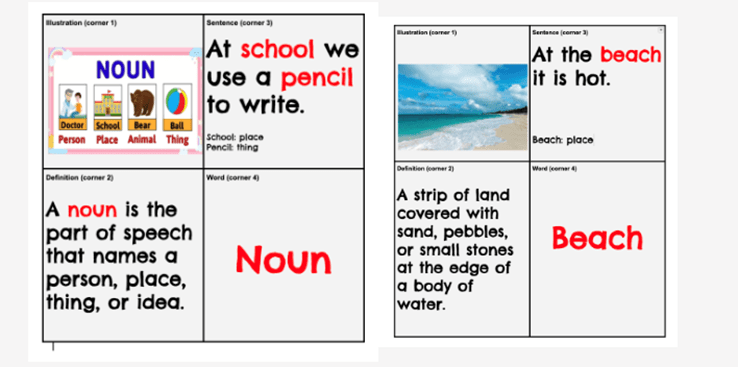
This week, I used the “four corners vocabulary charts” as an activity to learn about nouns. I gave my students directions for choosing a corner and then discussed the card in that corner with one partner. I showed them how to complete the activity by using the first image below of the vocabulary word “noun,” then we continued this activity but with five different nouns, such as the image of the word beach below. This helped all students, specifically ELLs, because I noticed they were listening to their peers, and some students were working hard to help their friends learn about nouns. I enjoyed using this activity because students loved walking around the room, allowing them to look at vocabulary differently. The multiple ways of representing nouns helped them clarify the differences between the types of nouns.
Review the Teaching Scenario Ms. Saunders (p. 90) and give one feedback point.
One feedback point is that Ms. Saunders could have spent more time reviewing the word sequence for English Learners (ENLs). The word sequence is a general academic vocabulary that not all students may know just by a quick reminder. Along with the SIOP Model’s emphasis on vocabulary development, I think incorporating one or two examples of sequencing before asking students to create a storyboard would have been beneficial. This approach would use a modeling strategy, which helps students visualize the concept. I also think that having students sequence seven parts of the story, it would have been more effective to start with just four parts. This adjustment would accommodate those who seemed unsure if they understood the assignment. As highlighted in the SIOP framework, breaking down tasks into manageable chunks is helpful by supporting comprehension. Seven parts may have overwhelmed students who are still developing their language skills and lowered their ability to engage with the task. By providing clearer instructions and examples, Ms. Saunders could have created a more supportive learning environment, which could have allowed more students to participate confidently.
Reference:
Echevarría, J., Vogt, M., & Short, D. (2017). Making Content Comprehensible for English Learners: The SIOP Model.
Peer Responses
Hi Q., I enjoyed your post. Specifically, your activity is introducing multiplication vocabulary. I used a similar activity but needed to include the drawing aspect. This would benefit ELLs because they can view other students’ work and connect the pictures to newly learned content vocabulary. I will be including this in my future lessons. I also agree that in your review of Ms. Saunders’s teaching scenario, she could have added a check for understanding and review at the end of the lesson. This could have provided students with a wrap-up to clarify misconceptions within student responses. I always try to do this in my classroom, and I am sometimes surprised at the confusion, but ultimately, it helps me grow as an educator.
Hi S., I enjoyed your post because I found connections to what I use in my classroom. I see that you use HMH for your English language arts program. I also conduct my lessons with vocabulary in the same way. My students struggle to read independently, so when I introduce the words, we say them together orally, discuss the meaning, and then use examples. I am unsure if you have tried this, but my students benefit from acting out the words when possible, depending on the context. I also like how you explained that your kindergarteners are now aware of a lot of general academic vocabulary, and I commend your patience as you teach it to them. As a second-grade teacher, I can say that if they begin in Kinder, then it becomes natural for them to hear and use these terms as they get older.
Hi C.! I loved your response to using an activity/method in your classroom. I loved how you did a read-aloud book to teach an important skill: washing hands. I also thought that after you discussed the story, you would provide a video. Not only did this provide visuals, but you also had another source of representation of the same skill. ELLs learn better with visuals and learning something in multiple ways. Then, providing students with a live experience of walking to the bathroom is exceptional. I will carry this lesson format into my classroom but with different content. Thank you for sharing.