Touro University TESOL Candidate Jeannine Pepe’s Science of Reading Insights for EDDN 637

The MS in Teaching English to Speakers of Other Languages (TESOL) Program helps NYS-certified PreK-12 teachers more effectively teach and communicate with a diverse student population. If you have questions about our admissions requirementscertification guidelines, or transfer credits, feel free to contact us.

By Dr. Jasmin Cowin: Discussion boards are an effective starting point for a sequential introduction to the Science of Reading because they give candidates a low-stakes, asynchronous space to work through foundational constructs, such as vocabulary’s role within the Big 6, while grounding their analysis in authentic texts. As Jeannine Pepe’s Science of Reading Insights for One Well: The Story of Water on Earth by Rochelle Strauss demonstrates, candidates can practice applying frameworks like brick-and-mortar words, cite course readings, and articulate instructional moves in writing, which makes their conceptual understanding visible to the instructor while giving candidates choices in choosing their own texts.

In addition, the required peer responses build a professional learning community as candidates refine or even revise their thinking (e.g., reconsidering whether brick-or-mortar words pose greater challenges for multilingual learners) through dialogue with colleagues. This written, iterative format is ideal early in the semester because it requires careful reading, evidence-based reasoning, and academic language development before candidates are asked to perform pedagogically. Later in the semester, short video demonstrations are folded in because they require candidates to transfer theoretical knowledge into observable practice, such as explicitly teaching Tier 2 vocabulary in context, modeling phoneme-grapheme mapping, or demonstrating a decoding routine as they would with real learners.. This sequence from written analysis to recorded enactment ensures that candidates’ SoR knowledge is not merely theoretical but demonstrably applicable, mirroring the transfer from declarative to procedural knowledge that we expect them to foster in their own students.

Bio: My name is Jeannine Pepe, and I am a 48-year-old educator with 26 years of teaching experience. For over 20 years, I have worked in ENL classroom settings, developing a strong commitment to supporting multilingual learners. Through my continued work with this population, I recognized the importance of further formalizing my training and expanding my instructional strategies. This led me to pursue advanced study, and I found my way to Touro University, whose TESOL program aligns closely with my professional goals and passion for supporting English language learners.

I have learned through my coursework, that the Science of Reading is a research-based approach to how students learn to read. Reading instruction should be explicit, systematic, and include phonological awareness, phonics, fluency, vocabulary, background knowledge, and comprehension. I also learned that oral language is especially important for multilingual learners because students need to understand and use language in order to make meaning from text.

Jeannine Pepe, Touro University TESOL Candidate

DB Question: Vocabulary — The Fourth Pillar of the Big 6

Select a short text from your text analysis. Analyze its vocabulary complexity by identifying the following: brick words and mortar words.  Your post should include:

Your text excerpt, cited with author, title, and page number – you must use text you will be using for your text analysis assignment next week.
A list of the brick words you identified and a brief explanation of why each is essential for comprehension of this text.
A list of the mortar words you identified and the comprehension or reasoning function each one serves.
A reflection on which word type poses the greater challenge for your multilingual learners and what one instructional move you would make before reading to reduce that barrier.

Connect your analysis explicitly to the Science of Reading component of vocabulary instruction and cite at least one course reading in your response.

Using insights from Robust Vocabulary Instruction to discuss how explicitly teaching vocabulary can enhance multilingual learners’ comprehension and engagement with complex texts.

For my text analysis, I selected pages 4–7 of One Well: The Story of Water on Earth by Rochelle Strauss. The text contains science concepts, diagrams, statistics, and challenging vocabulary related to freshwater, pollution, conservation, and population. It is used in EL Education’s Grade 3 Water Around the World module.  This section introduces the idea that all the water on Earth is connected. For this vocabulary analysis, I selected the opening sentence:

“Imagine for a moment that all the water on Earth came from just one well” (Strauss, 2007, p. 4).

Brick Words

  • Water: This is the central scientific concept in the text. Students must understand that the author is discussing all forms and sources of water, not only drinking water.
  • Earth: This establishes the global scale of the text. The author is discussing the entire planet rather than one particular community.
  • Well: This word is essential because the author uses a well as a metaphor for Earth’s connected water supply. Multilingual learners may initially interpret it only as a hole from which people collect water.

Mortar Words

  • Imagine: This word asks readers to form a mental picture and consider a hypothetical situation.
  • For a moment: This phrase signals that the reader should pause and temporarily consider the author’s idea.
  • All: This word communicates total inclusion. It emphasizes that no source of water is excluded.
  • Came from: This phrase expresses a source relationship by explaining where something originates.
  • Just one: This phrase emphasizes limitation and unity. It supports the author’s central idea that Earth’s separate-looking water sources are interconnected.

I believe the mortar words may present the greater challenge for multilingual learners because their meanings are less concrete and often depend on how they function within a sentence. Words such as water, Earth, and well can be supported with pictures or real objects, but phrases such as came from, just one, and imagine for a moment communicate more subtle relationships and reasoning. Sandora (n.d.) explains that traditional activities such as copying dictionary definitions often produce only a superficial understanding of vocabulary. Robust vocabulary instruction instead provides student-friendly definitions and repeated opportunities for students to encounter, discuss, and apply words in meaningful contexts.

Before reading, I would display a diagram showing oceans, rivers, lakes, rain, and groundwater flowing into one large container labeled “Earth’s Well.” I would introduce the important brick and mortar words with visuals and student-friendly explanations. Students would then complete an example/non-example activity and discuss their reasoning with a partner. For example, students could decide whether a river, rainstorm, swimming pool, or ocean represents part of Earth’s “one well” and explain why.  I would also  introduce the sentence orally, explain the metaphor, and have students use the frame, “Imagine that all ___ came from ___.” Students could practice the frame with a partner before applying it to water.  This supports the Science of Reading component of vocabulary, as students develop deeper knowledge of word meanings and relationships rather than merely memorizing definitions. Knowing how to pronounce a word is not enough; students need a deep understanding of its meaning and how it functions within a sentence. It would also increase multilingual learners’ engagement by allowing them to speak, collaborate, make visual connections, and use the vocabulary in meaningful ways. As Sandora (n.d.) emphasizes, students need opportunities to interact with words through activities such as examples and non-examples, word associations, physical actions, and writing.

References:

Echevarría, J., Vogt, M. E., & Short, D. J. (2017). Making content comprehensible for English learners: The SIOP model (5th ed.). Pearson.

Sandora, C. (n.d.). Robust vocabulary instruction. Institute for Learning, University of Pittsburgh.

Strauss, R. (2007). One well: The story of water on Earth. Kids Can Press.

Peer Response #1

Hi R.!  I really like how you pointed out that Mr. Lew earned the highest rating because he stayed actively involved with students throughout the lesson. I agree with your point that simply giving students a task is not enough, especially when working with multilingual learners. Your quote that “Mr. Lew circulated through the classroom, supervising the students and answering their questions” shows that he was checking for understanding and making the input more comprehensible as students worked. That kind of teacher support is so important because students may not always ask for help unless the teacher is nearby and available.

Peer Response #2

Hi J.!  I really enjoyed reading your vocabulary analysis of Esperanza Rising. I thought your choice of text was strong because the excerpt gives students both cultural vocabulary and emotional language that are important for understanding the story. I especially liked how you separated the brick words from the mortar words and explained why each type matters. Words like campesinosvaqueros, and quinceañeras help students understand the setting, culture, and ranch life in the novel. At the same time, I agree with you that the mortar words may create a bigger challenge for multilingual learners because words like premonitionuneasinessdismissed, and strained require students to understand feelings, tone, and deeper meaning.

Your point about using visuals, Frayer Models, and personal connections before reading really stood out to me. In my experience working with ELLs, students often understand concrete vocabulary faster when they can see a picture or connect the word to something familiar. The more abstract words usually need more discussion, modeling, and examples in context. I also liked how you connected this to the Science of Reading because vocabulary is not just about memorizing definitions. Students need repeated, meaningful exposure to words so they can use them to comprehend, discuss, and write about complex texts.

I also thought your connection to robust vocabulary instruction was important. Explicitly teaching vocabulary before reading can help multilingual learners feel more confident instead of overwhelmed by unfamiliar words. When students understand both the story-specific words and the academic language that connects ideas, they are better prepared to engage with the text. Your response reminded me that vocabulary instruction needs to be intentional, especially when a text includes cultural, academic, and emotional language all at once.

Touro University TESOL Candidate Ishrat Jahan’s Science of Reading Insights in EDDN 637 & EDDN 635 Techtool Resource


The MS in Teaching English to Speakers of Other Languages (TESOL) Program 
helps NYS-certified PreK-12 teachers more effectively teach and communicate with a diverse student population. If you have questions about our admissions requirementscertification guidelines, or transfer credits, feel free to contact us.

By Dr. Jasmin Cowin: Discussion boards are an effective starting point for a sequential introduction to the Science of Reading because they give candidates a low-stakes, asynchronous space to work through foundational constructs, such as vocabulary’s role within the Big 6, while grounding their analysis in authentic texts. As Ishrat Jahan’s Science of Reading Insights on Esperanza Rising demonstrates, candidates can practice applying frameworks like brick-and-mortar words, cite course readings, and articulate instructional moves in writing, which makes their conceptual understanding visible to the instructor while giving candidates choices in choosing their own texts.

In addition, the required peer responses build a professional learning community as candidates refine or even revise their thinking (e.g., reconsidering whether brick-or-mortar words pose greater challenges for multilingual learners) through dialogue with colleagues. This written, iterative format is ideal early in the semester because it requires careful reading, evidence-based reasoning, and academic language development before candidates are asked to perform pedagogically. Later in the semester, short video demonstrations are folded in because they require candidates to transfer theoretical knowledge into observable practice, such as explicitly teaching Tier 2 vocabulary in context, modeling phoneme-grapheme mapping, or demonstrating a decoding routine as they would with real learners.. This sequence from written analysis to recorded enactment ensures that candidates’ SoR knowledge is not merely theoretical but demonstrably applicable, mirroring the transfer from declarative to procedural knowledge that we expect them to foster in their own students.

Ishrat Jahan’s Bio: I earned my Bachelor of Science in Childhood Education with a bilingual extension in Bangla. Currently, I work in an elementary school dual-language classroom, supporting students from diverse cultural backgrounds and varying levels of English proficiency. To strengthen my ability to support multilingual learners and expand my professional knowledge, I am pursuing a master’s degree in TESOL at Touro University, where the flexible schedule and practical coursework have helped prepare me to better meet students’ academic and language needs. 

“The Science of Reading has taught me that every child deserves instruction built on evidence, not assumptions. It also taught me that successful reading is not left to chance-it is built through explicit, systematic, and evidence-based instruction.”

Ishrat Jahan, Touro University TESOL Candidate
  1. The DB question:

Vocabulary — The Fourth Pillar of the Big 6
Vocabulary is one of the Big 6 components of the Science of Reading and a critical lever for multilingual learner achievement. One practical entry point into vocabulary instruction is the Brick and Mortar framework, which helps teachers assess a text’s full vocabulary demand before teaching it.
Select a short text from your text anlaysis. Analyze its vocabulary complexity by identifying the following:
Brick words are specialized, content-specific terms essential for understanding the topic of the text (e.g., ecosystem, photosynthesis, denominator). These correspond to Tier 3 vocabulary in Beck, McKeown, and Kucan’s framework.
Mortar words are the general academic and functional language that holds ideas together and supports comprehension across content areas (e.g., however, as a result, evaluate, in contrast). These correspond largely to Tier 2 vocabulary.
Your post should include:

Your text excerpt, cited with author, title, and page number – you must use text you will be using for your text analysis assignment next week.
A list of the brick words you identified and a brief explanation of why each is essential for comprehension of this text.
A list of the mortar words you identified and the comprehension or reasoning function each one serves.
A reflection on which word type poses the greater challenge for your multilingual learners and what one instructional move you would make before reading to reduce that barrier.

Connect your analysis explicitly to the Science of Reading component of vocabulary instruction and cite at least one course reading in your response.

Using insights from Robust Vocabulary InstructionLinks to an external site. to discuss how explicitly teaching vocabulary can enhance multilingual learners’ comprehension and engagement with complex texts.

Ishrat Jahan’s Science of Reading Insights in EDDN 637

Text excerpt: For my text analysis, I selected an excerpt from Esperanza Rising by Pam Muñoz Ryan. I focused on the “Los Melones” section. In this scene, Esperanza, Miguel, Isabel, and Marta discuss the separate labor camps and the unfair conditions faced by farmworkers. Marta explains, “We all live separate and work separate. They don’t mix us” (Ryan, 2000, p. 62). She later explains that workers may need to strike to have better conditions. She said, “They don’t want us banding together for higher wages or better housing” (Ryan, 2000, p. 62). In this part of the story, Esperanza is learning about the living and working conditions of migrant workers in California.

Brick words identified:

  • Wages: This word is important because it explains the money workers earn for their labor. Students need to understand wages to understand why the workers want better treatment. 
  • Conditions: This word refers to the workers’ living and working situation. It helps students understand what Marta means when she says workers want “better conditions.”
  • Owners: This word refers to the people who control the farms and make decisions about workers’ pay, housing, and treatment. In this excerpt, the word “they” refers to owners. This word is important to know because it does not directly state that the word “they” refers to owners, and it is a pronoun that many students might not know about.     
  • Housing: In this excerpt, housing refers to the cabins and living conditions provided to farmworker families. It helps students understand why the workers are unhappy and why they want change.
  • Strike: This word is especially important because it explains the action workers may take by refusing to work together to demand fair treatment.

These words are important because they are connected to the main social and historical issues of the story, including migrant farm work, poverty, and unfair living conditions. Without understanding these words, students may understand that the characters are upset, but they may not fully understand why the workers are separated or why they are considering a strike.  

Mortar words identified:

  • Banding together: This word helps students understand the idea of workers joining as one group.
  • Separate: This word shows how the farm owners keep different groups of workers apart.
  • Higher: This comparison word shows that the workers want more pay than they currently receive.
  • Or: This word connects two possible needs: better wages or better housing.
  • Don’t want: This phrase helps students understand the motivation of the owners. The owners do not want workers to unite because they may ask for fairer treatment.
  • Better: This is a comparison word that helps students understand that the workers want improved wages, housing, and treatment.

Reflection:

 I think mortar words may be more challenging for multilingual learners than brick words because they represent abstract, functional language rather than concrete objects. Brick words usually have a clear visual representation, while mortar words require students to understand logical relationships and cognitive processes that can not be easily pictured. Mortar words can also change meaning depending on the context. For example, students may learn words like wages, housing, and strike with pictures, examples, and student-friendly definitions. However, words and phrases such as or, higher, and banding together may be harder to teach because their meanings depend on the context. These words are less concrete, and students may not understand their deeper meaning without support. They show relationships, comparison, action, and motivation in the sentence. If students do not understand these words, they may not fully understand the context of the passage. 

One instructional move I would make before reading is to use a simple cause-and-effect chart with visuals. I would write “Workers are separated” on one side and “They can not share information or organize for better wages and housing” on the other side. Then, I would introduce the sentence starter, “If workers join together, they might________.” Students would use the sentence starter to discuss their ideas. This would help students practice the mortar language while also preparing them to understand the problem of the text.   

  1. Connect your analysis explicitly to the Science of Reading component of vocabulary instruction and cite at least one course reading in your response.

Connection to the Science of Reading: This Brick and Mortar analysis connects to the Science of Reading because vocabulary is an important part of language comprehension. Both types of words are important for students to understand the context of the text. For example, students need to understand brick words such as strike, wages, and housing, but they also need mortar words such as or, higher, don’t want, and better to understand the relationships and conflicts of the text. Multilingual learners may find Mortar words challenging because they are less concrete and show cause, effect, comparison, and motivation. Before reading, I would use visuals and sentence starters, such as “The owners keep workers separate because________,” to help students practice these words in context. This supports vocabulary instruction because students learn both the meaning of the words and how the words work together in a sentence. This connects to Lesaux and Galloway’s (2017) point that “word knowledge develops for students as they connect what they know about a word, in any language, with new information being taught” (p.4). Before reading, I would encourage students to connect these words or ideas to what they already know in their home language.

Using insights from Robust Vocabulary Instruction

Links to an external site. to discuss how explicitly teaching vocabulary can enhance multilingual learners’ comprehension and engagement with complex texts.

Teaching vocabulary explicitly can enhance multilingual learners’ comprehension and engagement with complex texts because it gives them access to important words before those words become barriers to comprehension. Sandora (2023) explains that traditional activities, such as looking up definitions, may only create a “superficial understanding” of words instead of the deeper knowledge students need to understand a text. To help students understand complex texts, teachers should explicitly teach important Tier 2 and Tier 3 words, especially for multilingual learners. Teachers should use simple and clear language, student-friendly definitions, visuals, examples, cognates when appropriate, and repeated opportunities to use the words in speaking and writing. For example, before reading a complex text, I would introduce a few important words in context and ask students to discuss examples and non-examples with a partner. This would help students move beyond memorizing a definition and use the words to explain ideas from the text. As Sandora (2023) explains, students should interact with words in meaningful ways that “depend their understanding,” which can make them more confident and engaged when reading challenging text.

References

Echevarría, J., Vogt, M. E., & Short, D. J. (2017). Making content comprehensible for English learners: The SIOP model (5th ed.). Pearson.

Lesaux, N. K., & Galloway, E. P. (2017). Hallmark 1 of advanced literacies instruction: Engaging, content-rich texts. New York State Education Department. https://www.nysed.gov/sites/default/files/nov-8-nys_brief-3-of-8_summer_2017_hallmark_1final_2.pdf-a.pdf  

Ryan, P. M. (2000). Esperanza Rising. Scholastic Press.

Sandora, C. (2023, January 31). Robust vocabulary instruction. Bridges to Learning. Institute for Learning. https://www.ifl-news.pitt.edu/2023/01/robust-vocabulary-instruction/

Peer Response 1: I found your post interesting because you explained that brick words can also be challenging for multilingual learners. At first, I thought mortar words were more difficult for them because their meanings can change depending on the context and students need to understand grammar and sentence structure to use them correctly. However, your post helped me realize that brick words can be just as challenging, especially when students do not have background knowledge about the topic. Although teachers can use visuals to explain brick words, students still need multiple opportunities to hear, discuss, read, and use those words in context. I also liked your idea of using visuals and a bilingual glossary before reading. This is a meaningful way to activate prior knowledge and reduce vocabulary barriers before students begin the text. Chapter 4 explains that teachers should use “a variety of techniques … to make content concepts clear” (Echevarría et al., 2017, p. 110). Your use of visuals and bilingual support connects well to this feature because students can better understand important vocabulary before reading. One suggestion I would add is having students use both brick and mortar words in sentence starters after the pre-reading activity. This would help students not only recognize the words, but also use them to explain their thinking and better understand the text.

References

Echevarría, J., Vogt, M. E., & Short, D. J. (2017). Making content comprehensible for English learners: The SIOP model (5th ed.). Pearson.

Peer Response 2: I agree with you that mortar words can be more difficult for multilingual learners because their meanings may change depending on the context. I also liked how you gave an example of the word “difference,” which can have different meanings depending on how it is used. This example clearly shows why multilingual learners may need extra support to understand these words. I also think giving oral examples in a sentence can help reduce confusion and support students’ understanding. In addition to oral examples, visuals would be helpful, as students can see and hear the word at the same time. I support your ideas because Mr. Lew also used visuals, hands-on experiments, and clear explanations of terminology, which made the lesson easier for students to understand. His lesson was among the strongest because he provided students with multiple ways to access the content.

Peer Response 3: I also chose Esperanza Rising for my vocabulary excerpt. Vocabulary in this book may be difficult for non-Spanish speakers and multilingual learners from other language backgrounds, so they may need a lot of support. However, with the right support, the vocabulary will not feel as challenging. I also agree that brick words are easier to teach than mortar words because teachers can teach brick words with visual examples, while mortar words require a deeper understanding of the context. I think using visuals and Frayer Models would be a good way to explore mortar words because students can learn the definition, see examples and non-examples, and discuss how the word is used in different sentences. This can help students understand that the meaning of a mortar word may change depending on the context.

Your reflection also stood out to me when you explained that students at Levels 2 and 3 may struggle more with mortar words than brick words. I agree because concrete words such as campesinos or quinceañeras can be supported with pictures, while abstract words such as premonition and uneasiness require students to understand emotions and context. I liked your plan to use Frayer Models, pictures, examples, and connections to students’ own experiences before reading. This connects to your point because students need support with both brick and mortar words to understand the story. As Sandora (2023) explains, “Knowing the right vocabulary is essential for reading comprehension; students need to understand words to grasp the text’s meaning”. One additional strategy could be having students use sentence frames to practice the mortar words in discussion before reading, so they can understand both the meaning of the words and how they work in the story.

Reference

Sandora, C. (2023, January 31). Robust vocabulary instruction. Bridges to Learning. Institute for Learning. https://www.ifl-news.pitt.edu/2023/01/robust-vocabulary-instruction/Links to an external site.

EDDN 635 Techtool Resource

“Creating this Padlet taught me that technology is most meaningful when it helps multilingual learners and their families feel included, supported, and connected to learning both inside and outside the classroom.”

Ishrat Jahan, Touro University TESOL Candidate

Click here for: Ishrat Jahan’s EDDN 635 Techtool resource

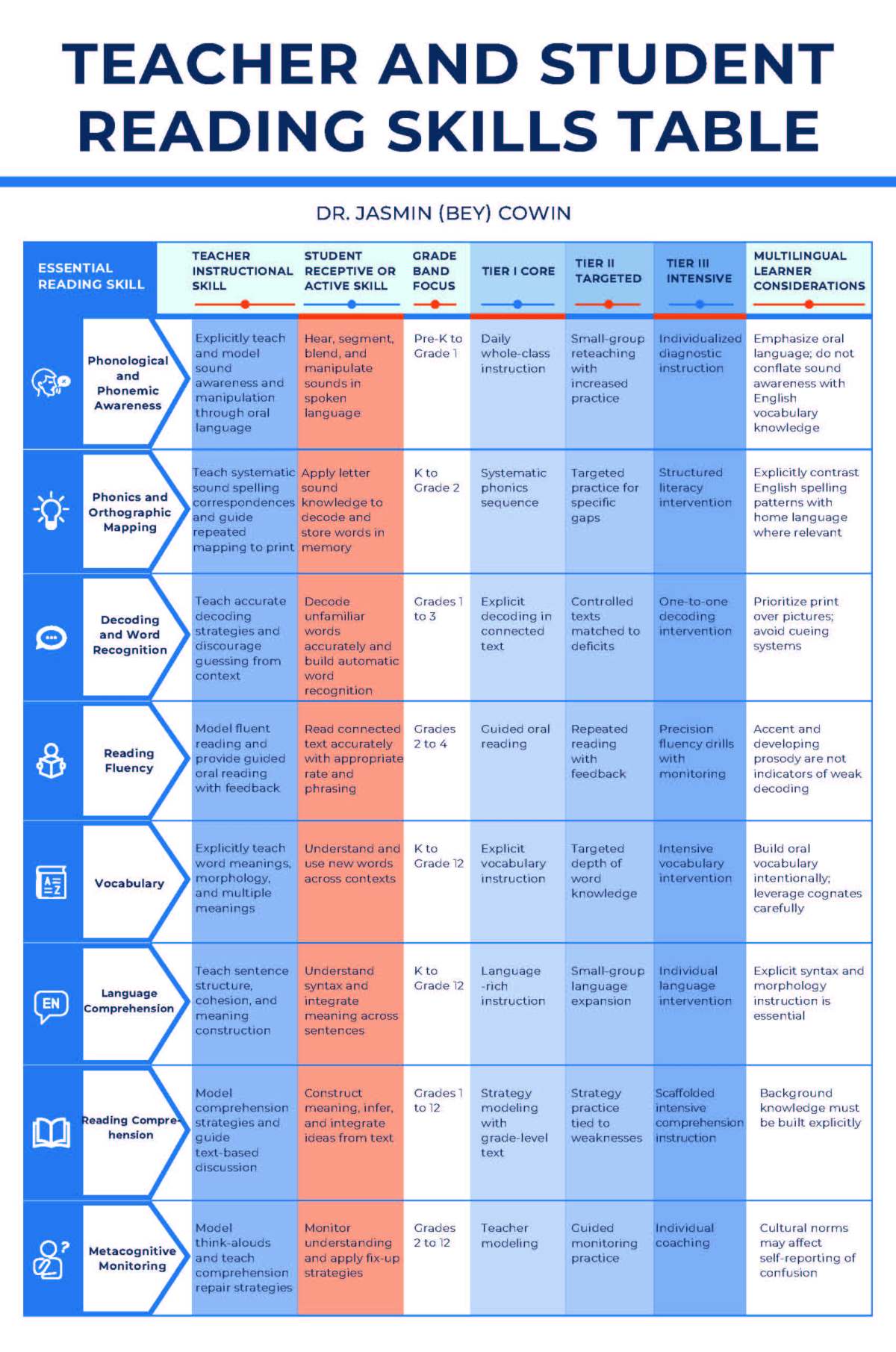
SoR: Teacher and Student Reading Skills Table


Supporting Instructional Alignment in Science of Reading Implementation

The Teacher and Student Reading Skills Table is intended to support educators in aligning instructional practices with evidence-based literacy research. Rather than operating as a scope-and-sequence, the table aims to clarify instructional roles, student skill development, grade band emphasis, tiered supports, and multilingual learner considerations. When used deliberately, it may help reduce ambiguity in Science of Reading implementation.

Foundational Skills: Phonological and Phonemic Awareness

The chart places phonological and phonemic awareness within oral language instruction, with emphasis in Pre-K through Grade 1. Teachers are expected to model and teach sound awareness and manipulation, while students work to hear, segment, blend, and manipulate sounds in spoken language.

An important implication of this framing is that phonemic awareness instruction does not rely on English vocabulary knowledge. For multilingual learners, sound awareness and lexical knowledge represent related but distinct competencies. Instruction that separates these skills may support more accurate interpretation of student performance and instructional need.

Across tiers, the chart suggests that increased intensity should involve additional practice and diagnostic attention rather than a shift to alternative activities.

Phonics and Orthographic Mapping

The chart situates phonics and orthographic mapping primarily in Kindergarten through Grade 2. Teachers provide systematic instruction in sound–spelling correspondences and guide repeated connections between print, pronunciation, and meaning. Students apply letter–sound knowledge to decode and gradually store words in memory.

This progression reflects the view that orthographic mapping develops through repeated, accurate decoding rather than exposure alone. The tiered structure emphasizes that students who experience difficulty may benefit from greater explicitness and structured practice rather than compensatory strategies.

For multilingual learners, contrastive analysis of English spelling patterns and home language orthographies is presented as an important instructional support when integrated within explicit phonics instruction.

Decoding and Word Recognition

In Grades 1 through 3, the table highlights instruction focused on accurate decoding strategies. Teachers guide students to attend to print, while students practice decoding unfamiliar words and building automatic word recognition.

The multilingual learner guidance encourages prioritizing print-based information and limiting reliance on pictures or context cues. This emphasis aims to support efficient word recognition development and to reduce instructional practices that may interfere with decoding growth.

Tiered supports in this domain are intended to reflect differences in intensity and instructional focus, informed by observed error patterns and student response to instruction.

Reading Fluency

Fluency instruction is emphasized in Grades 2 through 4 and is described as involving teacher modeling and guided oral reading with feedback. Students work toward reading connected text with increasing accuracy, rate, and phrasing.

The table notes that accent and developing prosody are not necessarily indicators of decoding difficulty. This consideration may help educators interpret fluency data more carefully for multilingual learners and distinguish between linguistic variation and skill-based needs.

Across tiers, fluency instruction becomes more targeted and closely monitored, with attention to maintaining a connection to underlying decoding accuracy.

Vocabulary and Language Comprehension

Vocabulary and language comprehension are presented as ongoing instructional priorities from Kindergarten through Grade 12. Teachers explicitly address word meanings, morphology, syntax, and sentence-level cohesion, while students work to understand and use language across contexts.

The chart’s separation of vocabulary, language comprehension, and reading comprehension reflects the view that these domains develop through related but distinct instructional pathways. For multilingual learners, intentional oral vocabulary development, explicit syntax instruction, and careful use of cognates may support language comprehension growth.

Tiered instruction in these areas often emphasizes depth of understanding and structured language practice rather than reduced linguistic demand.

Reading Comprehension and Metacognitive Monitoring

Reading comprehension instruction begins in early elementary grades and extends through secondary levels. Teachers model comprehension strategies and guide discussion grounded in text, while students practice constructing meaning, making inferences, and integrating ideas.

Metacognitive monitoring, introduced in Grade 2 and beyond, involves teacher modeling of think-alouds and instruction in comprehension repair strategies. Students develop the ability to notice breakdowns in understanding and apply appropriate fix-up strategies.

The table acknowledges that cultural norms may influence how students express confusion, suggesting that educators consider multiple indicators of comprehension.

Multi-Tiered Systems of Support and Instructional Coherence

The tiered structure outlined in the chart is intended to support instructional coherence across Tier I, Tier II, and Tier III. Core instruction provides the foundation, while targeted and intensive supports increase explicitness, practice, and responsiveness.

This framing positions MTSS as a system for adjusting instruction based on student need rather than as a static placement model.

Conclusion

I believe the value of the Teacher and Student Reading Skills Reference Table lies in its attempt to make instructional expectations more explicit across reading domains, grade bands, and tiers of support. When used reflectively, it may support instructional planning, collaborative decision-making, and more consistent implementation of Science of Reading principles across diverse classroom contexts.

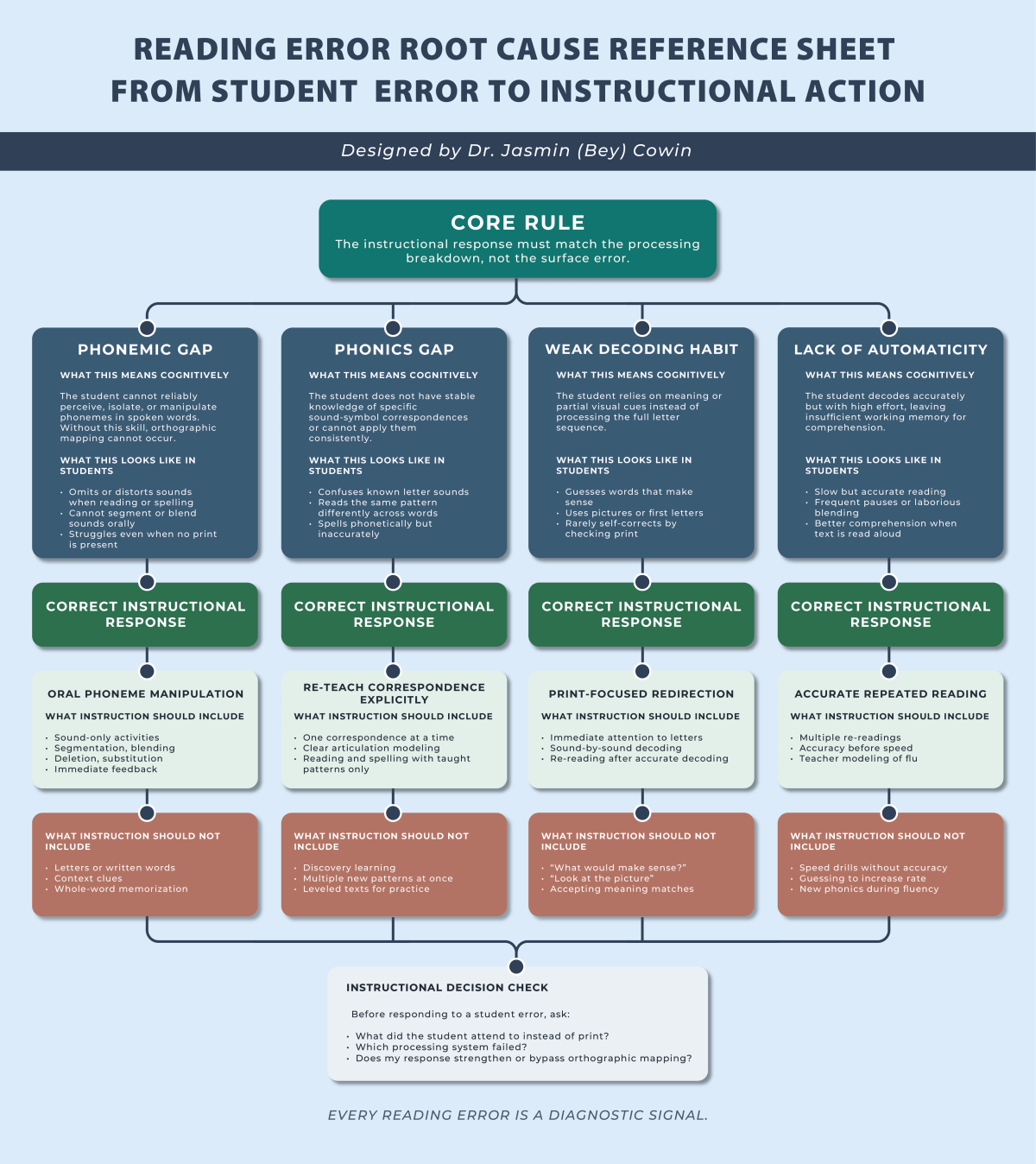
Infographic by Dr. Jasmin (Bey) Cowin: Reading Error Root Cause Reference Sheet – From Student Error to Instructional Action

This infographic is designed for educators working with Emergent Writers and Newcomers to Literacy (EWNL), English as a Foreign Language (EFL), and TESOL learners across elementary, secondary, and adult contexts who are acquiring literacy in alphabetic writing systems. Its purpose is to support instructional decision-making grounded in the Science of Reading by linking observable reading errors to the specific cognitive and linguistic processes that underlie word recognition.

The organizing principle of the infographic, the instructional response must match the processing breakdown, not the surface error, reflects a central finding of reading science: word reading difficulties arise from identifiable breakdowns in component processes rather than from general language proficiency, motivation, or exposure to text. Decades of research demonstrate that effective reading instruction requires diagnosing which processing system has failed and responding at that level with targeted instruction (Gough & Tunmer, 1986; Moats, 2020).

The framework is structured around four empirically supported domains of word recognition: phonemic awareness, phonics knowledge, decoding behavior, and automaticity. These domains align with models of skilled reading that distinguish between language comprehension and word recognition, most notably the Simple View of Reading (Gough & Tunmer, 1986), and with research on orthographic mapping as the mechanism that enables accurate and fluent word reading (Ehri, 2014; Share, 1995).

Each panel in the infographic identifies a specific processing breakdown and pairs it with an instructional response that directly supports orthographic mapping. For example, phonemic gaps require oral phoneme manipulation without print, while phonics gaps require explicit instruction in sound–symbol correspondences. Weak decoding habits reflect reliance on context or partial visual cues, which research has shown does not support long-term word learning (Share, 1995). Lack of automaticity reflects constrained working memory during reading and calls for accurate repeated practice rather than new phonics instruction (LaBerge & Samuels, 1974).

  1. Working Memory Capacity: Readers have limited working memory. Non-automatic word recognition quickly exhausts this capacity, hindering comprehension.
  2. Role of Practice: The goal of practice is to make decoding and word recognition so fast and accurate that it becomes automatic.
  3. Focus on Fluency: Instead of introducing new rules, practice should focus on increasing the speed and ease with which known skills are applied.

For multilingual learners, including EFL and TESOL students of all ages, this distinction is essential. Research indicates that decoding difficulties in second-language readers often mirror those of monolingual learners and should be addressed through the same evidence-based instructional approaches, while keeping language comprehension supports separate (August & Shanahan, 2006; Lesaux et al., 2007).

The instructional decision check reinforces a diagnostic stance toward reading errors, treating them as data that inform instruction. This approach aligns with Science of Reading principles that emphasize precision, systematic instruction, and alignment between assessment and response.

References