EDPN 673: Methods and Materials for Teaching English as a Second Language
This course provides an historical overview of second language acquisition theories and teaching methods. Students learn how to apply current approaches, methods and techniques, with attention to the effective use of materials, in teaching English as a second language. Students will engage in the planning and implementation of standards-based ENL instruction which includes differentiated learning experiences geared to students’ needs. Emphasis is placed on creating culturally responsive learning environments. The course also analyzes the applicability of applied linguistic studies to such teaching and the appropriateness of various methods and techniques to different developmental and skill levels. Special attention is given to curriculum development, planning and executing instructional activities. Additional emphasis is given to the selection of materials and the design of evaluation instruments for measuring cognitive development if the core subject areas.
This assignment focuses on exploring and analyzing K-12 pedagogical approaches, methods, and strategies relevant to teaching English to speakers of other languages (ESOL) in diverse classrooms. The objective is to develop a deep understanding of the strategies that effectively convey state and professional standards-based curricula to students from different age groups, ability levels, and cultural backgrounds. Additionally, the assignment aims to facilitate the development, adaptation, and evaluation of materials for lesson planning and assessment.
Originally from Long Island, New York, Madison Derwin holds a bachelor’s degree in Inclusive Childhood Education and is currently pursuing a graduate degree in TESOL. As an aspiring educator, Madison’s goal is to inspire students to reach their full potential through engaging lessons and hands-on learning experiences.
Ms. Derwin clearly connected her fieldwork to the course objective on second language teaching methods. Her interactions with the ENL-certified educator and attention to culturally responsive practices demonstrate strong professional engagement. Her descriptive focus on practical strategies such as scaffolding and visual aids, along with her recognition of the importance of inclusion and collaboration, reflects a thoughtful and intentional approach to her teaching observations.
“The only dreams impossible to reach are the ones you never pursue.”
There is a need for high-quality educators trained to offer bilingual education and services. For certified teachers and professionals, a bilingual certificate can extend your certification and opportunities. All Touro courses stress the importance of considering cultural factors alongside individual abilities in teaching bilingual students.
We offer three advanced certificates in bilingual education and services:
Bilingual General Education, PreK-12
The Advanced Certification in Bilingual General Education, PreK-12 is designed for mainstream teachers looking to work with bilingual students and teach your content area in two languages. This five-course program will equip you with the necessary knowledge, skills and strategies to effectively teach in bilingual classrooms, supporting students’ language development and academic success.
Courses
EDDN 636 – Linguistic Structure of the English Language – Sociolinguistic Perspectives
EDDN 638 – Teaching English as a Second Language through Modern English Approaches to Grammar
EDPN 671 – Theory and Practice of Bilingual and Multicultural Education
EDPN 673 – Methods and Materials for Teaching English as a Second Language
EDPN 675 – Methods and Materials for Teaching in the Native Language
Bilingual Special Education and Speech & Language Disabilities
The Advanced Certification in Bilingual Special Education and Speech & Language Disabilities is designed to prepare bilingual educational professionals to meet the unique needs of students with disabilities who are also English language learners. This five-course program will equip educators with specialized knowledge, skills, and strategies to provide effective bilingual education and services to students with special needs, speech and language disabilities, ensuring their academic, social and emotional growth. Upon completing this program, you will be equipped with the expertise and competencies necessary to positively impact the lives of students with disabilities who are English language learners.
Courses
EDSN 640 – Assessment of Individual Differences in General and Special Education: A Socio-Cultural Perspective
EDPN 671 – Theory and Practice of Bilingual and Multicultural Education
EDPN 672 – Methods of Teaching and Service Delivery in Languages Other Than English
EDPN 673 – Methods and Materials for Teaching English as a Second Language
EDPN 675 – Methods and Materials for Teaching in the Native Language
Bilingual Pupil Personnel Services
The Advanced Certification in Bilingual Pupil Personnel Services prepares educational professionals – including school psychologists, school social workers, school counselors, school administrators, and other pupil personnel services staff – to effectively support the diverse needs of bilingual students and their families. This four-course program will equip you with specialized knowledge, skills and strategies to provide culturally and linguistically responsive services, ensuring bilingual learners’ academic, social and emotional well-being.
Courses
EDPN 620 – Child Development and Learning in Cultural Context
EDPN 671 – Theory and Practice of Bilingual and Multicultural Education
EDPN 672 – Methods of Teaching and Service Delivery in Languages Other Than English
PSGN 698 – Field Experience in Bilingual Education and Service Delivery
Kenia Torres is a Bilingual Kindergarten teacher in the Brentwood Union Free School District. She received her Bachelor’s Degree in Child Studies with a concentration in Speech Communication from Saint Joseph’s University, a Bilingual Extension from Touro University, and is currently enrolled in a TESOL program in Touro University. Kenia is passionate about developing a classroom community that allows all children to achieve their academic and personal goals. In the future, she would like to pursue an educational leader role to empower educators and students to catalyze school success.
A quote that reflects Kenia’s vision about the educational field is:
“A teacher affects eternity; he can never tell where his influence stops.” – Henry Adams.”
🎯 My interview and podcast and interview is live: Season 4, Episode 2: The Future of Artificial Intelligence with Dr. Jasmin Cowin, Touro University Graduate School of Education. 💡 Thank you to my interviewer and excellent moderator, Gena Bardwell. It is an honor to be part of this episode of hashtag#Tourohashtag#Facultyhashtag#Chronicles. 🔴 We discussed the infallibility myth of AI, the often-held belief that AI outperforms human cognition. Yet, AI lacks human hashtag#commonsense. ✔️ We also discussed hashtag#nanotechnology, hashtag#syntheticdata, hashtag#socraticdiscourse, hashtag#algorithms and much more. 📖 I believe there is a difference between hashtag#intelligence and hashtag#consciousness. 💫The interview ends with a personal favorite quote by hashtag#Ovid: “All other creatures look down toward the earth, but man was given a face so that he might turn his eyes toward the stars and his gaze upon the sky.”
Our advanced certificates lead to NYSED certification in specialized areas and an extension/annotation on your NYS teaching credentials.
The extra credits can make all the difference, and specialization can help make you a more marketable, knowledgeable, and well-rounded educator.
Intensive, focused coursework and hands-on learning are benchmarks of the advanced certificate programs at the Graduate School of Education. We unite pedagogical theory and classroom practice, explore innovative teaching and outreach methods, and emphasize culturally responsive instruction.
Pursuing an advanced certificate is an ideal—and affordable—way for experienced teachers and educational personnel to strengthen their expertise in a specific area, from program development for gifted children to teaching English Language Learners with disabilities.
Most programs require 12-15 credits, inclusive of fieldwork. Upon successful completion, you’ll be eligible for an extension/annotation on your New York State teaching credentials, and your earned credits can apply to an additional salary differential.
With advanced certification, not only will you be able to more effectively and compassionately serve diverse student populations, you’ll increase your value as an educator and improve your career prospects.
Teaching English to Speakers of Other Languages (TESOL)
Our 15-credit Advanced Certificate in TESOL will allow you to expand your teaching to ESL or strengthening your capacities to serve a diverse student body. Evening, Sunday, and online courses are available.
Sara Sylaj was born in Albania and moved to the U.S at the age of 12. She holds a master’s degree in Italian education from Hunter College and is seeking an advanced TESOL certificate at Touro University. She currently work as a substitute teacher in the NYC DOE.
My experience at Touro University has been fruitful and productive, learning about different strategies and tools I can use to meet English learners’ language and academic needs and help them build confidence in their abilities as they acquire new knowledge in different content areas.
Sara Sylaj, Advanced TESOL certificate candidate at Touro University
The assignment: Differentiated Assessment Using Authentic Student Products with Emphasis on The Practices and Principles of Differentiation
Assignment Objectives:
Understand and integrate principles of differentiation into assessment techniques. Modify existing lesson plans to incorporate differentiated assessments using authentic student products. Integrate and discuss anonymized student products, focusing on differentiating assessment based on readiness, interest, and learning profile. Reflect on the practices and principles of differentiation and its impact on multilingual learners.
Paper:
Present both the original and modified lesson plans. In-depth discussion on the integration of anonymized student products and their relevance to differentiated assessment. Application of the differentiated strategies suchas Graphic Organizers, RAFTs, Choice Grids, VAK Tasks, etc. to provide clarity on the execution of differentiated assessment.
Video: Produce a 2-4 minute video presenting a chosen aspect of differentiated assessment, specifically showing how a student’s anonymized product illustrates YOUR PERSONALIZED differentiation in action.
Assignment Reflection:
Reflect on your understanding and application differentiation FOR ELLs/MLs. Discuss how differentiated assessment, grounded in student readiness, interest, and learning profile, impacts multilingual learners. Evaluate YOUR practices, challenges, and successes in implementing differentiation. Please note that you will write your reflection from an I-perspective, with explicit references to your work and professional growth.
Students will become acquainted with and practice effective approaches, methods, and strategies for teaching and evaluating English language learners in the content areas (ELA, social studies, math and science). Throughout the course, students will explore the impact of culture and language on classroom learning. Special challenges in teaching and assessment in each content area will also be discussed. Includes 15 hours of field work.
Anastasios Panagiotidis states that he is “a high school Earth Science teacher who proudly serves the South Huntington Union Free School District. As I enter my tenure year at the age of 25 my love and compassion towards the culturally and academically diverse student population have inspired me to craft lessons that not only target individual student needs but make learning relatable to the world outside of school. This is all in hopes that each student, regardless of language or academic abilities, can reach their highest possible potential through my instruction. “
I am eager to continue growing as a young educator, and Touro University has gifted me the tools, knowledge, and wisdom I strive to acquire as I continue to develop and mature as an educator, while allowing me the opportunity to broaden my horizons in a wide variety of areas relative to the rapidly evolving field of education.
Anastasios Panagiotidis, TESOL candidate, Touro University
The assignment description: Text Analysis & Critique Analyzing Complex Texts and Addressing Challenges for ELLs/MLs in the Content Area
Objective:
The objective of this assignment is to deepen your understanding of the cognitive and linguistic demands of complex texts in the content areas and to analyze a specific chapter or aspect of a content-area text currently used or recommended by the New York State/BOE. By closely examining the underlying concepts, you will develop a thesis and purpose for your analysis. You will critically evaluate the challenges that make the selected concept or section difficult for ELLs and provide substantial, logical, and concrete development of ideas in your critique.
Analyzing text complexity for English Language Learners (ELL) and Multilingual Learners (ML) requires a comprehensive approach that takes into account various factors. You can begin by examining the linguistic demands of the text, including vocabulary, sentence structure, and discourse patterns, ensuring they align with the proficiency levels of the students. Additionally, you, the teacher should consider the cultural and background knowledge necessary to comprehend the text, as well as the cognitive processes required, such as inference or critical thinking. Furthermore, evaluating the organization and coherence of the text, along with its purpose and intended audience, allows you, the teacher to gauge its appropriateness and relevance for ELL/ML learners. By conducting a thorough analysis of text complexity, you can make informed decisions about instructional strategies, adaptations, and scaffolding techniques to support their students’ language development and comprehension skills.
Deliverables:
Analysis of a Chapter or Aspect: Select a chapter or aspect of a content-area text and thoroughly analyze its complex nature. Identify and explain the quantitative elements, qualitative factors, and reader and task considerations that contribute to its complexity.
Development of Thesis and Purpose: Based on your analysis, develop a clear and concise thesis statement that reflects the main idea or argument of your analysis. State the purpose of your analysis, outlining the specific goals and objectives you aim to achieve.
Linguistic analysis which involves examining the linguistic features and demands of a text in order to determine its suitability for language learners. It focuses on various aspects of the text, including vocabulary, sentence structure, and discourse patterns, with the aim of aligning them with the proficiency levels of the students. Here’s a breakdown of these elements:
Vocabulary: The analysis considers the range and complexity of words used in the text. It examines whether the vocabulary is appropriate for the students’ language proficiency level, taking into account factors such as word frequency, difficulty, and relevance to the topic. It also considers the presence of idiomatic expressions, figurative language, and specialized terminology that might pose challenges for learners.
Sentence structure: The analysis looks at the complexity and variety of sentence structures employed in the text. It considers factors such as sentence length, grammatical structures (e.g., verb tenses, conditionals, relative clauses), and syntactic complexity. The aim is to ensure that the sentence structures are within the grasp of the students’ language proficiency level, allowing for gradual progression and challenges appropriate to their abilities.
Discourse patterns: This aspect of linguistic analysis examines how ideas and information are organized and presented in the text. It includes analyzing discourse markers (e.g., conjunctions, transitional phrases) that indicate relationships between ideas, as well as cohesive devices (e.g., pronouns, repetition, referencing) that connect sentences and paragraphs. The analysis ensures that the text’s discourse patterns are comprehensible and aligned with the students’ proficiency levels, promoting their understanding of the text’s overall structure and coherence.
This comprehensive course builds upon the foundation of curriculum development and classroom management in the context of teaching English language learners. Expanding its horizons to embrace the digital age, the course adeptly weaves innovative technology integration into the domain of Teaching English to Speakers of Other Languages (TESOL). Crafted to empower prospective TESOL/BLE educators, the course hones in on fostering competence in designing, implementing, assessing, and reflecting within diverse language learning environments, all while capitalizing on the potentials of cutting-edge technology. With a strong focus on practical application and discerning appraisal of technological tools, this course primes upcoming educators to excel amidst the ever-evolving educational landscape. Includes 10 hours of field work.
The assignment was to create a list of technology tools that not only aid teachers in instructional strategies and curriculum development but can also facilitate community outreach and engagement. I selected 9 tools that I currently use and explained how each tool can be used in an educational context for ELL students and for community outreach within my school. I used a padlet as I felt it was the best way to highlight each tool/website, it provides a clear view of the link, description and analysis. The assignment helped me further understand how many technological tools are used within a classroom.
Oralia Lainez-Tutka is a 4th year middle school Spanish teacher. This is her second semester with Touro University through the TESOL program.
“Although I have just begun my Touro journey, I do feel it is a positive one. My classes have supported my teaching, provided ample support, and I have been able to practice strategies and apply knowledge from my classes to my teaching. ”
This comprehensive course builds upon the foundation of curriculum development and classroom management in the context of teaching English language learners. Expanding its horizons to embrace the digital age, the course adeptly weaves innovative technology integration into the domain of Teaching English to Speakers of Other Languages (TESOL). Crafted to empower prospective TESOL/BLE educators, the course hones in on fostering competence in designing, implementing, assessing, and reflecting within diverse language learning environments, all while capitalizing on the potentials of cutting-edge technology. With a strong focus on practical application and discerning appraisal of technological tools, this course primes upcoming educators to excel amidst the ever-evolving educational landscape. Includes 10 hours of field work.
Jennifer Taranto, is currently enrolled in the Touro University TESOL master’s program. She earned a bachelor’s degree from Touro University in June 2023 and secured a teaching position immediately under a special education license. Now, in her second year of teaching, she approaches each day with a sense of gratitude and fulfillment. She shares: “This is my second year teaching, and every morning when I walk into my room, I feel extremely blessed and grateful.”
Touro is not just about learning facts, but about learning how to think, grow, and navigate the journey of becoming who I was meant to be.
Jennifer Taranto, Touro University TESOL master’s candidate
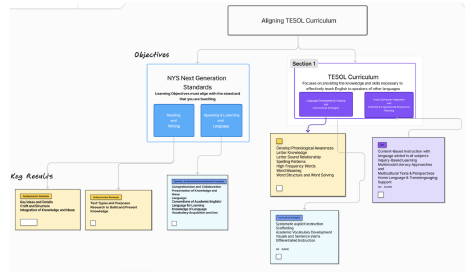
Jennifer Taranto: This was my first time creating a mind map. The assignment was to align NYS Next Generation Standards to the TESOL Curriculum. For aspiring ENL teachers, understanding how to align the NYS Next Generation Standards with TESOL instruction is crucial for delivering effective, meaningful, and legally compliant instruction. This alignment helps create an inclusive classroom where English learners can develop language proficiency while mastering grade-level academic content, ultimately setting them up for long-term success.
Jennifer Taranto: For this Padlet assignment in EDDN 635, I curated 9 favorite Tech tools. Each resource is broken down into descriptions, educational use, community engagement, and challenges. By completing this Padlet assignment, educators and students gain a well-rounded perspective on educational technology, learning how to leverage tech tools for student success, foster community connections, and navigate challenges. It is a valuable resource for future classroom integration and professional growth in a technology-driven educational landscape.
I am grateful to our collaborative, transdisciplinary and international work with Dr. Cristo Leon, Ph.D., James Lipuma, and Mauricio Rangel-Jimenez. 🚨 “Meta-participation and ethical transparency in role-playing games: Examining AI and algorithmic influence.” Integrating artificial intelligence (AI) and other non-human participants in role-playing games (RPGs) has brought new dimensions to interactive storytelling and game design. As AI evolves to simulate human-like interactions more convincingly, its role in games raises significant ethical questions, particularly regarding transparency and player agency. This paper critically examines these issues, focusing on the concept of the meta-participant—the programmer or author responsible for designing the AI’s decision-making algorithms— and the implications of their invisible influence and personal bias on the gaming experience of human players. Leon, C., Lipuma, J., Cowin, J., & Rangel-Jimenez, M. (2025). Meta-participation and ethical transparency in role-playing games: Examining AI and algorithmic influence [Peer-reviewed journal]. STEM for Success Resources(101). https://lnkd.in/eHSifda7
Students will become acquainted with and practice effective approaches, methods, and strategies for teaching and evaluating English language learners in the content areas (ELA, social studies, math and science). Throughout the course, students will explore the impact of culture and language on classroom learning. Special challenges in teaching and assessment in each content area will also be discussed. Includes 15 hours of field work.
Anastasios Panagiotidis is a dedicated high school Earth Science teacher serving the South Huntington Union Free School District. As he approaches his tenure year at the age of 25, he recognizes that his career is still in its early stages. However, his passion for education and commitment to fostering a supportive and inclusive learning environment drive his work every day. Inspired by the culturally and academically diverse student population he teaches, he strives to design engaging, student-centered lessons that not only address individual needs but also connect learning to real-world contexts. His ultimate goal is to ensure that every student, regardless of their language proficiency or academic abilities, has the opportunity to reach their fullest potential under his instruction.
Touro University contributes to the tools, knowledge, and wisdom I strive to acquire as I continue to develop and mature as an educator, while allowing me the opportunity to broaden my horizons in a wide variety of areas relative to the rapidly evolving field of education.
Anastasios Panagiotidis, Touro University TESOL candidate
The SIOP Model: An Essential Framework for ESL Instruction by Prof. Dr. Jasmin Cowin
The Sheltered Instruction Observation Protocol (SIOP) is a research-based instructional model designed to support English Learners (ELs) in developing both content knowledge and English language proficiency simultaneously. Developed by Echevarria, Vogt, and Short, the SIOP model provides a structured approach to lesson planning and delivery, ensuring that ELs receive comprehensible input and meaningful language support across content areas.
As a TESOL educator, understanding and implementing the SIOP model is essential for effective ESL instruction. The model provides a structured yet flexible framework that ensures ELs have equitable access to academic content while simultaneously developing their language proficiency. By integrating language and content instruction, teachers can create an inclusive classroom environment that promotes both linguistic and cognitive development for English Learners.
The SIOP Model: Components and Structure
The SIOP framework consists of eight interrelated components that guide teachers in designing effective lessons for ELs:
Lesson Preparation
Clearly defined content and language objectives
Use of supplementary materials to support comprehension
Meaningful activities that integrate both content and language practice
Building Background
Explicitly linking students’ background knowledge to new content
Connecting past learning experiences to new concepts
Introducing and reinforcing key vocabulary
Comprehensible Input
Adjusting speech for EL proficiency levels
Using clear explanations of academic tasks
Incorporating visuals, gestures, and realia to support understanding
Strategies
Teaching students learning strategies to support comprehension
Encouraging metacognitive awareness and self-monitoring of learning
Scaffolding tasks through teacher modeling, guided practice, and peer collaboration
Interaction
Promoting student-to-student discourse using structured peer interactions
Designing opportunities for extended academic conversations
Encouraging collaborative learning experiences
Practice & Application
Providing hands-on learning experiences
Integrating reading, writing, speaking, and listening activities
Allowing ELs to apply language skills in meaningful contexts
Lesson Delivery
Ensuring objectives are clearly communicated and met
Keeping students engaged and maintaining an appropriate pace
Aligning instruction with student needs
Review & Assessment
Regularly reviewing key concepts and vocabulary
Conducting formative assessments to monitor comprehension
Providing feedback to guide language and content development
Anastasios Panagiotidis’ Discussion Board provides excellent insight into Building Background.
Literacy [MS] The Master of Literacy program prepares teachers to become Literacy Specialists who work with students with reading and writing difficulties. The program includes ample field experience and leads to certification in both Birth – Grade 6 and Grades 5 – 12. Classes are offered online, as well as on site in Bay Shore in the evenings.
Alissa Fernstrom is currently a Teaching Assistant for a Special Education classroom in the Herricks School District. She completed her undergraduate dual degree in Early Childhood and Childhood Education at Molloy College, graduating in 2018. Afterward, she took graduate courses through Queens College to obtain her Special Education certification before selecting Touro University to obtain her Masters in Literacy. In addition to teaching in the classroom, she teaches dance, which allows her to share one of her life-long passions with others.
My time here at Touro has not been traditional, but the flexibility of the online program coupled with the supportive professors and staff, have made my journey to obtain my Masters in Literacy one I will forever be grateful for.
Alissa Fernstrom, Masters in Literacy, Touro University
Part I
a. Identify techniques for connecting students’ personal experiences and past learning to lesson concepts.
“It is a widely accepted notion among experts that a learner’s “schemata”—knowledge of the world—provides a basis for understanding, learning, and remembering facts and ideas found in texts” (Vogt, M., Echevarria, J.J., & Short, D. J., 2016, p.72). This fact is important to consider as a teacher, specifically of ENL students, because every learner comes into the classroom with their own set of knowledge that can be tapped into and utilized to help them better understand the new content being taught. One technique to connect students’ past experience with new lesson concepts is the use of anticipation guides. These guides consist of a number of statements that students can agree or disagree with based on their background knowledge of the topic being taught. This serves not only to activate their prior knowledge, but also to set a purpose for what they are to learn during the lesson. These questions should also be revisited at the end of a lesson in order to address any misconceptions and help students make new connections. Another technique that should be used when activating prior knowledge is culturally responsive teaching. Since students from different cultures will have vastly different experiences from their peers, it is important to consider that the way in which they will react to new information may not align with the way their peers do. It has been “questioned whether we can assume that students from every subculture will have the same experience with, or emotional reaction to a story or article, or whether we should expect the same outcomes from them” (Vogt, M., Echevarria, J.J., & Short, D. J., 2016, p.73). Teachers must consider that a student’s reading comprehension may be affected by their prior experiences or background knowledge and may not interpret a situation in the expected way. This is why culturally responsive teaching is a very important technique to utilize with ENL students.
b. List 2 elements of academic language and describe their importance for English learners.
”Academic language involves the use of more sophisticated sentence structures and forms of expression than are found in everyday conversation” (Vogt, M., Echevarria, J.J., & Short, D. J., 2016, p.76). This language is commonly seen in the content subject areas and leads to academic success. This type of language can be broken down into two specific groups, content vocabulary and general academic vocabulary. Content vocabulary “are the key words and terms associated with a particular topic being taught” (Vogt, M., Echevarria, J.J., & Short, D. J., 2016, p.76). These words are normally found in bold in the informational texts students read about a topic. They also include the words students need to know in order to share their thinking about a topic, such as character and setting. General academic vocabulary “are academic words and phrases students must learn because they are used in all academic disciplines” (Vogt, M., Echevarria, J.J., & Short, D. J., 2016, p.77). These types of words are not normally explicitly taught, but should be since they are words commonly seen in every academic setting. These words may have multiple meanings depending on the content being explored and can cause issues for ENL students. These words also help students to understand how information may be provided to them and how they are expected to interact with it. Both types of academic language are important and should be taught when working with ENL students.
Part II
a. Describe 1 activity YOU used during this week to introduce key academic subject-specific vocabulary for your ENL students. (p 76/77) divide your academic vocabulary using words from these three groups: content vocabulary, general academic vocabulary, word parts: roots and affixes?
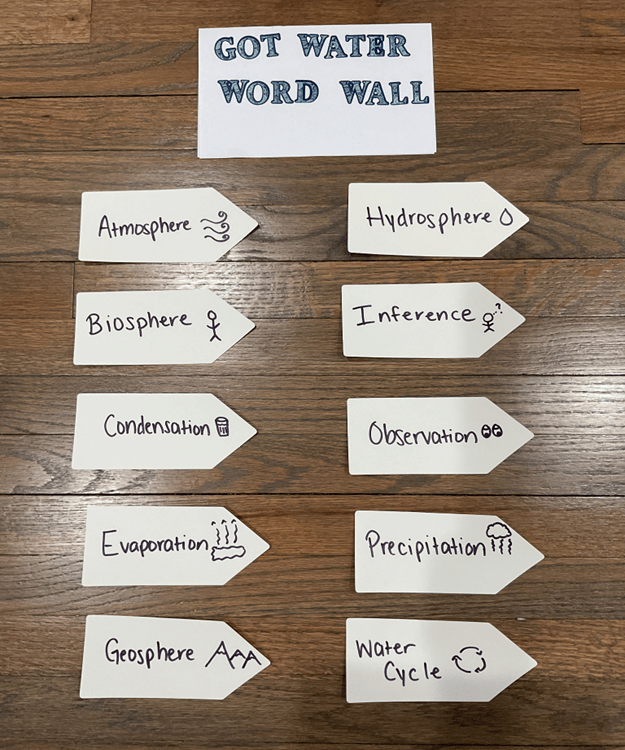
This week, I introduced academic subject-specific vocabulary to my 5th grade class, of which one student is an ENL student. We started a new science topic entitled “Got Water?” which focuses on the different spheres of the earth, specifically water. The way in which I introduced these words was by providing students with a list of the words and a picture to accompany each that they glued into their science notebooks. The pictures served as a great way for not only my ENL student, but for all students in my special education room, to create a concrete picture in their mind of what each word meant. Once students had their list, we went through each word one by one, giving students a chance to share their own background knowledge and build upon the definition I had given by using the word in a sentence. This allowed all students to participate and utilize the new vocabulary in a way that was familiar to them. We also talked about the prefixes on some of the words and had students share other words they knew of that started in a similar way. This further helped students to solidify the meaning of these new words.
general academic vocabulary: observation, inference, cycle
roots and affixes: hydro-, bio-
b. Describe 1 activity YOU used during this week to introduce general academic or language function vocabulary for your ENL students (p 76/77).
In our reading unit, students are working on a culminating project with their fantasy novels. The general academic words that were introduced and utilized this week to start this project were compare, contrast, and support your answer. The overall task is for students to pick two elements of a fantasy book and compare and contrast how these elements are seen in the class read aloud and their independent book. In order for students to effectively complete the assignment, they first had to understand what these general academic words mean. I started by simply writing both words on the board and having students use any prior knowledge they had about each word to create their own definition. Since these students are in 5th grade, they had all, including my ENL student, been exposed to these words and were quickly able to come up with definitions as a class. They also identified that we could use a venn diagram to help us compare and contrast the two books. Utilizing charts is a great way to help all students organize their thinking. Finally, we discussed what it means to support your answer. We first compared it to our math lessons when we are always asked to show our work. Students were able to make the connection that the work supports our answer and that in the case of reading, the words in the book are our support. This helped them to realize that supporting their answers in reading meant going back into the text.
c. Use one of the methods described (p 82 – 88) in YOUR classroom and describe what happened – please include a photo of any of YOUR realia/anchor chart/game cards.
The method I chose to utilize with my class is a word wall. A word wall is a place for relevant content words to be displayed in alphabetical order. “These words are revisited frequently throughout the lesson or unit, and students are encouraged to use them in their writing and discussions” (Vogt, M., Echevarria, J.J., & Short, D. J., 2016, p.85-86). I decided that a word wall could be a great way to display our new science words for students. I noticed that once the words were visible to students at all times, they were more likely to use the words when answering questions, not only during our science lessons, but making connections back to them throughout the entire day. For example, students spoke about how our predictions at the end of our chapter in reading were really inferences because we were using what we saw in the book to make a guess as to what would happen. This was so amazing to see as a teacher and hearing students that are both in special education and ENL utilize such sophisticated language in an appropriate way showed me how impactful such a simple vocabulary method could be.
C Vogt, M., Echevarria, J. J., & Short, D. J. (2016). Making content comprehensible for English Learners. (5th ed.). Pearson: New York.











 Dr. J's Education Blog