Touro University TESOL Candidate Oralia Lainez-Tutka’s Instructional Material Critique & Redesign with Infographic

EDPN 673: Methods and Materials for Teaching English as a Second
Language
: The Instructional Material Critique & Redesign with Infographic assignment prepares Touro University TESOL candidates to critically evaluate and adapt instructional materials for multilingual learners across diverse educational contexts. The assignment structure addresses specific TESOL and AAQEP standard requirements while developing essential professional competencies our graduates need in the field.
The dual-material analysis requirement ensures candidates develop expertise in material evaluation across developmental levels, addressing TESOL Standard 2 by requiring deep analysis of how language acquisition intersects with academic content delivery. Candidates must demonstrate understanding of developmental language trajectories and their implications for instructional material selection, a core competency for effective TESOL practice.
The WIDA PRIME protocol integration provides candidates with industry-standard evaluation tools currently used by school districts nationwide for material adoption decisions. This practical application directly aligns with AAQEP Standard 1’s emphasis on evidence-based practice while ensuring our graduates can contribute meaningfully to curriculum adoption processes in their professional contexts.
The non-negotiable criteria assessment develops candidates’ capacity to identify and address systemic barriers that multilingual learners face in accessing grade-level content. This component operationalizes TESOL Standard 3 by requiring examination of cultural representation and linguistic accessibility, while AAQEP Standard 2’s equity focus is addressed through critical analysis of how materials support or hinder multilingual learner success.
The redesign component transforms theoretical knowledge into practical application through differentiated material adaptation. Candidates must operationalize TESOL Standard 5 by creating instructionally sound modifications that maintain academic rigor while providing appropriate linguistic scaffolding across proficiency levels. This authentic assessment demonstrates candidate impact on multilingual learner outcomes, satisfying AAQEP Standard 3 requirements.
The infographic creation simultaneously addresses AAQEP’s technology integration competency requirements and develops visual literacy skills essential for multilingual learner instruction. Candidates must demonstrate proficiency with digital design tools while creating pedagogically sound visual supports that enhance comprehension for diverse learners. This component ensures graduates can effectively integrate educational technology to improve multilingual learner outcomes while building practical skills for immediate classroom application.
This assignment ensures our graduates possess both analytical expertise and practical competencies necessary for effective multilingual learner instruction.

Oralia Lainez-Tutka is a middle school Spanish teacher on Staten Island. Coming from a Spanish-speaking household, she is proud to be a first-generation college graduate now pursuing her master’s in TESOL at Touro College. She’s also a mom to a bilingual toddler, which makes this journey even more meaningful to her. She’s currently in her third semester.

I am already applying new scaffolding strategies and techniques in my teaching.  I’ve learned a lot so far during my Touro journey and am truly enjoying the learning process. I feel well supported by my professors and the program as a whole. 

Oralia Lainez-Tutka, TESOL Master’s Candidate, Touro University

Exclusive for Stankevicius “Global Supply Chains – From Fragmentation to Forecasting – an Interview with Wolfgang Lehmacher” by Dr. Jasmin Cowin

In this exclusive interview for Stankevicius Wolfgang Lehmacher offers a candid perspective on today’s logistics challenges: how de-globalization intersects with systems-level inefficiencies, why predictive analytics alone can’t solve carbon emissions, and what kind of innovation -cultural as much as technical – is required to redesign supply chains for a turbulent future. His views dovetail with the research evidence: that building intelligent, AI-powered supply chains requires not just algorithms but alignment—between systems, stakeholders, and strategies.

Cowin, J. (2025, March 25). Global supply chains – From fragmentation to forecasting – An interview with Wolfgang Lehmacher. Stankevicius. Retrieved from https://stankevicius.co/world/global-supply-chains-from-fragmentation-to-forecasting-an-interview-with-wolfgang-lehmacher/

Touro University TESOL Candidate Hamida Abdalla’s Technology Integration Fieldwork Project for EDDN 635

Teaching English to Speakers of Other Languages

New York is a state that speaks many languages. We need teachers who can find the common ground.

The MS in Teaching English to Speakers of Other Languages (TESOL) Program helps NYS-certified PreK-12 teachers more effectively teach and communicate with a diverse student population.

Academically rigorous and practice-intensive, the 33-credit program includes 5-15 hours of fieldwork embedded in each course

Hamida Abdalla is 22 and holds a bachelor’s degree in Childhood Education. She is pursuing a master’s degree in TESOL to help students develop their English language skills. Her goal is to create a supportive and accessible learning atmosphere that assists English language learners in improving their English language abilities, ensuring that every student can communicate effectively and achieve academic success.

Although this is only my first semester at Touro, I have gained valuable expertise to foster an inclusive learning environment where all students, regardless of their proficiency level, can thrive and reach their full potential. 

Hamida Abdalla, Touro University, TESOL Candidate

Ms. Abdalla submitted an exemplary and rich Field Experience for EDDN 635: Curriculum Development and Classroom Management in the Technology Era which required that”Candidates will engage in a dual observational role: in the classroom with English Language Learners (ELLs) or bilingual students, they will examine how educators integrate technology to enhance language instruction and manage a diverse classroom; in the school library, they will observe the role of technology in supporting literacy skills among linguistically diverse students.”

This field experience assignment is AI-proof because it demands direct personal observation and critical analysis of real-world classroom dynamics and personal interactions that cannot be fabricated by AI systems. The requirement for candidates to simultaneously examine classroom technology integration for ELL students and library-based literacy support creates a complex, interconnected observational task requiring authentic human presence and professional judgment. The rich, contextual details that emerge from observing how educators and librarians support linguistically diverse students through technology cannot be convincingly generated by AI, as these observations must draw from genuine human experiences, professional educational insights, and a nuanced understanding of how different learning environments complement each other.

Touro University TESOL Candidate Julianna Walter’s Text Analysis and Critique for EDDN 637 – “Marisol McDonald Doesn’t Match” by Monica Brown

Teaching English to Speakers of Other Languages

New York’s classrooms are some of the most culturally and linguistically diverse in the country. Our TESOL certificate program prepares NYS-certified teachers to provide responsive, comprehensive education to students of every background. 

EDDN 637 Second Language Learners and the Content Areas

Students will become acquainted with and practice effective approaches, methods, and strategies for teaching and evaluating English language learners in the content areas (ELA, social studies, math and science). Throughout the course, students will explore the impact of culture and language on classroom learning. Special challenges in teaching and assessment in each content area will also be discussed. Includes 15 hours of field work.

Julianna Walter, a 22-year-old graduate student in the TESOL program at Touro University holds an undergraduate degree in Elementary Education with a focus on both General and Special Education. Her passion for working with children and shaping young minds has always been a driving force in her career and studies.

“As a first-semester student in the TESOL program, I have already gained valuable strategies and tools for supporting English language learners, which I am eager to incorporate into my future classroom.”

Julianna Walter, TESOL program at Touro University

Excerpt by Julianna Walter, TESOL program at Touro University

Sentence Structure:

There are various sentence structures within the story ranging from short to long. The average sentence length in this story is 8 words. An example of a short sentence structure, with

minimal words, in the story is “Then I see him” (HMH, 31). This is one of the few short sentences in the story, as most sentences are longer and filled with detailed ideas that add to their length. An example of a longer sentence written in the story is “When I wake up on Saturday I put on my pink shirt, my favorite polka dot skirt, and my favorite hat— the one my abuelita brought me from Peru” (HMH, 30). Simple and complex sentence structures are also displayed throughout the story. The sentence “I like to wear polka dots” is an example of a simple sentence because it possesses a subject-verb-object structure. These types of sentences are more clear and straightforward making it more understandable for ELL students. Compound sentences “contain more than one independent clause” (Four Types of Sentences to Know). An example of a compound sentence in the story is “I am part Peruvian, and I am part Scottish” ( This sentence combines two related ideas with a conjunction. By basing this lesson on a story with various sentence lengths and structures it helps to build the students comprehension abilities. Second language learners will be able to improve their fluency and practice decoding words.

“Leveraging Fidgets for Enhanced Engagement in TESOL Classrooms: A TPR Approach” by Touro University TESOL Candidate Carly Croteau

I am very proud that my student Carly Croteau was selected to present at Touro University for the first GSE Shines Conference.

Carly Croteau graduated from SUNY New Paltz in 2021 with a Bachelor of Science Degree in Early Childhood and Childhood Education, concentrating in Spanish and minoring in Deaf Studies. As a dedicated student-athlete, Carly played on the varsity field hockey team for four years, serving as team captain for three of those years. In September 2022, C. began teaching fourth grade while pursuing a Master of Science Degree in Teaching English to Speakers of Other Languages (TESOL).

Croteau, C. (2024, September 22). Leveraging fidgets for enhanced engagement in TESOL classrooms: A TPR approach. GSE Shines Conference, Touro University.

View her video: Leveraging fidgets for enhanced engagement in TESOL classrooms: A TPR approach

Assessment Practices for Multilingual Learners: Insights from Touro University TESOL Candidate Carly Croteau

As an Associate Professor for the Touro University TESOL/BLE Department, I am immensely proud to feature outstanding student work from our MS in Teaching English to Speakers of Other Languages (TESOL) Program. New York’s linguistic diversity demands teachers who can find common ground and effectively communicate with students from different language backgrounds. Academically rigorous and practice-intensive, the 33-credit program leads candidates who complete all coursework, and fieldwork to recommendation for ESL certification.

Carly Croteau graduated from SUNY New Paltz in 2021 with a Bachelor of Science in Early Childhood and Childhood Education, concentrating in Spanish and minoring in Deaf Studies. Throughout her tenure at SUNY New Paltz, she was a committed varsity student athlete, playing for the field hockey team and serving as a three-year captain for the program. In September 2022, she began teaching fourth grade and started to work towards a Master of Science in Teaching English to Speakers of Other Languages (TESOL).

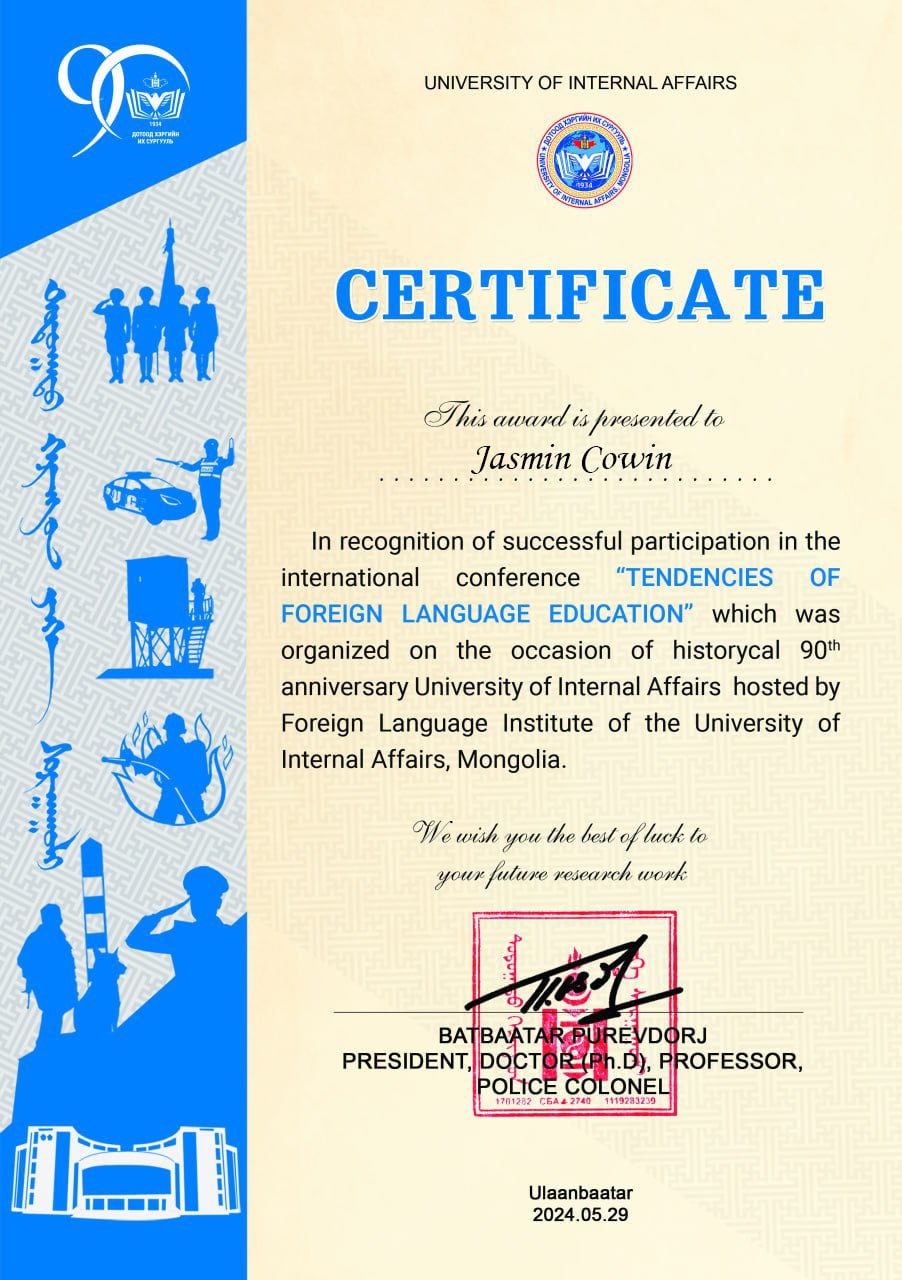
Dr. Jasmin (Bey) Cowin presents ‘Athenian Echoes: Technology’s Catalytic Impact on Academia 2030’ for the University of Internal Affairs of the Mongolian Ministry of Justice and Home Affairs

Cowin, J. (2024, May 29). Athenian echoes: Technology’s catalytic impact on academia 2030. Examining historical foundations and future transformations. Virtual presentation at the University of Internal Affairs of the Mongolian Ministry of Justice and Home Affairs “Tendencies of Foreign Language Education.”

Dr. Jasmin (Bey) Cowin published Sentient AI or Modern Myth? Anthropic’s Claude 3 Opus, Talos and the Golem of Prague

Cowin, J. (2024, April 29). Sentient AI or Modern Myth? Anthropic’s Claude 3 Opus, Talos and the Golem of Prague. Stankevicius. https://stankevicius.co/tech/sentient-ai-or-modern-myth-anthropics-claude-3-opus-talos-and-the-golem-of-prague/

Daniel Dinello, in his apocalyptic book “Technophobia!” forecasts, “Like a viral infection, technology develops into an autonomous, invasive force that expands and fulfills its dangerous potential by flourishing in the societal medium of corporate, military, and religious sustenance. Voracious in its urge to possess and engulf, technology is a parasite that frequently undermines human integrity—invisibly infiltrating, manipulating, seizing control, and mutating its human host to support its own survival and evolution. Like a virus, technology metamorphoses itself, because of unintended and uncontrollable consequences, progressively transforming the human world in the wake of its own modern changing structure.” (Dinello, 2006, p. 247)

For more, click on my column and read!

Dinello, Daniel. Technophobia!: Science Fiction Visions of Posthuman Technology, New York, USA: University of Texas Press, 2006. https://doi.org/10.7560/709546

“At the Crossroads of Languages, Morocco sings its Diversity” Infographic by Dr. Jasmin (Bey) Cowin

My infographic, “At the Crossroads of Languages: Morocco Sings Its Diversity,” portrays Morocco’s linguistic diversity, celebrating the rich tapestry of languages spoken nationwide. It explores the prevalence and cultural significance of Arabic, Berber, French, Darija, and Tamazight, illustrating how each contributes to Morocco’s unique societal and cultural identity.