Dr. Jasmin (Bey) Cowin joins as Co-Chair the Second Annual VirtuaTeLL Conference Committee for Spring 2022

Dr. Jasmin Cowin, Touro University, TESOL and Bilingual Department, GSE assumes the position as conference co-chair of the Second Annual VirtuaTeLL Conference Spring 2022.

VirtuaTeLL Conference Spring 2022 is part of NYS TESOL. This year’s conference theme Emerging Technologies in Language Learning and Teaching: Diversity, Criticality and Multimodality

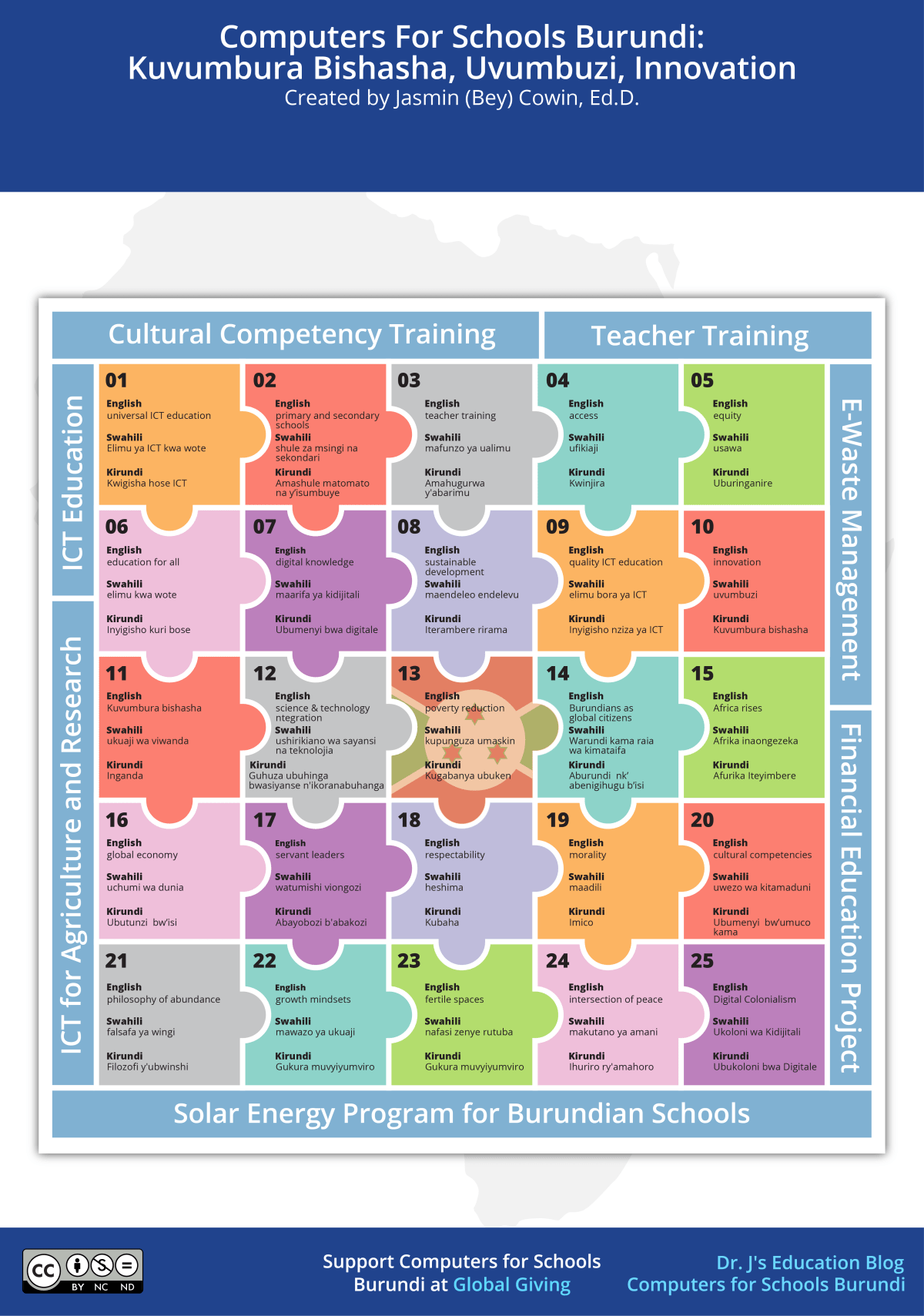
Dr. Jasmin (Bey) Cowin is a Fulbright Scholar; Assistant Professor and TESOL/Bilingual Practicum Coordinator at  Touro College, Graduate School of Education; co-conference chair of Second Annual VirtuaTeLL Conference Spring 2022 (VTCon 2022) Conference with the theme: Emerging Technologies in Language Learning and Teaching: Diversity, Criticality and Multimodality, past Editorial Board member of the Journal of Systemics, Cybernetics,  and Informatics for its special issue “Trans-Disciplinary Communication”, past chair of the New York State  TESOL 2021 conference; sustainability analyst for Computers for Schools Burundi; TESOL expert and Train the  Trainer for the Future Horizons Foundation for Translation, Training, and Development in Sanaa, Yemen; retired  Chair of the Rotary Club of New York United Nations International Breakfast Meetings; past President and past  Rotary Assistant Governor for New York State.  Dr. Cowin brings over twenty-five years of experience as an educator, technology specialist, and institutional leader. As an Education Policy Fellow at the EPFP™ Institute, Columbia University/Teachers College, she became part of a select group of strategic leaders analyzing trends regarding effective educational policy and leadership with a focus on preparing qualified educators for the complexities of 21st – century classrooms. Her extensive background in education, the Fourth Industrial Revolution, augmented and virtual reality simulation training, Green and Black Swan market shifts, not-for-profit leadership and commitment to the idea of education as a basic human right provide her with unique skills and vertical networks locally and globally.

The theme “Emerging Technologies in Language Learning and Teaching: Diversity, Criticality and Multimodality ” reflects current trends and approaches in second language learning and teaching Through inclusive, self-reflexive and multimodal practices embedded in our research and our teaching. This theme invites a broad consideration of related issues, including (but not limited to) the following: Smart CALL, Virtual Reality, Augmented Reality, language assessment and learner’s data, Natural Language Processing, Mobile Learning, Intelligent Tutors, games and language learning, gamification, Adaptive Learning algorithms.

Second Annual VirtuaTeLL Conference Committee

The Conference team:

Amany Alkhayat
Conference Chair

Dr. Jasmin (Bey) Cowin
Conference Co-chair

Christian Perticone
Conference Co-chair

Ali Safivand
Conference Co-chair

Annual VirtuaTeLL Conference Spring 2022 website

Touro University TESOL Candidates Brielmeier & Smith’s Comprehensible Input Mindmaps

EDDN 637 Second Language Learners and the Content Areas

Students will become acquainted with and practice effective approaches, methods, and strategies for teaching and evaluating English language learners in the content areas (ELA, social studies, math and science). Throughout the course, students will explore the impact of culture and language on classroom learning. Special challenges in teaching and assessment in each content area will also be discussed. Includes 15 hours of fieldwork.

Mindmapping is a strategy that helps students study and professors teach course material. A mindmap is a diagram that is used to visually outline information. One of the most common types of mindmaps is a large brainstorming web where a central word or idea branches out into related subjects. As ideas are fleshed out and connect to one another, one can see how concepts tie together to get a better understanding of what you are trying to study. By using words, pictures, and diagrams, you are able to organize your thoughts in a way that helps you follow your train of thought when you come back to study further. Using a combination of words and pictures while studying is six times more advantageous for remembering information than words alone. Mindmaps differ from other forms of outlines by removing their linear nature and instead positioning information in a way that is more natural for the brain to process and retain. Mindmapping takes a conceptual approach to teaching and learning, and helps students visualize a subject and understand how various ideas are interconnected in both the theoretical and practical senses. In addition to seeing information in a way that helps students remember more of what they are being taught, they are also able to increase their critical thinking and/or memory skills (and thus correct the deficit in critical thinking). Long after their days of cramming for finals are over, the skills they sharpen by using mindmaps will translate to their professional lives. For students that rely on visual learning methods in order to complete projects and study for exams, mindmaps make it easier to communicate thought processes so their teachers and classmates can better understand their ideas.

Mindmaps also allow teachers to gain insight into their students’ thought processes and see the development of their work. This allows them to assess strengths and weaknesses, while also monitoring growth.

The Benefits Of Mindmapping For Learning:
Drawing Ideas

by Andrew Sperl

Week 4’s Discussion Board is constructing a mindmap of comprehensible input strategies AND connecting those to teaching strategies.

  • Share the mindmap in your DB as a screenshot.
  • Below a sample Mind Map from Mind Meister, a free mind mapping tool https://www.mindmeister.com/
  • You need to include your name in the mindmap, title it, and show the connections of comprehensible input strategies to YOUR teaching IN your CLASSROOM.
  • Make sure you include all sources in your mind map
  • Give feedback on 2 of your peers’ mind maps.

Touro University TESOL Candidate Rachel Brielmeier is a certified teacher from B-6th grade general education and special education. She teaches in an 8:1:1 special education classroom and is completing her master’s degree in the TESOL program at TOURO College.

Touro University TESOL Candidate Shannon Smith pursues a master’s degree in TESOL at Touro University, Graduate School of Education. She is currently filling in as a leave replacement Kindergarten and First grade ENL teacher at Greenport Elementary School. Shannon Smith, “This mind map is a digital representation of all the different techniques and strategies I utilize in my own teaching to help support my ENL students.”

Touro University TESOL Candidate Kristen Bergin’s Multilingual First Grade Grammar Guide

In the Touro University TESOL course EDPN 673 Methods and Materials for Teaching English as a Second Language the infographic assignment aims to introduce instructional high-leverage practices to TESOL/Bilingual teacher candidates such as:

  • Systematically design instruction toward a specific goal
  • Adapt curriculum tasks and materials for specific learning goals
  • Teach cognitive and metacognitive strategies to support learning and independence
  • Provide scaffolded supports
  • Use explicit instruction

Kristen Bergin graduated from Saint Joseph’s College with her Bachelors in May 2021. She started her professional career as a substitute teacher for the Department of Education in Manhattan.

“As a teacher, it is my job to act as a guide in creating a rich environment for students to learn through my focus on high leverage instructional practices.”

Kristen Bergin, TESOL Candidate
Touro University, GSE

Infographic Description:

An infographic is a visual tool to provide information as a support for students. This infographic was created to support ML first-grade students in building a sentence. This infographic includes Spanish sentence building blocks to support all my first-grade students.

An infographic is a visual tool to provide information as a support for students.

Kristen Bergin, TESOL Candidate
Touro University, GSE

Touro University, GSE TESOL Candidate Erin Gage’s ‘Think Like a Historian’ Infographic

EDPN 673 Methods and Materials for Teaching English as a Second Language

This course provides a historical overview of second language acquisition theories and teaching methods. Students learn how to apply current approaches, methods and techniques, with attention to the effective use of materials, in teaching English as a second language. Students will engage in the planning and implementation of standards-based ESL instruction which includes differentiated learning experiences geared to students’ needs. Emphasis is placed on creating culturally responsive learning environments. Includes 15 hours of field work.

Erin Gage is a passionate educator who has taught 7th grade Social Studies and Humanities for six years in Brooklyn. She taught at both Summit Academy Charter School and Apollo Middle School before making her way to teaching back home on Long Island. She is a firm believer in creating a student-centered classroom where students feel validated and heard.

Infographic Description:

Infographics serve as a visual representation of information to enhance student learning. This infographic was created to support seventh-grade students taking United States History. Throughout this class, students are responsible for analyzing both primary and secondary sources while discussing the importance of perspective.

This infographic helps students identify examples of primary and secondary sources while comparing and contrasting similarities and differences between them.

Erin Gage

Touro University TESOL Candidate John Zurschmiede ‘s ‘Personal Experience Narrative Infographic’

EDPN 673 Methods and Materials for Teaching English as a Second Language

This course provides a historical overview of second language acquisition theories and teaching methods. Students learn how to apply current approaches, methods and techniques, with attention to the effective use of materials, in teaching English as a second language. Students will engage in the planning and implementation of standards-based ESL instruction which includes differentiated learning experiences geared to students’ needs. Emphasis is placed on creating culturally responsive learning environments. Includes 15 hours of field work.

Assignment Description:

For this assignment, you will create an infographic for a specific group of learners (your audience). It is highly recommended that you create your infographic for the learners that you are currently teaching, or typically teach. You will know more about this group than other groups of learners and are likely to have an easier time designing instruction for them. Integrating the infographic into one of the SIOP lessons is recommended.

Your project will be assessed on the following:

  • Content: content is specifically tailored to ENL/ESL students for a specific grade level,
  • Focus: All content (visual and textual) concisely complements the purpose of the infographic
  • Visual Appeal: Fonts, colors, layouts, & visual elements meaningfully contribute to the infographic’s ability to convey the overall message
  • Argument: The infographic effectively informs and convinces the reader of its intended purpose
  • Organization: Information is systematically organized and supports readers’ comprehension of the main message
  • Citation: Full bibliographic citations are included for all sources referenced
  • Mechanics: The infographic is free of spelling or grammatical errors

Infographics Background:

An infographic is a highly visual representation of information, data, or content that is intended to quickly communicate information to a reader. Smaller than but similar to a poster, an Infographic often communicates a central argument, topic, or thesis focusing on the overall patterns, themes, or salient points. As a quick visual representation, Gillicano and colleagues (2014) suggest that an infographic is easily comprehended and read in less than a minute.

Choose the purpose

Decide on the purpose and teaching point of the infographic for your Multilingual Learners (ML’s) .

WHY are you designing this infographic?
HOW will this infographic serve MLs?
WHAT are you trying to point out, teach, focus on, or reinforce?
WHICH language production is this infographic focusing on?
WHERE in your lesson plan will YOU be able to use this infographic?

‘I started my teaching career working with children who had special needs. Then, I transitioned to ESL but soon ended up in managerial roles. Recently, I made the happy decision to return to the classroom as that is what I am truly passionate about.”

John Zurschmiede, Touro University, GSE
TESOL Candidate

I created this infographic using a flow diagram we use at the Board of Education. I noticed that some of the MultiLingual Learners in my class struggled with some of the concepts outlined in the flow diagram. I decided to modify the flow diagram to make multilingual friendly by doing the following.

1) Explicitly show sequence and directionality by including arrows and numbers for each step.

2) Providing a clear visual for Mind Mapping while explicitly highlighting the ‘wh’ questions that needed to be answered.

3) Explicitly outlining what needed to be included in an opening and closing statement.

4) Explicitly providing transition words that students needed to use in their narrative.

John Zurschmiede’s Personal Experience Narrative Infographic

Touro TESOL Candidate Alyssa Petry on Classroom Discourse and Assessment in EDPN 673

Touro’s Teaching English to Speakers of Other Languages Program

New York is a state that speaks many languages. We need teachers who can find the common ground.

The MS in Teaching English to Speakers of Other Languages (TESOL) Program helps NYS-certified PreK-12 teachers more effectively teach and communicate with a diverse student population.

Academically rigorous and practice-intensive, the 33-credit program includes 50 hours of fieldwork and at least 20 days or 100 hours of supervised student teaching experience. Candidates that complete all coursework, fieldwork, and student teaching requirements are eligible for recommendation for ESL certification.

Alyssa Petry has been a pre-k teacher for the last three years. She is fuelled by a passion for education and supporting her students to achieve their fullest potential. Ms. Petri said: “I believe that given the right tools, our students can climb even the highest mountains!”

The teacher is there to provide support and encouragement and direct instruction, the students are there to practice and apply their new knowledge to content areas.

Alyssa Petry

Touro TESOL Candidate Kristi Mattina on Illustrative Examples of Teacher Classroom Discourse

Teaching English to Speakers of Other Languages

New York’s classrooms are some of the most culturally and linguistically diverse in the country. Our TESOL certificate program prepares NYS-certified teachers to provide responsive, comprehensive education to students of every background. 

What You’ll Learn

The 15-credit program includes five courses—each with carefully designed fieldwork experiences—that emphasize both academic content learning and English fluency for English Language Learners.

We explore contemporary theory and research-based instructional strategies for multicultural education, methods and materials for second language acquisition, and best practices for teaching ELLs in specific subjects. We give you the tools to ensure that your students meet the latest performance standards of PreK-12 curricula in both private and public schools.

Courses are offered evenings and Sundays, and online to accommodate our students’ diverse scheduling needs, and you’ll receive personalized guidance based on your current work and career goals from highly qualified and experienced professors.   

Upon completion of the program, you’ll be eligible for the New York State Advanced Certificate in ESOL. All courses are transferable to the master’s degree program in TESOL at Touro College

Kristi Mattina holds a Bachelor’s degree in Childhood Education and a Master’s in Special Education. In June, she completes her 11th year of employment with the NYCDOE. She is a Special Education teacher and taught in ICT and 12:1+1 settings in District 31. She also enjoys spending time with her family and two young children.

Course Description

EDPN 673 Methods and Materials for Teaching English as a Second Language

This course provides an historical overview of second language acquisition theories and teaching methods. Students learn how to apply current approaches, methods and techniques, with attention to the effective use of materials, in teaching English as a second language. Students will engage in the planning and implementation of standards-based ESL instruction which includes differentiated learning experiences geared to students’ needs. Emphasis is placed on creating culturally responsive learning environments. The course also analyzes the applicability of applied linguistic studies to such teaching and the appropriateness of various methods and techniques to different developmental and skill levels. Special attention is given to curriculum development, planning and executing instructional activities. Additional emphasis is given to the selection of materials and the design of evaluation instruments for measuring cognitive development in the core subject areas.

Kristi Mattina and her Discussion Board Contribution

DB 3 Program Models – Bilingual & ESOL

Give specific illustrative examples of YOUR PERSONAL teacher classroom discourse IN YOUR CLASSES.

Prior to teaching a new topic, my co-teacher and I always have some sort of a lesson warm-up. If we are beginning a new novel, we have students generate “before” reading questions and comments. We discuss the title, cover illustration, and topic of the novel and invite students to come up with any questions or comments they may have prior to reading. Students work in groups or pairs and write their responses on post-its which are then hung on an anchor chart under the heading “before reading.” Students are always quick to participate during this activity since it encourages students to share their prior knowledge or invites them to ask a question. There really aren’t wrong answers and this creates a stress-free environment for students who are usually reluctant to share ideas.

Another example of teacher classroom discourse, that I have been using more increasingly this year, is extended wait time. I admit that in past years, I would ask a question and call on one of the first few students who raised their hands. This does not give the class enough time to process the question being asked, especially if it uses academic language. As an adult, I find that it takes me time to process some questions, so why would that be different for my students? As I increased the wait time after I asked a question, I saw that more students slowly began to raise their hands. It is definitely an effective way to encourage students to share their thinking.

As I increased the wait time after I asked a question, I saw that more students slowly began to raise their hands. It is definitely an effective way to encourage students to share their thinking.

Kristi Mattina, Candidate at the TESOL and Bilingual Department,Touro College, GSE

PRETEND THAT YOU OBSERVE YOUR OWN CLASS – use the sample classroom observation feedback form p. 361 in your textbook and reflect on what you learned about your planning, teaching and assessment.

I chose to reflect on an activity I implemented after finishing a narrative writing unit. The purpose of this lesson was to reinforce the narrative writing standards that were taught previously and to give students an “on demand” writing piece to demonstrate how much they retained in regards to narrative writing techniques. The lesson involved watching a 3-minute cartoon without volume. We then showed a written model of how one could have narrated the video. Students watched a different video on silent and were given the task of narrating the video using the techniques we had taught.

Lesson Quality: The lesson objectives involved using narrative techniques in student narration. Students were engaged while watching the video and they seemed to enjoy creating their own stories to go along with the video.

Teacher Presentation: I have been a 5th-grade teacher for 7 out of my 11 years of teaching. I feel that I know the writing standards very well. We are constantly looking for different ways to teach our lessons in order to keep our students engaged. They seemed to love this activity. I knew I had clearly presented the task when all students were working actively and independently.

Student Participation: As mentioned above, students were very interested. After I modeled the task, students asked questions such as: “Can we add dialogue to our narration?” “Can we make up names for the characters?” and “Is it alright if we exaggerate a little?” Students made sure that their questions were answered and they were excited to begin the task.

Major Strengths: Regardless of academic ability, all students were able to create a narrative story to explain what was happening in the video. I think a strength was coming up with an activity that all students could access while keeping them interested.

Questions/Suggestions: I think one thing I would have done differently would have been to include a 2nd video that was 1 minute long instead of the 3 minute video. When planning the lesson, 3 minutes seemed short to me. However, there was a lot of detail that occurred and it may have been difficult for all students to capture it in their writing.

4. ON p 389 in your textbook -391 you will find textbook evaluation checklists. Take one book YOU USE CURRENTLY in YOUR classroom and analyze it with those checklists. Reflect on what you learned in your answer in the DB with specific, descriptive examples.

I chose to analyze an ELA Practice Coach book. We use this book because at this point in the school year we have covered most of the 5th-grade reading standards and the book allows us to spiral back to review and reinforce the standards.

Analysis of Linguistic Content: The text uses academic language in its questioning. We change the sequence of the text to suit the standards we are teaching at that moment. The book is aligned to the 5th-grade learning standards and mirrors our curriculum.

Analysis of Thematic Content: Many topics are covered throughout the text. It includes a variety of literary and informational texts. Being that the topics are so vast, students usually identify with a lot of the topics, but not necessarily all of them.

Analysis of Activities for In-Class Use: Each topic in the text begins with an introductory activity. After assessing previous student data on the standard and depending on the level of support needed for the standard, we may incorporate the introductory activity. If the students demonstrate understanding of the topic, we may just go-ahead to the practice part of the lesson. The introductory activity includes guided reading questions and analysis of a question and response.

Analysis of Activities for Homework: Homework, in my class, is given as a reinforcement of the lessons taught that day. I use the text to assign homework on the topic discussed that day, as long as I don’t feel it is too complex for independent practice.

Analysis of Activities for Testing Purposes: The text does supply benchmark assessments to mirror the book’s material.

Analysis of Activities for Review Purposes: Generally, we use the entire text to spiral back to standards already taught. We also use the materials in the text to help students apply what they have already learned.

Analysis of Activities: Special equipment does not need to be ordered ahead of time, but I do create model answers to constructed and extended response questions to help students organize their responses more clearly.

Analysis of Unit Connections and Review Points: Connections are constantly made between the standards we have covered and the activities in the text.

Analysis of What to Skip: As stated above, we do “jump around” quite a bit so that the information in the text mirrors our lesson objectives. At times, we may skip the introductory part of the lesson if students have demonstrated that they do not need that support.

5. Gather some information on student assessment from your school district. What kinds of student assessments are regularly administered, and in what language? If the district includes non-native speakers of English, are testing and assessment requirements modified or altered in any way to accommodate them? If so, how?

One example of an assessment given by our district is the Measure of Student Learning. It is given at the beginning of the school year to assess students’ incoming proficiency on a topic. It is then given again at the end of the school year to measure growth. In my school, the test is given in English. Accommodations are given to students with special needs as they are written on the IEP. After discussing it with the ENL teacher at my school, she explained that since MOSL is a baseline assessment that measures student growth and does not measure English proficiency, there is the option to give it in the student’s home language. The only accommodation given to an ELL student who does not have an IEP is extended time.

6. In NYS, what are the Program Options for English Language Learners/Multilingual Learners?

In NYS, program options for ELLs/MLLs include: Transitional Bilingual Education (TBE) programs- In these programs, students speak the same language. They learn to read, write, speak, and understand English while receiving content instruction in their home language.

Dual Language (DL) programs- Students receive instruction in both their home language and the language they are learning in the hopes reading, writing, speaking, and understanding 2 languages. There is an emphasis on culture in order to promote strong self-esteem.

One-way Dual Language program-Students speak the same language and have similar backgrounds. Instruction is taught in students’ home and target languages.

Two-way Dual Language program-Students include native English speakers and ELLs. Students receive instruction in both their home and target languages. “The goal of these programs is for students to develop literacy and proficiency in English and in the home/target language (the second language that is being acquired/learned)” (Program options for Ells and MLS). Integrated ENL classes- Students receive both content area and English instruction. The home language is used to support understanding. Teachers of these programs have content area and ENL certification OR each certified teacher works collaboratively.

Stand-alone ENL class- Students have very diverse backgrounds. Students are taught English instruction by an ESOL teacher in the hopes of supporting the student in other content areas. (Program options for Ells and MLS)

7. What is the purpose of Commissioner’s Regulations – Sections 117 http://www.p12.nysed.gov/sss/lawsregs/117-1-3.html (Links to an external site.)

The purpose of Commissioner’s Regulations -Sections 117 is to ensure that all new student admits into a district are properly screened. New students are screened for having learning disabilities, limited english proficiency, or being gifted and talented. Upon admittance to a NYS school, students are screened for health exams including immunizations, academic development, and home language. If it is determined that a student has a disability, limited english proficiency, or is gifted, the appropriate referral will be made (NYSED, 2010).

8. How do the BLUEPRINT FOR ENGLISH LANGUAGE LEARNER/MULTILINGUAL LEARNER (ELL/MLL) SUCCESS http://www.nysed.gov/common/nysed/files/nys-blueprint-for-ell-success.pdf (Links to an external site.) and CR Part 154 Comprehensive ELL Education Plan (CEEP) and ENL staffing requirements connect with each other? http://www.nysed.gov/bilingual-ed/cr-part-154-comprehensive-ell-education-plan-ceep? (Links to an external site.)http://www.nysed.gov/common/nysed/files/programs/bilingual-ed/enl-k-8-units-of-study-table-5-6-15.pdf

The blueprint for ELL/MLL success describes all teachers as being ENL teachers, whether that is their background or by working collaboratively. This blueprint ensures that all the needs of the learner are being met. This includes academic and social needs. It encourages districts to see ELLs and MLLs and their families as assets and partners within the learning environment. It also involves the use of formative assessment tools in order to ensure that students are understanding content area material. The main purpose of a CEEP is to also ensure the needs of a student are being met. The CEEP is a document, where as the blueprint is a set of principles. The principles outlined in the blueprint should be considered when writing the CEEP. This plan should specifically explain how student needs are being met. “The CEEP is divided into multiple sections in which LEAs must outline how they are addressing the needs of their ELLs and describe their strategic plan for providing grade-appropriate, linguistically and academically rigorous instruction that will allow ELLs to meet the Next Generation Learning Standards in alignment with the expectations set forth in the New York State Blueprint for English Language Learner/Multilingual Learner Success. When completing the CEEP it is recommended that LEAs familiarize themselves with the principles outlined in the Blueprint.” (CR Part 154 comprehensive ell education plan (Ceep) 2021)

Resources:

Commissioner’s Regulations – Sections 117.1-3. NYSED. (2010, March 31). Retrieved February 1, 2022, from https://www.p12.nysed.gov//sss/lawsregs/117-1-3.html

CR Part 154 comprehensive ell education plan (Ceep). New York State Education Department. (2021, October 26). Retrieved February 1, 2022, from http://www.nysed.gov/cr-part-154-comprehensive-ell-education-plan-ceep

Blueprint for ell success – new york state education … (n.d.). Retrieved February 1, 2022, from http://www.nysed.gov/common/nysed/files/nys-blueprint-for-ell-success.pdf

Program options for Ells and MLS. New York State Education Department. (n.d.). Retrieved February 1, 2022, from http://www.nysed.gov/bilingual-ed/program-options-english-language-learnersmultilingual-learners

Rennie, J. (1993, August 31). ESL and bilingual program models. Eric Digest. ESL and Bilingual Program Models. ERIC Digest. Retrieved February 1, 2022, from https://www.ericdigests.org/1994/esl.htm

Celce-Murcia, M., Brinton, D. M., & Snow, M. A. (2014). Teaching English as a second or foreign language. Boston: National geographic learning.

Dr. Jasmin (Bey) Cowin presents Reimagine and Redesign: Augmented Reality Digital Technologies and 21st Century Education at ICLTTE 2022, the 16th International Conference on Language Teaching and Teacher Education in Jeddah

I am pleased to share my presentation and abstract for Reimagine and Redesign: Augmented Reality Digital Technologies and 21st Century Education.

The International Conference on Language Teaching and Teacher Education aims to bring together leading academic scientists, researchers and research scholars to exchange and share their experiences and research results on all aspects of Language Teaching and Teacher Education. It also provides a premier interdisciplinary platform for researchers, practitioners and educators to present and discuss the most recent innovations, trends, and concerns as well as practical challenges encountered and solutions adopted in the fields of Language Teaching and Teacher Education.

Algorithmic approaches to decision-making are starting to permeate both institutional and personal spheres through decision support systems. In education, AI and intelligent systems are poised to become change agents with deep impacts not only on assessment, administrative functions, organizational strategic planning, student acquisition, and retention but also on curriculum design, and personal learning networks (PNL). The global competitiveness of educational institutions and their graduates’ rests on their ability to be agile and nimble in adopting adaptive technology spaces.

Dr. Jasmin (Bey) Cowin

Abstract
This paper explores augmented reality digital technologies (ARDTs) and their use in educational cases in the artificial intelligence (AI) age. The future of education and work are evolving to a fluid landscape with an uncertain job or career trajectories due to a VUCA (volatility, uncertainty, complexity, ambiguity) environment. Structuring education as a menu of predefined
disciplines and degrees, situated in brick-and-mortar educational institutions may no longer be an optimal education model.
Algorithmic approaches to decision-making are starting to permeate both institutional and personal spheres through decision support systems. In education, AI and intelligent systems will become change agents with deep impacts not only on assessment, administrative functions, organizational strategic planning, student acquisition, and retention but also on curriculum design and pedagogies.
The convergence of three areas: ARDTs, big data, and global demand for a highly qualified teacher workforce will bring forth far-reaching consequences to the field of education while raising fundamental questions about the functions of educational institutions and educators.
Transformative ways of knowledge generation and pedagogy come on top of business processes enabled through data aggregation and analytic forecasts. Areas in which AI is already entwined in education include smart content, intelligent tutoring systems, virtual facilitators, ARDTs, and yet-to-be-invented learning environments with the distinct possibility of blockchain or Holochain integration for administrative organizational purposes.
The future of education will need to be reimagined and redesigned while implementing and harnessing innovative technologies. Reshaping educational philosophies and their underpinning pedagogies will transform the modes of delivery in educational institutions worldwide. Ultimately, 21st-century ARDTs present significant opportunities and challenges to educational institutions and learners alike.
Keywords:
Fourth Industrial Revolution, artificial intelligence (AI), the Internet of Things (IoT), Augmented Reality Digital Technologies, Distributed Ledger Technology

Cowin, Jasmin. “Reimagine and Redesign: Augmented Reality Digital Technologies and 21st Century Education.” virtual presentation, ICLTTE 2022: 16. International Conference on Language Teaching and Teacher Education, Jeddah, Saudi Arabia

Dr. Jasmin (Bey) Cowin’s presentation on The Metaverse for the Dhofar University Foundation Program, 1st International ELT Conference on Shaping New Understandings in ELT

I am pleased to share my presentation on The Metaverse for the Dhofar University Foundation Program1st International ELT Conference Shaping New Understandings in ELT

Cowin, Jasmin. “The Metaverse Wheel: A Digital Trend Visualization .”[virtual] Lecture, Dhofar University Foundation Program, 1st International ELT Conference, Shaping New Understandings in ELT, February 17, 2022.
#metaverses#university#education#augmentedreality