Our conference theme reflects current trends and approaches in second language learning and teaching through inclusive, self-reflexive, and multimodal practices embedded in our research and our everyday teaching. This theme invites a broad consideration of related issues, including (but not limited to) the following: Smart CALL, Virtual Reality, Augmented Reality, language assessment, and learner’s data, Natural Language Processing, Mobile Learning, Intelligent Tutors, games and language learning, gamification, Adaptive Learning algorithms.
Our goal: To facilitate equal and equitable opportunities for attendees to take advantage of our VirtuaTell 2022 Conference presentations, workshops and seminars, including access to educational & tech resources. We hope to accomplish this through removal of any actual or potential barriers such as conference cost to facilitate equitable worldwide participation from interested attendees .
VirtuaTell’s 2022 Conference Team Amany Alkhayat, Conference Chair Farah Akbar, Conference Co-chair Dr. Jasmin (Bey) Cowin, Conference Co-chair Christian Perticone, Conference Co-chair Dr. Ali Safivand, Conference Co-chair
VirtuaTell 2022 Conference Scholarship Application/Fee Waiver Filling out this application will enable the VirtuaTell 2022 conference team to register you free of charge to the VirtuaTell 2022 Conference if you meet eligibility. Eligibility centers around financial needs and personal/professional hardship. This free registration is available for the first 200 applicants. Your registration does not give you membership to NYS TESOL. Submissions close May 8th, 2022.
This course provides a historical overview of second language acquisition theories and teaching methods. Students learn how to apply current approaches, methods and techniques, with attention to the effective use of materials, in teaching English as a second language. Students will engage in the planning and implementation of standards-based ESL instruction which includes differentiated learning experiences geared to students’ needs. Emphasis is placed on creating culturally responsive learning environments. Includes 15 hours of fieldwork.
Bianca Soto-King is an NYC Public School teacher who currently works in Bensonhurst, Brooklyn. She teaches 6th grade ELA and is completing her master’s degree in TESOL at Touro University. She is a native Brooklynite and a lover of all things literary.
Redesign for Chapter 7 , Freak the Mighty
The first thing I would do is have a prereading activity. I would use Quizlet and assign vocabulary flashcards for homework the day before we read the chapter. The five words that I would present are perspective, trajectory, converging, swaggering and nanosecond. The flashcards would have the word in English, Spanish and Chinese, the page number the word is located in, a visual aid and the definition of the word.
World Book Day celebrates the joy of reading and the pride of having books of your own. Touro’s Graduate School of Education faculty and friends are joining in the celebration on Thursday, April 7th, 2022, through a marathon read aloud from 9 am to 4 pm, and also by sharing award-winning books and resources for teachers, parents, and caregivers.
Attend a Read Aloud – Thursday, April 7, 2022
You can attend the entire day or come in and out for stories that interest you. If you are a teacher, we encourage you to bring your class. The webinar read alouds will be enriched with carefully selected web resources for teacher/parent/caregiver activities that can be used in conjunction with a shared reading of the book.
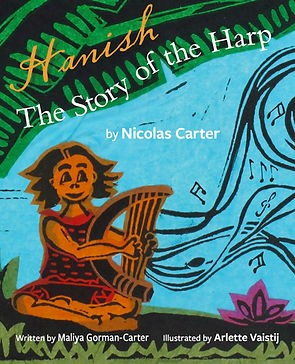
10:20AM HANISH: THE STORY OF THE HARP by Nicolas Carter Read by Jasmin Cowin, Ed.D. Assistant Professor, TESOL
Inspired by a dream, a young boy named Hanish transforms a hunting bow into the first harp and shares his music with the world. His story, with fabulous illustrations by Arlette Vaistij, reveals how a weapon can be transformed into an instrument of peace and how magical the harp can be.
Dr. Cowin will enrich the story with her harp music.
The goal of our conference is to provide TESOL professionals with an opportunity to showcase their student-centered approach with a focus on promoting and nurturing student engagement in their classroom and beyond.
VirtuaTell Spring 2022 Conference
A one-day conference of talks, activities, and workshops. Conference Theme – Emerging Technologies in Language Learning and Teaching: Diversity, Criticality and Multimodality. This theme reflects current trends and approaches in second language learning and teaching Through inclusive, self-reflexive and multimodal practices embedded in our research and our teaching. This theme invites a broad consideration of related issues, including (but not limited to) the following: Metaverses, Smart CALL, Virtual Reality, Augmented Reality, language assessment and learner’s data, Natural Language Processing, Mobile Learning, Intelligent Tutors, games and language learning, gamification, Adaptive Learning algorithms.
Touro University Graduate School of Education will celebrate World Book Day Thursday, April 7th, 2022 through a marathon read-aloud from 9 am to 4 pm. Concurrently, Touro University celebrates its 50th anniversary by sharing award-winning books and resources for teachers, parents, and caregivers. Click here for the complete schedule: https://www.touro.edu/news–events/events/world-book-day-2022.php
Course Description: This course provides an understanding of basic linguistic concepts and their applications for TESOL instruction. Students will be introduced to the essential concepts of language development and modern linguistic components that are relevant to first and second language pedagogy. Specific concepts include: phonetics, phonology, morphology, semantics, syntax, pragmatics, discourse analysis, and the nature of regional and social variations in English and the relationship between dialects and ethnic identity. Students will explore the origins, diversity, and functions of human languages, in addition to the relationship between language and society. Students will also study key concepts of sociolinguistics in order to gain a solid understanding of the social and cultural dimensions of language. Includes 10 hours of fieldwork. 3 credits
Michele Goldin is an Assistant Professor of Bilingual Education and TESOL at Touro University Graduate School of Education. She received her Ph.D. in Bilingualism and Second Language Acquisition from Rutgers University. Her research broadly focuses on child bilingualism. As a heritage speaker of Spanish herself, she strives to increase our understanding of bilingual development with direct implications for successful academic outcomes, language policy and pedagogy, as well as bilingual and dual-language education.
Kelly Broshears is a 3rd-semester student at Touro College as a member of the TESOL master’s program. She received her undergraduate degree at Salve Regina University in Newport RI in 2019 majoring in early childhood education. “This is where I found a passion for working with ENL students. Currently, I am a kindergarten teacher for the NYC DOE in District 27.”
Context games: One idea I thought of would be a game in regard to the context of the word. I would introduce a word and would read the definition of the word. Then, I would give 3 sentences with the word but two do not make sense in the context. Students would have to choose which sentence would make sense.
Kelly Broshears, Touro University, Graduate School of Education TESOL Teacher Candidate
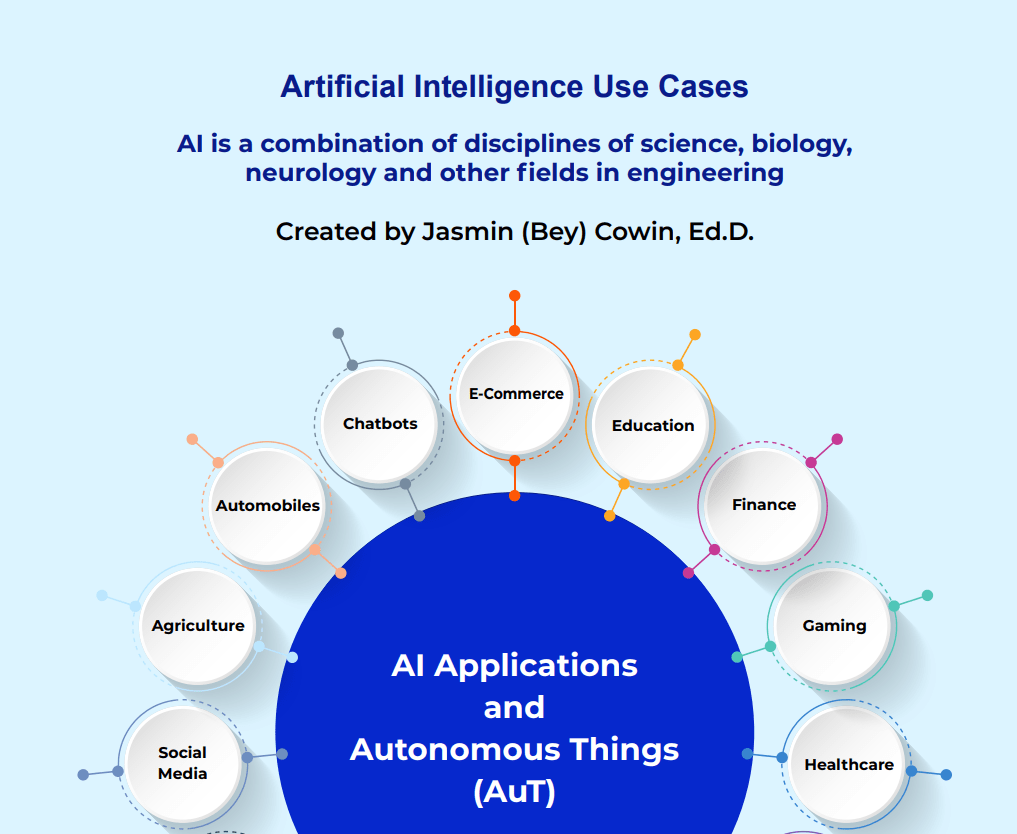
I am excited to share my infographic”Artificial Intelligence Use Cases” which visualizes the spectrum of AI across different sectors. Each white button in the PDF below contains a link to further resources.
There are a plethora of resources available such as blog posts, podcasts, white papers, scholarly articles, online courses, and newsletters. This infographic is intended as a resource and starting point for people who want to learn more about AI and its use cases.
Course Description This course provides an understanding of basic linguistic concepts and their applications for TESOL instruction. Students will be introduced to the essential concepts of language development and modern linguistic components that are relevant to first and second language pedagogy. Specific concepts include: phonetics, phonology, morphology, semantics, syntax, pragmatics, discourse analysis, and the nature of regional and social variations in English and the relationship between dialects and ethnic identity. Students will explore the origins, diversity, and functions of human languages, in addition to the relationship between language and society. Students will also study key concepts of sociolinguistics in order to gain a solid understanding of the social and cultural dimensions of language. Includes 10 hours of fieldwork. 3 credits
Michele Goldin is an Assistant Professor of Bilingual Education and TESOL at Touro University Graduate School of Education. She received her Ph.D. in Bilingualism and Second Language Acquisition from Rutgers University. Her research broadly focuses on child bilingualism. As a heritage speaker of Spanish herself, she strives to increase our understanding of bilingual development with direct implications for successful academic outcomes, language policy and pedagogy, as well as bilingual and dual-language education.
Touro University’s Graduate School of Education TESOL Teacher Candidate Timothy Bura received his Bachelor’s degree in Sociology/Anthropology from Long Island University Brooklyn. After completing his undergraduate studies, he joined the NYC Teaching Fellows and earned his Master’s degree in Teaching Urban Adolescents with Disabilities from Long Island University Brooklyn. “Currently, I am working on my second Master’s in Teaching English to Speakers of Other Languages at Touro University. I taught for four years at Midwood High School at Brooklyn College and transferred to Innovation Diploma Plus High School this year.”
I did some research into how to make and teach the phoneme /th/ and found a Chicago based speech therapist named Karen George’s website. She advises that you first teach the mouth movements and tongue placement for that sound. She writes that you place your tongue in between your teeth and breathe out. This will make an “unvoiced /th/ sound”. When David and I met to work on this, I had him do this exercise (George, 2012). Since we are required to wear masks, I separated myself from him to show him what I meant by placing one’s tongue in between their teeth.
TESOL Teacher Candidate Timothy Bura, Touro University – Graduate School of Education
Students will become acquainted with and practice effective approaches, methods, and strategies for teaching and evaluating English language learners in the content areas (ELA, social studies, math and science). Throughout the course, students will explore the impact of culture and language on classroom learning. Special challenges in teaching and assessment in each content area will also be discussed. Includes 15 hours of fieldwork.
Shannon Smith, a Touro University TESOL candidate pursues a degree in the TESOL program at Touro University, Graduate school of education. She is a certified general education and special education 1-6th grade. She is currently filling in as a leave replacement Kindergarten and First grade ENL
English language learners face a lot of challenges when the linguistic and cognitive demands of certain content areas are unaligned to their cultural background knowledge and perspectives. The academic standards recommended by the NYS for English language learners can be very overwhelming for both students and educators. Teachers play a critical role in ensuring that students are linked with available basic literature and prior knowledge whenever they are being guided to understand any of the general subjects(Haynes,2005).
The instruction begins with educators learning from the learners and putting ourselves in the place of our students with the frustrating, challenging factors they face on a daily basis so that we can learn and understand the way they do. As educators, we can find more engaging ways to help ELLs learn new material that draws on their own unique background knowledge and perspectives. I am currently a Kindergarten and first-grade ENL teacher. With some setbacks this year and a shortage of substitutes, I have been placed all over the school and do not see my ENL students as much as I would like to. I have not been able to cover the subjects I had planned to. When I do have the opportunity to see my students we are still working on letter and sound recognition which was difficult to find required texts and resources for since it is very simple and basic. I chose to use a resource that was provided in this course that will still be beneficial in my teaching since I am acting as a substitute majority of the time and work with students k-6. I chose to analyze and critique a chapter from a social studies textbook on the American Revolution. Chapter four of the American revolution is a relevant example of how English language learners face challenges when learning social studies, especially when relating to American history.
This American Revolution unit explores the major causes and people of the war, focusing on the importance of America and New York State during this period. The education system lacks efficiency in impacting new English learners to respond to cognitive needs because there is a lack of familiarity with the historical background being used. If a student is not from America or specifically New York State, but is expected to have prior background knowledge on New York State and information about America, students are not going to understand key ideas and details. A majority of ELLs do not have the same background knowledge that their peers have or that textbook authors take for granted, like knowing the 50 states and having them memorized. They also bring their own unique and valuable experiences and background to the classroom. Sometimes those experiences can be connected to the content to make the instruction meaningful and help them comprehend the material, but if they cannot make connections to their background knowledge and different points of view or ideas are expressed, they might miss important concepts and ideas in the lesson. A student might be a master in history about the country they are from, and know all about the regions and areas, and would be able to understand wars and battles that were fought where they were from, but cannot grasp or make connections to places like New York, Boston, Philadelphia, Massachusetts, etc. that this unit also places a huge emphasis on. The textbook states “The Treaty of Paris gave Britain most of Canada, all French lands east of the Mississippi River, and Spanish Florida.” (p.297). This could be very confusing to students who do not have background knowledge about these places. When a student hears “Spanish Florida” and does not know what state Florida is, what could it possibly mean to them by saying Spanish Florida? And how confusing could it be for them to talk about the French lands, but then also talk about Canada and Florida?
English Language Learners might have already learned about important historic moments in their own country, and now we are asking them to relearn something they learned about in a different way because what they have already learned is not correct or relevant to what they are learning in American history today in the classroom. The first thing I would do prior to introducing the American Revolution is to pre-teach about America and introduce the 50 states. I would create engaging activities and games using visual representatives to help students recognize and eventually maybe memorize the 50 states so when they are reading and learning about them in this unit, they can make some connection to them or be familiar with Boston when it comes up, or New York. Some ways to also engage ELLs in regards to this unit of the American Revolution to draw on their background knowledge and perspectives could be to hold a class discussion on where students are from and to show visual representations like maps to point out where they are from and then take that opportunity to compare it to America and relate it into the American Revolution and use this as a teaching point to teach about the states in America that they might see come up in lessons about the American Revolution. The more they see and learn about the states that are presented in the unit, the more they will start to recognize and memorize them and gain more knowledge about them.
This unit on the American Revolution has a lot of academic language and key vocabulary that is essential for students to know in order to understand concepts and ideas of the American Revolution. Two major ideas that come up a lot in this unit are cause and effect. The textbook states “Why It Matters Understanding cause and effect can help you see why events happen” (p.303). Pre-teaching the meaning of these words will eliminate any confusion when students are learning about a cause and effect of an aspect from the American Revolution. Explicitly explaining to students that a cause is an action or event that makes something happen, and an effect is what happens as the result of the action or event, is essential in this unit as a majority of the battles fought during the Revolution was a cause of something and always has an effect. This concept is also important to teach because a question on a state test might come up like “what was the cause of______” or “what was the effect of________”. It can be difficult for students to understand cause and effect especially on a topic that they do not connect to or understand. For example, the textbook states “In the mid-1600s, people began to leave the Massachusetts Bay Colony and start their own settlements. Some left because of religious reasons. Others left to find better economic opportunities” (p.304). In this statement, it is important for students to understand the cause and effect of people leaving the Massachusetts Bay Colony, but it might be difficult to understand if they do not have background knowledge of Massachusetts or know what that is, and also if they don’t understand the meaning of cause and effect it will be challenging to understand why wars in the revolution began and ended. Starting by having students find and share real-life examples of causes and effects that relate to their personal lives and backgrounds is a great start to introduce cause and effect of the American Revolution.
In this unit of the American Revolution, there are also an incredible amount of unknown words for students and key vocabulary words that could be difficult to understand. Words like boycott, taxation, representation, parliament, proclamation, congress, protest, repeal appear a lot throughout the chapter and are important to be exposed to when learning about the different wars and battles of the American Revolution. For example, “In October 1765, representatives from nine colonies met in New York City in what became known as the Stamp Act Congress” (p.303). If students come across this excerpt, or it is read to them, and they do not know what congress means they are going to be very confused. The lines “no taxation without representation” also are repeated a lot throughout the chapter and is an important concept when learning about the American Revolution. Introducing these vocabulary words in depth is going to be beneficial to engage students in understanding the American Revolution. Some ways I would help my students is to pre-teach all of the important vocabulary words by utilizing word clouds and making sure I present a visual definition for each word. To begin a lesson on vocabulary, I would post a word cloud using wordsift containing the important vocabulary words for the unit. I would have the students on their own make a list of the words that they know and words that they do not know. After a few minutes of independent work, I would have the students turn and talk to a partner to compare their lists and learn from one another some of the words they did not know. After the partner talks I would move into the vocabulary instruction so that by the end of the lesson, every student would at least be exposed to and recognize every word.
To begin a lesson on vocabulary, I would post a word cloud using wordsift containing the important vocabulary words for the unit. I would have the students on their own make a list of the words that they know and words that they do not know. After a few minutes of independent work, I would have the students turn and talk to a partner to compare their lists and learn from one another some of the words they did not know
Shannon Smith, Touro University Graduate School of Education TESOL Teacher Candidate