
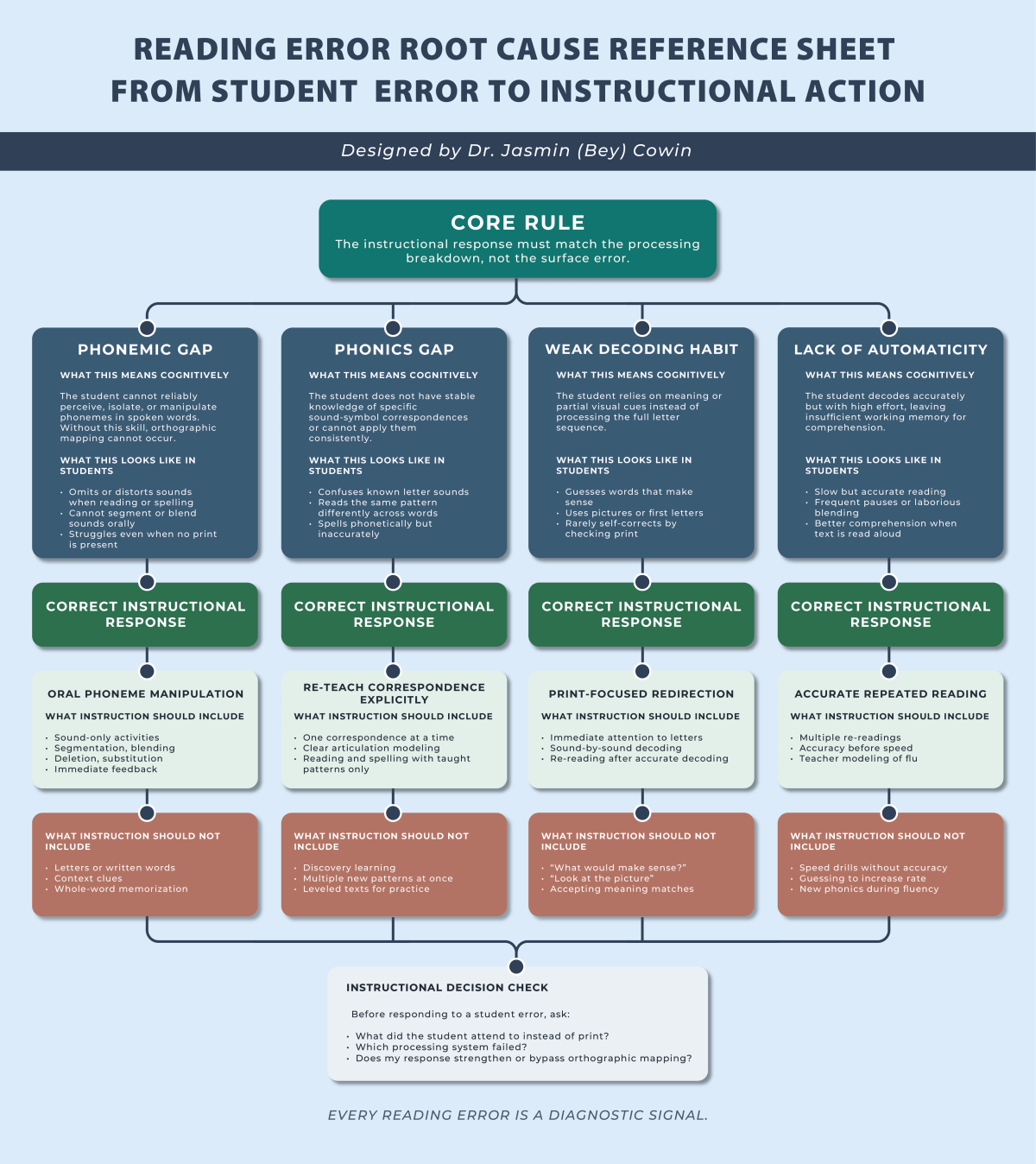
This infographic is designed for educators working with Emergent Writers and Newcomers to Literacy (EWNL), English as a Foreign Language (EFL), and TESOL learners across elementary, secondary, and adult contexts who are acquiring literacy in alphabetic writing systems. Its purpose is to support instructional decision-making grounded in the Science of Reading by linking observable reading errors to the specific cognitive and linguistic processes that underlie word recognition.
The organizing principle of the infographic, the instructional response must match the processing breakdown, not the surface error, reflects a central finding of reading science: word reading difficulties arise from identifiable breakdowns in component processes rather than from general language proficiency, motivation, or exposure to text. Decades of research demonstrate that effective reading instruction requires diagnosing which processing system has failed and responding at that level with targeted instruction (Gough & Tunmer, 1986; Moats, 2020).
The framework is structured around four empirically supported domains of word recognition: phonemic awareness, phonics knowledge, decoding behavior, and automaticity. These domains align with models of skilled reading that distinguish between language comprehension and word recognition, most notably the Simple View of Reading (Gough & Tunmer, 1986), and with research on orthographic mapping as the mechanism that enables accurate and fluent word reading (Ehri, 2014; Share, 1995).
Each panel in the infographic identifies a specific processing breakdown and pairs it with an instructional response that directly supports orthographic mapping. For example, phonemic gaps require oral phoneme manipulation without print, while phonics gaps require explicit instruction in sound–symbol correspondences. Weak decoding habits reflect reliance on context or partial visual cues, which research has shown does not support long-term word learning (Share, 1995). Lack of automaticity reflects constrained working memory during reading and calls for accurate repeated practice rather than new phonics instruction (LaBerge & Samuels, 1974).
- Working Memory Capacity: Readers have limited working memory. Non-automatic word recognition quickly exhausts this capacity, hindering comprehension.
- Role of Practice: The goal of practice is to make decoding and word recognition so fast and accurate that it becomes automatic.
- Focus on Fluency: Instead of introducing new rules, practice should focus on increasing the speed and ease with which known skills are applied.
For multilingual learners, including EFL and TESOL students of all ages, this distinction is essential. Research indicates that decoding difficulties in second-language readers often mirror those of monolingual learners and should be addressed through the same evidence-based instructional approaches, while keeping language comprehension supports separate (August & Shanahan, 2006; Lesaux et al., 2007).
The instructional decision check reinforces a diagnostic stance toward reading errors, treating them as data that inform instruction. This approach aligns with Science of Reading principles that emphasize precision, systematic instruction, and alignment between assessment and response.
References
- August, D., & Shanahan, T. (2006). Developing literacy in second-language learners: Report of the National Literacy Panel on Language-Minority Children and Youth. Lawrence Erlbaum.
- Ehri, L. C. (2014). Orthographic mapping in the acquisition of sight word reading, spelling memory, and vocabulary learning. Scientific Studies of Reading, 18(1), 5–21. https://doi.org/10.1080/10888438.2013.819356
- Gough, P. B., & Tunmer, W. E. (1986). Decoding, reading, and reading disability. Remedial and Special Education, 7(1), 6–10. https://doi.org/10.1177/074193258600700104
- LaBerge, D., & Samuels, S. J. (1974). Toward a Theory of Automatic Information Processing in Reading. Cognitive Psychology, 6, 293-323. http://dx.doi.org/10.1016/0010-0285(74)90015-2
- August, D., & Shanahan, T. (Eds.). (2007). Developing Reading and Writing in Second-Language Learners: Lessons from the Report of the National Literacy Panel on Language-Minority Children and Youth. Published by Routledge for the American Association of Colleges for Teacher Education (1st ed.). Routledge. https://doi.org/10.4324/9780203937600
- Moats, L. C. (2020). Teaching reading is rocket science (2020 ed.). American Federation of Teachers. https://www.aft.org/sites/default/files/moats.pdf
- Share, D. L. (1995). Phonological recoding and self-teaching: Sine qua non of reading acquisition. Cognition, 55(2), 151–218. https://doi.org/10.1016/0010-0277(94)00645-2
 Dr. J's Education Blog