Teaching English to Speakers of Other Languages (TESOL) [MS] We offer a Master of Science in TESOL appropriate for NYS-certified PreK-12 teachers interested in expanding their teaching fields to ESL or strengthening their capacities to serve a diverse student body. Evening, Sunday, and online courses are available.
Teaching English to Speakers of Other Languages
New York is a state that speaks many languages. We need teachers who can find the common ground.
The MS in Teaching English to Speakers of Other Languages (TESOL) Program helps NYS-certified PreK-12 teachers more effectively teach and communicate with a diverse student population.
Academically rigorous and practice-intensive, the 33-credit program includes 5-15 hours of fieldwork embedded in each course and at least 10 days or 50 hours of supervised student teaching experience. Candidates that complete all coursework, fieldwork, and student teaching requirements are eligible for recommendation for ESL certification.
Ivelisse Martinez holds a bachelor’s degree in Education from Brooklyn College and is currently pursuing a master’s degree in TESOL at Touro University. She is passionate about empowering young learners, particularly those learning English as a second language. Inspired by her own teachers as a child, she sees a reflection of herself in many of her students, understanding firsthand the challenges and joys of learning a new language. As a former ELL, her goal is to inspire and support the next generation of learners on their educational journey.
So far I have been able to observe in both an ENL pullout classroom and ENL push-in periods. I notice the difference between the teacher when she has access to her materials and room versus a push-in period where the room is shared with the classroom teacher.The teacher has to use various tools depending on the setting but one tool that stays consistent for instance is the use of the pocket talk. The pocket talk device allows the teacher to translate in real time, two way translation and access to 84 plus languages all in one small device. (Here is the link to the device Pocket Talk).”
“Teaching is a way of giving back the inspiration and support you once received, guiding others to see their potential and know that every challenge is a stepping stone toward success.
Ivelisse Martinez, Touro University TESOL Candidate
Teaching English to Speakers of Other Languages (TESOL) [MS] We offer a Master of Science in TESOL appropriate for NYS-certified PreK-12 teachers interested in expanding their teaching fields to ESL or strengthening their capacities to serve a diverse student body. Evening, Sunday, and online courses are available.
Teaching English to Speakers of Other Languages
New York is a state that speaks many languages. We need teachers who can find the common ground.
The MS in Teaching English to Speakers of Other Languages (TESOL) Program helps NYS-certified PreK-12 teachers more effectively teach and communicate with a diverse student population.
Academically rigorous and practice-intensive, the 33-credit program includes 5-15 hours of fieldwork embedded in each course and at least 10 days or 50 hours of supervised student teaching experience. Candidates that complete all coursework, fieldwork, and student teaching requirements are eligible for recommendation for ESL certification.
Zeynep Yildirim: As a dedicated general education teacher, she is passionate about fostering an inclusive classroom where all students can thrive. Currently expanding her expertise in TESOL, she aims to better support English Language Learners and enhance their educational experience. Her goal is to integrate this specialized knowledge into her teaching practice to ensure every student has the opportunity to succeed.
As a professor, I am pleased to endorse her as an outstanding student whose dedication and skill set in supporting English Language Learners (ELLs) are exemplary. She demonstrates not only a strong foundation in analytical and practical skills but also deep insights into the unique needs of ELL students. Her commitment to her studies is matched by her drive to make a meaningful impact in the field. Her impressive ability to integrate theoretical knowledge with actionable strategies makes her exceptionally well-prepared to serve and advocate for ELLs, contributing to their academic growth and overall success. Our Touro University TESOL students are exceptional!
My journey at Touro College is more than academic—it’s a path of discovery, resilience, and dedication. Each day, I’m not just learning; I’m evolving, ready to bring meaningful change to the lives of those I teach.
New York’s classrooms are some of the most culturally and linguistically diverse in the country. Our TESOL certificate program prepares NYS-certified teachers to provide responsive, comprehensive education to students of every background.
EDDN 637 Second Language Learners and the Content Areas
Students will become acquainted with and practice effective approaches, methods, and strategies for teaching and evaluating English language learners in the content areas (ELA, social studies, math and science). Throughout the course, students will explore the impact of culture and language on classroom learning. Special challenges in teaching and assessment in each content area will also be discussed. Includes 15 hours of field work.
Julianna Walter, a 22-year-old graduate student in the TESOL program at Touro University holds an undergraduate degree in Elementary Education with a focus on both General and Special Education. Her passion for working with children and shaping young minds has always been a driving force in her career and studies.
“As a first-semester student in the TESOL program, I have already gained valuable strategies and tools for supporting English language learners, which I am eager to incorporate into my future classroom.”
Julianna Walter, TESOL program at Touro University
Excerpt by Julianna Walter, TESOL program at Touro University
Sentence Structure:
There are various sentence structures within the story ranging from short to long. The average sentence length in this story is 8 words. An example of a short sentence structure, with
minimal words, in the story is “Then I see him” (HMH, 31). This is one of the few short sentences in the story, as most sentences are longer and filled with detailed ideas that add to their length. An example of a longer sentence written in the story is “When I wake up on Saturday I put on my pink shirt, my favorite polka dot skirt, and my favorite hat— the one my abuelita brought me from Peru” (HMH, 30). Simple and complex sentence structures are also displayed throughout the story. The sentence “I like to wear polka dots” is an example of a simple sentence because it possesses a subject-verb-object structure. These types of sentences are more clear and straightforward making it more understandable for ELL students. Compound sentences “contain more than one independent clause” (Four Types of Sentences to Know). An example of a compound sentence in the story is “I am part Peruvian, and I am part Scottish” ( This sentence combines two related ideas with a conjunction. By basing this lesson on a story with various sentence lengths and structures it helps to build the students comprehension abilities. Second language learners will be able to improve their fluency and practice decoding words.
Students will become acquainted with and practice effective approaches, methods, and strategies for teaching and evaluating English language learners in the content areas (ELA, social studies, math and science). Throughout the course, students will explore the impact of culture and language on classroom learning. Special challenges in teaching and assessment in each content area will also be discussed. Includes 15 hours of field work.
“As I begin my journey at Touro, I aspire to grow as an educator, enhancing my effectiveness and inspiration for my students along the way.”
Alexandra Olivo, Touro University, TESOL Candidate
Alexandra Olivo is a second-year teacher and graduate student from Long Island, New York. Through her advanced studies, she aims to bring creative approaches to the classroom and create an engaging and supportive learning environment where students can succeed. Alexandra said, “I am committed to student growth and empowering students to reach their full potential.”
Ms. Olivo submitted an exemplary Discussion Board:
Identify techniques for connecting students’ personal experiences and past learning to lesson concepts.
After reading, I better understand how students can benefit from connecting personal experiences and past learning to continue learning new concepts and hit target objectives. I found that on page 74 of Making Content Comprehensible for English Learners, KWL charts can help classes brainstorm about a topic, which can be helpful when grasping what students know and what they will learn. There is one disadvantage of this technique because, as mentioned on page 74, “some English learners have little or no prior knowledge about a content topic,” so teachers should be aware that choosing the right topic for their KWL can have a difference in how much information they receive from students. For example, if you are teaching a writing lesson about favorite holidays, choose a widely celebrated holiday rather than “Fourth of July,” which is only celebrated in The United States of America. Another technique discussed in this chapter is implementing information students have learned in new lessons. Integrating knowledge helps students to see the connections and think back to resources such as anchor charts and vocabulary. Just this past week, I was teaching an ELA lesson. Although the objective differed from the prior day, I connected the lessons because the language used was in the readings and the strategy we were implementing. (Echevarría et al., 2017)
List 2 elements of academic language and describe their importance for English learners.
One element of academic language I will describe is using and implementing “Content Vocabulary.” Content vocabulary is described in Chapter 3 as “…keywords and terms associated with a particular topic being taught” (Echevarría et al., 2017). This is important for English learners because they may not know these terms in their first language, which means they may be unable to use that knowledge to help them understand the meaning of English. In general, I find that in my second-grade classroom, content and vocabulary are difficult for most students but harder for ELLs because they struggle to comprehend the meaning of words. A great way to implement content vocabulary for my ELL students is to have my general education students help describe what the word means by shouting out words based on a student-friendly definition I provide. I also show visuals to help students understand what these words represent. They can connect with their peers, explaining and using visuals to grasp content vocabulary. The second element of academic language described is “General academic Vocabulary.” This is where students have to understand words used across multiple content areas. Although content vocabulary is essential for students to know what we are learning about, I find that general academic vocabulary works hand in hand and sometimes may be more critical. This is because students used general vocabulary to conversate with me, other teachers, and their peers. Without this, they cannot understand lesson objectives, assignment directions, social cues, and other essential aspects of daily language. ELLs may not have words equivalent to English terms. Therefore, it is vital to make sure we are scaffolding ways for these students to learn this discourse, such as visuals in the classroom, describing and explaining the meaning, and using context clues.
Jana, Echevarria; Vogt MaryEllen; Short Deborah J.. Making Content Comprehensible for English Learners (SIOP Series) (p. 100). Pearson Education. Kindle Edition.
Describe 1 activity YOU used during this week to introduce key academic subject-specific vocabulary for your ENL students. (p 76/77) divide your academic vocabulary using words from these three groups: content vocabulary, general academic vocabulary, word parts: roots and affixes?
This week, my students were introduced to key academic vocabulary in math. The unit we are currently working on is adding and subtracting within 20. We used the activity of a word wall displayed in the front of the classroom. This was the first time I was showing students this resource, and I built the word wall with them rather than displaying it for them to view independently. I decided to pull all students to the carpet to go through each word and have students try to remember what the terms meant if they had heard them in first grade. This sparked some curiosity in my ELLs. As we put up each word, I describe it and then discuss it together, especially when we see it in either addition or subtraction problems.
Content Vocabulary: sum, equation, difference,
General academic vocabulary: describe, write, draw, word parts: none used for this lesson.
Jana, Echevarria; Vogt MaryEllen; Short Deborah J.. Making Content Comprehensible for English Learners: The SIOP Model (SIOP Series) (p. 100). Pearson Education. Kindle Edition.
Describe 1 activity YOU used during this week to introduce general academic or language function vocabulary for your ENL students (p 76/77)
One activity I used this week to introduce general academic language was a vocabulary word wall, but I changed this activity by adding an act-it-out activity. As a class, during ELA, we discussed five new words: describe, “presenter, explain, observe, and listen. We began by saying each word aloud and predicting what these words mean in our classroom. Then, I provided them with a definition, and we read it together, repeating it after me. Following this, we acted out each one to provide a visual, and I chose a few students who accurately portrayed it to show the class. This helped my ENL students because they repeated the word multiple times and then connected it to whatever the acting-out move was. A few students had a live “aha” moment during the word presenter. The ELA reading for that day was science-based, and these words helped guide students through the vocabulary content.
Use one of the methods described (p 82 – 88) in YOUR classroom and describe what happened. Please include a photo of any of YOUR realia/anchor chart/game cards.
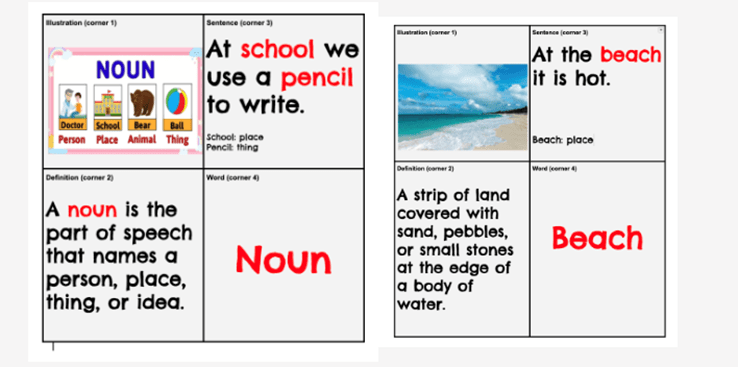
This week, I used the “four corners vocabulary charts” as an activity to learn about nouns. I gave my students directions for choosing a corner and then discussed the card in that corner with one partner. I showed them how to complete the activity by using the first image below of the vocabulary word “noun,” then we continued this activity but with five different nouns, such as the image of the word beach below. This helped all students, specifically ELLs, because I noticed they were listening to their peers, and some students were working hard to help their friends learn about nouns. I enjoyed using this activity because students loved walking around the room, allowing them to look at vocabulary differently. The multiple ways of representing nouns helped them clarify the differences between the types of nouns.
Review the Teaching Scenario Ms. Saunders (p. 90) and give one feedback point.
One feedback point is that Ms. Saunders could have spent more time reviewing the word sequence for English Learners (ENLs). The word sequence is a general academic vocabulary that not all students may know just by a quick reminder. Along with the SIOP Model’s emphasis on vocabulary development, I think incorporating one or two examples of sequencing before asking students to create a storyboard would have been beneficial. This approach would use a modeling strategy, which helps students visualize the concept. I also think that having students sequence seven parts of the story, it would have been more effective to start with just four parts. This adjustment would accommodate those who seemed unsure if they understood the assignment. As highlighted in the SIOP framework, breaking down tasks into manageable chunks is helpful by supporting comprehension. Seven parts may have overwhelmed students who are still developing their language skills and lowered their ability to engage with the task. By providing clearer instructions and examples, Ms. Saunders could have created a more supportive learning environment, which could have allowed more students to participate confidently.
Reference:
Echevarría, J., Vogt, M., & Short, D. (2017). Making Content Comprehensible for English Learners: The SIOP Model.
Peer Responses
Hi Q., I enjoyed your post. Specifically, your activity is introducing multiplication vocabulary. I used a similar activity but needed to include the drawing aspect. This would benefit ELLs because they can view other students’ work and connect the pictures to newly learned content vocabulary. I will be including this in my future lessons. I also agree that in your review of Ms. Saunders’s teaching scenario, she could have added a check for understanding and review at the end of the lesson. This could have provided students with a wrap-up to clarify misconceptions within student responses. I always try to do this in my classroom, and I am sometimes surprised at the confusion, but ultimately, it helps me grow as an educator.
Hi S., I enjoyed your post because I found connections to what I use in my classroom. I see that you use HMH for your English language arts program. I also conduct my lessons with vocabulary in the same way. My students struggle to read independently, so when I introduce the words, we say them together orally, discuss the meaning, and then use examples. I am unsure if you have tried this, but my students benefit from acting out the words when possible, depending on the context. I also like how you explained that your kindergarteners are now aware of a lot of general academic vocabulary, and I commend your patience as you teach it to them. As a second-grade teacher, I can say that if they begin in Kinder, then it becomes natural for them to hear and use these terms as they get older.
Hi C.! I loved your response to using an activity/method in your classroom. I loved how you did a read-aloud book to teach an important skill: washing hands. I also thought that after you discussed the story, you would provide a video. Not only did this provide visuals, but you also had another source of representation of the same skill. ELLs learn better with visuals and learning something in multiple ways. Then, providing students with a live experience of walking to the bathroom is exceptional. I will carry this lesson format into my classroom but with different content. Thank you for sharing.
If you’re already certified to teach, we offer specialized Master’s and Advanced Certificate programs that can help make you a more marketable, knowledgeable, and well-rounded educator. Our advanced certificates lead to NYSED certification in specialized areas and an extension/annotation on your NYS teaching credentials.
Pursuing a specialized Masters or Advanced Certificate is an ideal—and affordable—way for experienced teachers and educational personnel to strengthen their expertise in a specific area. Upon successful completion, you’ll be eligible for an extension/annotation on your New York State teaching credentials, and your earned credits can apply to an additional salary differential.
Teaching English to Speakers of Other Languages (TESOL) [MS] We offer a Master of Science in TESOL appropriate for NYS-certified PreK-12 teachers interested in expanding their teaching fields to ESL or strengthening their capacities to serve a diverse student body. Evening, Sunday, and online courses are available. New York’s classrooms are some of the most culturally and linguistically diverse in the country. Our TESOL certificate program prepares NYS-certified teachers to provide responsive, comprehensive education to students of every background.
Zeynep Yildirim: As a dedicated general education teacher, she is passionate about fostering an inclusive classroom where all students can thrive. She is currently expanding her expertise in TESOL to better support English Language Learners and enhance their educational experience. Her goal is to integrate this specialized knowledge into her teaching practice to ensure every student has the opportunity to succeed.
I am delighted to showcase Ms. Yildirim’s outstanding work from summer 2024.
Teaching English to Speakers of Other Languages at Touro University New York is a state that speaks many languages. We need teachers who can find the common ground. The MS in Teaching English to Speakers of Other Languages (TESOL) Program at Touro University helps NYS-certified PreK-12 teachers more effectively teach and communicate with a diverse student population.
I was particularly impressed and am delighted to share the work of Albania Ramos. Her attention to detail and thorough engagement with the course materials truly stood out to me. She effectively connected theoretical concepts with practical examples, showcasing deep understanding and critical thinking. It’s always rewarding to see such dedication and depth in a student’s work. Especially her Spanish-English worksheet shows her support for her bilingual students in this Differentiated Instructional Activity Assignment with a focus on assessment submission.
Albania Ramos, originally from the Dominican Republic, has dedicated her career to teaching English Language Learners after relocating to Long Island at a young age. With certifications in secondary education, English language arts, Spanish, bilingual education in place, she continues to work towards her English for New Learners. degree at Touro, Driven by her parents’ immigrant journey and inspired by her role as a mother, Albania is committed to creating an inclusive, supportive classroom that fosters academic growth, cultural appreciation, and social-emotional development for all her students.
“The essential learning experiences in the TESOL online program are invaluable, as they equip me with the tools and understanding needed to empower diverse learners and create inclusive classrooms.”
Students will become acquainted with and practice effective approaches, methods, and strategies for teaching and evaluating English language learners in the content areas (ELA, social studies, math and science). Throughout the course, students will explore the impact of culture and language on classroom learning. Special challenges in teaching and assessment in each content area will also be discussed. Includes 15 hours of fieldwork.
Bio: Cassandra Fegert is an English Language Arts high school teacher in Queens, New York. She is always seeking ways to underscore the importance of language and literacy while promoting student agency in her teaching. Having taught both English to native speakers and those learning English as a new language, she seeks to incorporate various ways of knowing in her classroom.
My journey at Touro has been an exciting one filled with immersive and innovative practices that enrich my pedagogical framework.
Cassandra Fegert, Touro University TESOL Candidate
Students will become acquainted with and practice effective approaches, methods, and strategies for teaching and evaluating English language learners in the content areas (ELA, social studies, math and science). Throughout the course, students will explore the impact of culture and language on classroom learning. Special challenges in teaching and assessment in each content area will also be discussed. Includes 15 hours of field work.
Gabrielle Woerner has been serving as a long-term substitute teacher for four years in District 75 within the NYCDOE. During this time, I received my teaching certifications in Early Childhood Education and Students with Disabilities. I decided to return to Touro University to obtain my Advanced TESOL Certification with the hopes of one day being a part of my multilingual students’ journey to acquiring English proficiency.
Through my time at Touro University, I’ve learned that every child has their own unique strengths, needs, and background which should be fostered to support their ability to achieve the best possible educational outcomes.
This comprehensive course builds upon the foundation of curriculum development and classroom management in the context of teaching English language learners. Expanding its horizons to embrace the digital age, the course adeptly weaves innovative technology integration into the domain of Teaching English to Speakers of Other Languages (TESOL). Crafted to empower prospective TESOL/BLE educators, the course hones in on fostering competence in designing, implementing, assessing, and reflecting within diverse language learning environments, all while capitalizing on the potentials of cutting-edge technology. With a strong focus on practical application and discerning appraisal of technological tools, this course primes upcoming educators to excel amidst the ever-evolving educational landscape. Includes 10 hours of field work.
Kenia Torres is a Bilingual Kindergarten teacher in the Brentwood Union Free School District. She received her Bachelor’s Degree in Child Studies with a concentration in Speech Communication from Saint Joseph’s University, a Bilingual Extension from Touro University, and is currently enrolled in a TESOL program in Touro University. Kenia is passionate about developing a classroom community that allows all children to achieve their academic and personal goals. In the future, she would like to pursue an educational leader role to empower educators and students to catalyze school success. A quote that reflects Torres’ vision about the educational field is: “A teacher affects eternity; he can never tell where his influence stops.” by Henry Adams
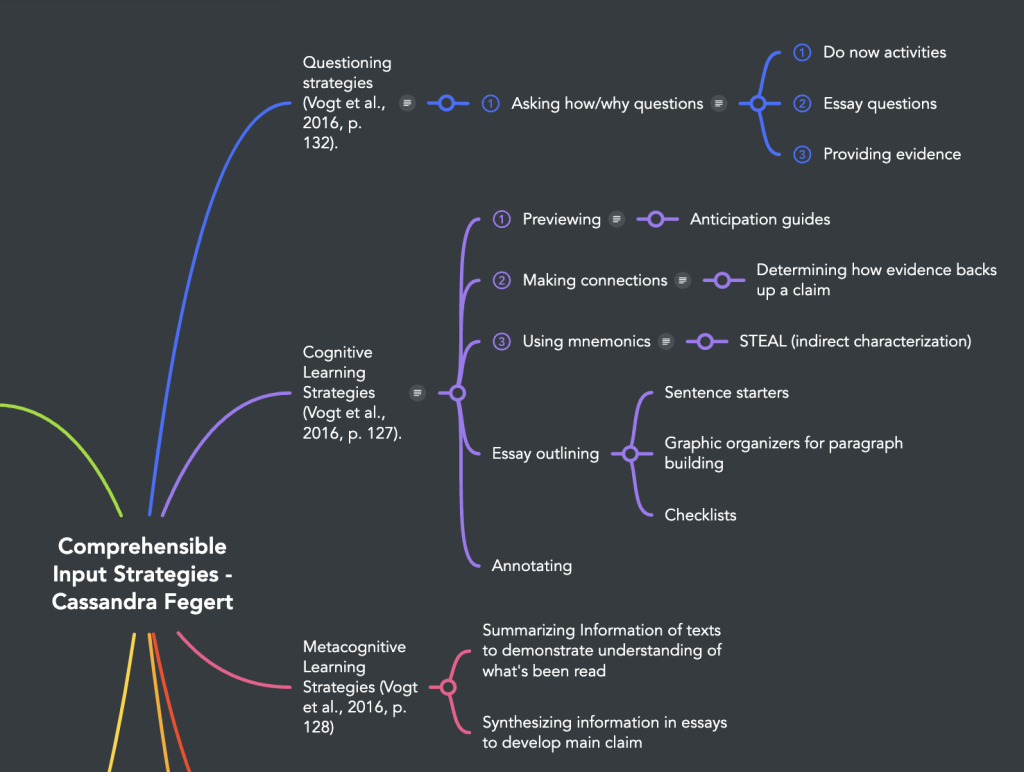
Ms. Torres’ mindmap for the DB deliverable: Outline the process of aligning a TESOL curriculum with state and national standards as demonstrated in the Newburgh, NYS Curriculum Map using a mindmap tool such as FIGMALinks to an external site. orLucidChart.
As an Associate Professor for the Touro University TESOL/BLE Department, I am immensely proud to feature outstanding student work from our MS in Teaching English to Speakers of Other Languages (TESOL) Program. New York’s linguistic diversity demands teachers who can find common ground and effectively communicate with students from different language backgrounds. Academically rigorous and practice-intensive, the 33-credit program leads candidates who complete all coursework, and fieldwork to recommendation for ESL certification.
Alexa Armentano is a candidate in the TESOL Graduate Program at Touro University. She attended Hofstra University for her undergraduate degree where she earned a dual degree in Early Childhood Education and Childhood Education, as well as a Psychology degree. Fun Fact! She coaches the Commack High School dance team.
My journey through the Touro University Graduate School of Education TESOL program has been an enriching experience that has deepened my passion for teaching and equipped me with the skills necessary to make a meaningful impact in the field of education.
Alexa Armentano, TESOL Graduate Candidate at Touro University
Directions and the Tasks: Discussion Board 3 Program Models – Bilingual & ESOL
CUT AND PASTE QUESTIONS IN ORDER AND ANSWER EACH ONE OF THEM.
How might the principles of CLT be applied or adapted to meet the challenge posed by the following context? Students seem to be shy and unaccustomed to discussing topics of a personal or social nature with one another, and the teaching approach is very teacher-centered. Celce-Murcia, Marianne; Brinton, Donna M.; Snow, Marguerite Ann. Teaching English as a Second or Foreign Language (Chapter 2). Heinle ELT. Kindle Edition.
How do (or might) you use technology for CLT language teaching and learning in your context? What constraints do you face? Do you think that you as a language learner or your (future) students would want to engage in virtual or simulated learning environments online? Why or why not? Please write from your own experience and from the I perspective. Chapter 2Celce-Murcia, Marianne; Brinton, Donna M.; Snow, Marguerite Ann. Teaching English as a Second or Foreign Language (p. 29). Heinle ELT. Kindle Edition.
TO DO:
Please cut and paste the questions into your DB dialogue box and answer each question.











 Dr. J's Education Blog