Dr. Jasmin (Bey) Cowin on “Practicing the Philosophy of Abundance: Resources to Support Displaced Learners,” VirtuaTELL Spring 2022 Conference May 14, 2022, NYS TESOL

It was my pleasure to present this workshop for the VirtuaTELL Spring 2022 Conference on May 14, 2022, NYS TESOL

I believe that in alignment with SDG 4.c that teachers are the change agents for the future.

4.c By 2030, substantially increase the supply of qualified teachers, including through international cooperation for teacher training in developing countries, especially least developed countries and small island developing States.

Dr. Jasmin (Bey) Cowin
Assistant Professor and TESOL Practicum Coordinator
Touro University
Graduate School of Education, New York, NY

This workshop covered:

The Philosophy of Abundance
Understanding Trauma and Its Impact
The Stress Response System
Words Matter
Teaching materials on refugees, asylum and migration for primary and secondary education
UNHCR Teaching About Refugees 2021 – Language Learning Guidebook
Teaching Techniques for Multilingual Learners
The Teacher Tech Tool Wheel
Google Resources
The Internet Archive
Open Educational Resources
Q&A

I am sharing the workshop with all the global conference participants and educators who support displaced learners. I believe that in alignment with SDG 4.c that “teachers are the change agents for the future.

Both PDF’s feature embedded links to resources you can click on – go ahead, download and use the abundant resources available to YOU.

Teaching is an Act of Love

Let us move away from deficit thinking and the scarcity education model where education providers together with a group of experts use expensive resources such as required purchases for materials, texts etc., and paid access to platforms which in essence constitute a social justice issue.

Instead, let us embrace the social and situated nature of learning while embracing and developing an asset-based approach to teaching and learning.

Dr. Jasmin (Bey) Cowin
Assistant Professor and TESOL Practicum Coordinator
Touro University
Graduate School of Education, New York, NY

Dr. Cowin publishes in the Journal of Systemics, Cybernetics and Informatics on “The Fourth Industrial Revolution: Technology and Education.”

I am pleased to share that my latest article on The Fourth Industrial Revolution: Technology and Education was published:

Cowin, J. (2021). The Fourth Industrial Revolution: Technology and Education. Journal of Systemics, Cybernetics, and Informatics (2021) 19(8), 53 63,
https://doi.org/10.54808/JSCI.19.08.53

Dr. Cowin on “The Metaverse Wheel: Discovery, Terminology, and Context”, A WHERS Conference and Exhibition Speaker Invitation

I am honored to be invited to speak on “The Metaverse Wheel: Discovery, Terminology, and Context” at the World’s Largest Higher Education Ranking Summit which will bring together 10,000+ of the world’s brightest minds in higher education, leading global authorities like the United Nations, most prominent change-makers, government officials, and policymakers to implement best practices and adopt new technologies that will drive institutions forward.

I am honored to be invited to speak on “The Metaverse Wheel: Discovery, Terminology, and Context” at the World’s Largest Higher Education Ranking Summit which will bring together 10,000+ of the world’s brightest minds in higher education, leading global authorities like the United Nations, most prominent change-makers, government officials, and policymakers to implement best practices and adopt new technologies that will drive institutions forward.
The conference will take place in Dubai, UAE from the 22nd to the 24th of February 2022 in a hybrid format both physically in the Canadian University of Dubai and online with a total outreach of more than 500,000 academics, students and innovators.


Language Acquisition in Virtual Worlds Versus Traditional Classroom Environments: A Comparative Overview Between the United States and Russia by Jasmin B. Cowin and Dana S. Saulembekova

The book is out! And our chapter is published!

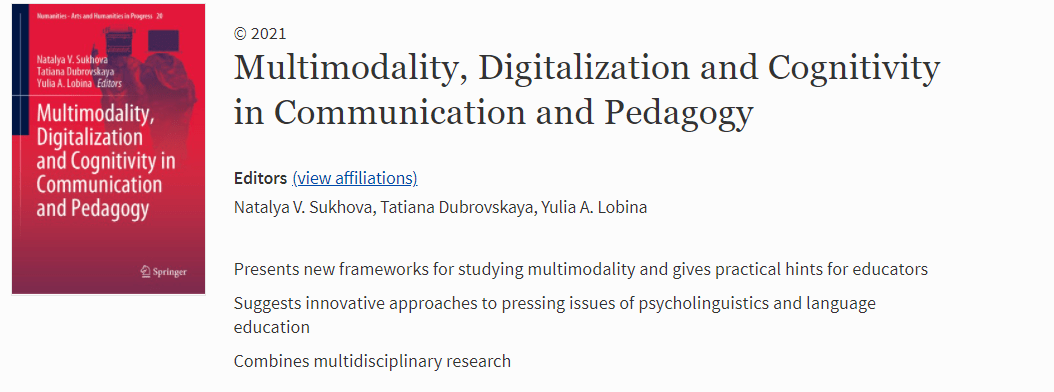
Multimodality, Digitalization and Cognitivity in Communication and Pedagogy
Editors:
Natalya V. Sukhova, Tatiana Dubrovskaya, Yulia A. Lobina
Presents new frameworks for studying multimodality and gives practical hints for educators
Suggests innovative approaches to pressing issues of psycholinguistics and language education
Combines multidisciplinary research

Part of the Numanities – Arts and Humanities in Progress book series (NAHP, volume 20)

Language Acquisition in Virtual Worlds Versus Traditional Classroom Environments: A Comparative Overview Between the United States and Russia by Jasmin B. Cowin and Dana S. Saulembekova

Abstract

The development of virtual worlds (VWs) in the field of language education evolved from purely text-based environments to two- and eventually three-dimensional spaces. VWs date back to the adventure games and simulations of the 1970s. Unlike traditional classroom settings, which are anchored in brick-and-mortar buildings, VWs give language learners the opportunity to practice languages in simulated, visually rich settings. Collaborative and communicative learning opportunities in VWs, together with the ubiquitous growth of online learning platforms and online degrees, raise questions on the long-term outlook for language teaching and learning in the Fourth Industrial Revolution. Although both the Russian Federation and the United States have a multitude of programmes, education degrees and certifications with specific competency requirements for future language teachers and higher education faculty, are there common long-term concerns about domains and respective definitions in technology, multicultural education and language acquisition? To shed light on these questions, the authors analysed US and Russian national missions and second language teaching standards for communication study teacher preparation programmes.

Keywords

Virtual worlds Digital environments Traditional classroom environments Second language acquisition Russia US 

Cite this chapter as:

Cowin J.B., Saulembekova D.S. (2021) Language Acquisition in Virtual Worlds Versus Traditional Classroom Environments: A Comparative Overview Between the United States and Russia. In: Sukhova N.V., Dubrovskaya T., Lobina Y.A. (eds) Multimodality, Digitalization and Cognitivity in Communication and Pedagogy. Numanities – Arts and Humanities in Progress, vol 20. Springer, Cham. https://doi.org/10.1007/978-3-030-84071-6_6

https://link.springer.com/book/10.1007/978-3-030-84071-6#about

Introduction

This book positions itself at the intersection of the key areas of the modern humanities. Different authors from a variety of countries take innovative approaches to investigating multimodal communication, adapting pedagogical design to digital environments and enhancing cognitive skills through transformations in teaching and learning practices. The eclectic forms under study require eclectic approaches and methodologies, and the authors cross disciplinary boundaries drawing on philosophy, linguistics, semiotics, computational linguistics, mathematics, cognitive studies and neuroaesthetics. 
Part I presents methods of analysing multimodal communication in its different displays, covering promotional video in crowdfunding project presentations, multimodal public signs of prohibition and visuals as arguments. Part II explores varied teaching methodologies that have emerged as a result of and in response to modern technological changes and contains some practical hints for educators. It demonstrates the pedagogical potential of video games, virtual worlds, linguistic corpora and online dictionaries. Part III focuses on psychological and cognitive factors influencing success in the classroom, primarily, ways of developing students’ and teachers’ personalities. 
The volume sits at the intersection between Communication Studies, Digital Humanities, Discourse Analysis, Education Theory and Cognitive Studies and is useful to scholars and students of communication, languages, education and other areas of the humanities. This book should trigger scholarly discussions as well as stimulating practitioners’ interest in these fields.

Keywords

Methodology in Humanities Semiotic pragmatics Discourse Analysis Studies in Multimodality Cognitive Development Education in Digital Environments Pedagogical Design Foreign Language Teaching Online Lexicography Corpus Technologies

Touro GSE At Work features Assistant Professor Jasmin Cowin in Faculty Spotlight

It is an honor to be chosen as featured faculty at Touro GSE.

Jasmin Cowin, assistant professor and TESOL practicum coordinator for TESOL and Bilingual Programs at the Touro College Graduate School of Education, has brought innovation to the educator preparation program by presenting virtual, augmented and mixed reality e-learning platforms. Her students use avatars to explore a variety of simulation-based settings in ways that facilitate active knowledge in multi-modal ways, which enhance candidates’ understanding of  diverse learners’ educational needs. The student avatars in simulations are controlled by artificial emotional intelligence software. As intensive web applications, these environments provide a safe, risk-free virtual space to explore a range of teaching strategies, while offering immediate feedback as a training tool for teacher candidates during clinical experiences. Cowin’s latest research on e-learning was published in the International Research and Review Journal of Phi Beta Delta Honor Society of International Scholars Fall 2020 edition. She also serves as chair of the New York State Teaching English as a Second Language 51st Annual

https://mailchi.mp/c9e0aa3148d6/touro-college-ranks-in-top-100-best-online-graduate-education-programs-4926338?e=0597240d44

Jasmin Bey Cowin, Ed.D. to speak at the virtual 26th Annual NATE Conference Digital Change in the ELT Community in Moscow, Russia

The 2021 NATE Conference is dedicated to Digital Change in the ELT Community. Never has the world faced such fast-paced change and vast digitalization and, as a result, required such spur-of-the-moment creativity and agility from educational professionals. We are in this process together and have a lot of personal and professional experience to share.

Dr. Bey Cowin’s conference topic will be: Innovation, Collaboration, Transformation: Education for a Connected World. The conference host is the National University of Science and Technology.

Globally, the way we educate and are educated is changing at a rapid pace. New technologies and ways of interpreting the world are reshaping educational philosophies and their underpinning pedagogies while transforming modes of delivery in educational institutions worldwide. This presentation explores the necessity of rethinking education for a successful integration in the artificial intelligence (AI) age.

The need to adapt by educational institutions, corporations, teachers, and learners is great. However, what kind of frameworks are necessary for education in the digital age? What resources will be necessary to bring education into digital classrooms from early childhood through tertiary and technical education? What trends and possibilities are on the horizon to educate and train entire generations of educators to stay relevant in the 21st Century and beyond? Five emerging trends for 21st-century education will be explored.

Resources from the Webinar: NYS TESOL Resources for Supporting English Learners and their Parents- Prof. Jasmin Bey Cowin, Ed.D.

Dear Participants,

I hope my post finds you well and safe.

Here the promised Zoom recording and slides Resources for Supporting English Learners and their Parents.

Zoom recording of Webinar

 Resources for Supporting English Learners and their Parents by Prof Jasmin Cowin EdD

Teaching as an Act of Love by Prof. Jasmin Bey Cowin, Ed.D.

Touro College, Graduate School of Education featured my philosophy on teaching via a video clip with the following observation: Touro’s Graduate School of Education Professor Jasmin Cowin’s Lessons Go Beyond the Classroom:

Jasmin Cowin, Ed.D., wants the students in her Teaching English as a Second Language (TESL) program to know that language isn’t only grammar and vocabulary.

“My focus is not just on the acquisition of grammar and vocabulary, but also the understanding that language is a culture,” explained Dr. Cowin, an assistant professor at Touro’s Graduate School of Education (GSE). “You have to meet people where they are and help guide them so that they can fulfill their potential.”

“I’ve always thought of teaching as an act of love,” continued Dr. Cowin. “The students are coming here for something that is important to them, not only professionally, but also personally.”

Watch the video:

Teaching as an Act of Love


Dr. Jasmin Bey Cowin

As an Assistant Professor for TESOL and Bilingual Programs at Touro College, Graduate School of Education Dr. Cowin’s focus is on the Responsibility to Touro Students (Teaching), Responsibility to the Discipline (Scholarship), and Responsibility to Touro College and Community (Service).

Dr. Cowin strives to inspire students to be creative and to model the love of lifelong learning by inculcating the habits and attitudes that create agile mindsets. 21st-century education extends well beyond the classroom, and Dr. Cowin incorporates online learning technologies for L2 language acquisition and current global trends in teaching English as a Second Language.

She represents high levels of scholarship and participates fully in the larger world of TESOL academic discipline. Ongoing research, expressed in scholarly contributions to the advancement of knowledge is demonstrated through publications (articles in Education Update), presentations and participation in academic conferences, blogging and other scholarly activities, including public performances and exhibitions at conferences and workshops such as the Plekhanov University of Economics keynote address and seminars in 2018. Of particular interest to her are The Blockchain of Things and its implications for Higher Education; Current Global Trends in TESOL; Developing Materials and Resources in Teaching English; E-learning & Micro-Methodology in TESOL; E-Resources Discovery and Analysis; and Language Acquisition and the Oculus Rift in VR.

Dr. Cowin believes that the prestige of Touro College and its TESOL Department depends on her endeavors and work outside the Touro College System. She demonstrates the same high standards of personal integrity both inside and outside the classroom through her Presidency at the Rotary Club of New York, chairing of the RCNY United Nations International Breakfast Meetings, and her US Ambassadorship for the Rotary Action Group for Eradication of Hepatitis.

She served as Chief Marketing Officer for a start-up IT company, PeopleMovers®, a Community Networking Platform. As an experienced executive, both at a strategic and operational level, with strong track record in developing, driving and managing business improvement and development, change management and turn-around she worked with value-adding leadership. The main drivers were branding, marketing and efficiency, improved customer satisfaction and retainment, customer service, product management, crosscross-functionalness improvements and development of sponsor presentations with sponsor meetings.

The Presidency of the Rotary Club of New York is dear to her heart. As the second woman to be elected in 109 years, Dr. Cowin had a leadership role in shaping and directing the club’s programs and international strategic alliances. Part of this volunteer leadership position centers around cooperation and collaboration to do “Service above Self.” The Rotary network encompasses more than 1.3 million members worldwide. Currently, I am working on our International Breakfast Lecture series at the United Nations and a Harvey Relief event to increase visibility of the club’s Rotary branding. The International Breakfast Series is streamed live on Facebook with an audience of 5000+ international viewers. In addition, she is the US Ambassador of the Hepatitis Zero Campaign, a worldwide campaign for which she is part of the MediRelationsns team. Through her volunteer position as the President of the Rotary Club of New York and host mother to international students from South Korea, Venezuela, Brazil, Saudi Arabia, Belgium, France, China, Kazakhstan, and Italy Dr. Cowin is extremely knowledgeable about cultural differences and sensitivities, team work, plus meaningful cooperation and collaboration within a team structure.

As a University Pathway facilitator at EF – Education First, she conceived, designed and developed multiple portfolios of face-to-face, online and blended curricula across a variety of disciplines. For EF’s Russian branch she held interactive Adobe Connect webinars for Russian ESL university faculty at academic institutions such as Moscow University, St. Petersburg, and Siberia with practical applicability into real-life teaching scenarios. Dr. Cowin successfully designed, implemented and taught 21st Century courses for international students which focused on educational technology literacy, assessments, activity paths, learning objectives and content for each course with a 100% paper-free learning environment. Excellent student participation and student ratings for her courses were achieved through online collaborative tools.

Realizing that Educational and Instructional Technology are pivotal in today’s fast changing education environment Dr. Cowin completed  August 2017 a Masters Degree in Educational Technology at the Marlboro School of Graduate and Professional Studies, Vermont, with a GPA of 4.0. During her time at Marlboro College, she studied, analyzed and applied pedagogical best practices and supporting media and educational technologies needed to successfully execute online, f2f and blended learning and marketing environments.

DR. Cowin is a Fulbright Scholar, who holds a Doctorate in Education from Columbia University and a Masters in Educational Technology.